
“Every good and excellent thing in the world stands moment by moment on the razor-edge of danger and must be fought for …” —Thornton Wilder, The Skin of Our Teeth
The world these days is full of unsung counterparts to Martha, the last passenger pigeon, and Lonesome George, whose death marked the extinction of the Pinta Island giant tortoise. These final survivors of their kind are numerous enough now to belong to a class, the “endlings,” a term borrowed from the example of nursing home patients thought to be the endpoint of their family line.
Despite the name, an endling isn’t always the end of its species. Plants in particular can cast their seeds out into unimaginable futures. In 2005, for instance, a seed from an extinct date palm excavated in the Judean Desert germinated and produced a flourishing plant of its kind, which now stands 15 feet tall. Even better, in 2021, it pollinated a female also grown from ancient seed, according to lead scientist Sarah Sallon. That happy union, she said in an email, yielded “the first Judean dates in 2000 years, which have a lovely honey taste.”
So the news caught my eye this week about the seeds of another tree called Dendroseris neriifolia, from Robinson Crusoe Island in the South Pacific. Only a single known individual survives in the wild, and it is a twisted, tortured-looking thing, maybe 150 years old, clinging in its solitude to the side of a cliff. But this neriifolia is still capable of producing the daisy-like flowers of its kind and thus also seeds. The tree is now the focus of an international rescue effort to give neriifolia a future.
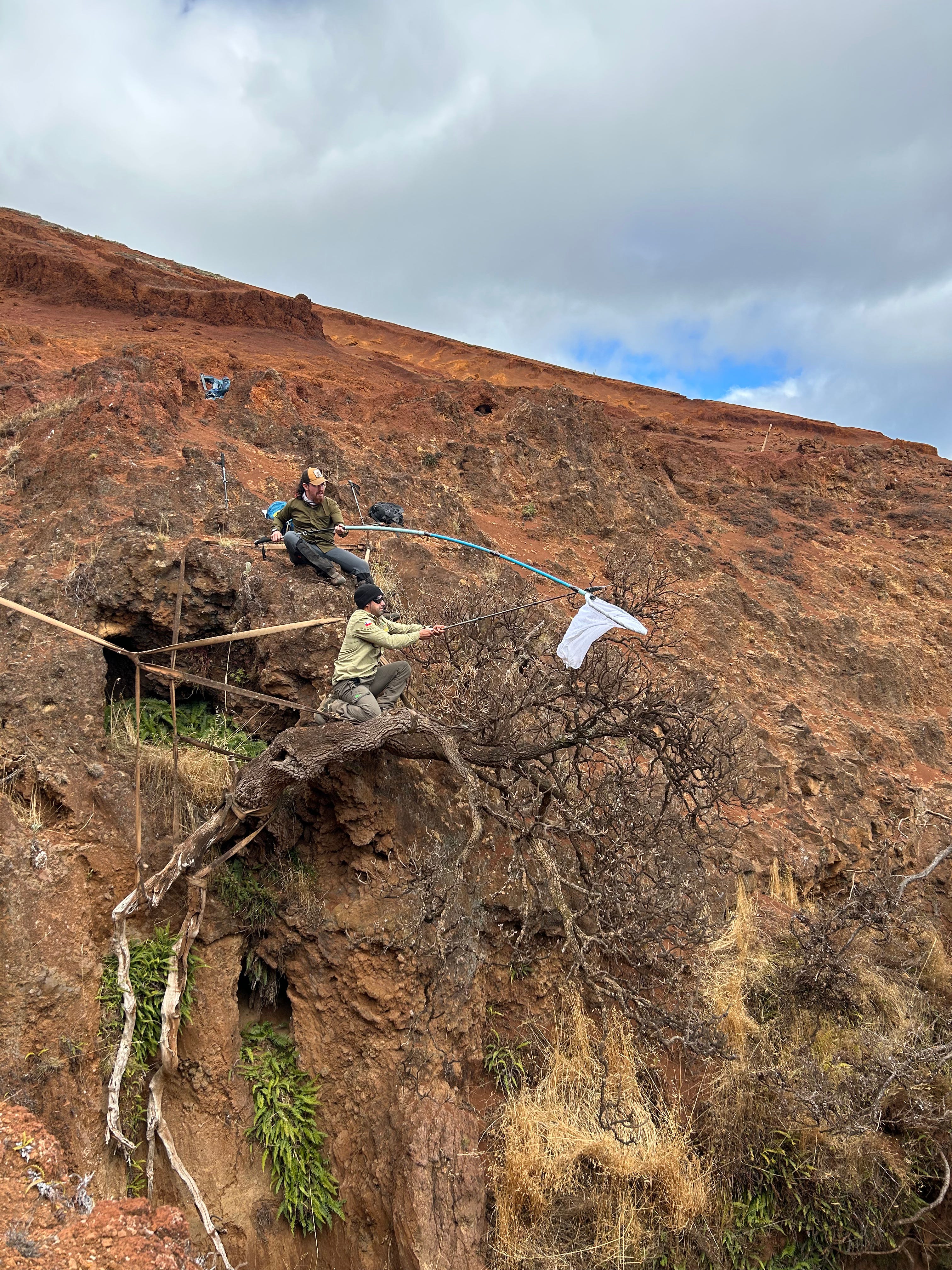
I should admit that it wasn’t just the news of this effort that caught my eye, but also the photo (above) showing the vertiginous-seeming start of the rescue effort. Take a closer look, and you will notice that the tree itself is roped up, but the two men working on it are not. Moreover, the system of trusses supporting the tree is vintage 1995. This sort of thing makes me nervous, for reasons I’ll explain later. But the ravine below the tree is only about 20 feet deep, and the men do their work carefully, said Felipe Sáez, chief ranger of the Juan Fernández Archipelago National Park, when I reached him to talk about D. nerifolia. “The park rangers’ expertise keeps them calm throughout the process.”
I’ve written here before about Robinson Crusoe Island and the rest of the volcanic Juan Fernández Archipelago, located 500 miles off the coast of Chile. These islands are home to more endemic species—plants and animals found nowhere else on Earth—than even the celebrated Galapagos Islands. “More per square kilometer than Amazonia, more than the Peruvian or African forests. Here on a little island in the middle of the Pacfic,” added Sáez, who is a plant biotechnologist. “We have the most concentration of birds, the most concentration of insects, the most of fishes, microorganisms, plants …”
The problem for this abundance is the same one that has afflicted the endemic wildlife on islands worldwide: a plague of invasive species left behind by mariners. Take another look at the photo, and you’ll notice that everything above the cliff has been grazed and nibbled to a moonscape by introduced species including sheep, goats, coatis, rabbits, mice, and rats. The tree’s cliffside location is the only reason D. nerifolia has managed to survive there: It’s too steep for hungry rabbits or rats to climb down to nibble its bark and girdle the tree trunk.
A 2003 effort successfully eradicated rabbits from Santa Clara, an uninhabited island just off the southernmost tip of Robinson Crusoe Island. The rabbits had overrun the nesting grounds of the pink-footed shearwater. Their removal led to a sharp recovery in the shearwater population. The nonprofit Island Conservation, which has deep experience in removal of invasive species, is now attempting a similar turnaround on Robinson Crusoe Island itself. Meantime, though, finding D. neriifolia a safe house outside the Juan Fernández Archipelago seems like the smartest way to give it a future.
The rescue effort, timed to a best estimate of when the seeds would reach maturity, required putting Sáez and four others from the park’s staff of eight in an open wooden boat, with an empty Zodiac towed behind. It was only an hour-long ocean trip from the island town of San Juan Bautista to the best landing for the three-hour hike up to the tree, said Sáez. First, they had to transfer in small groups to the Zodiac to approach the shore.
“You have to count the waves, 1-2-3, and then there’s gonna be a stage, and you go the fastest you can, and jump to the beach.” It’s the same thing going back. “You have to wait, in just this space of peace in between the three waves, but sometimes it is 1-2-3, and then a fourth wave, and the fourth wave is dangerous, because—how do you say?— it could turn the Zodiac over.” Break an arm on the rocks and you’d not only need to get back town, he added; you’d also have to fly to mainland Chile to get it set.
On the big day, this past March, Ignacio Ibáñez, a park ranger, inched out on the trunk of the neriifolia tree with an extension pole to lop off a mature seed head. Just above him in the photo, Jorge Rojas, a consultant for Island Conservation, perched on the edge of the cliff with a net, and caught the falling seed head. That part of the rescue effort took about 20 minutes. Because weather is a factor at every stage, the complete expedition took five days.
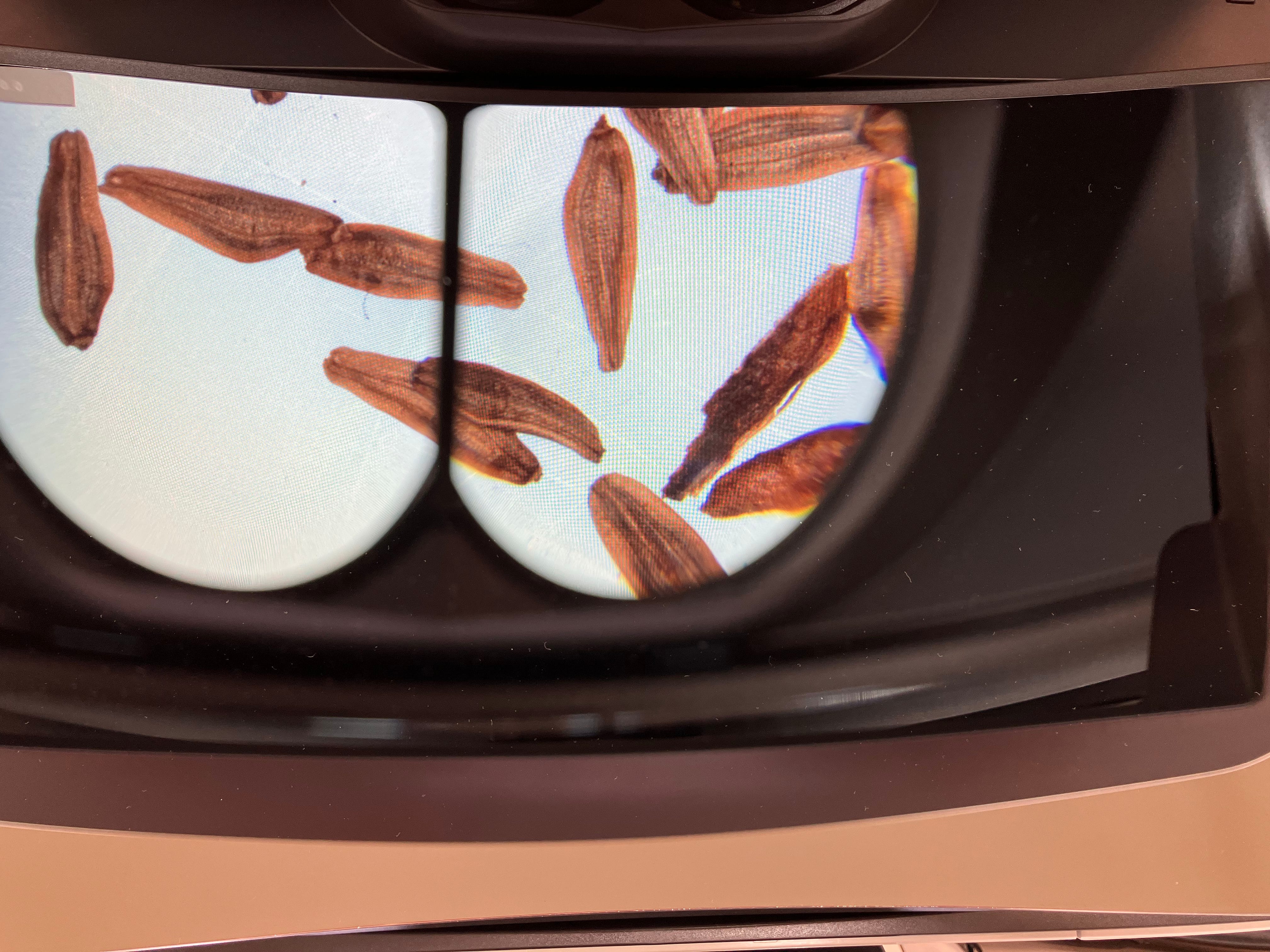
Back at the park’s laboratory, staffers separated out the 400 seeds they’d collected and examined them one by one with a microscope. The remote location of the tree and the absence of any other D. neriifolia tree made pollination chancy at best, and only 30 seeds showed signs of being viable.
Botanist Paulina Hechenleitner, science leader at Chile’s Jardín Botánico VerdeNativo and a research associate at Royal Botanic Garden Edinburgh, had been working to obtain the necessary export permits. That’s a difficult process in many countries because of the deeply-ingrained fear that unscrupulous foreigners are carrying off the nation’s natural heritage for their own profit. Even for Hechenleitner, a Chilean citizen working on a Chilean initiative, “it was stressful.”
The plan was to get seeds growing during the normal planting season in the well-equipped facilities of Britain’s Royal Botanic Gardens, Kew. “I was running out of time,” said Hechenleitner. She’d booked a flight for the last Monday in March, and her permits came through only the Friday before her departure. At that point, the usual stress of air travel kicked in, slightly amplified. She transferred the seeds from a glass Petri dish to avoid having them confiscated by airport security. Then, when flight attendants on her connecting flight in Brazil tried to relieve her of the carry-on luggage containing the envelope of seeds, she firmly declined. “They looked at me thinking, ‘Gosh, this lady’s crazy.’ But I was really, you know, strong about it. I said, ‘I’m really sorry, but I’m not leaving my bag because last time I lost it.’ So they let me go through.”
Arriving finally in England, she discovered that Sáez was still working on the collecting permit. Knowing that Kew would not accept specimens unless all the T’s were properly crossed and the I’s dotted, she put the envelope of seeds into her fridge for two weeks till Sáez came through.
The destination for the seeds was Kew Wakehurst in Sussex, home to the Millennium Seed Bank Project, dedicated to insuring against plant extinctions in the wild by preserving their seeds into the future. The laboratory there x-rayed the neriifolia seeds and determined that only 24 were actually viable. Eight immediately went into pots of compost, with 16 held in reserve. (The Project’s usual minimum target for a species is 2000 seeds.)
Assuming the Chilean government and other parties are willing, Sáez and Hechenleitner hope to repeat the exercise next year, and thereafter as long as the sole remaining tree in the wild survives. Hechenleitner suggested sending all 400 seeds to Kew next time, for a quicker assessment of viability by x-ray. Sáez also has 155 other plant species, including five other Dendroseris species now teetering on the brink of extinction, “that need to be safe.”
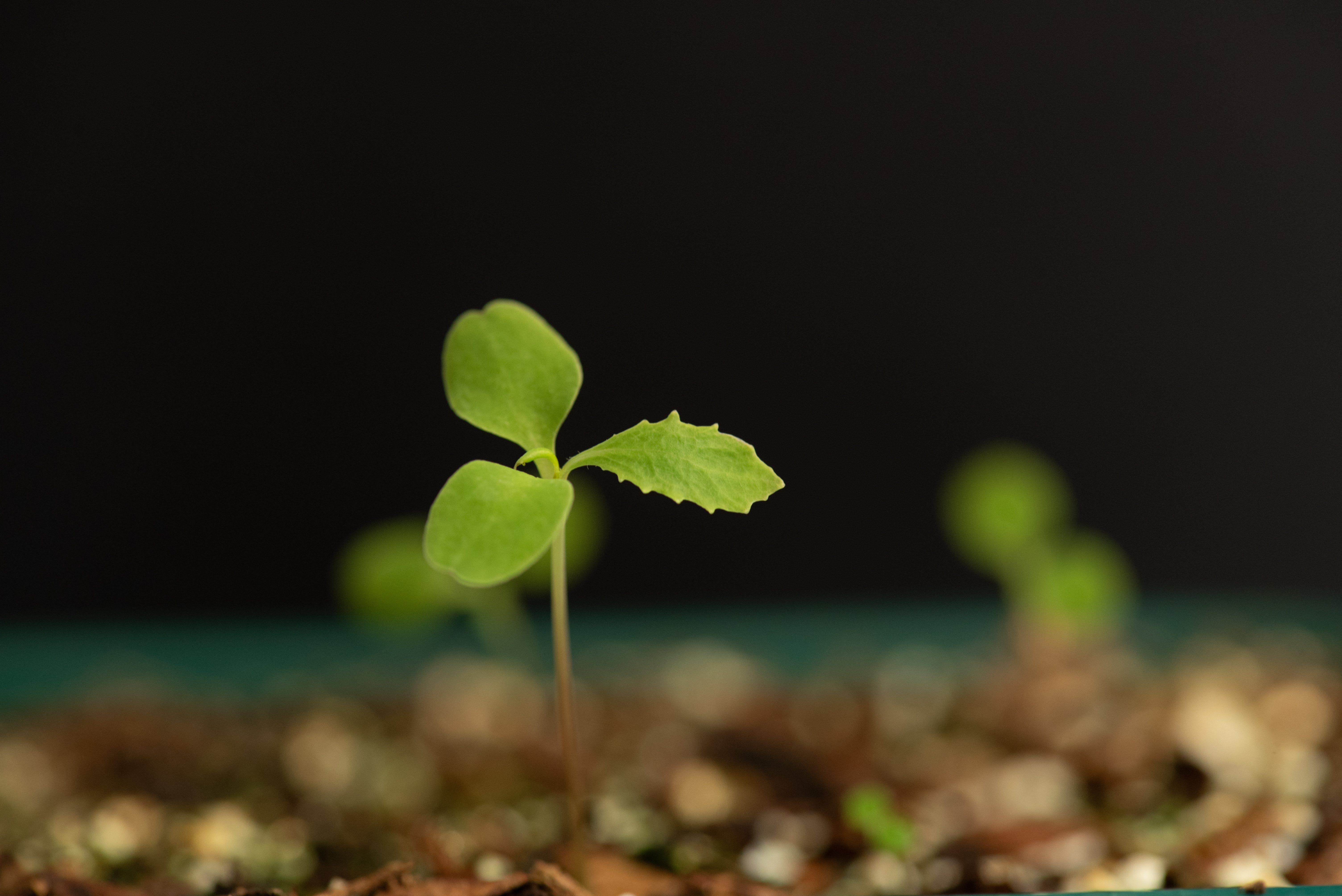
For now, eight neriifolia seedlings are thriving at Kew Wakehurst. On the principle that multiple safe havens make for greater security, three of them will eventually go to mature at Logan Botanic Garden on the southwest tip of Scotland, where other species from the Juan Fernández Islands have thrived in the soft Gulf Stream air. They’ll begin producing seeds in perhaps five or ten years, according to Sáez. It’s not possible to predict when the endling’s descendants will be ready to repopulate Robinson Crusoe Island, or when the island will be ready to receive them.
“We put some seed in the seed banks, and this is the first step,” said Sáez. “Now I say if the neriifolia is dying, I have the genetic material from my friends [at Kew and Jardín Botánico VerdeNativo] and we take it back and start again. But the first step that we need to do is to save the plant. And we did it.”
POSTSCRIPT: I said there was another reason, beside the obvious one, that the ropeless neriifolia rescue made me nervous. Here it is: In an odd corner of my life as a writer, I maintain a web page called “The Wall of the Dead: A Memorial to Fallen Naturalists,” honoring those who have died in the course of their field work. It started from the research for my book The Species Seekers, and enough tragic endings now populate this list for me to think in terms of categories. Deaths by planes, trains, and automobiles inevitably come out on top. But deaths by falling from cliffs or rocks are not far behind, with 14 recorded so far.
Though Sáez assured me that the work his park rangers do is safe, he also said that on some more perilous climbs, the rangers secure themselves with fishing ropes. I did not ask if he meant new fishing ropes, or used ones. So here is my request to readers:
If you happen to be a climber, or just an environmentalist interested in supporting the work on Robinson Crusoe Island, please contact Island Conservation to discuss a donation. In Chile, email the Jardin Botanico VerdeNativo (parquebotanicoverdenativo@gmail.com), to learn more about the neriifolia rescue effort and to discuss the possibility of making a donation. Or contact the Mohamed bin Zayed Species Conservation Fund, which is currently funding the neriifolia work, and ask them to up the ante. Any donation at all to save the incredible diversity of the Juan Fernández Archipelago will help—but a donation of proper climbing ropes and training would be particularly good. I do not want to add cliff-fall victim number 15 to the list.
Richard Conniff’s latest book, Ending Epidemics: A History of Escape from Contagion, is now out in paperback. His other books include The Species Seekers: Heroes, Fools and the Mad Pursuit of Life on Earth (W.W. Norton), Spineless Wonders: Strange Tales of the Invertebrate World (Henry Holt), and Swimming with Piranhas at Feeding Time—My Life Doing Dumb Stuff with Animals (W.W. Norton). He is a National Magazine Award-winning feature writer for Smithsonian, National Geographic, and other publications, and a former contributing opinion writer for The New York Times.
Comments
Nothing yet. Say the first thing.
Sign in to join the conversation.