
In the course of my work for magazines, I have often traveled to distant places and done odd, even foolish things, the better to understand and write about wildlife. Once, for instance, I strapped on climbing gear for the first time in my life, then inched out on a horizontal line across the corner of a climbing wall, 15 feet above a concrete floor, in an attempt to replicate the web-building behavior of spiders. It took five hours to create something like an orb web, and it was undeniable folly.
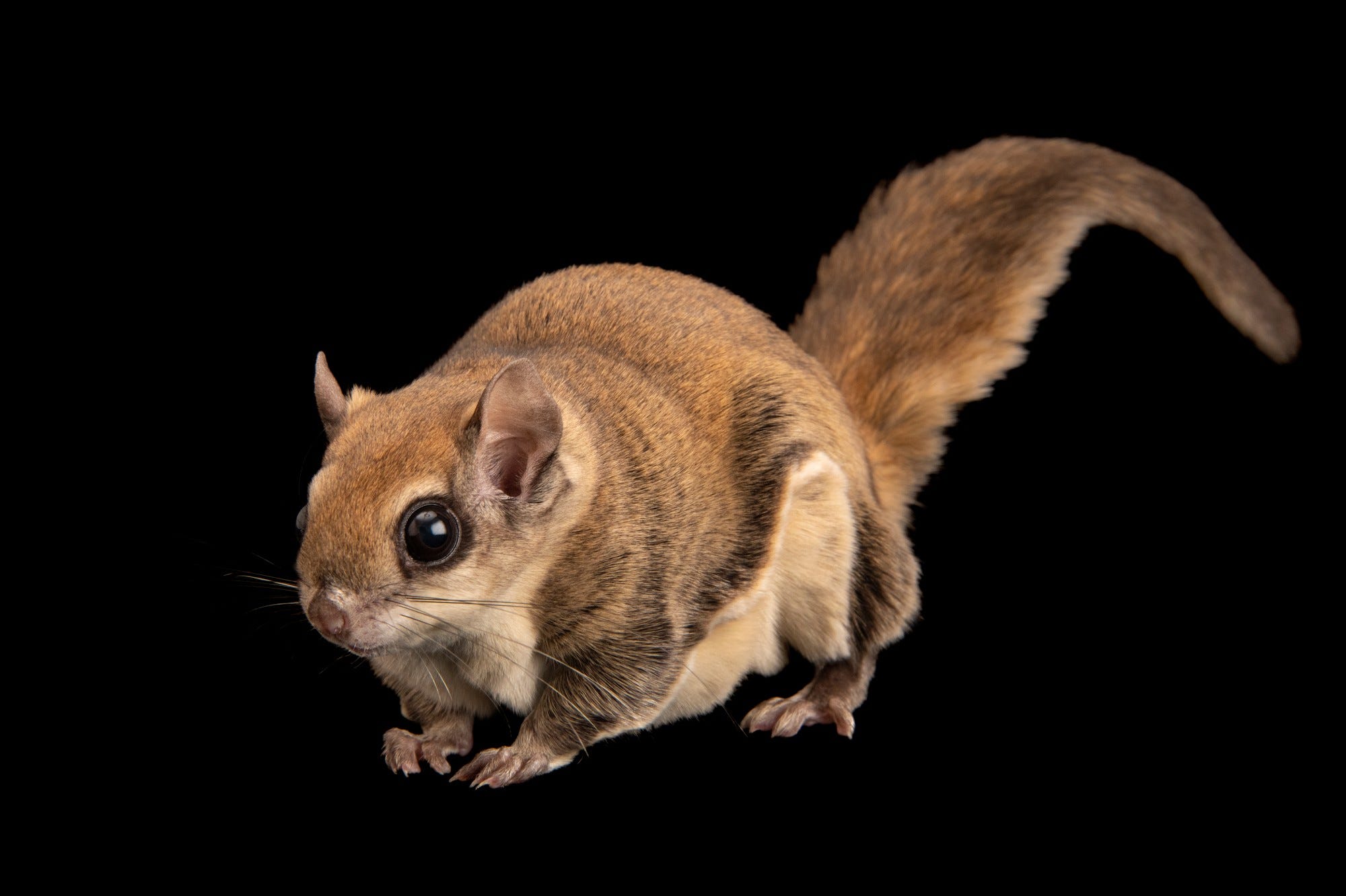
Oddly, though, I’ve never written about the wildlife experience that made me feel most like an utter fool. The wildlife in this case was a flying squirrel. More precisely, it was a southern flying squirrel, of a species found in forested areas from the Atlantic Coast west to the edge of the Great Plains, and from Honduras to the Canadian border (where a northern species takes over).
Carolus Linnaeus, the great classifier of the natural world, called the southern flying squirrels Glaucomys volans, meaning the grayish flying mouse. But they are not mice at all, and they cannot fly. They are, to use the technical term, merely glissant squirrels, from the French word meaning slippery, sliding, or in the case of these squirrels, gliding.
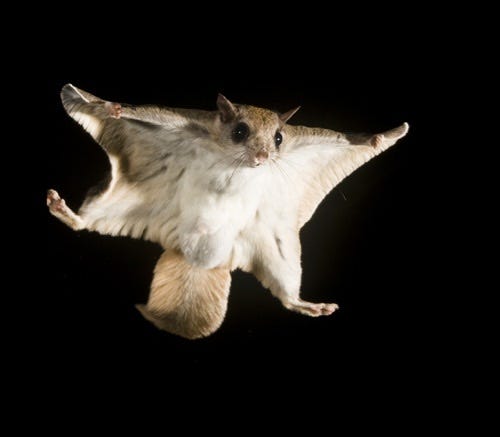
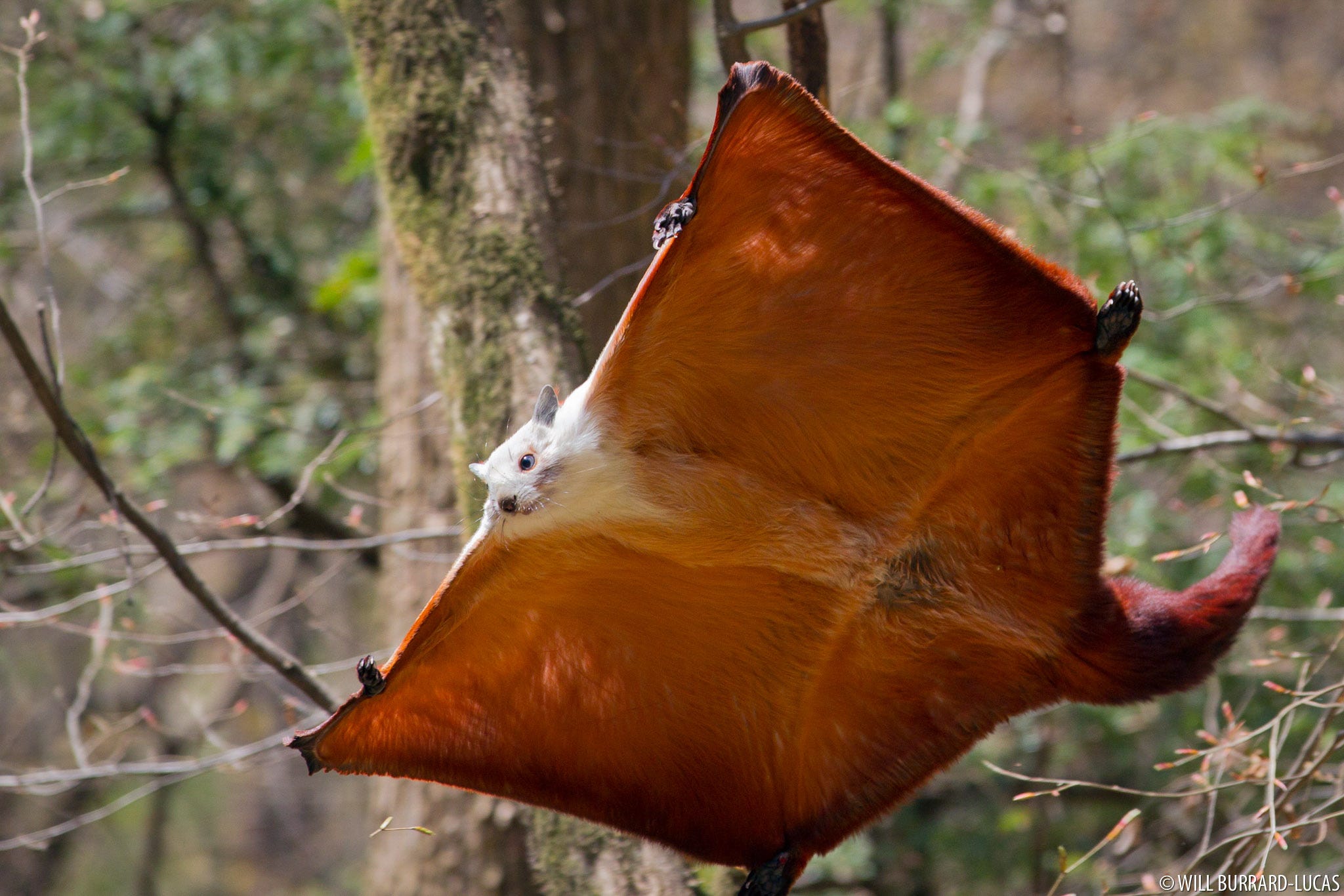
Flying squirrels have evolved into about 80 species worldwide. Their common characteristic is an extra webbing of flesh, called a patagium, down each flank, which connects front and back legs all the way out to the ankles. Most of the time, when a squirrel is moving along a tree trunk or branch, the patagium stays neatly folded away like an umbrella. But when a squirrel leaps into space with all four limbs akimbo, the patagium spreads out and becomes a paraglider’s sail. For extra lift, the tail is wide and flat. It’s also mobile enough to serve as a rudder for changing course, or even reversing direction, in mid-glide.
We tend to think of the common gray squirrel as high wire artist when we see it making a nine-foot leap across the gap between trees. But the southern flying squirrel can glide anywhere from nine to ninety feet, on average. Distance of course increases with launch height. Scientists employing trigonometric calculations of the flight path have estimated that under the right circumstances, a flying … sorry, glissant squirrel could in theory glide 450 feet, half again the length of a football field.
We tend not to know it, even in places where flying squirrels are common, because flying squirrels perform most of their long-distance leaps in the dark. They are nocturnal, with huge, glossy, protuberant black eyes, the better to see by the light of the moon.
Those eyes, together with their outsize heads and relatively small bodies, add up to neoteny, juvenile-seeming traits that persist into adulthood, and trigger an “Oh my god, they’re so cute” response in humans. People sometimes keep them as pets, and poachers take them from the wild to supply that trade.
One other thing worth knowing is that flying squirrels can travel on the ground, but only for relatively short distances and at considerable risk from predators. That makes them completely dependent on forests. In Illinois, where deforestation has reduced their habitat from the original 13.8 million forested acres to just 4.3 million today, the flying squirrel population is patchy at best. (This patchiness can be quirky. Flying squirrels turned up last year in the middle of Manhattan, in forested areas of Central Park. This may be the result of people releasing pets in the wild, rather than, say, a pre-colonial holdover.) Connecticut, where I live, was once almost completely deforested. But today forests cover about 55 percent of the land, and flying squirrels have repopulated the place in large numbers. And that brings me to my foolish story.
We have had three houses over the years here in Connecticut, all of them in the woods. The first two received frequent, uninvited visits from flying squirrels, which always entered, like Santa, by descending a chimney. Or so I am told. Often, I was out of town on assignment when these visits occurred, a sore point with my wife.
“One night, you were out of town,” she began recently, “and I was sitting on the couch in front of the fireplace watching TV.” The cats were curled up peaceably beside her. “I heard scruffling noises, and then a flying squirrel appeared in the fireplace.” Whispering, she advised it to turn around and go back up the chimney. Instead, it climbed up the firescreen and over the top.
“By then, the cats had heard it and were awake and ready,” she said. They were indoor cats, confined to quarters for the good of local wildlife and not particularly happy about it. “As soon as it got over the screen, they were after it. I knew it was a lost cause to try to stop them and, not wanting to witness the carnage, I turned off the TV and went to bed.”
Another time, at our first house, she went on, she and the children were all asleep on the third floor when “I heard noises like someone rummaging around looking for valuables on the first floor. You were out of town. So I called 911 from the bedroom.” It took 45 minutes for the state trooper to show up, and 911 kept her on the phone throughout. She went downstairs to let him in and pointed him in the direction of the supposed burglar. Instead, he found a flying squirrel dancing on the mantle. The trooper took off his hat to catch it. When the squirrel bolted, he followed until the squirrel vanished down a floor vent and away.
After a time, we became fairly casual about these visits, and even about the occasional flying squirrel carcass turning up on the living room floor. (For the third house, I finally realized that screening over the chimney tops might be a good idea. We have been squirrel-free since then. I think.)
I have the impression that many of these visits ended more happily for the squirrels. One morning at the second house, around the holidays, I came downstairs early to find a flying squirrel perched on a Christmas pillow on the couch, and the cats nowhere in site. The squirrel remained on the pillow staring at me with those big, glossy, almost trusting eyes, as I lifted the pillow and carried it outside to release in its proper habitat. Jackie Olexa, a mammalogy graduate student who recently co-authored a flying squirrel study at Kansas State University, suggests the squirrel was immobilized in a state of “fight or flight freeze.”
I had a feeling at the time that the squirrel was just going to find its way back inside that night, or soon after. There were plenty of clues. Not rodent droppings, oddly, but acorns sometimes turned up in the pantry, which was conveniently located next to the chimney. Once, the acorns even turned up in a box of Cheerios, though the cereal itself was tightly wrapped up in its bag, unmolested. This suggests to me that flying squirrels were using the house as a stash and, incidentally, that the cats were heavy sleepers.
One morning when I was home, a ruckus downstairs awakened me much too early. The goddam cats, I thought, no doubt frustrated by their indoor lives and getting up to their usual mischief. I rolled out of bed and found Rama, the Siamese, swaying and quivering on the stairway railing, barely containing the urge to leap into the airspace over the front entry. Sam, the Maine coon cat, sat on the floor below, at the center of the double doorway. Both had their phasers set to stun and were pulsing energy up at the top of the astragal, a wooden strip overlapping the gap between the two doors. There, nervously, nine feet in the air, sat a flying squirrel.
I wished at that moment that flying squirrels could fly, and that this one was winging around the room in search of an exit. That would have made my life so much easier: Lock up cats, open door, go back to bed. My wife had arrived on scene and I left her presiding over the cats while I went to search of equipment suitable to the occasion. I settled on a wok lid. When I returned, we each grabbed a cat and locked them both up in the closet under the stairs. I approached the squirrel, which did not dither on the fight or flight spectrum, instead launching itself right over my head and away. The chase was on.
This was my moment of utter foolishness, and I was instantly conscious of how ridiculous I looked. I was running down the hallway barefoot, dressed only in boxer shorts, with one hand raised overhead clutching the knob on the top of the wok lid, hoping to clamp it down over an extremely cute squirrel scampering away, tail up, toward god knows where.
Over the next few seconds, in rapid succession, I thought of the wok-y shape of Don Quixote’s helmet and the general haplessness of his chivalric endeavors. I thought of Rocky, the flying squirrel from the 1960s cartoon series, who could whip around the open sky with “a thunder of jets” and “a cheerful hi.” And then, as the glass doorway at the end of the hall drew closer, I thought of Road Runner sending Wile E. Coyote full speed into a fake tunnel entrance. SPLAT!
The squirrel reversed course and slipped past me back out toward the front hall. But then, in a moment of incredible athleticism that should have been videotaped and viewed 63 million times on Instagram, or so it seemed to me, I leaped out to my full length, a flying tackle, and brought the wok lid down—THWUMP!—on top of the squirrel.
I waited, face down on the floor, lid firmly secured, while my wife retrieved a good size piece of cardboard. I slid the cardboard expertly under the lid, then lifted cardboard and lid together and carefully carried them outside. My plan was to slide the squirrel down into a five-gallon bucket, cover it with the lid, and drive it someplace very far away. You never know when an animal might be capable of geomagnetic navigation or some other infernal homing talent, so I was planning to release it in a large forest on the far side of a very wide river.
As I tilted the cardboard up, I peeked into the bucket, then back at the cardboard. There was no sign of a squirrel anywhere. It was as if it had never been there. All I had to show for this ridiculous episode were some bruised ribs, and a couple of angry cats demanding to be let out of jail.
I’d like to say that squirrel learned its lesson and never visited again. But I am fairly certain that, like the legendary cat, it came back whenever it damn well pleased.
Thanks for reading Richard Conniff’s Substack! This post is public so feel free to share it with friends.
Olexa, Jacqueline (2026), The genetic value of volans: Assessing phylogenetics and population genetics of southern flying. (Wordy title but full of good biological background.)
Turcios Casco, Manfredo (2020) Unseen for 43 years! A new occurrence of Glaucomys volans (Linnaeus, 1758) (Rodentia, Sciuridae) in Honduras.
The State of Connecticut also publishes a useful page about flying squirrels, including methods to avoid uninvited visits intp your house.
And here’s a BBC video of Siberian flying squirrels:
Richard Conniff’s latest book, Ending Epidemics: A History of Escape from Contagion, is now out in paperback. His other books include The Species Seekers: Heroes, Fools and the Mad Pursuit of Life on Earth (W.W. Norton), Spineless Wonders: Strange Tales of the Invertebrate World (Henry Holt), and Swimming with Piranhas at Feeding Time—My Life Doing Dumb Stuff with Animals (W.W. Norton). He is a National Magazine Award-winning feature writer for Smithsonian, National Geographic, and other publications, and a former contributing opinion writer for The New York Times.
Comments
Nothing yet. Say the first thing.
Sign in to join the conversation.