
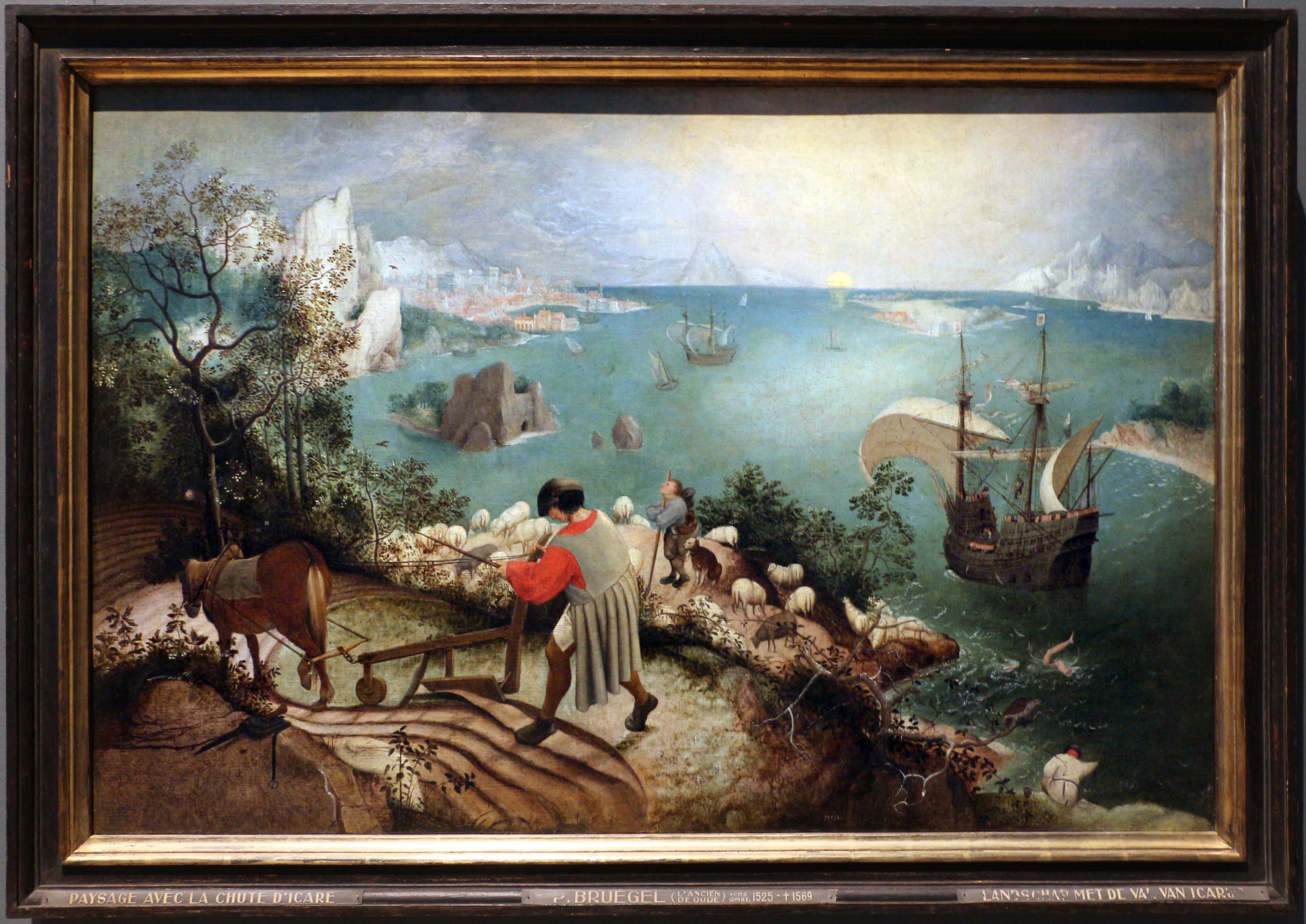
“About suffering they were never wrong, the Old Masters,” W.H. Auden wrote in his celebrated poem “Musée des Beaux Arts.” He was talking specifically of Pieter Breugel the Elder’s 1558 painting about Icarus, the legendary boy who flew too close to the sun and fell to his death in the sea. The point for both Breugel and Auden was that the world does not stop to notice the suffering all around us.
Pieter Breugel’s son, the painter Jan Breughel the Elder, learned this lesson, not surprisingly. But he applied it more knowledgeably than anyone might have imagined to the suffering of birds and the aerial behaviors of bats, according to a paper published today in Proceedings of the American Academy of Sciences (PNAS).
In fact, his 1611 allegorical painting “Air” included a predatory behavior it took scientists another 400 years to discover—a behavior that researchers at Spain’s Doñana Biological Station conclusively demonstrated for the first time only this past October. Here’s what I wrote about that discovery back then:
Now it turns out bats aren’t just hunting insects. Every spring and autumn, a river of migratory songbirds—billions of them—passes high overhead. These birds often travel by night, for safety from hawks and other birds that might target them by day. But a study published this week in the journal Science reports that at least one bat species has risen to this abundant feeding opportunity. That is, these bats detect, chase down, and kill birds—birds that are up to half their own body weight—and then eat them on the wing.
I relished this discovery at the time not for the gruesome details, but because it was such an inspiring case of persistence and ingenuity by senior author Carlos Ibáñez and his fellow scientists in the face of very long odds:
Over the next two decades, he and his collaborators tried using military radar to identify birds and bats in flight, and ideally at the moment of a kill. That failed, as did an attempt with a hydrostatic balloon equipped with ultrasonic microphones positioned one kilometer above ground. Putting GPS devices on the bats showed only where they were foraging—not what they were foraging on. It was maddening, and more so after a 2016 analysis by Ibáñez and his co-authors found that feathers in the bat scats contained DNA from 31 different bird species, almost all migrating from sub-Saharan Africa.
The quest by Ibáñez et al caught the interest of “biologging” researchers at Aarhus University in Denmark. They equipped greater noctule bats living in nest boxes at Doñana with a lightweight package including a microphone, an altimeter, and an accelerometer. An antenna at the nest box picked up data from each flight as the bat returned to its roost, and a total of 14 bats flew with the device, for an average of two nights apiece.
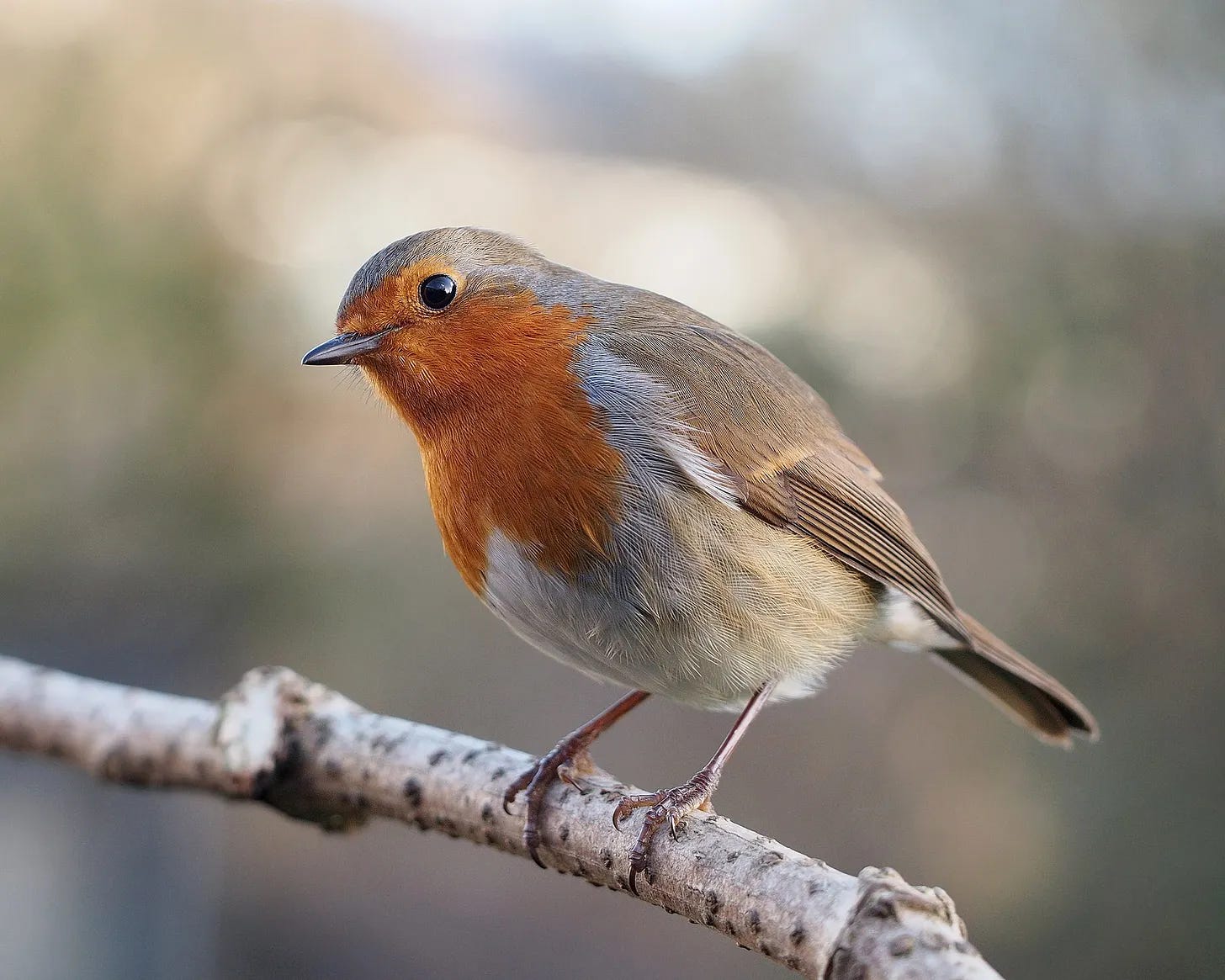
This collaboration recorded greater noctule bats, the largest European bat species, hunting and killing birds on the wing exactly as Ibáñez had first proposed a quarter century earlier. The researchers could even hear the screaming of a European robin in the terrible moments before the bat delivered its lethal bite.
Two months after the publication in Science, Pedro Romero-Vidal, an ecologist at Doñana, was working his way through old artworks looking for evidence of exotic species—parrots, monkeys, cheetahs, and the like—turning up in places where they did not naturally exist. It’s basic research in the field of historical ecology, and European paintings of the early colonial period are a particularly rich source of information. Romero-Vidal uses that past evidence to inform his work on the modern illegal wildlife trade. Jan Breughel’s “Air,” which mixes allegory with naturalistic observation, was ripe for detailed inspection.
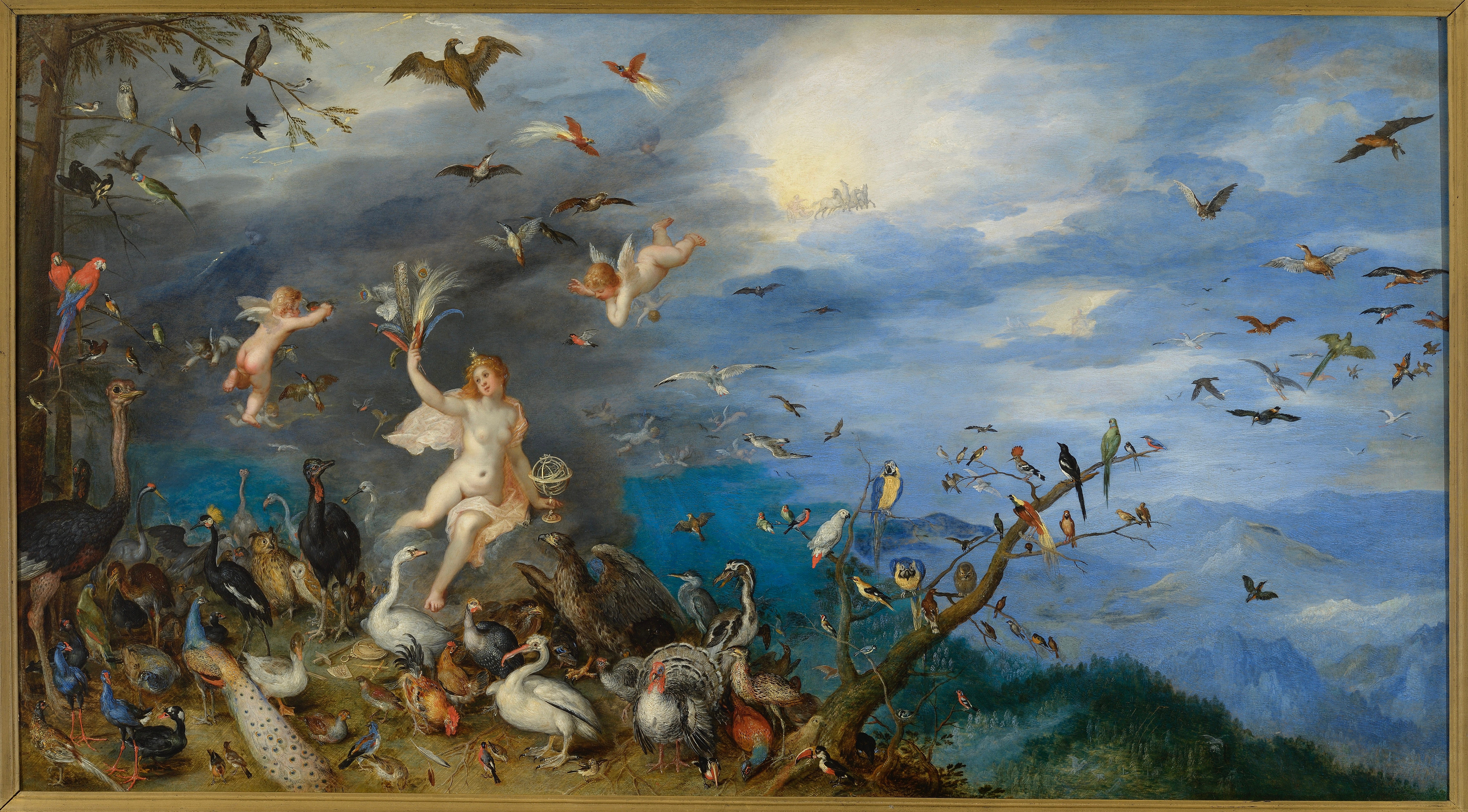
“What first captures the viewer’s attention,” Romero-Vidal and his co-authors write in the new PNAS study, “is the astonishing diversity of avian species portrayed … The painting represents more than 60 species, including nearly 40 recognizable native European bird species [and] at least 14 exotic ones,” among them a Black Crowned Crane from the African Sahel and a Red-and-green Macaw from South America. Also an ostrich.
Breughel’s remarkably detailed knowledge of life on the wing extended to native European bats. On the upper left side of the painting, according to the PNAS co-authors, he depicted a bat of the genus Plecotus. (Finding it, like finding Icarus, is a “Where’s Waldo” challenge. Hint: Look under the owl perched on a tree branch.) At mid-canvas, more obviously, there’s a pair of bats “probably belonging to the family Vespertilionidae.” Then, in the upper right corner of the canvas, Romero-Vidal noticed something remarkable: A greater noctule bat, which has seized a small songbird headfirst in its mouth.
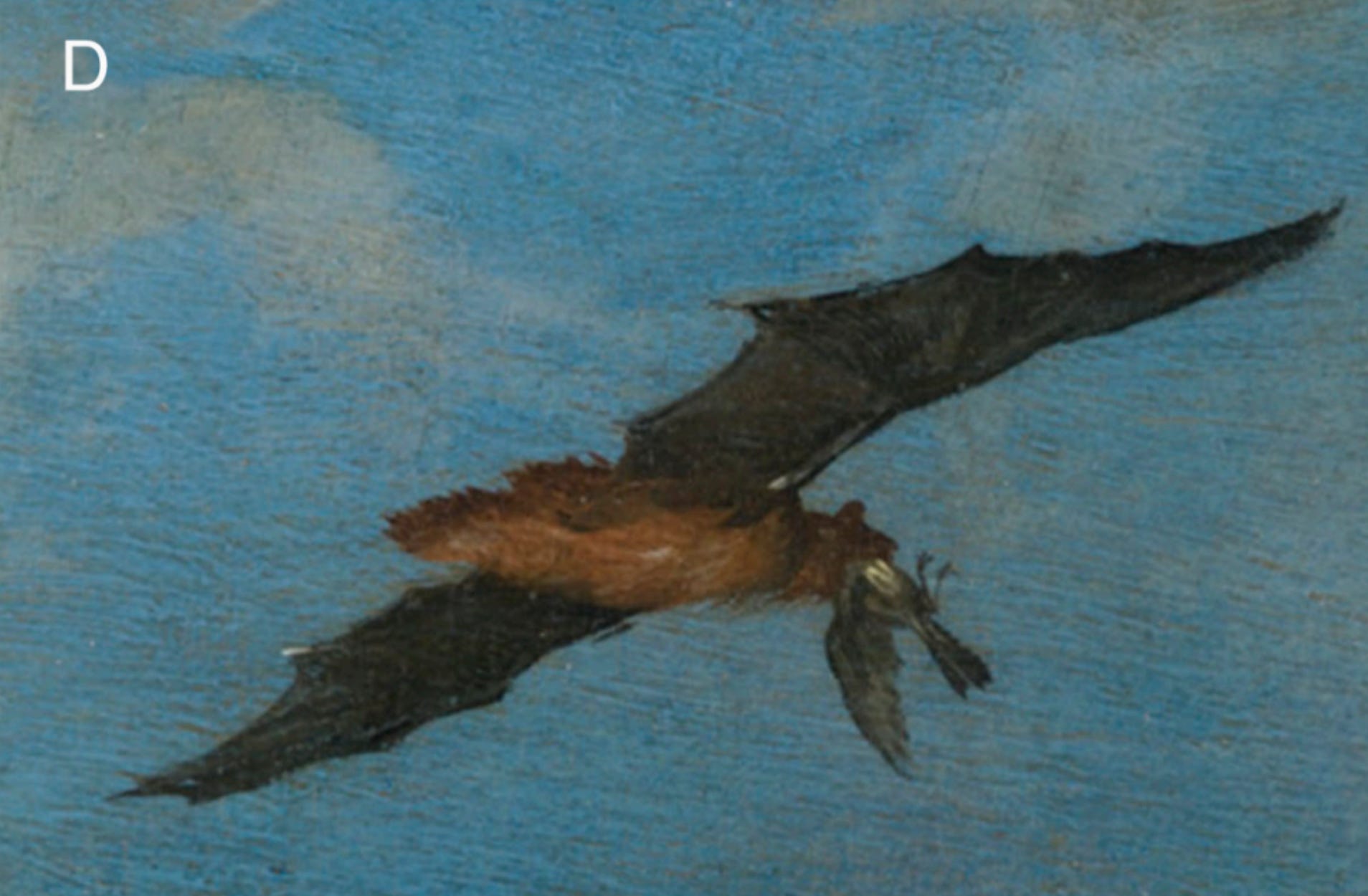
Breughel wasn’t calling attention to this small drama. In fact, the bat seems half a moment from flying out of frame. It reminded me of the line from the Auden poem, about how the Old Masters
… never forgot
That even the dreadful martyrdom must run its course
Anyhow in a corner, some untidy spot
Where the dogs go on with their doggy life and the torturer’s horse
Scratches its innocent behind on a tree.
For Pieter Breugel, it was Icarus, and his “white legs disappearing into the green/ Water,” as a ship with somewhere to get to “sailed calmly on.” For Jan Breughel, it was the up-flung legs of a dying songbird amid all the living birds busily displaying their resplendent colors.
The big question, for Romero-Vidal and the authors of the original paper on bat predation on birds, was: How did Breughel know? These hunts generally take place hundreds of meters in the air, and at night. Belgium, where Breughel lived at the time of the painting, was also an unlikely spot for observing the hunting behavior. That far north, the rivers of migratory birds have thinned out to mere rivulets, and bats are better off sticking to their familiar insect prey.
In the first half of the 1590s, though, Breughel had lived in Italy, traveling as far south as Naples. Romero-Vidal and his co-authors theorize that he may have encountered the greater noctule bat there. It was still unlikely he witnessed a nighttime, high-altitude hunt. But they note that, in Central Europe, a related species, the common noctule, occasionally hunts by day during the fall migration.
Breughel was visiting in Prague at that time of year in 1604, at the court of the Emperor Rudolf II, a passionate collector of art and also of plants, animals, and other specimens from the natural world. It’s possible Breughel actually witnessed that species on the hunt during that visit, or more likely heard descriptions of the behavior from the naturalists who also gathered around the court. In any case, the startling behavior clearly stayed with him.
I suppose the moral here is to use the word “discovery” with caution, and never to underestimate just how alive some of our predecessors once were to the splendid but also endlessly catastrophic world around us.
Thanks for reading Richard Conniff’s Substack. This post is public so feel free to share it.
Richard Conniff’s latest book, Ending Epidemics: A History of Escape from Contagion, is now out in paperback. His other books include The Species Seekers: Heroes, Fools and the Mad Pursuit of Life on Earth (W.W. Norton), Spineless Wonders: Strange Tales of the Invertebrate World (Henry Holt), and Swimming with Piranhas at Feeding Time—My Life Doing Dumb Stuff with Animals (W.W. Norton). He is a National Magazine Award-winning feature writer for Smithsonian, National Geographic, and other publications, and a former contributing opinion writer for The New York Times.
For a closer look at Breughel’s “Air,” here’s a brief video from the Musée des Beaux-Arts de Lyon:
And here’s a recording of Auden reading his “Musée des Beaux Arts,” which is one of my favorite poems.
Comments
Nothing yet. Say the first thing.
Sign in to join the conversation.