Richard Conniff on Nature · Richard Conniff’s Substack
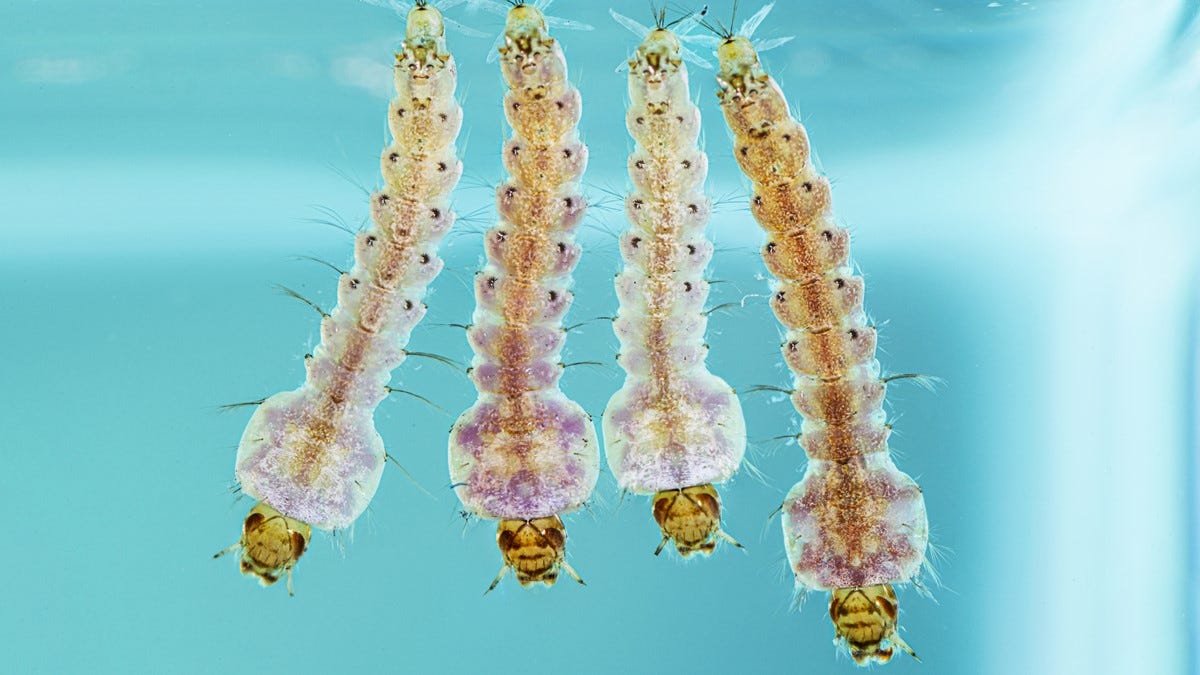
Pretty little vectors, also known as Anopheles quadrimaculatus larvae (Photo: CDC/Amy E. Lockwood)
This is not a story about our vampire presidency. Nor is it about ticks, which are already too much in the news for their expanding pathogenic capabilities. Instead, this overheated season turns my mind to what is technically the most dangerous animal on Earth.
It is mosquito season again, time for entertaining unwholesome thoughts about nature. Just now, I was reading one of my old journals from a field trip somewhere in South America, when I turned the page. There, flattened next to the binding, was the dark smudge of a mosquito and, on the opposite page, its Rorschach image in dried blood, probably my own.
All the unheralded charms of the rain forest came rushing back … the way my clothes were always caked and sodden with mud … the howler monkeys roaring their jocund welcome and flinging excrement at my head … the endless sliding down wet clay trails and the cautious shuffling over wobbly one-log bridges at midnight in the rain, with a dehydration welling up behind my brow. Above all, I recalled the relief of finally making it back to camp and to bed under the blessed shelter of my bed netting.
For those of you who have not experienced it, here’s how the final moments of such a day transpire. You drop your clothes in a sodden heap, leaving your sweaty, puckered flesh bare just long enough for the mosquitoes to roar in for last call. This causes you to dive into your individual cocoon of bed netting, where the mosquitoes inevitably follow. You spend the next ten minutes slapping and spattering winged droplets of your own blood all over the netting and the sheets. Then, having killed the last mosquito, you recollect that you have forgotten to pee. You climb back out, after yearning in vain for a catheter, and do it all over again.
According to my journal for that night, the sound of mosquito slaughter finally died away, and there was a brief period during which the hostility and bone weariness of the day subsided. Across the way, one of my travel companions looked up disconsolately at his white shroud and remarked: “I feel like a pupa.”
“I was beginning to think of you as a maggot,” the tough guy in the group replied. (Did I mention that I was traveling with field researchers who learned their manners largely from insects, and not social insects either?)
“I’ve got a tear in my mosquito net,” someone else said, as he started slapping again.
The tough guy immediately began counting off mosquito-borne diseases: malaria, yellow fever, dengue fever, and so on. Then, in search of something more immediately lethal, he wondered aloud how long it might take for mosquitoes to drain enough blood to kill a person. (He had apparently learned his manners largely from the botfly, a type of insect that deploys a mosquito to get its egg under your skin, where the baby botfly can wriggle and otherwise annoy you for weeks on end.)
“A mosquito only takes a millionth of a gallon per bite,” said the pupa. He was a decent guy who liked to smooth things over. “It couldn’t happen.”
“Brazoria, Texas, 1980,” said the tough guy. “There were so many mosquitoes they killed the cattle. Autopsies said half the blood in their bodies was missing . . .” He enjoyed trying to keep us awake at night with entomological horror stories.
“I wish I was home,” sobbed the guy with the torn netting.
“We could be in the Arctic tundra,” the tough guy offered. He proceeded to explain that spring in the tundra is so short and sudden that the snowmelt hatches all the dormant mosquito eggs at the same instant. The entire population of mosquitoes then has about 20 minutes to mate, find a victim, get a blood meal, and lay a new batch of eggs before winter sets in again. Some Canadian researchers once forced themselves to sit still in such a swarm long enough to report that they suffered 9,000 bites a minute.
“Those Canadians know how to have fun,” said the pupa.
Suddenly sleep whacked me sideways on the head, and I fell into a dream about all those newly emerged little vampires taking wing in one vast, sky-darkening, bloodsucking swarm, their collective need for a meal so sudden and intense that unlucky, half-frozen victims were literally being sucked to death everywhere I looked.
When I woke in the middle of the night, I saw that the tough guy had flopped sideways against his netting. Mosquitoes were now congregating eagerly in a black knot on the other side, threading their proboscises through the fabric into his rump. I calculated how much blood he was losing at a millionth of a gallon per bite but did not wake him up. I figured it was how he would have wanted to go.
To drown out the sound of the mosquitoes’ bloodthirsty buzzing, I put on some earphones and a soothing tape called “Rain Forest Retreat.” (”A myriad of beautiful butterflies dance in the shafts of sunlight that filter through a warm, soft mist . . .”) I slept the rest of the night like a baby, being careful to keep to the middle of the cot.
One time on an assignment to write about tarantulas for National Geographic, I shared a boat in the Amazon for a couple of weeks, or perhaps it was a year, with photographer Mark Moffett. Mark was a genius when it came to insect and spider macrophotography, but oblivious to almost everything else. Colleagues sometimes wondered if he was an insect in a former life, or aspired to become one. Years later, I saw him give a talk in which he went groveling across the stage to his new wife as a way of demonstrating the technique certain male spiders use when begging for sex.
Mark didn’t much like taking pictures of humans, who are at least four legs short of ideal. He had been diligently ignoring the magazine’s request that he take an “author-on-assignment” photograph of me.
Late one night out in the rain forest, we discovered a tarantula carrying a big egg sac, like a leathery, puckered old potato. I’m not sure what we thought the tarantula was going to do next, but we sat down on the ground to record it. There was a downpour. Mark was bent forward with his elbows on his knees and his camera trained on the spider. I had my pen and notepad ready under my poncho (but was privately imitating a gargoyle, by making the rain sluice off the tip of my nose). Ants, beetles, grasshoppers, and other creatures appeared on the tarantula, and on us. Eventually, a mosquito landed on the tarantula’s abdomen.
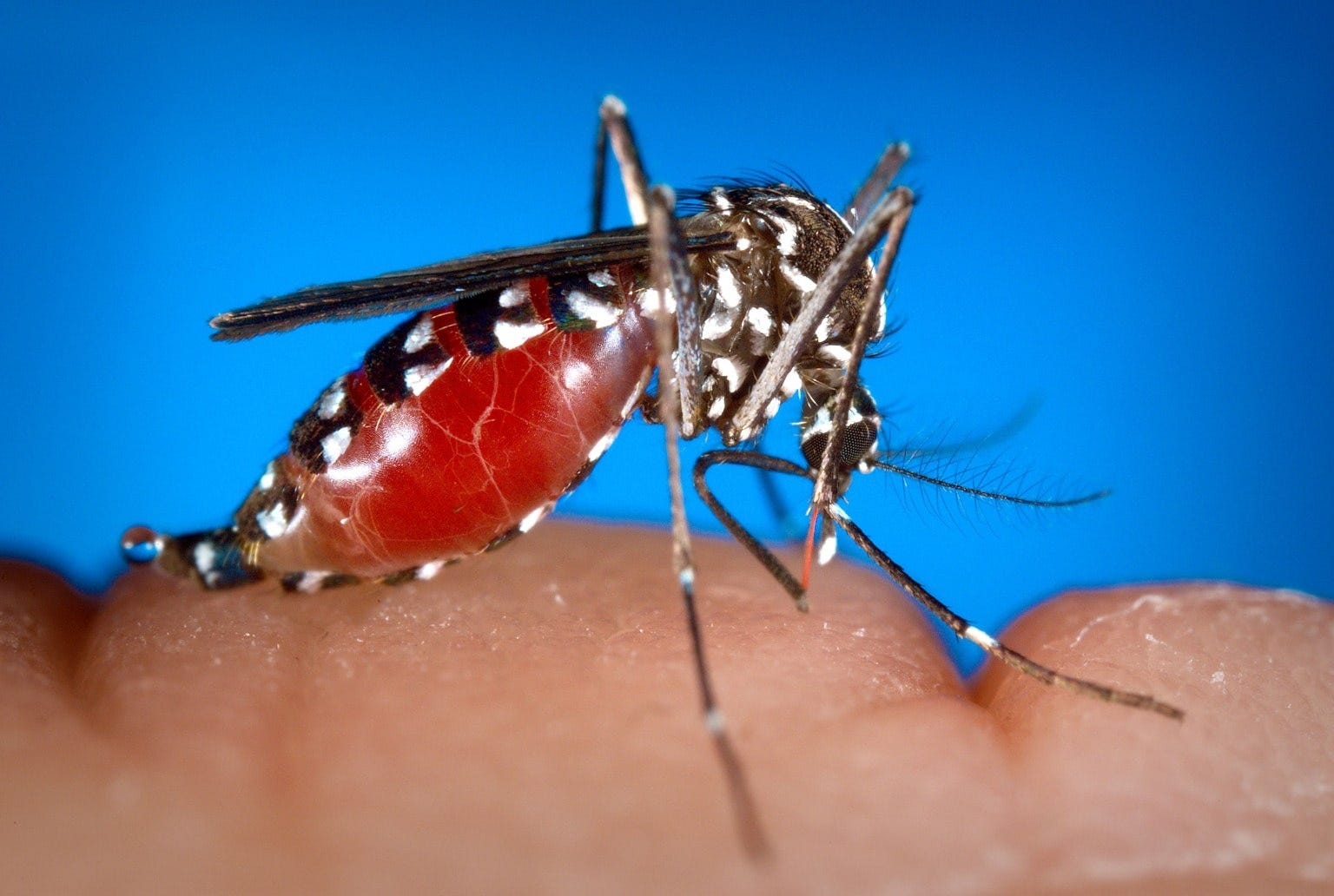
An engorged mosquito, still feeding (Photo: CDC/James Gathany)
“That mosquito’s been eating your blood, Conniff,” Mark said, as he focused on its swollen red abdomen. The camera clicked, and the strobe light glittered momentarily off a thousand raindrops. “That’s my idea of an author-on-assignment shot,” he said.
By way of a mosquito’s gut, I had entered the world according to Mark.
Thanks for reading Richard Conniff’s Substack! This post is public so feel free to share it.


Comments
Nothing yet. Say the first thing.
Sign in to join the conversation.