
“No temptation has overtaken you except what is common to mankind. And God is faithful; he will not let you be tempted beyond what you can bear. But when you are tempted, he will also provide a way out so that you can endure it.” 1 Corinthians 10:13
You’ve heard the short version of that verse. It shows up on sympathy cards and in comment sections. It gets said in hospital hallways and church lobbies and funeral receiving lines, usually by someone who means well and has run out of anything else to say.
God won’t give you more than you can handle.
Many of us have said it at some point. And the instinct behind it isn’t wrong. The person saying it is trying to tell you that God is still God, that you’re not alone, that this isn’t the end of the story. All of that is true.
But that sentence isn’t in the Bible. Not in any translation. It’s a rewrite of 1 Corinthians 10:13, and the rewrite does something significant: it changes the subject of the sentence.
Paul’s sentence is about God. Ours is about us. Our strength. Our capacity. Whether we’ve got enough left to carry this.
And once the subject changes, the verse can be used two very different ways, and both of them are wrong. It becomes a burden for people who are barely standing, and a permission slip for people who are sure they’re fine.
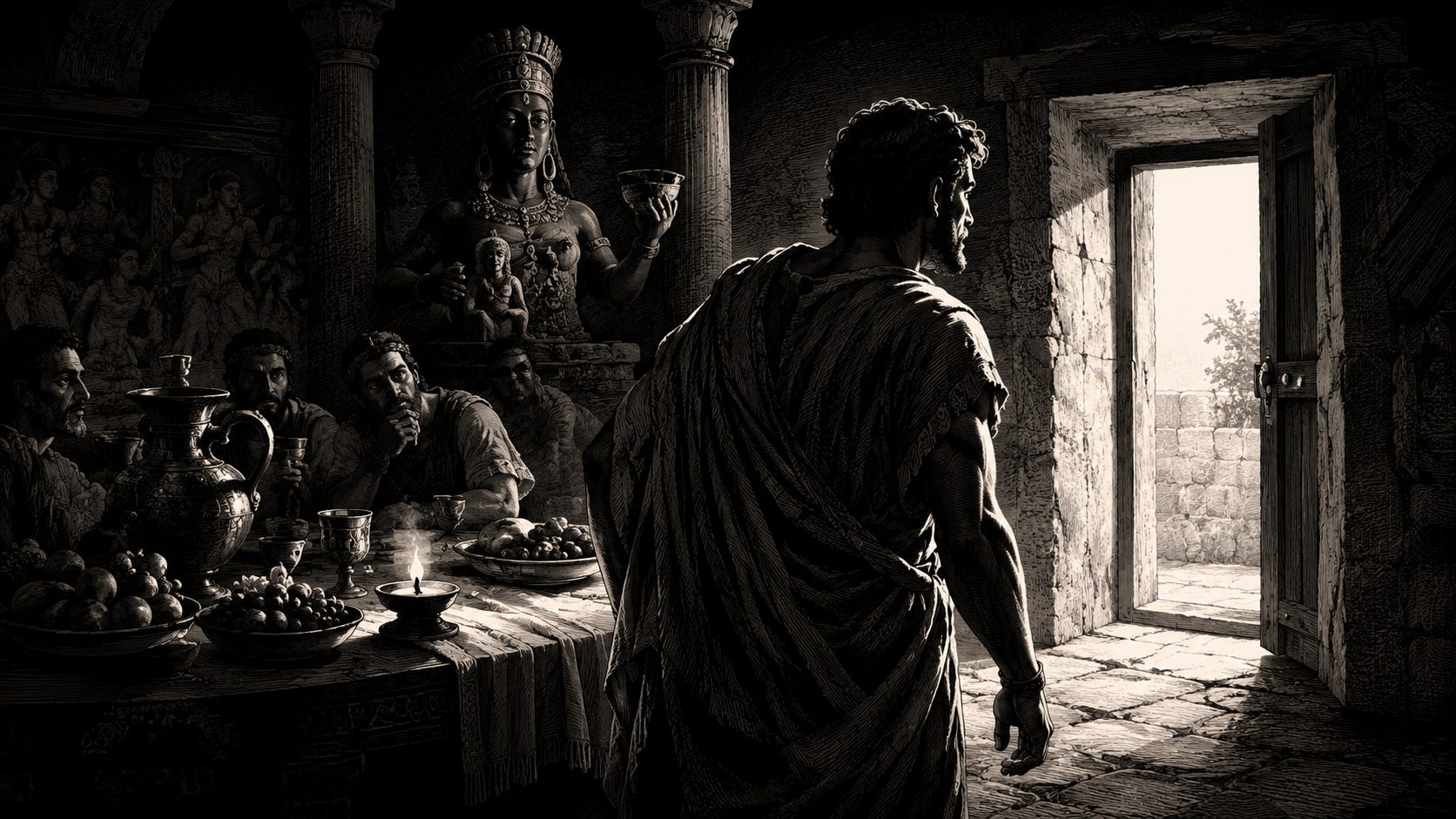
Paul didn’t write it for a funeral. He wrote it for a dinner party.
The whole misquote turns on one substituted word.
Paul wrote peirasmos. Temptation. The pull toward sin. We hear hardship… cancer, layoffs, custody hearings, the phone call at 2 a.m.
Same verse, completely different subject. And once it’s applied to suffering, it makes a promise God never made: that your life will stay carryable, that you’ll always have the capacity for what’s coming, that if you’re drowning, you must have misjudged your own strength.
The man who wrote that verse also wrote this one, to the same church, in his next letter:
“We were under great pressure, far beyond our ability to endure, so that we despaired of life itself” 2 Corinthians 1:8
Far beyond our ability to endure. Paul got handed more than he could carry and gave up on living. He is not contradicting himself. He’s talking about something else entirely.
And he tells you why it happened:
“But this happened that we might not rely on ourselves, but on God, who raises the dead” 2 Corinthians 1:9
God did not size Paul up and load him to the line. God let him get to the end of himself so he’d stop trusting himself. That’s not cruelty. That’s the point.
So if you are in something right now that is genuinely more than you can handle, you are not failing a test. You didn’t misjudge. You’re standing exactly where Paul stood. The promise was never that you’d be strong enough.
The first misuse gets aimed at people who are hurting. The second gets aimed at nobody, because it’s the one we say to ourselves.
Pull verse 13 out on its own and it starts to sound like coverage. God won’t let it get past what I can bear. He’ll give me an out. I’ll be fine. That’s the mood Paul is writing to correct, and it’s the reason the verse exists in the first place.
Both readings make the same mistake. Both of them measure you. The verse measures God… “and God is faithful” is the clause the whole sentence hangs on, and it’s the clause nobody quotes.
Two sentences fence this verse in, and to understand this verse we need to understand where it sits.
Paul has spent three chapters on a strangely specific problem: can Christians eat meat that’s been sacrificed to an idol, and can they eat it reclining at a table inside the pagan temple? Archaeologists have dug up those dining rooms in Corinth. Small, formal, built for a dozen or so guests. This wasn’t a theological hypothetical. It was Friday night, and everyone you did business with was going.
Some of the Corinthians said yes, and their theology was decent. An idol is nothing. The building is just a building. The meat is just meat.
Paul answers by taking them back to the wilderness. Israel had everything, he says. The cloud, the sea, bread from heaven, water out of a rock. Real provision from the real God. And they still ended up dancing around a golden calf. Then he turns it on them:
“So, if you think you are standing firm, be careful that you don’t fall!” 1 Corinthians 10:12
That’s the sentence immediately before ours. Paul isn’t writing to people saying I can’t take any more. He’s writing to people who have stopped being afraid of temptation at all.
Now read the promise slowly, because there are four things in it and we usually only take one.
No temptation has overtaken you except what is common to mankind. Whatever it is, it’s ordinary. You’re not uniquely broken and you’re not uniquely targeted. That’s humbling and it’s a relief, in that order.
And God is faithful. Not you are strong. Not you are resilient. The guarantee rests on his character, and it holds on your worst day, which is precisely when your capacity doesn’t.
He will not let you be tempted beyond what you can bear. There’s a ceiling, and God is the one enforcing it.
He will also provide a way out so that you can endure it. The Greek word is ekbasis. Commentators like Leon Morris and William Barclay describe it with a military picture: an army boxed in by mountains, out of options, and then someone spots the pass. Not a helicopter. Not a surrender. A road out that you have to walk on your own feet.
Which brings you to the next sentence:
“Therefore, my dear friends, flee from idolatry” 1 Corinthians 10:14
Therefore. God provides the exit; you take it. And in Corinth, the exit wasn’t mystical. It was: don’t go to dinner.
That only sounds like retreat. It isn’t. Sometimes walking away is how the fight is one. The Corinthians who stayed and trusted their theology, or worse their own strength, to protect them are the ones who lost.
Most of us pray to survive the room, but Paul keeps pointing at the door.
We want the way out to feel like something. We want a surge of strength, a settled peace, some evidence that God has done something inside us. So we stay in the situation and ask him to change how we feel about it. Then we lose, and we conclude he didn’t come through.
He did. He put a door in the room. It’s just an unremarkable one.
The phone charges in the kitchen. You take the other route home. You don’t schedule the meeting. You leave the group text. You cancel the app. You tell one person the truth this week instead of next year. None of it feels holy. All of it works.
Here’s the test: stop asking how do I get strong enough for this, and start asking what’s the exit, and why haven’t I used it? Most of us don’t need a better strategy. We need to admit we’ve walked past the door on purpose.
“I’ve got that one handled” is not evidence that you have it handled. Verse 12 says it’s a warning light. The Corinthians didn’t fail because their doctrine was weak. They failed because their doctrine was strong and they trusted it to do a job it can’t do. Knowing an idol is nothing doesn’t keep you out of the temple. Only your feet do that.
So the question isn’t where you’re struggling. You already know that. The question is: what’s the one area where you’d say it isn’t really an issue for you anymore?
Whatever came to mind, when’s the last time you told anyone the truth about it?
If you’ve read this far, some of you have done the math already: the exit was always there, maybe you’ve even walked past it. God provides a way for us through it.
But there was one man who asked God for a way out and didn’t get one.
In a garden, the night before he died, Jesus prayed, “My Father, if it is possible, may this cup be taken from me. Yet not as I will, but as you will” (Matthew 26:39). He asked three times. There was no pass through the mountains. He got up and walked toward it.
That’s why Hebrews can say we don’t have a high priest “who is unable to empathize with our weaknesses, but we have one who has been tempted in every way, just as we are; yet he did not sin.” And then, immediately: “Let us then approach God’s throne of grace with confidence, so that we may receive mercy and find grace to help us in our time of need” (Hebrews 4:15–16).
Mercy for the doors you didn’t take. Grace for the one in front of you now.
God isn’t standing over your life measuring your capacity and filling it to the line. He knows your capacity. He knows it’s less than you think it is. That’s why he sent his Son to carry what you never could.
So no, God won’t give you more temptation than you can bear. Because you have a God who will help you through whatever is in front of you.
Paid subscribers get a second post every Thursday focused on what Scripture actually means for how you live. $6 a month or $54 a year — both go up August 1. Lock in the lower price now.
If this was helpful, pass it along to someone who might need it.
No posts
Comments
Nothing yet. Say the first thing.
Sign in to join the conversation.