
I’ve been a pastor for over fifteen years, and I can’t tell you how many times someone has pulled me aside after a service and asked some version of the same question. And it usually starts with, “This is going to sound crazy, but…”
Then it comes out. I think I’ve committed the unforgivable sin… What do I do?
Maybe that’s you. Maybe it was something you screamed at God in the worst week of your life. Maybe it was a season where you walked away and meant it. Maybe it was just a thought, one you’d never say out loud, that showed up uninvited and wouldn’t leave. And then somewhere along the way you ran into Matthew 12, and it’s been sitting in the back of your mind ever since, like a splinter you can’t find.
Here’s what I’ve learned after fifteen years of those conversations: almost everyone who’s afraid of this verse is afraid of the wrong thing.
Now, I want to be clear… The warning is real. Jesus said it, and I’m not going to sand the edge off it to make you feel better. But it’s aimed at somebody. And the person it’s aimed at isn’t the one who’s loosing sleep over it.
Before we get to the passage, it’s worth naming what the misreading actually does to people, because it does damage.
We’ve absorbed the idea that the unforgivable sin is a moment. A sentence. A thought. One trip of the tongue that flips a swditch somewhere and locks a door behind you forever. So you get stuck living in this loop evaluating everything you’ve done or said worried you’ve committed the unforgivable sin.
I’ve watched people live in that loop for years. They get reassurance. They feel better for an afternoon. It comes back, sometimes worse, and they need reassurance again. And they carry it alone, because how do you bring that up? Everybody around you seems to have it handled, and you’re sitting on the one sin Jesus said couldn’t be forgiven. So you say nothing. You smile. You show up on Sunday and take it home with you.
So, let’s slow down and look at what Jesus actually said.
Everything changes when you read the whole scene instead of the scary part. So let’s actually do that.
Here’s Matthew 12:31–32:
“And so I tell you, every kind of sin and slander can be forgiven, but blasphemy against the Spirit will not be forgiven. Anyone who speaks a word against the Son of Man will be forgiven, but anyone who speaks against the Holy Spirit will not be forgiven, either in this age or in the age to come.”
Read the first half again. Before Jesus says one word about anything unforgivable, he says every kind of sin and slander can be forgiven.
We skim that. His audience couldn’t have. Under the law they grew up on, blasphemy wasn’t a sin you made amends for. It was capital. Leviticus 24 is blunt about it; no sacrifice, no remedy, you were cut off, that’s it. And here’s Jesus, in front of people who knew that law, saying every kind of blasphemy is forgivable.
That’s the sentence that would have stopped the room.
Now, who’s he talking to? Mark tells this same story, and he builds it in a way that’s easy to miss and hard to unsee once you’ve seen it.
Jesus has just healed a man who was demon-possessed, blind, and mute. The crowd starts asking whether he could be the Son of David.
Mark surrounds that with two reactions.
First, Jesus’s own family. They hear what’s going on and they come to take custody of him, because they think he’s out of his mind (Mark 3:21). His family. The people who watched him grow up. They love him, they’re worried about him, and they are completely wrong about who he is.
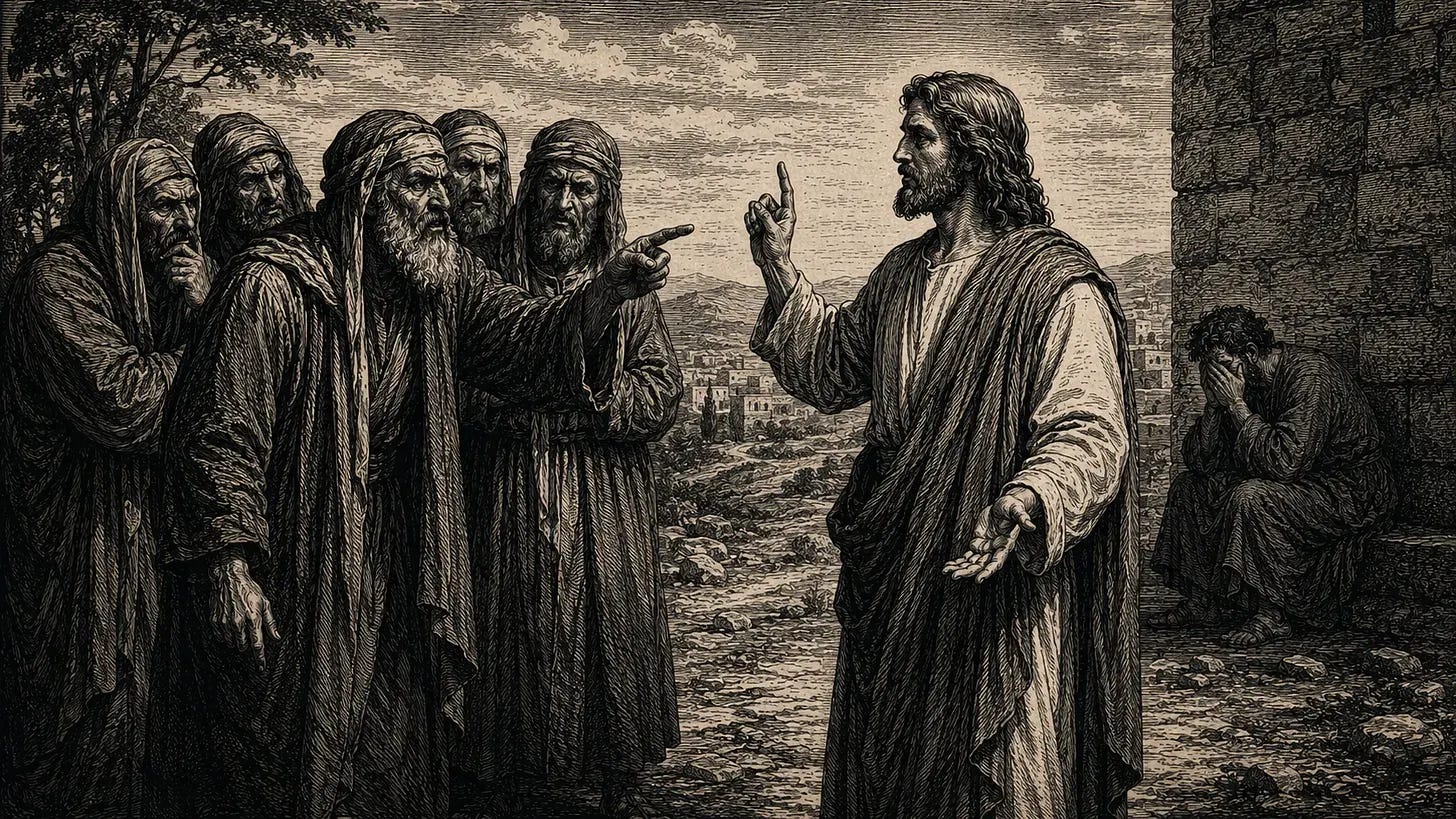
Second, the scribes down from Jerusalem. These are not confused outsiders. These are the most theologically trained men alive. They look at a healed man standing in front of them and say Jesus is doing it by the power of Satan.
Then Mark closes the whole thing out. Jesus’s family shows up asking for him, and he looks around at the people sitting there and says, “Whoever does God’s will is my brother and sister and mother” (Mark 3:35).
So: same man, same evidence, two very different responses. One group is confused and worried and loves him anyway. The other is certain and hostile. And when Jesus draws the circle of who’s family at the end, it’s not the certain ones who end up inside.
Confused affection turns out to be closer to belonging than confident certainty is.
That’s what should bother us about the scribes. They didn’t miss Jesus because they didn’t know the Scriptures. They missed him because they did.
The knowledge was the thing in the way. They had a system. The system worked, it had worked for a long time, and they were good at it. Jesus didn’t fit the system. So Jesus had to be the problem.
That’s the person Jesus is warning. Not the skeptic. Not the person up at 2 a.m. terrified of a thought. The expert. The one with the credentials and the answers and the seat down front.
Look at the text. Jesus never tells those scribes they’ve done it. There’s no verdict handed down, no line drawn behind them. He says whoever blasphemes against the Holy Spirit… Third person, spoken as a warning, to men standing right in front of him who still have road left.
He’s not describing people who are finished. He’s describing a direction, to people still walking it.
Which means this passage was never a checklist for auditing your past. It’s a warning about a trajectory. And a trajectory doesn’t feel like anything while you’re on it. That’s the whole problem.
If the danger is a direction and not a moment, the useful question isn’t what did I do. It’s which way am I facing. Those are very different questions, and only one of them can actually be answered.
There’s a way to be around Jesus for twenty years and slowly stop needing him. You learn the language. You get good at church. You develop opinions about the music and takes on other people’s theology. And somewhere in there the thing that started out desperate turns competent. You’re not rebelling. You’re not even doubting. You’re fine.
The scribes didn’t get where they were overnight. Nobody wakes up one morning and decides to randomly reject God. They got there through a long series of small, defensible choices, position over evidence, comfort over disruption, being right over being changed. Every one of those was probably justifiable in the moment. None of them felt like a turn.
So the diagnostic isn’t a checklist. It’s a couple of questions I have to keep asking myself:
When did I last come to God actually needing mercy — not out of habit, but because I needed it?
When somebody says something true about me, is my first move to receive it or to explain it?
If everything I do for God disappeared tomorrow, would I still know he was for me?
Every other religion on earth runs on the same engine: perform well enough and God accepts you. The gospel runs backwards. You’re accepted first, by grace you couldn’t earn on your best day, and everything else follows from that. You can sit in a Bible-teaching church your entire life, agree with every word of that, and still be running the old engine underneath.
Almost certainly not. And I don’t want to ground that in how tender your heart feels, because your heart lies to you and mine does too.
Ground it here instead.
Look at who didn’t commit this. Paul called himself “a blasphemer and a persecutor and a violent man” — his words, 1 Timothy 1:13 — and says plainly that he was shown mercy. Peter denied Jesus out loud, three times, and got breakfast on a beach. Jesus’s own family thought he was insane, and his brother James ends up leading the church in Jerusalem. If informed hostility toward God were the line, those men were over it. They weren’t.
And then look at the cross. When they finally got Jesus in front of the council, the charge they convicted him on was blasphemy. Mark 14:64 — “They all condemned him as worthy of death.” The one sin with no remedy in the law is the sin they killed him for.
He took the charge. The sin with no sacrifice got a sacrifice.
So when Jesus opens with every kind of sin and slander can be forgiven, that’s not optimism. That’s a bill he’s about to pay in full. Your assurance doesn’t rest on whether you’re the kind of person who worries about this. It rests on what he already did about it.
The unforgivable sin isn’t the one you’re afraid of. It’s the one you’d never think to be afraid of.
Now, for some of you, this isn’t a theology problem anymore. You already know everything I just said. You could teach it. It just doesn’t stick… The fear comes back on schedule no matter what’s true. That’s not weak faith. That’s anxiety. And it responds to care, not to more information. Say it to somebody. A pastor, a counselor, a friend who won’t flinch. This particular fear only survives in the dark.
Here’s what I want you to walk out with.
This sin isn’t unforgivable because God slams a door. It’s unforgivable because a person stops walking toward it. Forgiveness doesn’t run out, it gets refused, and eventually stops being wanted at all. That’s not a God scanning the horizon for a reason to shut you out. That’s a God who led with every kind of sin and slander can be forgiven before he said anything else, and then went to a cross to make it true.
So if you’ve been carrying this at night, quit auditing your memory. It won’t tell you anything, and it was never the test.
Just come get mercy. That’s the whole move. You came in asking whether you’re too far gone. The fact that you want him at all is the answer and the reason you can have him has nothing to do with you.
If you can still be nervous, you can still come.
Paid subscribers get a second post every Thursday focused on what Scripture actually means for how you live. $6 a month or $54 a year — both go up August 1. Lock in the lower price now.
If this was helpful, pass it along to someone who might need it.
No posts
Comments
Nothing yet. Say the first thing.
Sign in to join the conversation.