
On August 4, 1794, Supreme Court Justice James Wilson determined that federal law could no longer be enforced in parts of western Pennsylvania. That finding gave President George Washington the legal authority to call out the militia under the Militia Act of 1792.
The issue was Alexander Hamilton’s excise tax on distilled spirits, enacted three years earlier. It was the first internal tax imposed by the new federal government, and on paper it looked manageable. Whiskey was widely consumed, distillers could be identified, and taxing alcohol could be defended as both a source of revenue and a charge on a nonessential product.
But whiskey was not merely a drink in western Pennsylvania.
For farmers living far from the major markets of the East, grain was difficult and expensive to move. Roads were poor. Cash was scarce. Rye and corn could spoil, and wagonloads of grain were bulky. Distilling that grain into whiskey made it easier to store, transport, sell, and trade.
In some communities, whiskey functioned almost like money.
So when the federal government taxed distilled spirits, frontier farmers did not see it as a narrow tax on alcohol. They saw it as a tax on the way their local economy worked, and on their ability to survive within it.
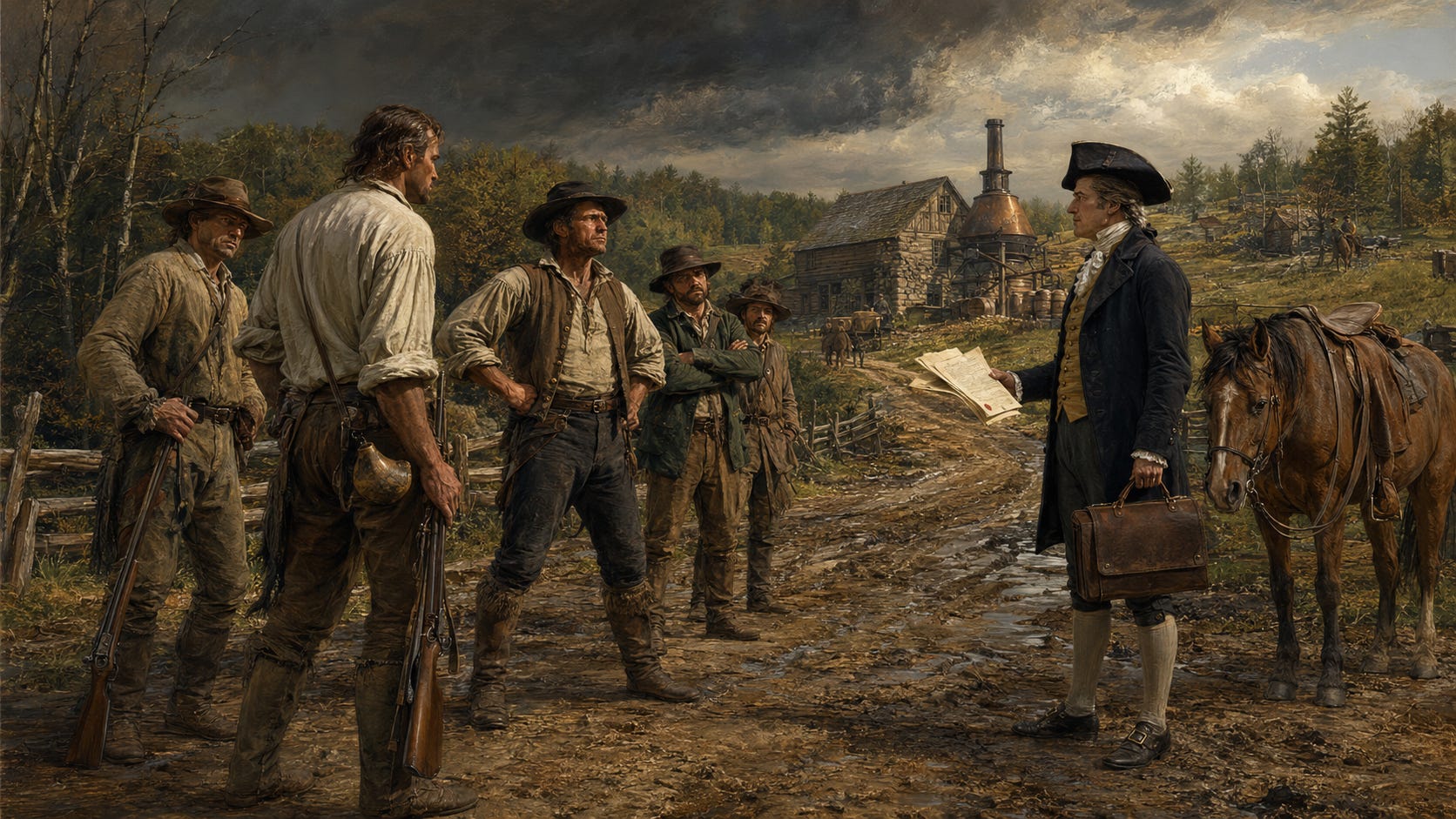
The Tax Behind the Revolt
Hamilton needed revenue. The federal government had assumed substantial debts after the Revolution, and he wanted to establish the financial credibility of the new nation. An excise tax on whiskey was part of that larger plan.
The burden, however, did not fall evenly.
Large eastern distillers could pay the tax more efficiently and absorb it across greater production. Small western producers, many of whom distilled only part of their harvest, felt the cost much more directly. They also resented the requirement to register with federal officials and, in some cases, travel long distances to resolve disputes in federal court.
To them, the tax looked familiar in the worst possible way: a distant government imposing costs without understanding local conditions.
Resistance began with refusal. It moved to intimidation. Tax collectors were threatened, attacked, tarred, and feathered. Federal mail was intercepted. Armed groups gathered near Pittsburgh beneath liberty poles, borrowing the symbols and language of the Revolution.
Only this time, the government they were resisting was their own.
Washington’s Decision
Washington first attempted negotiation. He also issued a proclamation calling on the resistance to end.
When that failed, he made a decision no president had made before: he mobilized a militia force of roughly 13,000 men and sent it toward western Pennsylvania.
Washington accompanied the troops for part of the march, becoming the only sitting president to take the field with an army raised to enforce federal law. By the time the force reached the region, organized resistance had largely collapsed. Most of the leaders had fled, and there was no major battle.
Two men were eventually convicted of treason. Washington pardoned both.
The military campaign produced little fighting, but that was not the point. The government had demonstrated that federal laws could not be nullified simply because a region considered them unfair.
The message was clear: the new government had the authority to tax, and it was prepared to enforce that authority.
Why It Still Matters
The Whiskey Rebellion is often described as America’s first tax revolt after independence. It was also one of the country’s first arguments over the uneven effects of national economic policy.
Hamilton saw the tax as a reasonable way to raise revenue and strengthen the government’s finances. Western farmers saw the same tax as evidence that national policy was being designed around eastern markets and larger commercial interests.
Both were looking at the same law. They were not experiencing the same burden.
That tension has never disappeared. Taxes do more than raise money. They shape incentives, reward some forms of economic activity, discourage others, and distribute costs across regions, industries, and households.
The whiskey tax remained in place until 1802, when President Thomas Jefferson signed its repeal.
The argument behind it was, who should pay, what should be taxed, and whether the burden is fairly shared continued.
Did You Know?
George Washington later became one of the largest whiskey producers in the United States.
His Mount Vernon distillery began operating in 1797 under the direction of his farm manager, James Anderson. At its peak, it produced roughly 11,000 gallons of whiskey a year, making it one of the most productive distilleries in the country.
So the president who sent troops to enforce the whiskey tax eventually became a major participant in the industry being taxed.
The restored distillery at Mount Vernon operates today as a working historical site, producing rye whiskey using methods based on those of the eighteenth century.
No posts
Comments
Nothing yet. Say the first thing.
Sign in to join the conversation.