
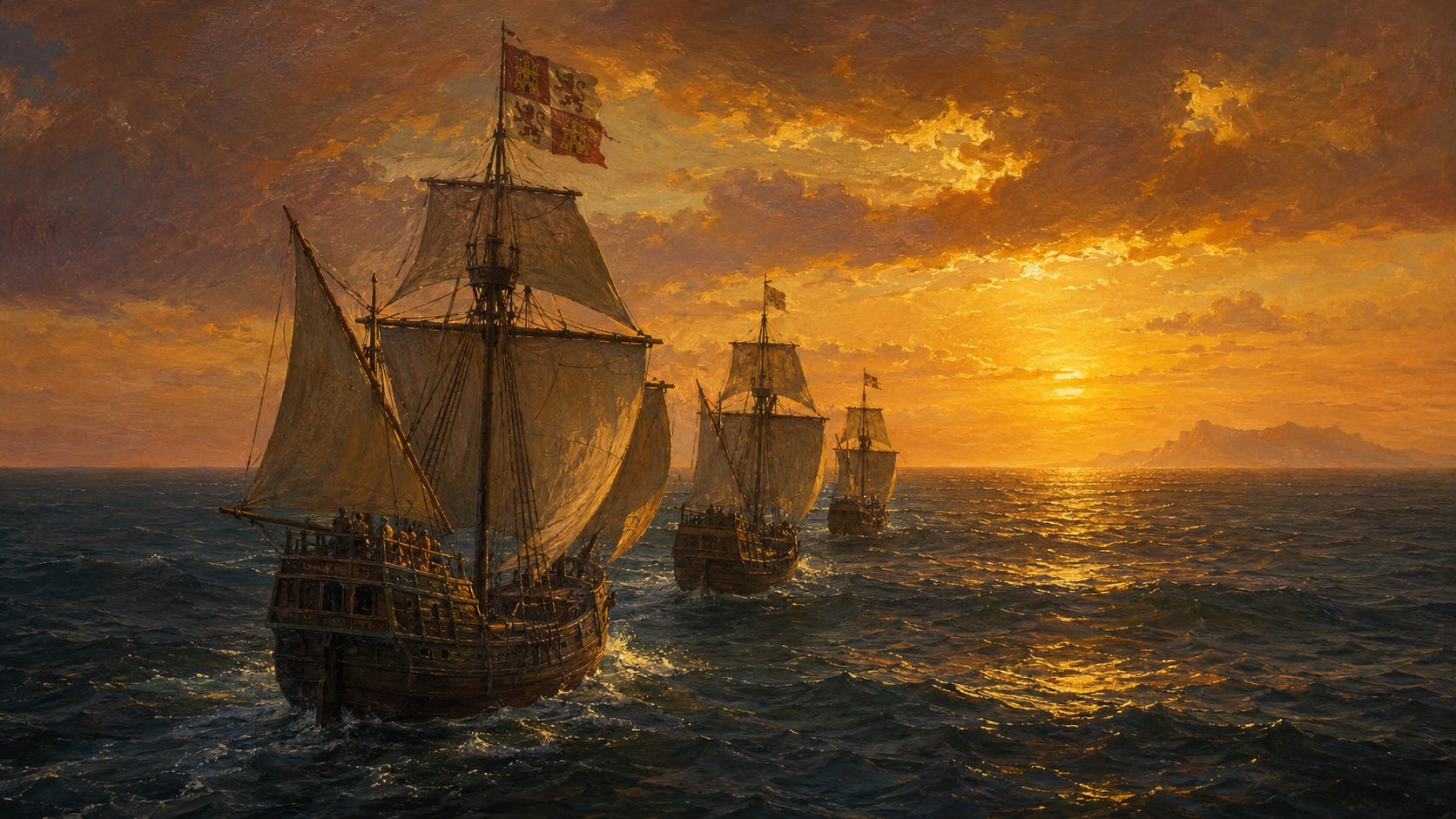
On August 3, 1492, Christopher Columbus sailed from Palos, Spain, with three ships—the Niña, the Pinta, and the Santa María - and a crew of roughly ninety men. His assignment was commercial: reach the spice markets of Asia by sailing west.
Spain’s interest was not driven by curiosity alone. Portugal had spent decades building a route around Africa and toward the Indian Ocean, giving it a powerful advantage in the trade for pepper, cinnamon, cloves, nutmeg, and other high-value goods. Spain needed another way into those markets. Columbus proposed one. Sail west long enough, he argued, and east would eventually appear.
The logic was sound. His calculation of the distance was not. More importantly, he had no idea that two continents stood between Europe and Asia.
The Commercial Calculus.
The Age of Exploration is often told as a story of courage, discovery, and national ambition. It was also a fight over trade.
Ocean routes determined who could reach valuable goods, who controlled their movement, and who captured the profit along the way. Portugal’s growing command of the African route threatened to leave Spain commercially boxed out. Funding Columbus was therefore less an act of adventure than a competitive investment.
Ferdinand and Isabella expected a return. They wanted access to markets, sources of wealth, territorial claims, and converts. Columbus, in turn, negotiated titles, authority, and a share of whatever riches the voyage produced.
That arrangement would become familiar. Many later expeditions combined royal protection, private ambition, religious justification, and an expectation of commercial gain. Exploration was not separate from enterprise. It was one of its most aggressive forms.
What It Unleashed.
Columbus did not reach Asia, but his voyages helped turn the Atlantic into a permanent commercial corridor.
What followed is now called the Columbian Exchange: the movement of plants, animals, diseases, technologies, and people between the Eastern and Western Hemispheres. Potatoes, tomatoes, maize, cacao, and tobacco traveled east. Horses, cattle, wheat, sugar, and devastating diseases traveled west.
The effects were enormous, and they were anything but equal.
The exchange transformed diets, agriculture, populations, labor systems, and patterns of settlement across the world. It also accelerated conquest, dispossession, forced labor, and the destruction of Indigenous societies. The Atlantic economy that emerged would become inseparable from the transatlantic slave trade, one of the most brutal commercial systems ever created.
The same ocean network that moved crops and commodities also moved human beings as cargo.
Where It Stands Now
The commercial principle behind Columbus’s voyage remains recognizable: distance is expensive, routes create power, and whoever controls the movement of goods can often control the margin.
The technology has changed. The scale has changed. The logic has not.
The Panama Canal, the Suez Canal, the Strait of Malacca, the shipping lanes of the South China Sea, and the port infrastructure of every major trading nation all reflect the same basic calculation. Find the faster route. Reduce the cost. Secure access before a competitor does.
Columbus failed at the mission he was given. He did not find a western route to Asia. Instead, his voyage set in motion the creation of an Atlantic commercial system that would become larger, richer, and far more consequential than the one he had been sent to reach.
Did You Know?
Columbus made four voyages across the Atlantic and died in 1506 still insisting that he had reached the outer regions of Asia.
It was Amerigo Vespucci, a Florentine navigator and writer, who argued that the lands across the Atlantic were not part of Asia at all, but a previously unknown continent—a “New World” from the European perspective.
In 1507, the German cartographer Martin Waldseemüller placed the name “America” on a map in Vespucci’s honor.
Columbus got the holiday. Vespucci got the continent.
No posts
Comments
Nothing yet. Say the first thing.
Sign in to join the conversation.