
Ice dance is the only sport that demands the skating skills of an athlete, the training of a ballroom dancer, and the emotional range of an actor — all in the same four minutes
If you prefer to listen to this post, please click on Play below:
0:00
-16:30
While the Michigan training centers provided the technical foundation, it was the skaters themselves who transformed that base into something unforgettable. What made the American and Canadian champions special wasn’t simply their mastery of technique — it was the way they infused that technique with personality, musicality, and a distinctly Western sense of storytelling. Where the Soviet system prized discipline, power, and uniformity, the North Americans brought warmth, individuality, and emotional intelligence. They didn’t just skate programs; they created characters, moods, and narratives. They made ice dance feel human.
What all of these teams shared was something the Soviet system, for all its rigor, never prioritized: individuality. They skated as themselves, not as products of a system. Their programs reflected their personalities, their relationships, their artistic instincts. And woven through all of this is the unmistakable influence of Torvill and Dean — the first Western team to prove that artistry, musicality, and emotional storytelling could rival Soviet precision. Their playful, dramatic, romantic, and inventive approach runs like a thread through every North American champion who followed.
Before the North American champions reshaped ice dance, there was a pair who showed the world what skating could be. Jayne Torvill and Christopher Dean were the bridge — the team that carried ice dance from the rigid, technically driven Soviet era into a new realm of emotion, musicality, and storytelling. They didn’t just skate programs; they created experiences. And nothing captured that transformation more powerfully than Boléro.
As a piece of music, Boléro is deceptively simple: a single theme repeated over and over, building in intensity. It isn’t an obvious choice for skating — no clear phrasing, no easy accents, no natural breaks. But Christopher Dean saw something in it. He choreographed a program that turned repetition into seduction, restraint into tension, and musical simplicity into emotional fire. In a recent interview, he admitted the music was fourteen seconds too long for competition, but the timing didn’t start until the blades moved — so he and Jayne swayed on the ice, burning those seconds away. That stillness became iconic. And when they finally began to skate, the entire arena held its breath as the program built and built toward its hypnotic crescendo.
Boléro was only the tip of the iceberg. Torvill and Dean spent their entire career proving that ice dance could be dramatic, playful, romantic, comedic, avant‑garde — that it could be anything the music demanded. Their range was astonishing. And because Christopher Dean was such a gifted choreographer, other skaters sought him out. Michelle Kwan famously attempted her own interpretation of Boléro, a testament to how deeply this program had embedded itself in skating’s artistic DNA.
Prior to Torvill and Dean, the man in the dance was a more passive skater, but Christopher’s choreography made him a true partner, with more interesting steps and actions. This was another contribution to the sport moving forward. As commentator Peggy Fleming stated, your eyes were drawn to Chris as much as Jayne.
Watch the Original Dance from the 1984 Olympics:
This is why Torvill and Dean matter so much to the story of North American ice dance. They showed that emotion and narrative could stand shoulder‑to‑shoulder with technique. They proved that artistry wasn’t a luxury — it was a competitive weapon. And every champion team that followed, from Belbin and Agosto to Chock and Bates, carried a piece of that legacy with them.
They were the bridge. And once they crossed it, the sport was never the same.
Just for Fun, watch one of my favorites: Cecelia
If Torvill and Dean opened the artistic door, Belbin and Agosto were the first Americans to walk through it.
Although the United States had produced some talented ice dancers over the years, climbing into the top ranks remained an uphill battle. The Soviet teams dominated the discipline with a depth and consistency that seemed impossible to crack. When the Russian coaches arrived in North America, the landscape began to shift. And the first American team to truly break through that ceiling was Tanith Belbin and Ben Agosto.
Tanith, originally from Canada, had competed in both ice dance and pairs in her home country. When her career stalled and the opportunities she hoped for didn’t materialize, she made a bold decision: in 1998 she moved to Michigan to train with Igor Shpilband. He paired her with American skater Ben Agosto, and together they created a spark that the U.S. had been waiting decades to see. Their chemistry was immediate, their style fresh, and their programs lit up the ice.
But there was a problem — a bureaucratic one. To compete internationally as a U.S. team, especially at the Olympics, Tanith needed American citizenship. Although she and Ben qualified for the 2002 Olympics, they were unable to compete. Over the next few years, they won four U.S. Championships and earned a World silver medal, building a passionate fan base who believed they deserved their shot on the Olympic stage. Those fans petitioned Congress to grant Tanith expedited citizenship, and in a rare move, Congress agreed.
If this sounds familiar, it should — the 2026 U.S. Championships saw a similar situation when the top American pairs team was unable to compete at the Olympics due to citizenship timing. But for Tanith and Ben, the story had a happier ending. At the 2006 Winter Olympics, skating a program choreographed by Tanith herself, they won the silver medal — the first Olympic ice dance medal for the United States since 1976.
Their success marked the beginning of the North American rise in ice dance. They were the first to prove that American teams could not only compete with the Russians but stand beside them on the podium. And once that door opened, the teams who followed would push it wide.
Watch Belbin and Agosto in their silver medal free dance at Torino in 2006:
Belbin and Agosto didn’t just win medals — they changed the perception of what was possible for American ice dance. Before them, U.S. teams often felt like outsiders looking in, technically solid but stylistically overshadowed. Then Tanith and Ben arrived with something completely different: a fresh, theatrical, charismatic style that made audiences fall in love with them instantly. They were fun. They were expressive. They were modern. And they were skating programs that felt like they belonged to them, not to a system.
From the stands — and from the armchair — they were irresistible. Fans didn’t just support them; they adored them. They made ice dance feel exciting in the U.S. in a way it hadn’t since the 1970s.
And skaters noticed.
After their rise, more teams began relocating to Michigan, drawn by the combination of Soviet‑trained coaching, a growing critical mass of elite teams, and the proof that this environment could produce world‑class results. Belbin and Agosto were the catalyst — the first spark that showed North American skaters that the podium wasn’t a fantasy. It was a path.
Their success didn’t just lift the U.S. in the standings. It lifted the ambition of an entire generation.
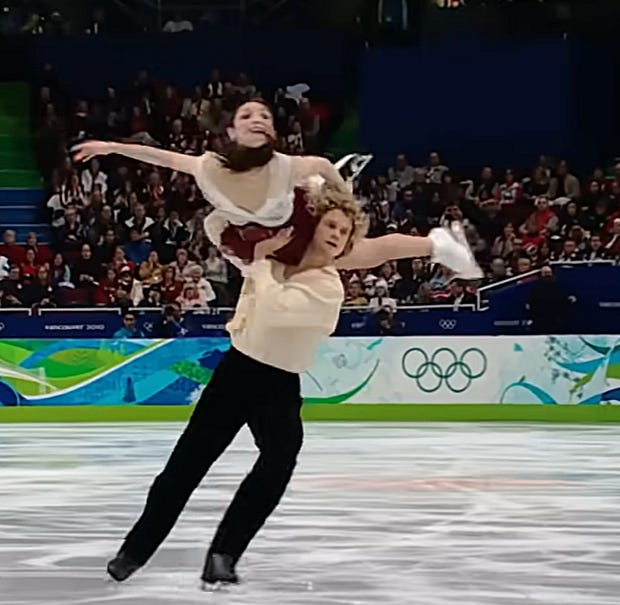
When Meryl Davis and Charlie White first appeared on the scene, they didn’t immediately project the aura of future Olympic champions. Meryl, with her shy demeanor and soft, almost childlike voice, seemed like the quieter half of the partnership, while Charlie appeared to be the one steering the ship. But that impression didn’t last. As the seasons passed — and especially once she appeared on Dancing with the Stars — it became clear that Meryl was the power core of the team.
Beneath her gentle exterior was a fierce, disciplined, relentlessly driven athlete whose strength and precision shaped the team’s identity. Together, she and Charlie developed a style that blended technical ferocity with sweeping, cinematic movement, skating with a speed and stamina that felt uniquely American. And all the while, they were training shoulder‑to‑shoulder with Virtue and Moir, the Canadian team whose emotional depth and romantic realism provided the perfect counterweight. Their rivalry wasn’t just competitive; it was catalytic, pushing both teams to heights neither might have reached alone.
When Meryl Davis went on Dancing with the Stars, her partnership with Maxim Chmerkovskiy raised the dancing to a whole new level. Meryl joked that the hardest part of Dancing with the Stars was trading blades for high heels. After that, her lightning‑fast choreography skills carried her straight to the Mirror Ball.
Watch Davis and White at the 2014 Olympics in Sochi
Where Davis and White projected a clear dynamic, Virtue and Moir were harder to pin down. For many fans, they were a cipher. Their skating was undeniably beautiful, their technique refined, their emotional expression polished to a high shine, but their personalities didn’t always break through the way other teams did. They were elegant, romantic, and controlled, but not always easy to know.
The one moment when their off‑ice voices became unmistakably loud was during the controversy surrounding Marina Zoueva. Virtue and Moir felt that Zoueva had choreographed a stronger program for Davis and White than for them, and they said so publicly. It was a striking accusation — especially because both teams trained under the same roof, with the same coach, at the same time. But the truth was more complicated. The two teams had fundamentally different styles, and Zoueva choreographed to those strengths. Davis and White thrived on speed, power, and sweeping momentum; Virtue and Moir excelled in softness, nuance, and emotional realism. Their programs weren’t weaker — they were simply different. And the difference wasn’t a flaw. It was the essence of who they were.
Virtue and Moir’s skating always leaned closer to the Russian tradition: deep edges, classical lines, and a romantic sensibility that felt timeless rather than modern. Their programs were technically demanding and emotionally rich, but they weren’t always as innovative or boundary‑pushing as Davis and White’s. Instead, they specialized in refinement — in making every moment look effortless, every transition seamless, every gesture meaningful. They were the heartbeat to Davis and White’s engine, the lyricism to their athleticism.
And that contrast — that tension between two equally brilliant but fundamentally different visions of ice dance — is what made their rivalry unforgettable.
Watch Virtue and Moir at the Olympics in Pyeong Chang 2018 Olympics:
And the Michigan story didn’t end with those two teams. Maia and Alex Shibutani — the ShibSibs — were also part of this extraordinary training group. Their musicality, precision, and sibling synchronicity added yet another dimension to the rink’s atmosphere. Imagine it: three future Olympic medalist teams, all sharing the same ice, all learning from the same coaches, all pushing each other simply by being in the room, elevating the whole culture.
Watch the Shib Sibs show off their Twizzles at Pyeong Chang in 2018:
This was the Michigan miracle at its peak — a cluster of talent so dense that excellence became the baseline. And from that environment emerged some of the most iconic programs, rivalries, and moments in ice dance history.
By the time Madison Chock and Evan Bates reached the current Olympic cycle, their competitive record spoke for itself. Few teams in the history of U.S. ice dance — or global ice dance — have demonstrated such sustained excellence across so many seasons. Their list of titles reads like a map of their evolution: early breakthroughs, mid‑career reinvention, and a late‑career dominance that cemented their place among the greats.
They earned Olympic gold medals in the 2022 and 2026 Winter Olympics as part of the U.S. team event, and added an Olympic silver medal in the 2026 individual event, a testament to their longevity and their ability to peak when it mattered most.
Watch Chock and Bates at the 2026 Turin Olympics:
Their World Championship record is equally impressive: three consecutive World titles in 2023, 2024, and 2025, each one showcasing a different facet of their artistry and technical mastery. They also claimed three Grand Prix Final titles, proving their consistency against the strongest fields of each year.
Their success at the Four Continents Championships marked the early and middle stages of their rise, while their dominance at the U.S. National Championships tells the story of a team that refused to fade. They won national titles seven times, spanning more than a decade of elite performance.
Taken together, these achievements place Chock and Bates among the most decorated ice dancers in American history. They are tied for the most Olympic medals ever won by a U.S. skater, and their influence on the sport — through their creativity, longevity, and willingness to reinvent themselves — has shaped an entire generation of American ice dance.
This brings us to the end of this chapter in the story of North American ice dance — a journey shaped by breakthroughs, rivalries, reinventions, and the steady rise of skaters who refused to accept the limits of the past. From Belbin and Agosto’s spark to Chock and Bates’ sustained brilliance, the sport has grown into something richer, deeper, and more globally connected than ever before. And as new teams step forward — from Canada, from France, from the former Soviet bloc, and from right here in the U.S. — the momentum continues.
But ice dance is only one thread in the tapestry of American figure skating. To understand the full picture, we must turn to the skater who defined an era, inspired a generation, and still stands in many eyes as the greatest of all time.
In the next installment, we shift from the rise of ice dance to the woman who became the emotional and artistic center of American skating for more than a decade. Michelle Kwan remains, for countless fans, the GOAT — the most influential and beloved skater since Sonja Henie, competing in a sport that had grown far beyond anything Henie ever imagined. Her longevity, her artistry, her competitive fire, and her cultural impact shaped not just U.S. skating, but the global landscape.
Again, I thank everyone, including the Olympics, for uploading these performances on YouTube so we can all enjoy them.
No posts
Comments
Nothing yet. Say the first thing.
Sign in to join the conversation.