
‘Skating has given me so much that it’s priceless.’ – Michelle Kwan
To listen to this post, please click on the play button below:
0:00
-17:21
The Night Everything Came Together — and Came Apart
In Nagano, Michelle Kwan skated the long program of her life. Lyra Angelica was pure poetry — polished, mature, emotionally resonant, and technically clean. It was the kind of performance that stays with you for decades. But Frank Carroll, ever the realist, had warned her: “You have to attack.” Michelle skated beautifully, flawlessly, but she didn’t skate with the aggressive urgency the judges were looking for.
Tara Lipinski, meanwhile, attacked with everything she had. Her jumps were sharp, her triple–triple was clean, and she skated with a fearless momentum that judges couldn’t ignore. It was youthful brilliance at its peak.
And in the end, the judges rewarded the technical difficulty.
Tara won the gold.
Michelle won the silver.
And an entire generation felt their hearts crack just a little.
Watch “Lyra Angelica” at Nagano
Two Paths After Nagano
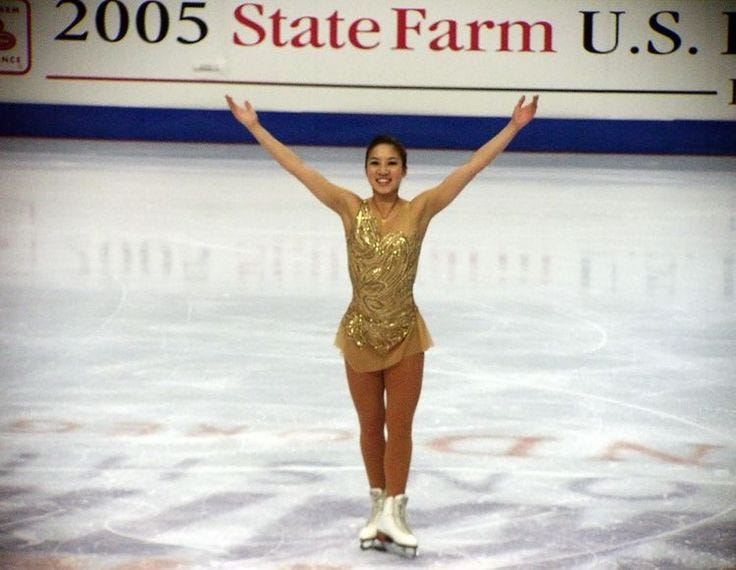
Michelle stayed in the sport, deepening her artistry and becoming the standard by which all future skaters would be measured. She continued to tour, to compete, to evolve — and every time you saw her live, she delivered that same quiet magic. She didn’t just skate programs; she skated stories.
Tara took her medal and stepped into the professional world, skating for a few years before hip problems forced her to retire. Her competitive career was short, brilliant, and intense — a burst of light that faded quickly.
For many fans — and for me — Michelle was the true heart of that Olympics. She was more polished, more mature, more artistically complete. And under the 6.0 judging system, the long program wasn’t supposed to be a jump contest. It was judged on artistry — musicality, interpretation, edge quality, choreography, emotional expression. That’s why the scoring in Nagano stung so deeply for so many of us. Tara skated brilliantly and deserved full credit for her technical difficulty, but her artistry simply wasn’t on Michelle’s level. Yet the judges scored their presentation marks almost identically. To fans who understood the nuances of skating — the edges, the phrasing, the transitions, the emotional depth — it felt like the system had failed the very skater it was designed to reward.
Michelle didn’t lose because she faltered. She lost because she skated like an artist, and Tara skated like a comet. Still, in the long arc of skating history, Michelle’s legacy has only grown. She became the emotional center of the sport — the skater whose programs are still studied, still remembered, still felt.
Tara won the gold.
Michelle won the era.
Before she became the defining skater of her generation, Michelle had already lived through one of the most unusual experiences in American skating history. In 1994, at just 13, she finished second at the U.S. Championships — behind Tonya Harding — and was named the alternate for the Lillehammer Olympics. It’s the only time the U.S. has ever sent an alternate to the Games.
Michelle never stepped onto Olympic ice, but she absorbed everything. She watched practices, studied the tension of the Harding–Kerrigan saga, and saw firsthand what the Olympic spotlight could do to a skater. It was a quiet education, but a profound one.
Years later, she would say Lillehammer taught her what pressure felt like — and what kind of skater she wanted to become.
Michelle’s drive was unmistakable even as a child. In one of the most charming stories of her early career, she took her senior‑level tests without telling her coach, Frank Carroll. She simply decided she was ready — and passed. Frank was stunned, but he also recognized what it meant: Michelle wasn’t just talented. She was determined, self‑directed, and fearless.
That independence would become one of her defining traits.
Michelle was already a gifted skater when she began working with choreographer Lori Nichol, but Lori unlocked something deeper — the emotional resonance that would become Michelle’s signature. Under Lori’s guidance, Michelle’s skating gained a richer musicality, more nuanced phrasing, deeper emotional expression, and transitions that flowed like breath. Her programs became living stories.
This was the birth of the Michelle Kwan the world remembers — the skater who could make an arena fall silent with a single edge, who could turn a spiral into a moment of pure poetry, who could make you feel something every time she stepped onto the ice.
Watch Michelle at the 1996 World Championship skate to “Salome.”
By the time she reached the 1998 Olympics, Michelle wasn’t just a competitor. She was an artist shaped by the quiet lessons of Lillehammer, the discipline of forging her own path, the emotional depth Lori Nichol helped her discover, and the maturity that came from skating beyond her age. All of this made Lyra Angelica so unforgettable. It wasn’t just a program. It was the culmination of everything she had lived, learned, and become.
Michelle skating to East of Eden in 2001 at Worlds. She skated to this music four different times with different programs.
Salt Lake City was supposed to be Michelle’s redemption. She skated beautifully in the short program, leading the field. But in the long program, a rare mistake on the triple flip opened the door for the unexpected.
Sarah Hughes, just sixteen, delivered the performance of her life — fearless, joyful, packed with technical difficulty. She soared from fourth to first, winning the gold in one of the most stunning upsets in Olympic history.
Irina Slutskaya, Michelle’s longtime rival and friend, took the silver. Their rivalry was fierce, but their friendship was real — a bond forged through shared pressure and mutual respect.
Michelle won the bronze. Not the medal she wanted, but a medal earned with grace.
Watch Michelle’s Gala skate at Salt Lake City in 2002. One of my favorites and a bit bittersweet to “Fields of Gold.”
After Salt Lake City, Michelle continued to compete, adapting to the new judging system that emerged after the 2002 pairs scandal. The revised system required more transitions, turns, and intricate skating movements between and into jumps — the very qualities Michelle had been doing for years. Ironically, what the sport now demanded as “new” was simply what Michelle had always done naturally. When she missed the U.S. Nationals due to injury, the Olympic Committee evaluated her privately to determine whether she could compete under the new rules. She passed without difficulty.
But her body had other plans. A lingering hip injury, combined with a groin injury in December, made training nearly impossible. In Torino, she reinjured herself during practice. She couldn’t do it — not for four minutes, not for the program she needed to skate to win. And Michelle Kwan was never a skater who showed up just to be there.
She withdrew — one of the hardest decisions of her life — stepping aside with dignity, knowing that competing injured would not honor the sport she loved.
Michelle never won Olympic gold. But she won something far more enduring. She became the emotional center of an entire era. She inspired skaters across the world. She set the standard for artistry, musicality, and emotional depth. She made audiences feel something every time she stepped onto the ice.
Her legacy isn’t a medal.
It’s a feeling.
A memory.
A quiet glide on deep edges that still echoes decades later.
‘Winning is not about how many medals you get—it’s about accomplishing goals and just being the best you can be!’ – Michelle Kwan
I had the joy of seeing Michelle skate her Pocahontas program live with the Tour of World Figure Skating Champions, and it remains one of the most memorable performances I’ve ever witnessed. What has always impressed me about her skating is the quality of it — the beautiful edges, the long, extended changing‑edge spirals, and the silence. With Michelle, you don’t hear the blades scraping across the ice. That quiet is the mark of deep knees, precise edges, and absolute control. Very few skaters achieve that level of refinement.
For a time, television broadcasts used an ice‑level microphone so viewers could hear the sound of the blades. With most skaters, you heard the chatter of the edge or the scrape of a rushed turn. With Michelle, there was almost nothing — just the whisper of steel on ice. It was artistry expressed through technique.
And then there was the storytelling. The way she carried the music, the way her face lit up, the way her joy radiated through the arena. Even now, when she steps onto the ice for a rare appearance, she looks like she’s in her happy place — as if skating is still the language her heart speaks most fluently.
Watch Michelle skate as Pocohontas during the tour in 1996.
Michelle Kwan never moved fully into the professional skating world. Her injuries made the high‑impact jumps impossible, but her spins, spirals, and artistry remained luminous. When she did appear — in specials, exhibitions, or rare performances — she skated with the same emotional clarity that had defined her competitive years. But her life was already expanding beyond the rink.
Shortly after Nagano, Michelle entered one of the most unique partnerships in figure skating history: a long‑term relationship with The Walt Disney Company. Disney didn’t just hire her for a commercial or a one‑off special — they made her a representative of the company, a role no other skater has ever held.
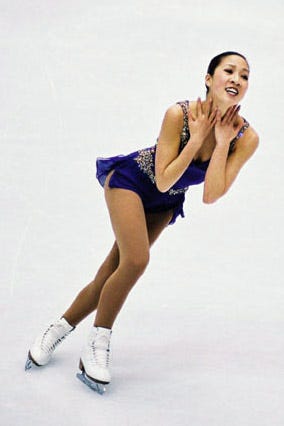
Disney saw in her what millions of fans already knew: grace, integrity, multicultural representation, and emotional storytelling. Over the next decade, she appeared in Disney‑produced skating specials — including Mulan and Pocahontas — and performed the Pocahontas program I saw live with Tour of World Figure Skating Champions. She hosted public service announcements, appeared at theme park openings, participated in charitable events, and represented Disney across their global platforms.
She wasn’t just performing. She was embodying the values Disney wanted to project to the world.
In 2006, U.S. Secretary of State Condoleezza Rice appointed her as the first American Public Diplomacy Envoy, a role created specifically for her. Michelle traveled the world meeting with young people, athletes, and cultural leaders, using her global recognition to promote American values and cross‑cultural understanding.
She built the academic foundation to support this work, earning a B.A. in international relations from the University of Denver and an M.A. from the Fletcher School of Law and Diplomacy at Tufts University. Her work deepened during the Obama administration, where she served as a Senior Advisor at the Bureau of Educational and Cultural Affairs and later as an Advisor to the Office of Global Women’s Issues. Fluent in Cantonese, she became a bridge between cultures in a way few athletes ever have.
In 2022, President Biden nominated her as the U.S. Ambassador to Belize, making her the first Asian‑American woman to hold the post. She served until 2025, continuing her long commitment to diplomacy, education, and international cooperation.

Michelle Kwan’s story is often framed as “the greatest skater never to win Olympic gold.” But that framing misses the truth. Her life is a testament to something far more powerful.
She didn’t peak at seventeen.
She didn’t fade after the medals.
She didn’t cling to the past.
She grew.
She became a symbol of artistry, integrity, and emotional depth in skating — and then she became a symbol of service, education, and global citizenship beyond it.
And that is why many — myself included — still consider her the GOAT.
Some of the greatest skaters in history never won Olympic gold. Their legacies were built on artistry, innovation, and longevity — not a single night every four years. These are the names fans still speak with reverence:
Michelle Kwan (USA) — Five‑time World Champion, nine‑time U.S. Champion, the emotional center of an era.
Kurt Browning (Canada) — Four‑time World Champion, first man to land a quad, a master technician and showman.
Mao Asada (Japan) — Triple Axel pioneer, three‑time World Champion, beloved worldwide.
Brian Orser (Canada) — Two‑time Olympic silver medalist, World Champion, later coach to multiple Olympic champions.
Elvis Stojko (Canada) — Three‑time World Champion, two‑time Olympic silver medalist, a technical trailblazer.
Midori Ito (Japan) — First woman to land a triple Axel, World Champion, Olympic silver medalist.
Carolina Kostner (Italy) — World Champion, Olympic bronze medalist, one of the most artistic skaters of the modern era.
Sasha Cohen (USA) — Olympic silver medalist, known for unmatched line, flexibility, and presence.
Stéphane Lambiel (Switzerland) — Two‑time World Champion, Olympic silver medalist, a master of spins and musicality.
Paul Wylie (USA) — Olympic silver medalist, one of the most expressive performers of his generation.
None of them needed gold to prove their greatness.
Their influence outlasted the podium.
This post is biased, of course, but I followed Michelle Kwan for many years, watching her grow as both a skater and a person. She inspired so many young girls over the years, and countless skaters point to her as the reason they first stepped onto the ice. She still has a huge fan following and an enormous amount of admiration for everything she has achieved throughout her life.
Now the mother of two little girls, Michelle is back on the ice, teaching her older daughter the basics of skating. Maybe, just maybe, we’ll see another Kwan glide her way up the ranks someday.
If you’ve enjoyed this series, please let me know. I’ll return to my usual ramblings next week.
No posts
Comments
Nothing yet. Say the first thing.
Sign in to join the conversation.