
The story of rare earth elements (REE) and the processes we employ to extract them is largely a tale of two countries: China and the U.S.
Despite the American dominance in oil and gas production over the past couple of decades – or perhaps because of this dominance – we have overlooked the highest-leverage materials of the modern high-tech economy. As we sealed our victory in the Cold War of the previous century, we sowed the seeds for our defeat in the Cold War of this century. This isn’t obvious yet, and it wasn’t even on our radar a few decades ago when we earnestly started outsourcing heavy industry to China. Sooner or later, though, it will be painfully obvious, and no trade war will fix it.
The story of REE, however, does not begin in China or the United States.
It begins in Sweden.
A miner discovered a strange new black rock in the village of Ytterby, Sweden (near Stockholm) in 1788. The chemist Johan Gadolin named this substance “yttria” (yttrium oxide, or Y2O3) in 1794 to honor its place of discovery. In addition to yttrium, three additional REE have since been named for the town: erbium, terbium, and ytterbium.
By the late 19th and early 20th centuries, REE started showing commercial promise in gas mantles, cigarette lighters, and automobile ignition devices. With a small but growing market, other countries started mining for rare earths. Early commercial REE mining centered around monazite sands in Brazil, India, and North Carolina in the 1890s and 1900s; rare earths like cerium, lanthanum, neodymium, and praseodymium came from these locations. For decades, this niche market remained niche. By the early 1930s the U.S. imported around 1,600 tons of monazite annually, mostly from what is now the state of Kerala in South India, and the global market for rare earths was probably somewhere in the thousands of tons per year.
Shortly after World War II, everything changed.
While searching for uranium in April 1949, prospectors discovered bastnaesite (a mineral containing cerium, lanthanum, neodymium, and yttrium) in the Mojave Desert of California, about 180 miles northeast of Los Angeles and 50 miles southwest of Las Vegas, Nevada. The Molybdenum Corporation of America acquired the claim to this site, called Mountain Pass, in 1950 and started production in 1952.
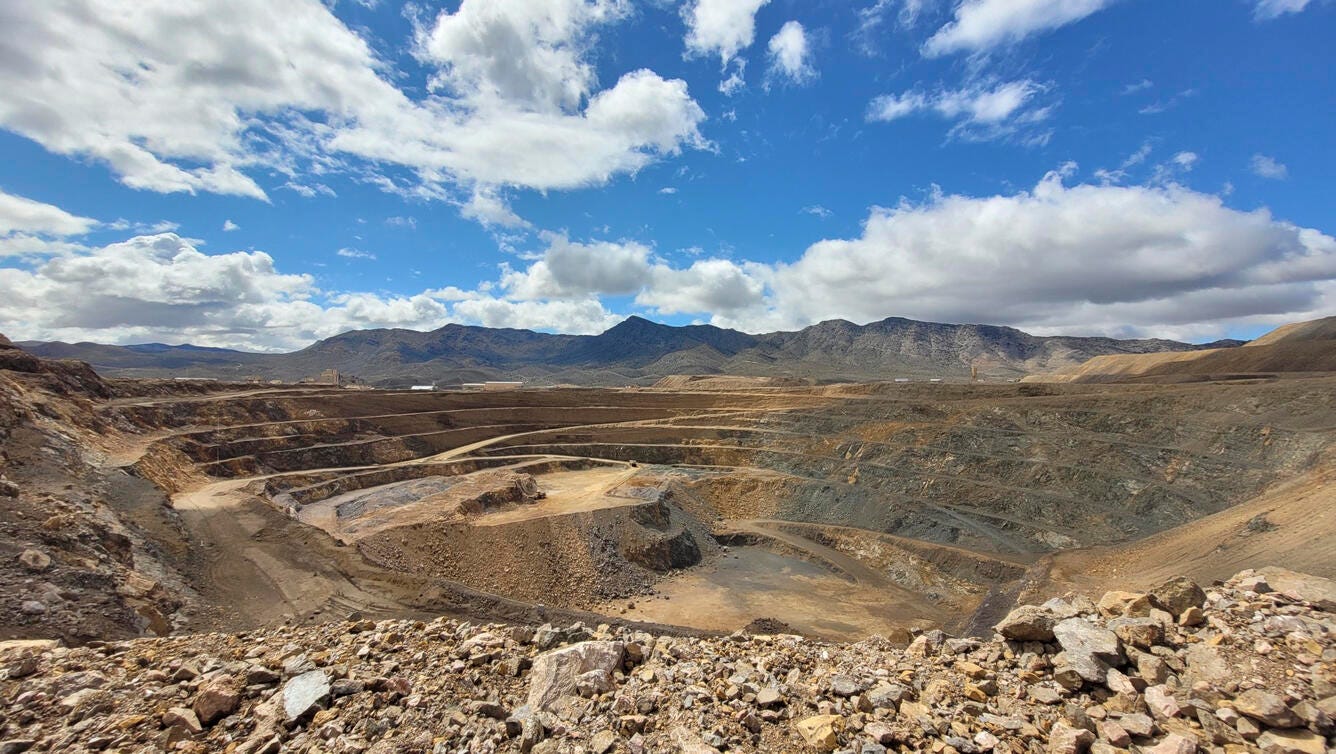
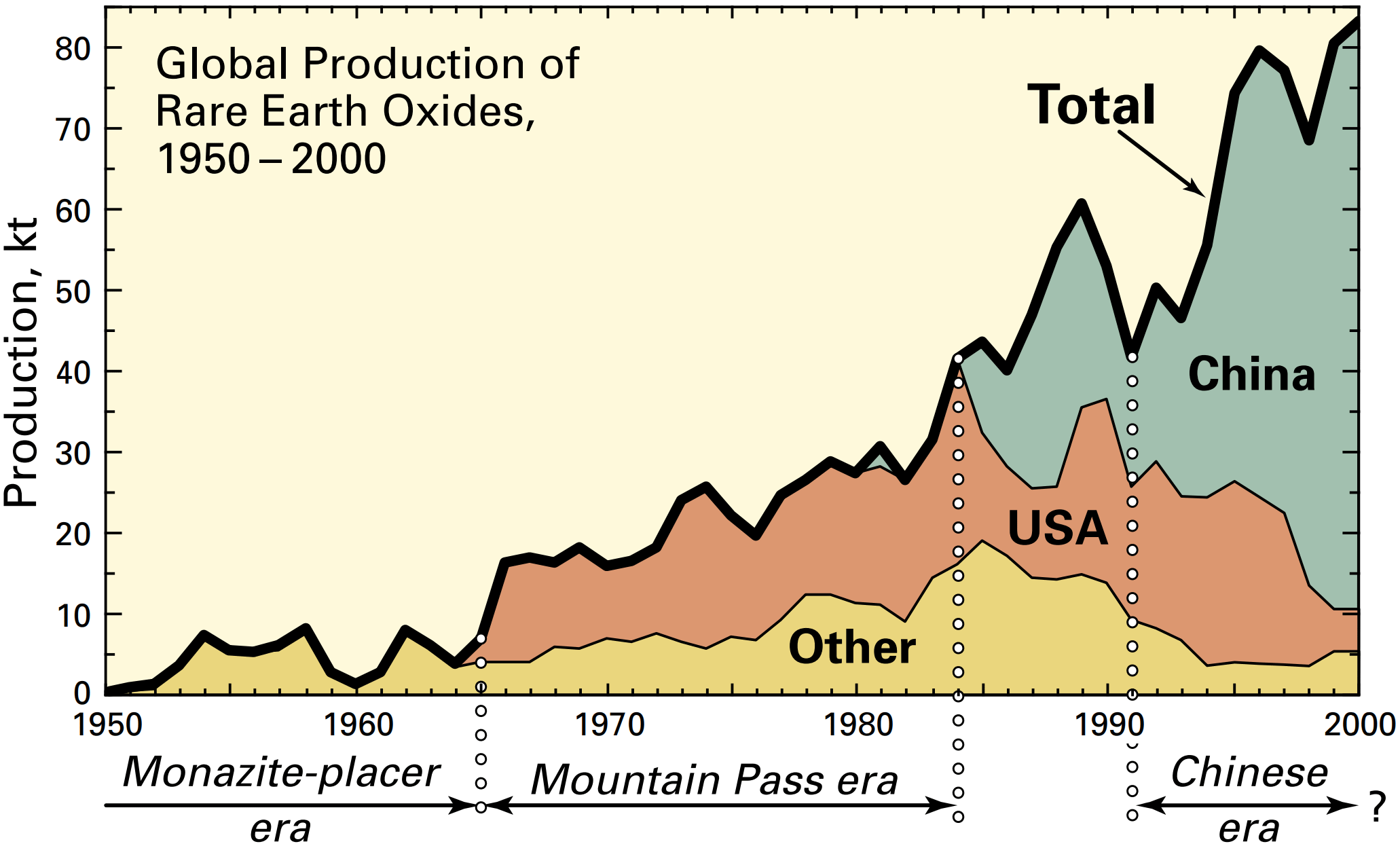
As the 50s yielded to the 60s and the 60s yielded to the 70s, the commercial applications of REE expanded exponentially, from color TV screens (europium) to strong permanent magnets (neodymium) in a variety of consumer electronics. For decades, the U.S. led the world in REE mining. Even as our dependence on energy from the Middle East became clear, we at least led global production of some niche, yet critical, minerals. It wasn’t a consolation prize, but it was at least something.
Then, in the 80s, everything changed again.
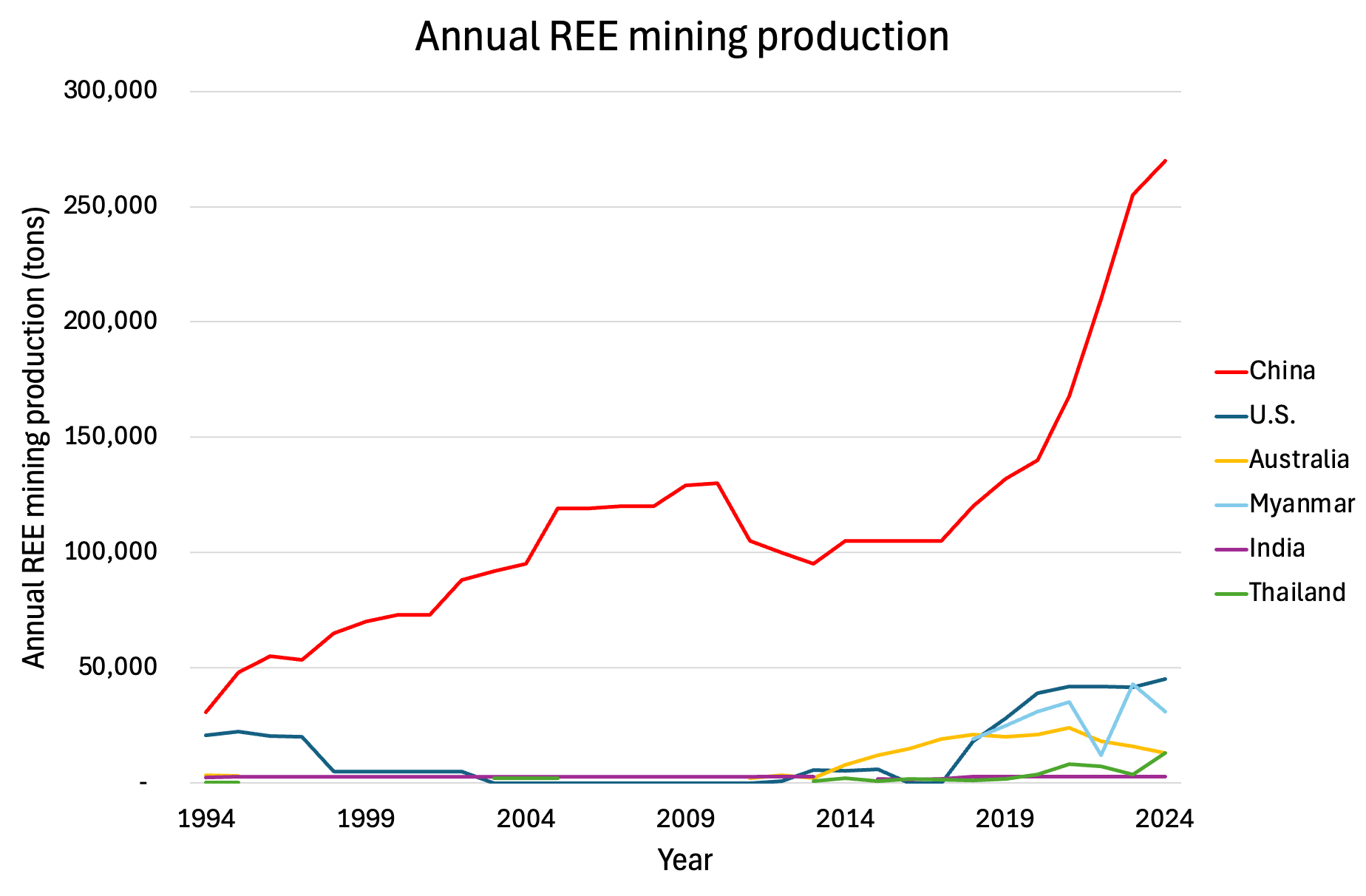
Deep within the Inner Mongolia region of China, Dao-heng Ding, an assistant professor of geology at Peking University, discovered iron ore in 1927 and rare earths in 1935. This site, now known as the Bayan Obo Mining District, started producing REE in 1957. After a few decades of operations at Bayan Obo, and once REE mining took hold in other Chinese provinces like Jiangxi and Sichuan, China overtook the U.S. in rare earth mining output and never looked back:
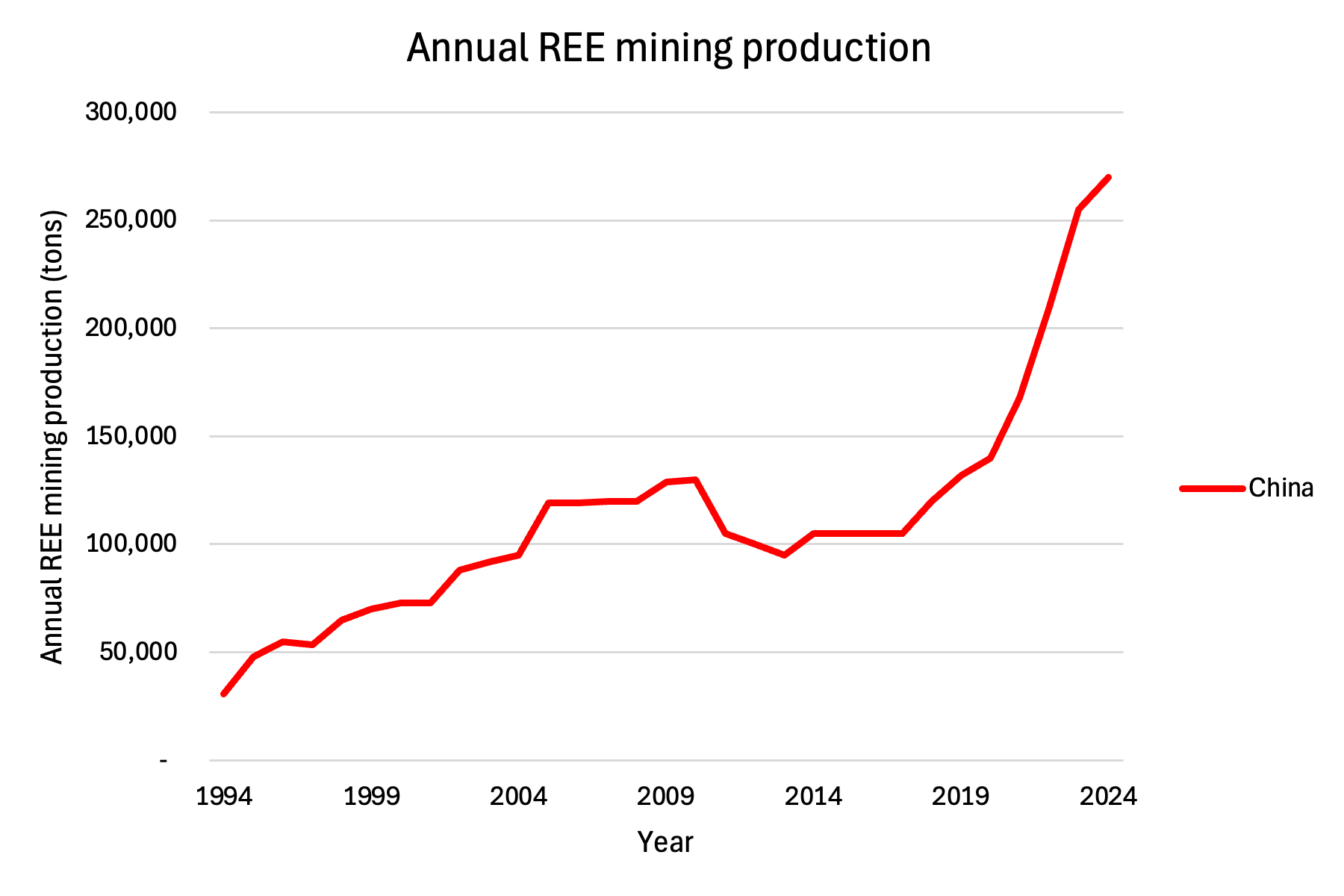
As it turns out, China was only warming up in the 90s. Bayan Obo accounts for over 40 percent of known REE reserves worldwide, and naturally, China doubled down on this mining district:
By 1995, Chinese REE mining output more than doubled American REE mining output. By 1998, China held a 13-to-1 advantage. By 2003, the U.S. stopped mining for REE altogether:
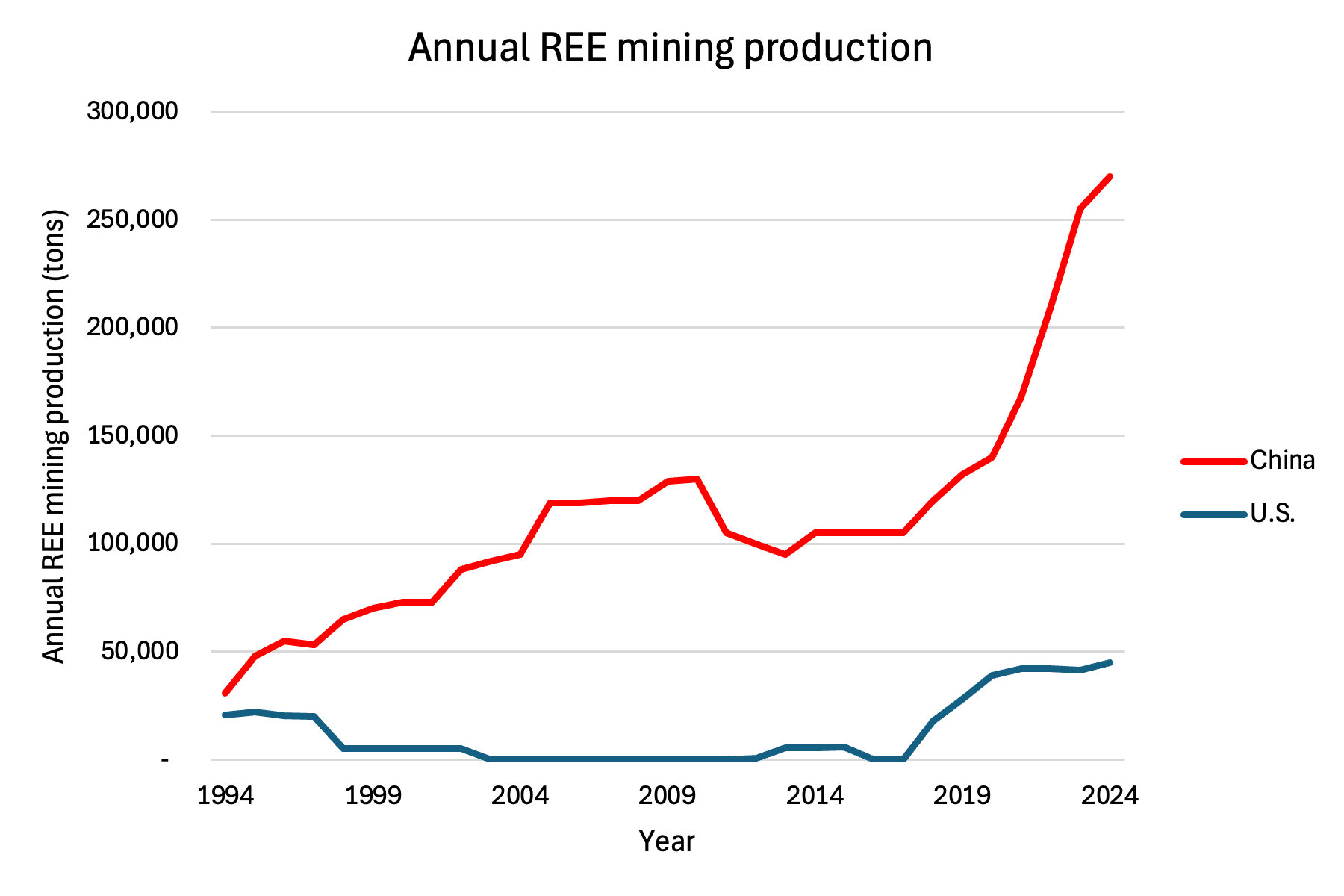
The U.S. paused its mining precisely when global demand for rare earths shot through the roof, leaving the door wide open for China. There are countless reasons for this, but a couple stand out.
Reason 1: Globalization
After World War II, and especially in the final decades of the 20th century, the world economy saw greater and greater overlap across and integration between national economies. This was due in no small part to advances in digital technology that allowed us to more efficiently communicate massive amounts of information over thousands of miles instantaneously. Reduced communications barriers enabled higher trade volumes, and higher trade volumes enabled countries to produce goods and services according to their comparative advantages. China’s production of REE skyrocketed in this globalized economy.
China doesn’t hold a comparative advantage in REE reserves, exactly; rare earths are pretty evenly spread throughout the Earth’s crust (they just never occur in high concentrations, hence the misleading “rare” label). Because of this, in a truly global economy, multiple countries should have comparative advantages in areas as important as rare earths. But that is not the case:
China’s REE comparative advantage comes from the fact that it has low labor costs and lax environmental laws, a perfect combination to excel in a mining sector that requires loads of manpower and harms surrounding environments.
This brings us to the second reason.
Reason 2: Environmentalism
When President Richard Nixon signed the National Environmental Policy Act (NEPA) into law in January 1970 and created the Environmental Protection Agency (EPA) in December 1970, he built upon President Lyndon B. Johnson’s environmental record. He also laid the foundation for the idea that America should outsource polluting industries to the rest of the world (China) in the rapidly globalizing economy. While the EPA has undoubtedly had a positive environmental impact, it has also been a thorn in the side of efforts over the past five decades that could have ultimately accelerated clean energy deployment.
One such effort was the operation of the Mountain Pass Mine, when in 1996 a pipeline, meant to carry uncontaminated wastewater from the mine to the Ivanpah Dry Lake 14 miles away, ruptured. The ensuing EPA investigation found that Molycorp (renamed from the Molybdenum Corporation of America) had failed to disclose spills of heavy metals and radioactive water into the Mojave National Preserve. The mine closed in 2002, didn’t reopen until 2011, and didn’t really ramp up production again until 2018.
The EPA and other agencies, like the California Regional Water Quality Control Board, prevented further damage to the Mojave National Preserve and minimized the risk to California’s drinking water supply. But this environmental action came with a cost (and an environmental one, at that). Once the Mountain Pass Mine closed, China established an even greater stranglehold over the global REE supply, which it can use to build our modern power generation systems (like wind turbines) and modern automobiles (like electric vehicles) at a lower cost than anyone else.
China approached a near monopoly in REE mining in the 2000s, and fortunately, the U.S. has regained a bit of market share:
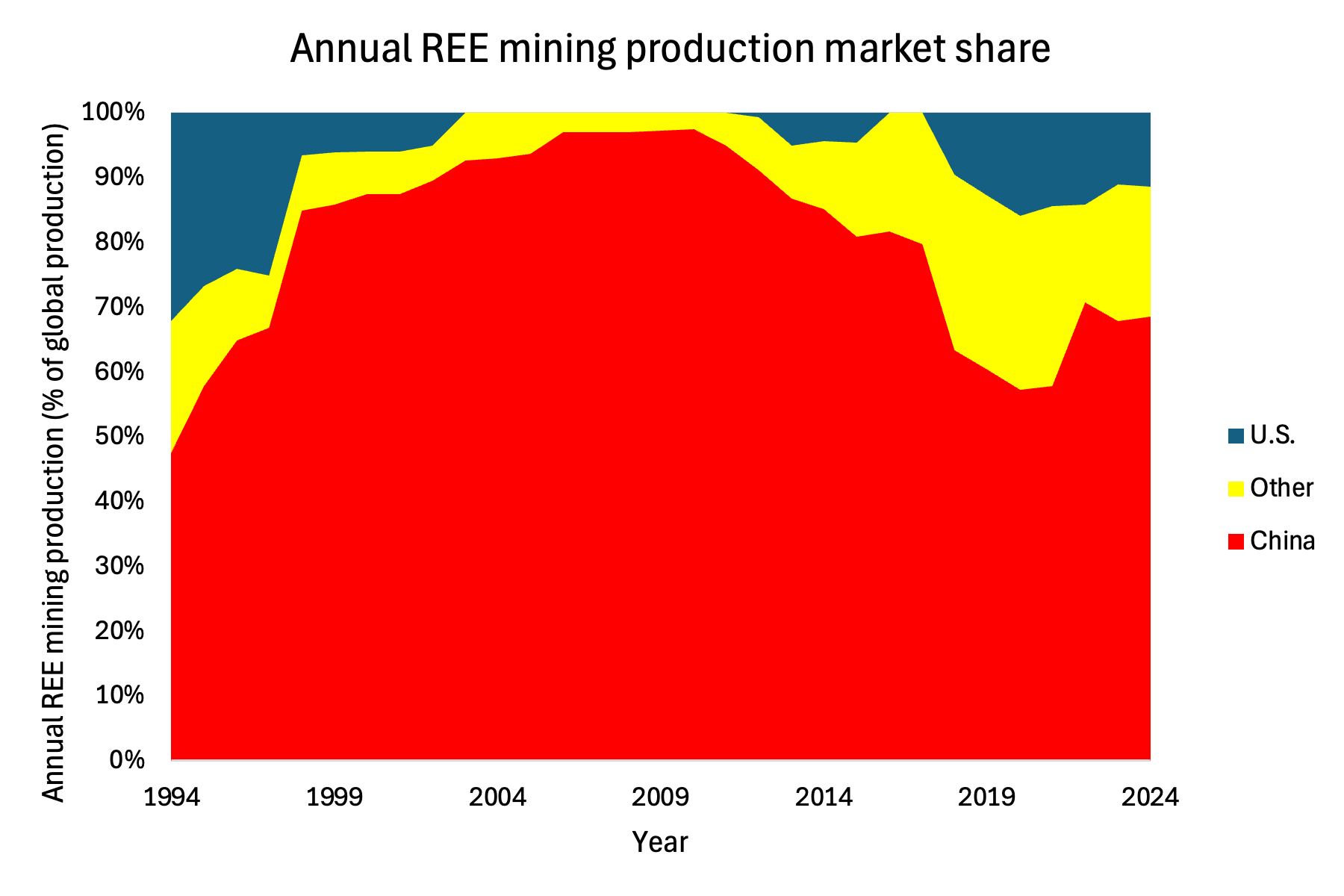
The amount by which the U.S. has increased its share of global REE mining over the past several years is not reflective of the amount of control it has taken back, though. REEs are by no means interchangeable; they all simply happen to share some bizarre characteristics that give them their valuable magnetic properties. From a high level, we can divide the 17 elements (scandium, yttrium, and the 15 lanthanides) into two groups: heavy rare earth elements (HREE) and light rare earth elements (LREE).
Most rare earth mines, like Bayan Obo in China and Mountain Pass in California, focus on LREE. Unfortunately, HREE have a more limited range, and China has a near-monopoly on HREE production in its Jiangxi Province. Because HREEs enhance heat resistance, they are critical across a variety of rare earth end uses, from energy technologies like wind turbines and electric vehicles to defense technologies like missiles and fighter jets.
While we’re at it, defense technologies are no slouches when it comes to REE demand in general. According to the DOD, F-35 fighter jets each require 900 pounds of REE, Arleigh Burke DDG-51 destroyers each require 5,200 pounds of REE, and Virginia-class submarines each require 9,200 pounds of REE.

While each produced by a Republican-led U.S. House of Representatives committee, the reports “Reset, Prevent, Build: A Strategy to Win America’s Economic Competition with the Chinese Communist Party” and “Predatory Pricing: How the Chinese Communist Party Manipulates Global Mineral Prices To Maintain Its Dominance,” use slightly different explanations of rare earths. The difference matters. Here’s how the first report characterizes them:
“Congress should incentivize the production of rare earth element magnets, which are the principal end-use for rare earth elements and used in electric vehicles, wind turbines, industrial automation, wireless devices, and countless other products.”
Here’s how the second report characterizes them:
“REEs are essential components in numerous U.S. advanced defense systems, including F‐35 fighter jets, Virginia‐ and Columbia‐class submarines, Tomahawk missiles, radar systems, and Predator drones. 93 The American people even depend on them for the necessities of everyday life, from smartphones to refrigerators and electric toothbrushes to household drills.”
Notice the difference? The first sorely lacks any mention of national defense. The second provides several examples of defense technologies reliant upon REE. If we can use fighter jets and submarines as Trojan Horses for wind turbines and electric vehicles, we should. Chances are that’ll be politically advantageous for a long time, at least in the U.S.
Just because Donald Trump is in the White House for another three years doesn’t mean we can’t make progress scaling industries necessary for our clean energy future. We just have to be smart with how we communicate about them.
And on that note, I’ll leave the deep dive into the Trump administration’s rare earth policy for Part III.
Rock ‘n’ roll afterword
Disclaimer: The opinions expressed in Renaissance Carbon are my own and do not necessarily reflect the opinions of any employer.
Contact: ryandavidson911@gmail.com
Comments
Nothing yet. Say the first thing.
Sign in to join the conversation.