
Up to this point, I’ve generally tackled topics one post at a time. I often discuss the politics, economics, and communication strategies around some clean energy topic while implying that we can leverage this decarbonization to grow our economy, and then I move on to the next thing. But now, I’d like to look at an area that has so far been completely absent from the pixels of Renaissance Carbon: rare earths.
Renaissance Carbon is an outlet for my own learning, and that may be apparent over the next several posts. If you are interested in and / or know a lot about rare earths (or anything related to mining), I’d love to hear from you. If not, I’d love for you to join me on this learning journey.
I can already tell you that rare earths are obscenely underappreciated in the context of… just about anything. Given their importance not only for the energy transition, but for the global economy, and given their position as a key bargaining chip in U.S. / China trade relations in recent years (more on that later), I would have thought usage of the phrase “rare earths” would be increasing more than it is:
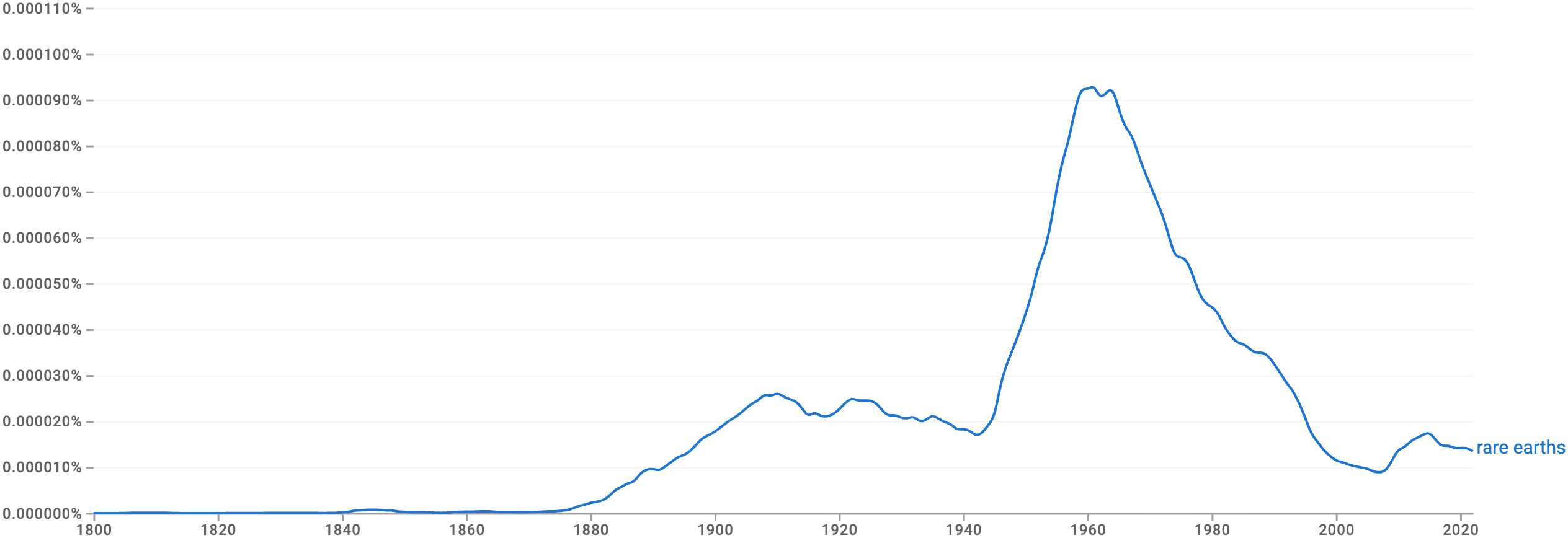
Surely the years since 2022 have seen a spike in usage that has not yet appeared in Google’s data. And if they haven’t, that spike is sure to come sooner or later.
To be completely honest, I could not have told you the difference between rare earths and critical minerals a few weeks ago. I knew they were different – or at least had some idea that they were – but I had no semblance of a detailed understanding. The Energy Act of 2020 defined critical minerals as those that:
Are essential to the economic or national security of the United States;
Have a supply chain vulnerable to disruption;
And serve an essential function in the manufacturing of a product, the absence of which would have significant consequences for the economic or national security of the United States.
The U.S. Geological Survey (USGS) released its final 2025 List of Critical Minerals a few weeks ago:
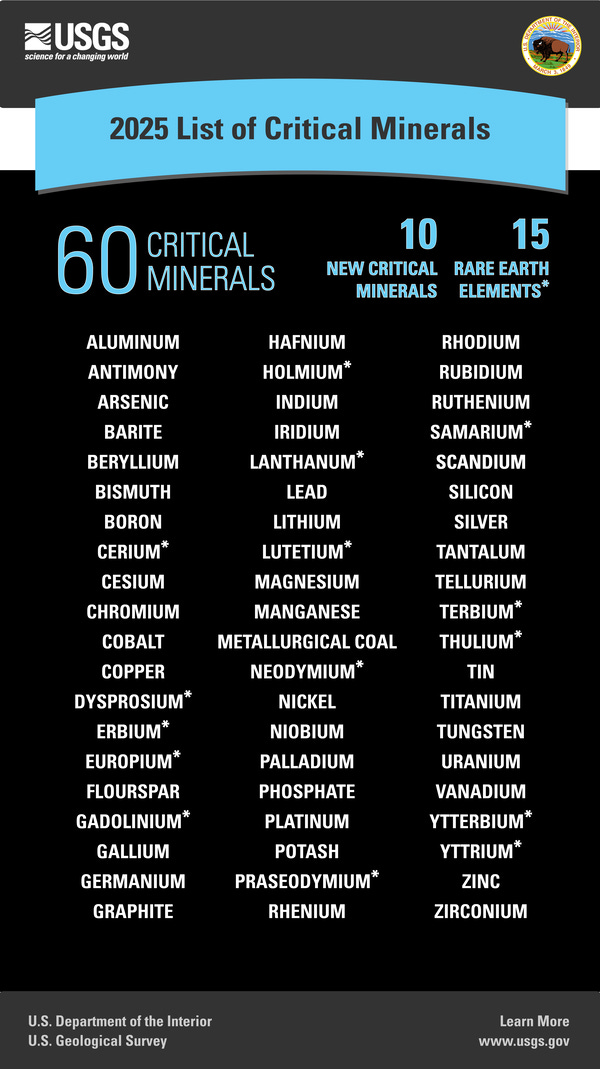
Rare earth elements, or REE, are a set of 17 elements with “unique physical, chemical, magnetic, and luminescent properties” that “enhance efficiency, durability, and performance while enabling the miniaturization of electronic components and alloys.” Basically, they enable technology as we know it today. These 17 elements are made up of the 15 lanthanides (elements 57 through 71), plus scandium (21) and yttrium (39).
So, while critical minerals and REE are not the same thing, they are closely related. REE (an objective set of 17 elements) are a subset within critical minerals (a subjective set of 60 elements and other minerals). It’s worth noting that REE are not particularly rare, but they tend to appear in low concentrations, which makes mining difficult, costly, and environmentally harmful. The process goes something like this:
Extraction: Ore is extracted from a mine (usually an open pit mine).
Crushing: The ore is crushed into gravel.
Milling: Once the gravel is mixed with water, steel balls crush this mixture into a powder slurry.
Flotation: The slurry is combined with chemical reagents that make the target REEs hydrophobic. Air bubbles are injected into the mixture, which the REEs bind with to separate from the waste rock (tailings). This process occurs multiple times.
Roasting: The remaining concentrate is heated to high temperatures.
Leaching: The roasted concentrate is mixed with an aqueous solution containing an acid, which dissolves the rare earth compounds and creates a “leach liquor.”
Pre-purification: Chemical extractants are added to the leach liquor to pull impurities (like iron and thorium) out of the aqueous phase.
Separation: The purified leach liquor is mixed with other extractants, each of which has a slight preference for one particular REE over the others. Because the chemical differences between some REEs are so small, this final phase must occur thousands of times to achieve high purity.
This resource-intensive process leads to the waste and environmental degradation that we so often associate with mining.
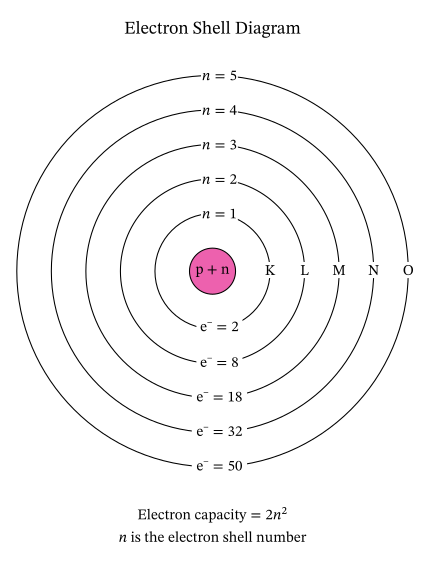
Atoms contain electrons (negative charge) that revolve around a nucleus of protons (positive charge) and neutrons (no charge). Electrons occur in shells, subshells within these shells, and orbitals within these subshells. Each orbital can hold two electrons, and then additional electrons fill in subsequent orbitals. The electrons farthest from the nucleus, called the valence electrons, can have incomplete orbitals and therefore bond with the incomplete orbitals of other atoms, forming chemical compounds. The number of electrons that can fit in each shell is equal to 2n2, where n is the relative position of the shell relative to other shells around the nucleus:
Typically, electrons organize around an atom’s nucleus based on the relative energy in each subshell, taking their places in order of the lowest energy orbital available; this is called the Aufbau Principle. Generally speaking, electrons in orbitals farther from the nucleus have more energy and are less tightly bound to the atom than electrons in orbitals closer to the nucleus. Electrons fill their orbitals according to the following diagram, from the bottom subshell to the top subshell:
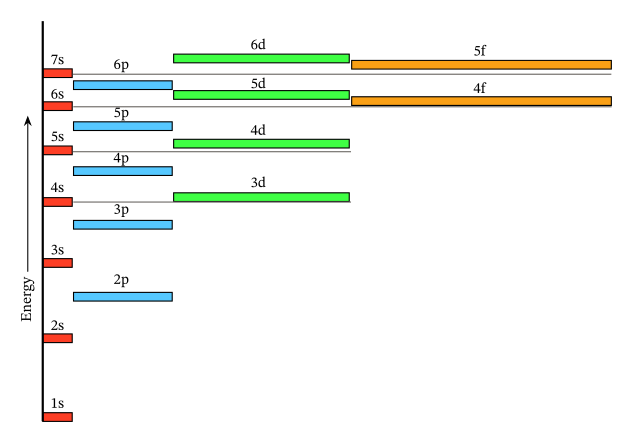
One major factor that makes REE so special is that they contain exceptions to the Aufbau Principle. Because the energy differences between the 4f, 5d, and 6s subshells are so small, some electrons not in the outermost subshell (particularly, those in the 4f subshell) are alone in their orbitals. Because these electrons are shielded, however, they cannot bond with other atoms. As an example, here’s the electron configuration of neodymium:
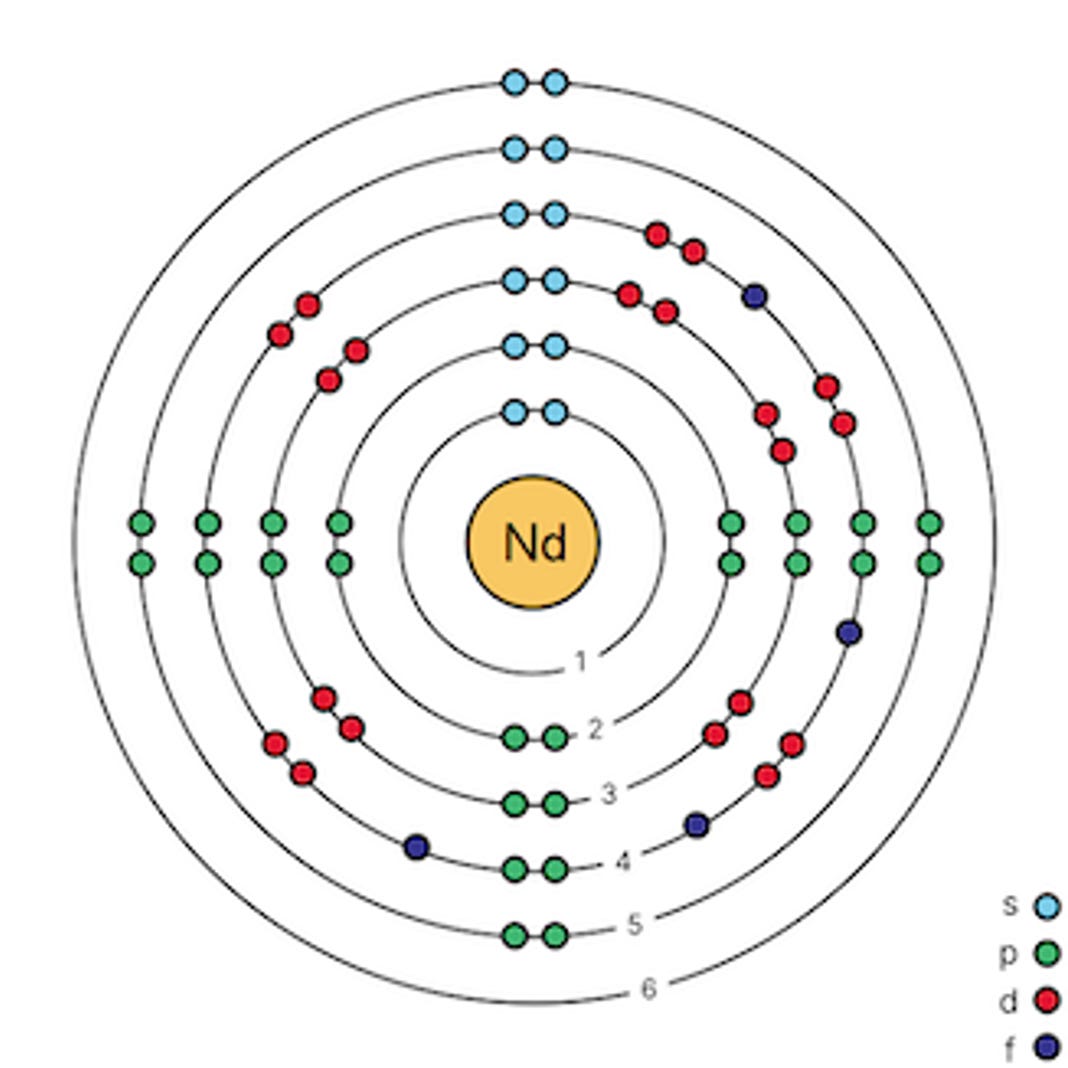
These unpaired electrons give REE extreme magnetic and luminescent properties, making them valuable across a variety of technologies:
Electric vehicles
Wind turbines
Batteries
Smartphones
Headphones
Screen displays
Many, many, many more…
…And, of course, advanced defense technologies like missiles and radar systems
Clearly, REE are vital both for national and economic security; that’s why 15 of the 17 are included on the USGS List of Critical Minerals. Unfortunately, the U.S. has not put itself in the best position to control REE supply chains.
Over the next few weeks, I’d like to address some of the following questions:
Where are REE typically mined and refined? (Hint: China)
How has China put itself in such a dominant position?
How does the rest of the world fare today?
How do REE factor into the U.S. / China trade tensions specifically? Or today’s geopolitical tensions in general?
Can the U.S. catch up to China in developing a domestic REE supply chain? If so, how?
I was thinking about naming this series “How the West was lost,” but Simon Nixon beat me to it on his Wealth of Nations Substack a few weeks ago. I’d recommend checking it out.
Since there is no shortage of Wild West cinematic references from which to draw, I’ll swap one Henry Fonda movie for another.
Once upon a time in the West, we held control of the critical commodities that would power the next era of economic growth: fossil fuels. Despite shocks like the oil crises of 1973 and 1979, the United States started the oil boom of the early 20th century, led the Shale Revolution of the early 21st century, and produces more hydrocarbons than any other country today. We’ve been dominant in producing the substances that run the global economy for a long time, but we must not assume this dominance will last forever.
It won’t. Indeed, we can already see cracks in the foundation.
In the coming weeks, we’ll dig deeper into the bedrock below.
Rock ‘n’ roll afterword
Disclaimer: The opinions expressed in Renaissance Carbon are my own and do not necessarily reflect the opinions of any employer.
Contact: ryandavidson911@gmail.com
Comments
Nothing yet. Say the first thing.
Sign in to join the conversation.