
This is the third post in a four-part series on rare earths. The first two posts can be found at the following links:
Part I: A series on the most important resources we almost never talk about
Part II: How the U.S. ceded dominance in rare earth mining
Mere hours into his second administration, Donald Trump issued an executive order to pull the U.S. out of the Paris Agreement. The very same day, he restarted reviews of liquified natural gas exports, reversed the cancellation of oil and gas leases in the Arctic National Wildlife Refuge, and paused offshore wind leasing for all offshore wind areas on the Outer Continental Shelf (wind turbines are definitely the cause of his 7-iron woes). On the 249th birthday of the Republic, Trump signed the One Big Beautiful Bill Act into law, and the clock started ticking for solar and wind projects to get steel in the ground (or at least components ordered) to claim federal tax credits.
Folks in climate despaired. The Rhodium Group predicted in September we’ll now see U.S. greenhouse gas emissions drop only 26 to 35 percent between 2005 and 2035 (instead of 38 to 56 percent, as of last year’s prediction). It’s impossible to know what the long-term effects of any of these policies might be. At the end of the day, unsubsidized solar and wind still often outcompete subsidized natural gas, and we’re going to need more electrons on the grid no matter what. Trump isn’t exactly a modern-day Nixon (when it comes to energy and environmental policy, that is), but he isn’t going full Cheney-in-Iraq mode, either. Clean energy will live.
As head-scratching as this administration’s energy policy can be, the White House has doubled down on an area that it should have prioritized decades ago: building a China-free rare earth elements (REE) supply chain. (Instead of invading Iraq, maybe? But I digress.)
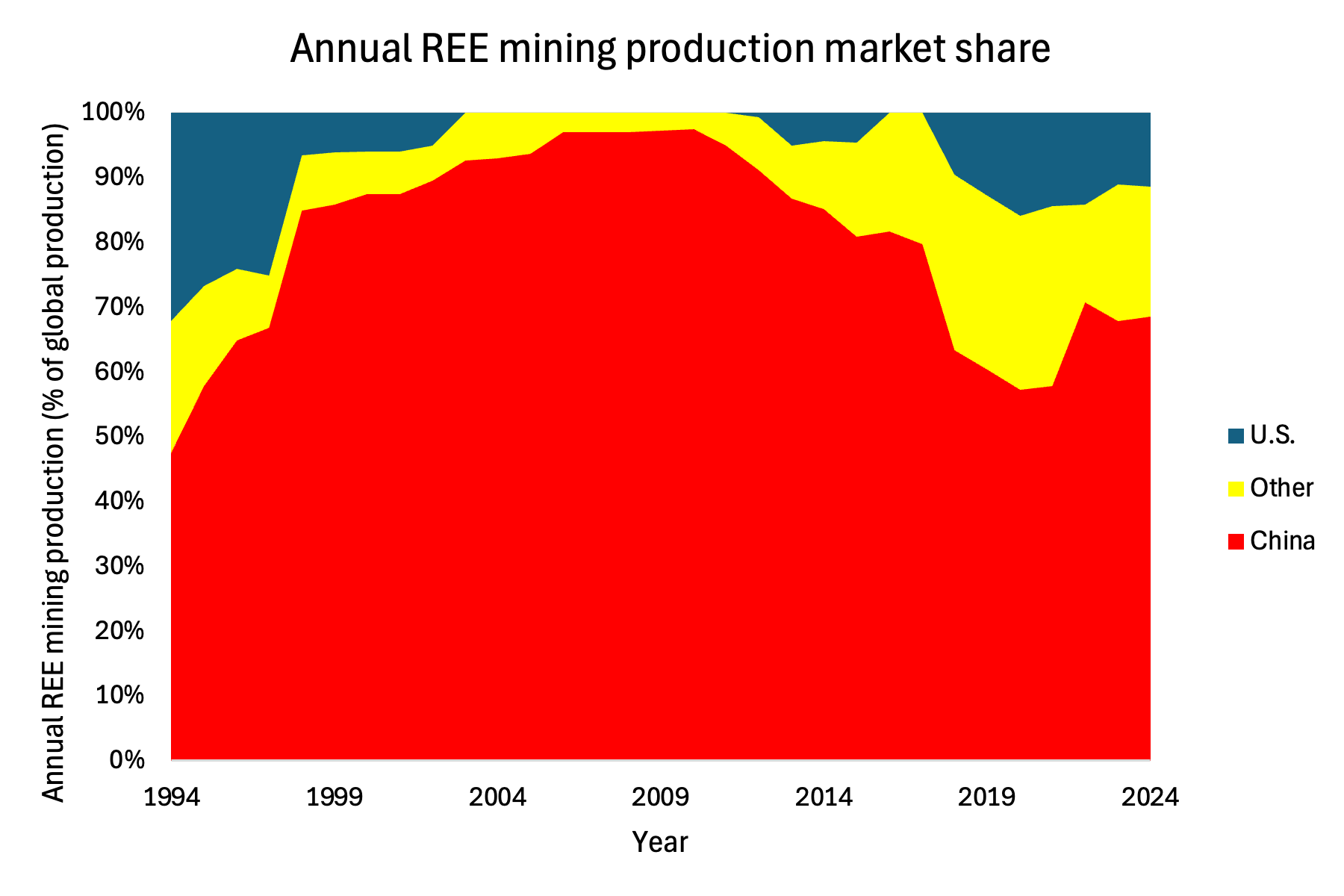
To recap last week’s post, China mined less than half the world’s REE in 1994 but mined 97 percent of the world’s REE by 2006. Countless factors led to this, but chief among them was that wealthy countries (including the U.S.) started more earnestly offshoring dirty industrial processes to countries with lower labor rates and more lax environmental laws. Spills of heavy metals and radioactive water from the only REE mine in the U.S. didn’t help things.
This mine, Mountain Pass in California’s Mojave Desert, closed in 2002 and fully reopened in 2018 after several years of fits and starts. The U.S. accounted for 11 percent of global REE mining by 2024, second only to China… at nearly 70 percent. Consider refining capacity – of which the U.S. has virtually none – and China still holds a significant advantage.
Critical minerals, and REE specifically, were clearly going to play a key role in Trump’s energy and defense policies from the outset, and rightfully so. Of the 142 executive orders he signed in his first 100 days (which shattered FDR’s record of 99 EOs in his first 100 days), five mention critical minerals, four focus on critical minerals, and three establish REE as crucial pieces of the critical minerals supply chain:
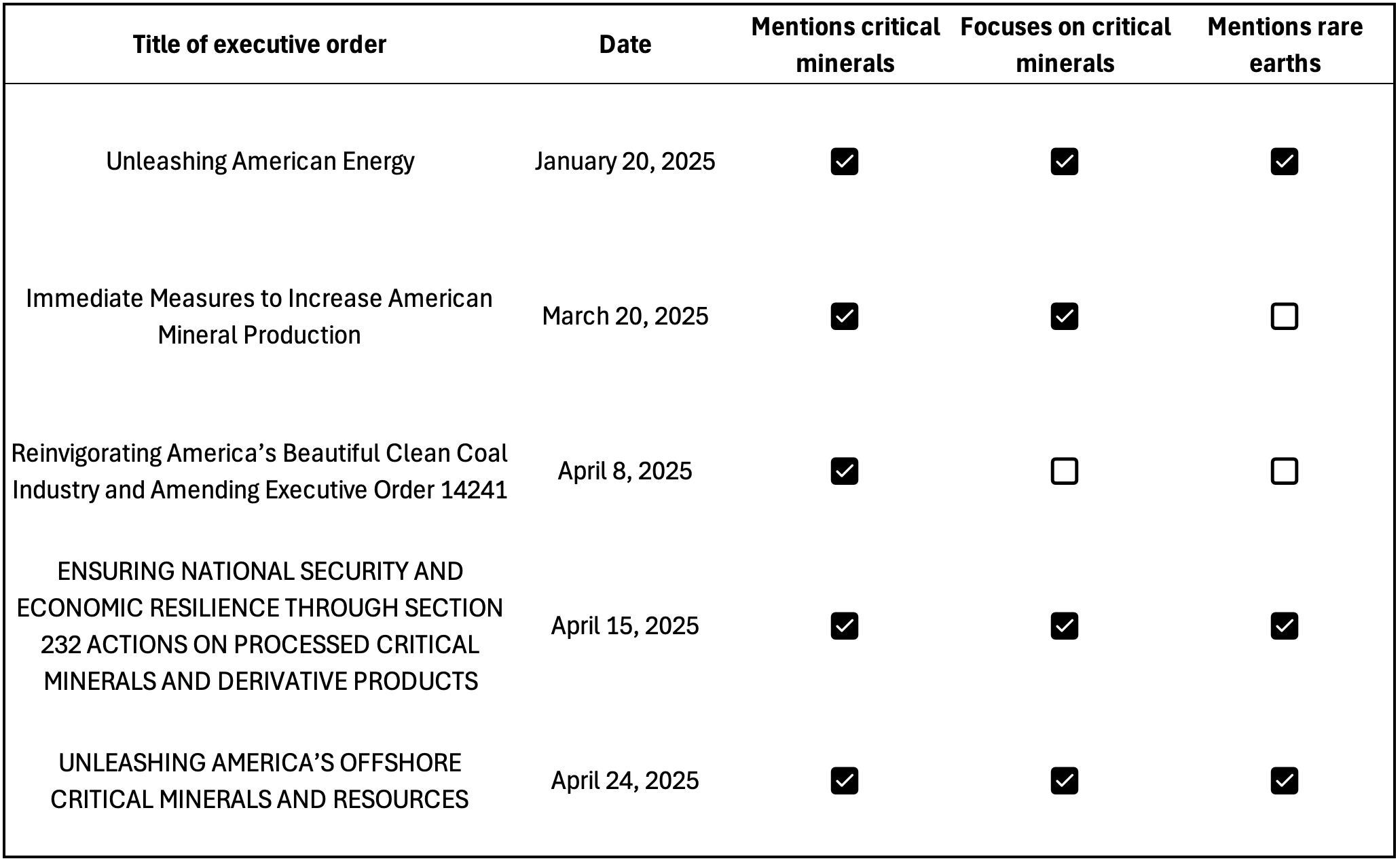
These executive orders are all fine and good (except for “clean coal,” whatever that means), but EOs will only take us so far.
We need effective trade policy.
Throughout his 2024 campaign, Trump emphasized the need for higher tariffs. He eloquently summarized his feelings for import taxes in an interview at the Economic Club of Chicago on October 15, 2024:
“To me, the world’s most beautiful word in the dictionary is tariffs. It’s my favorite word.”
He wasn’t messing around. Within 43 days, his administration had increased tariffs on Chinese imports by nearly 20 percentage points, almost doubling the tax American companies (and therefore consumers) must pay on those imports. Then, on April 2, Trump announced his so-called “Liberation Day” tariffs:
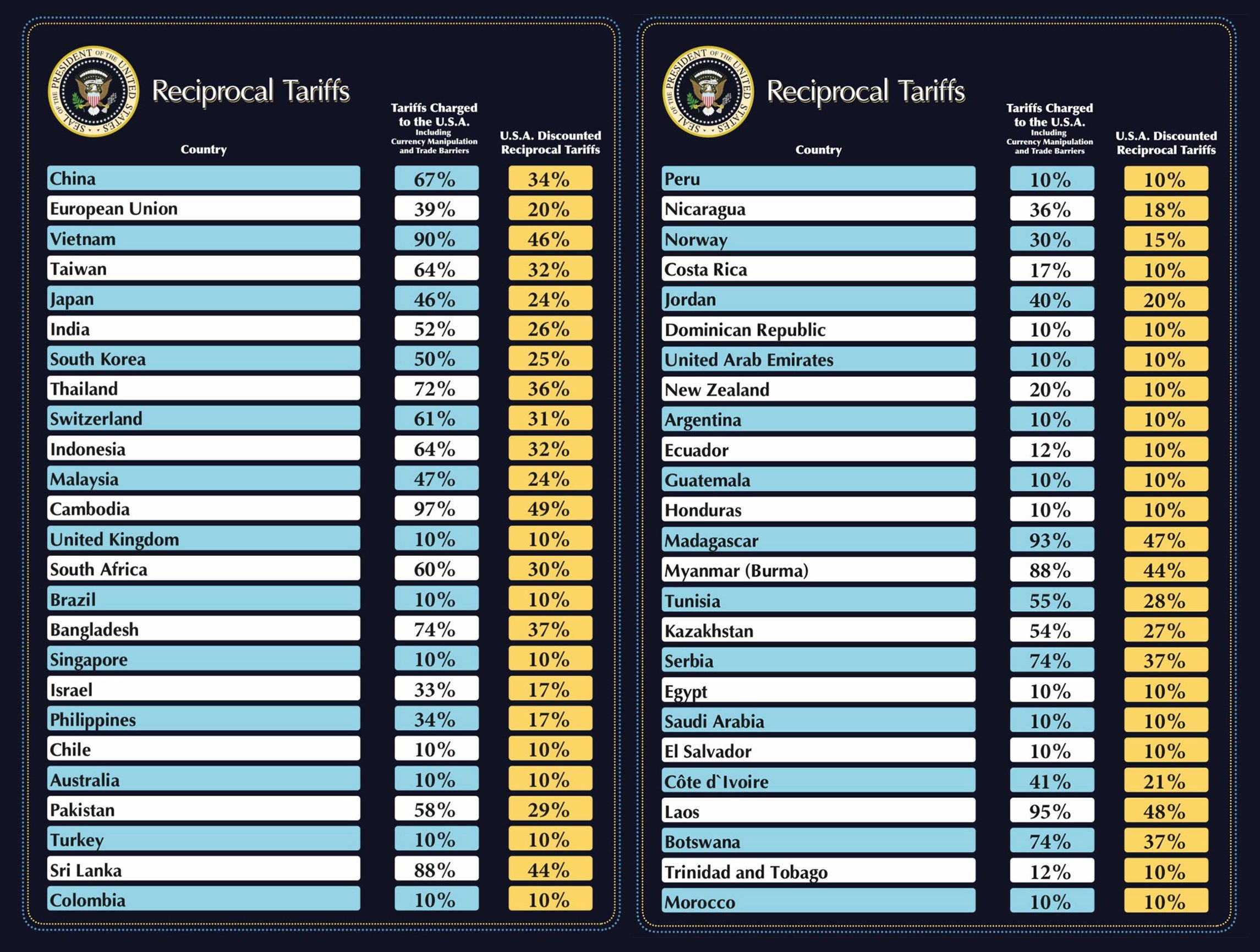
Aside from the fact that the “reciprocal” tariffs were in no way reciprocal (the White House simply calculated them based on our trading partners’ trade deficits with the U.S. divided by their exports to the U.S.), the move alienated allies and emboldened adversaries. Who gives a damn about our trade deficit with Cambodia? Generally speaking, the U.S. offshores industries for good reasons, and except for supply chains critical to our national security and energy security, we’re better off because of this.
Liberation Day led to a few frameworks (but not necessarily trade deals) here and there, like the U.S.-UK Economic Prosperity Deal and the U.S.-EU Tariffs and Trade Framework Agreement, but one country made it clear it wouldn’t be tossed around. Chinese President Xi Jinping called Trump’s bluff, because China and the U.S. aren’t actually playing a real game of cards. China can see America’s hand and they’re chomping at the bit, no poker face necessary.
The average U.S. tariff on imports from China peaked at 135.4 percent on April 10 before both countries started pulling back. Even now, it sits at 47.5 percent, more than double what it was when Trump took office. The lesson hasn’t slapped us in the face quite yet, but it will at some point: Nobody wins in a trade war.
China, for its part, has long recognized (and weaponized) its REE advantage without starting a full-blown trade war.
After gaining entry to the World Trade Organization (WTO) in 2001, the country started imposing export restrictions on its rare earth supply. For example, in response to a questionable September 2010 dispute between the Japanese Coast Guard and a Chinese fishing trawler, China banned REE exports to Japan for over two months.
After several years of rare earth export quotas, the U.S., EU, and Japan brought a case against China to the WTO in 2012, claiming the country had violated its obligations as a WTO member. The WTO Appellate Body confirmed in 2014 that China’s export restrictions were illegal, and they relented.
Several years later, China reversed course:
The country implemented its Export Control Law on December 1, 2020, limiting exports of dual-use items, military products, nuclear materials, “and other goods, technologies, services and items that are related to the protection of national security and interests or the fulfillment of non-proliferation or other international obligations.” Rare earths conveniently fall into the “other” category.
Nine days after the U.S. House of Representatives Select Committee on the Chinese Communist Party released its December 2023 “Reset, Prevent, Build” report mentioned in last week’s post, China announced an export ban of REE extraction and separation technologies.
In April 2025, the Chinese Ministry of Commerce imposed export restrictions on seven REE (samarium, gadolinium, terbium, dysprosium, lutetium, scandium, and yttrium) and started requiring Chinese companies to obtain special export licenses to export the minerals and the magnets made from them.
In October 2025, China implemented its most stringent REE and permanent magnet export restrictions yet. According to Gracelin Baskaran, Director of the Critical Minerals Security Program at the Center for Strategic & International Studies:
“The newly announced restrictions represent China’s most consequential measures to date targeting the defense sector. Under the new rules, starting December 1, 2025, companies with any affiliation to foreign militaries—including those of the United States—will be largely denied export licenses. The Ministry of Commerce also made clear that any requests to use rare earths for military purposes will be automatically rejected. In effect, the policy seeks to prevent direct or indirect contributions of Chinese-origin rare earths or related technologies to foreign defense supply chains.”
Trump’s frustrations are not unfounded, but the ultimate problem with his provocation of China is that America needs Chinese goods more than China needs American goods. The pen may be mightier than the sword, but we still need swords to underwrite the powers of our pens. In this case, we literally cannot make more swords without China’s rare earths.
Between Trump and Xi, it appears only one man knows this.
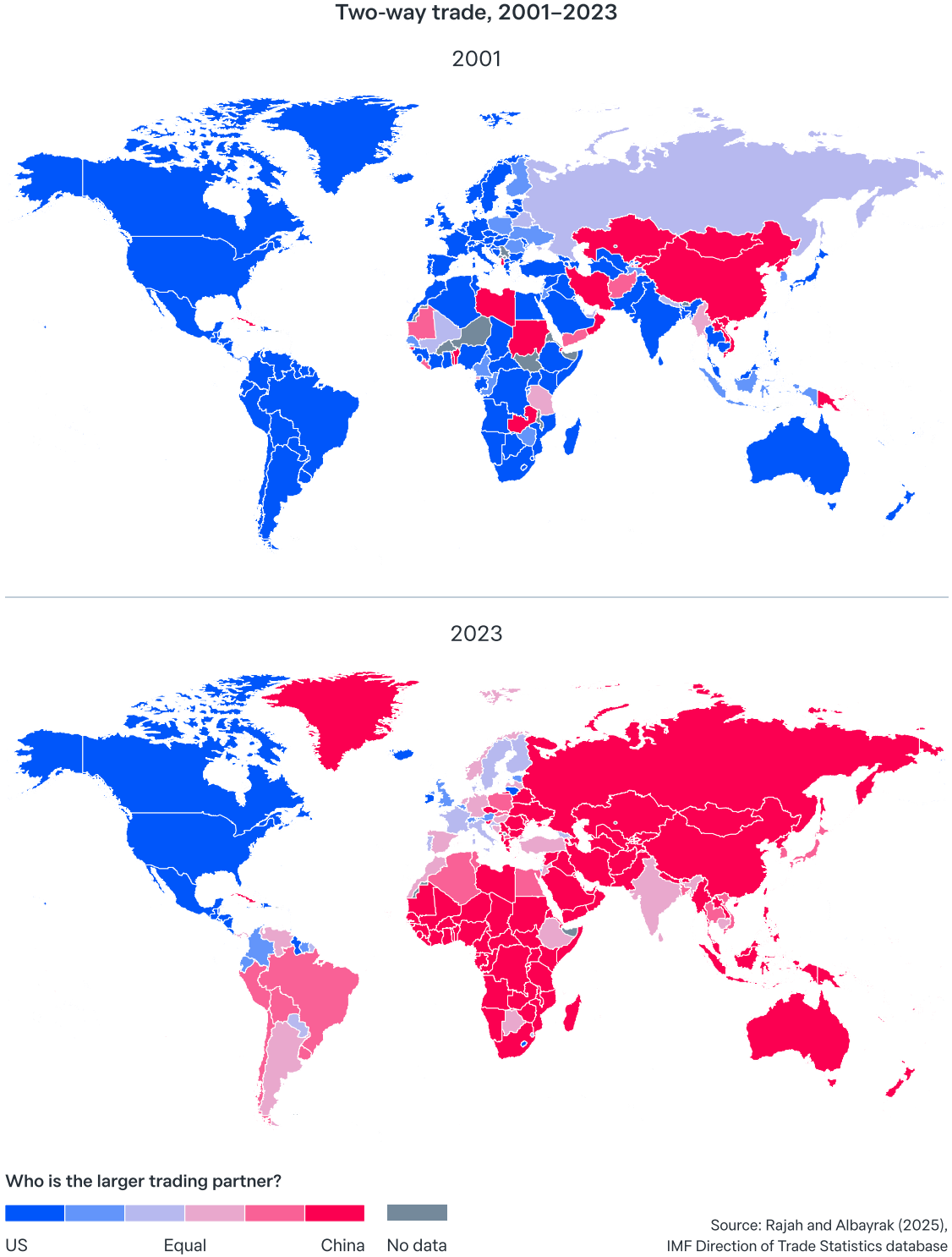
Under a year into the second Trump administration, one thing is obvious regarding rare earths: We must not prod China with ill-conceived tariffs, or else we’ll effectively lose access to a vast majority of the global REE market. That this was already obvious is an understatement.
What has been more surprising, however, has been the administration’s domestic rare earths strategy.
Especially considering Trump’s prominent position in the pantheon of Republican politicians, his second administration has taken a sharp left turn on its actions toward fostering a free market in the U.S. For better or for worse, the Trump administration might look more like Stalin’s U.S.S.R. than your grandfather’s GOP.
Let’s zoom in on the federal government’s support of MP Materials (founded in 2017 to reopen the Mountain Pass mine) for a few examples of these actions.
Procurement commitments: According to the MP Materials press release from July 10 regarding the company’s facility scheduled for commissioning in 2028, the DOD has “agreed to ensure that 100% of the magnets produced at the 10X Facility will be purchased by defense and commercial customers” for a period of 10 years. In other words, the federal government has made a procurement commitment to MP Materials, ensuring that whether or not the market demands the 10X Facility’s full output, the company will sell 100 percent of its product.
Price floors: While the federal government’s procurement commitment signals demand for the output of the new MP Materials facility, a price floor actually puts a monetary value on the output from Mountain Pass. Specifically, the agreement sets a price floor of $110 per kilogram of neodymium-praseodymium (NdPr) oxide. Where global markets stand in early December 2025 ($83 per kilogram), the DOD is signing up to pay roughly a 33 percent premium. If NdPr production at Mountain Pass holds steady at 6,075 metric tons annually, the DOD would basically subsidize MP Materials to the tune of $164 million per year ($110 - $83 = $27 per kilogram, multiplied by 6,075,000 kilograms). On the flip side, if market prices rise above $110 per kilogram, then the federal government would receive some of the profits.
Government equity positions: This one is big. The DOD didn’t stop at procurement commitments or even price floors; the Pentagon went so far as to invest $700 million in MP Materials for a 15 percent stake in the company, becoming its largest shareholder. The implications of this investment are not yet clear, and we don’t yet know how far the federal government might extend this buying spree, but one thing is certain: This is abnormal, especially outside the context of financial crises. I couldn’t fault you for speaking of this in the same breath as Stalin’s or Mao’s Five-Year Plans.
The federal government’s investment in MP Materials has not been its only critical minerals investment; the Department of Energy Loan Programs Office owns a 5 percent stake in Lithium Americas and the DOD owns a 10 percent stake in Trilogy Metals.
I know these actions don’t signify full-blown communism, but how funny would it be for the White House to take an essentially socialist stance toward rare earths (and critical minerals generally) to confront China in what looks like a Second Cold War? Trump gives Ronald Reagan a million reasons to roll in his grave, but I think even he would have laughed at this one.
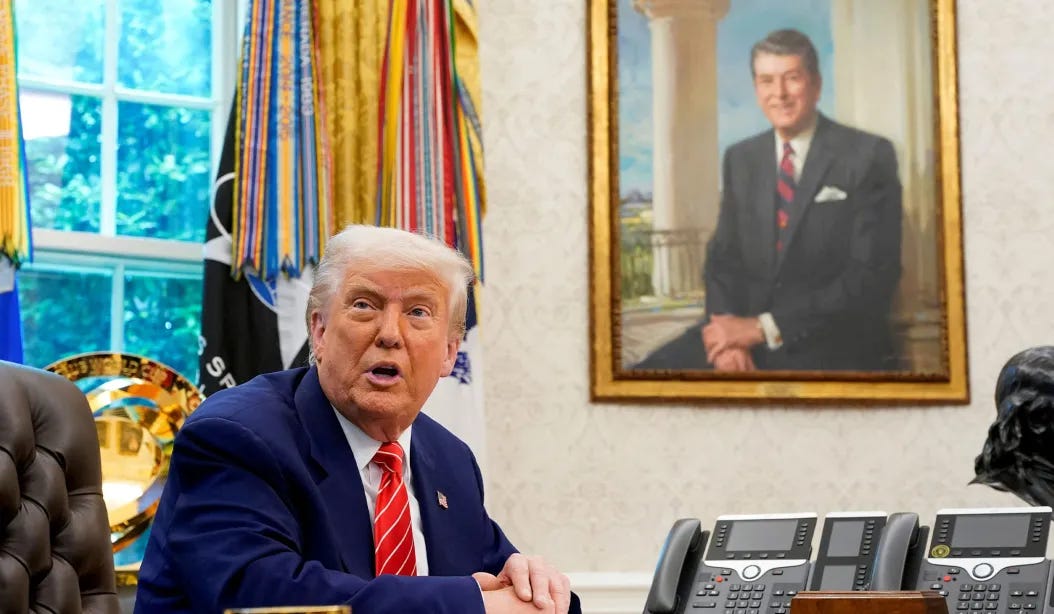
It’s too late for the U.S. to go head-to-head against China and come out on top. But is going head-to-head our only option?
Join me for the final installment of this four-part series to find out.
Rock ‘n’ roll afterword
Disclaimer: The opinions expressed in Renaissance Carbon are my own and do not necessarily reflect the opinions of any employer.
Contact: ryandavidson911@gmail.com
Comments
Nothing yet. Say the first thing.
Sign in to join the conversation.