
I started the year with a post last week breaking down the first half of my 2026 energy and climate predictions. For some predictions, I’m highly confident. The line between energy security and national security will continue to blur more and more until the two are practically indistinguishable from each other. For other predictions, I’m already not so sure. Will the AI bubble really pop this year? Are we in a bubble at all???
To quote Nate Bargatze paraphrasing George Washington: Nobody knows.
Now, on to the second half of my 2026 predictions.
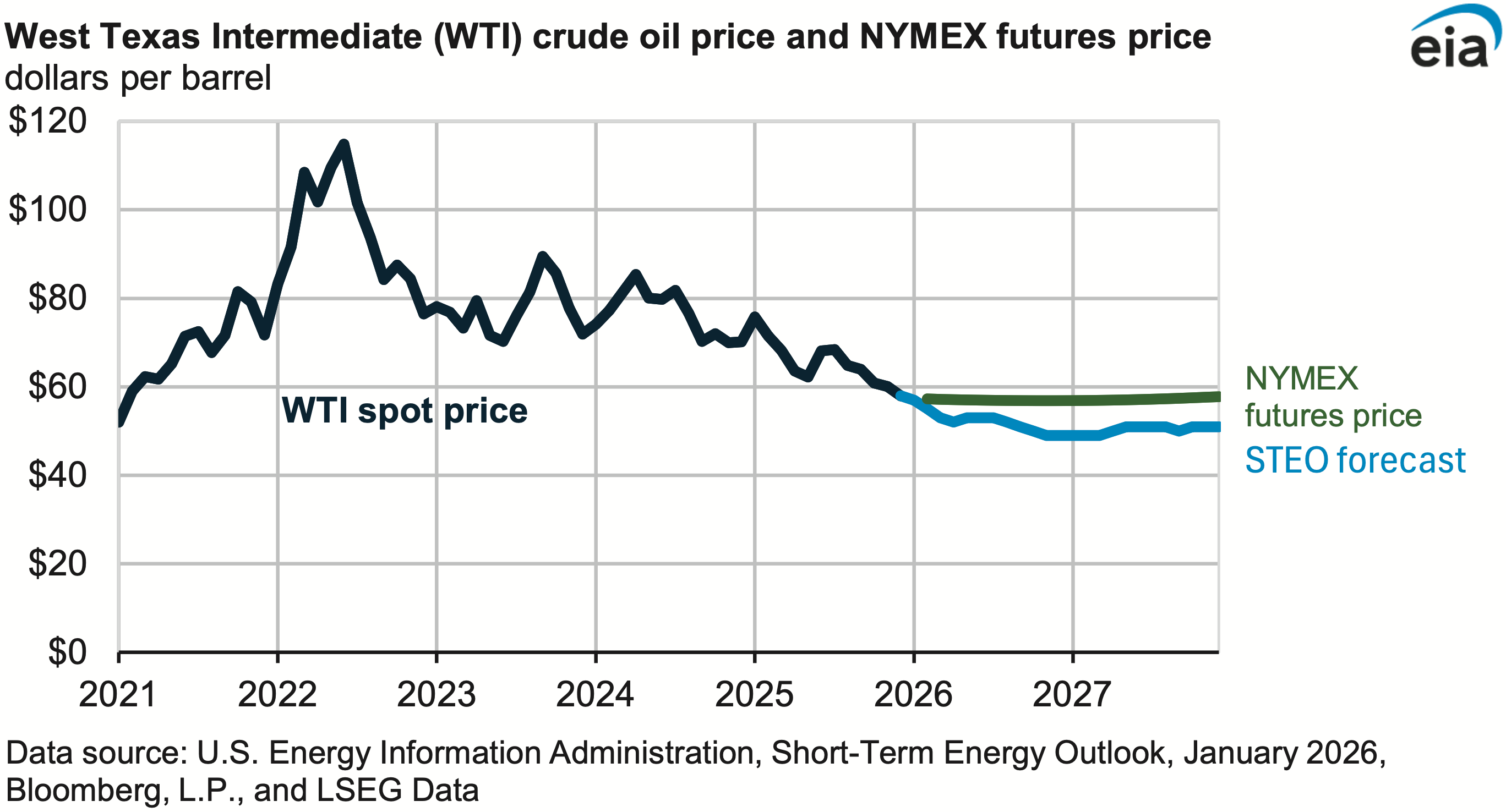
14. Amid oversupply, the WTI crude oil spot price will drop below $50 per barrel for the first time in five years. Trump has set a target of $50 per barrel of crude oil in an effort to lower gasoline prices for consumers. Unfortunately for oil workers, I think he’ll get what he wants at some point this year. It makes sense to assume the extra supply causing these crude oil price reductions might come from Venezuela, but by and large, that will not be the case. For Venezuela’s oil infrastructure to experience any sort of revitalization would take years and tens of billions of dollars. Oversupply won’t come from the U.S. either, where the EIA forecasts oil production to fall slightly below 2025 levels, but rather it will come from three non-OPEC countries: Argentina, Brazil, and the wunderkind of the oil world, Guyana. OPEC+ countries probably won’t increase production by much, if at all, unless Trump succeeds in his pressure campaign to make them do so; if he does, this prediction becomes all the more likely to come true. At the end of the day, massive uncertainty around currently unfolding geopolitical conflicts – from Iran to Venezuela to Greenland and more – could render this prediction obsolete within weeks (or days).
15. After appearing to fall from 2024 to 2025, China’s emissions will fall again from 2025 to 2026. When Heatmap surveyed energy and climate experts for their annual Insiders Survey, only 34 percent said they believed China’s emissions would peak during the 2020s; while this was a plurality, the 2030s and 2040s didn’t fall too far behind, with 30 and 28 percent of the vote, respectively. China has more coal plants under construction than the rest of the world combined, but the country also has more renewables capacity under construction than the rest of the world combined. Sure, burning coal will emit greenhouse gases regardless of how much renewable capacity comes online, but the presence of so much renewable capacity will suppress the utilization rate for all that new coal. The rapid adoption of electric vehicles is also playing a key role in China’s now-falling emissions. As recently as 2020, EVs made up just 5.7 percent of new passenger vehicle sales in the country. In 2025, that figure cruised past 50 percent.
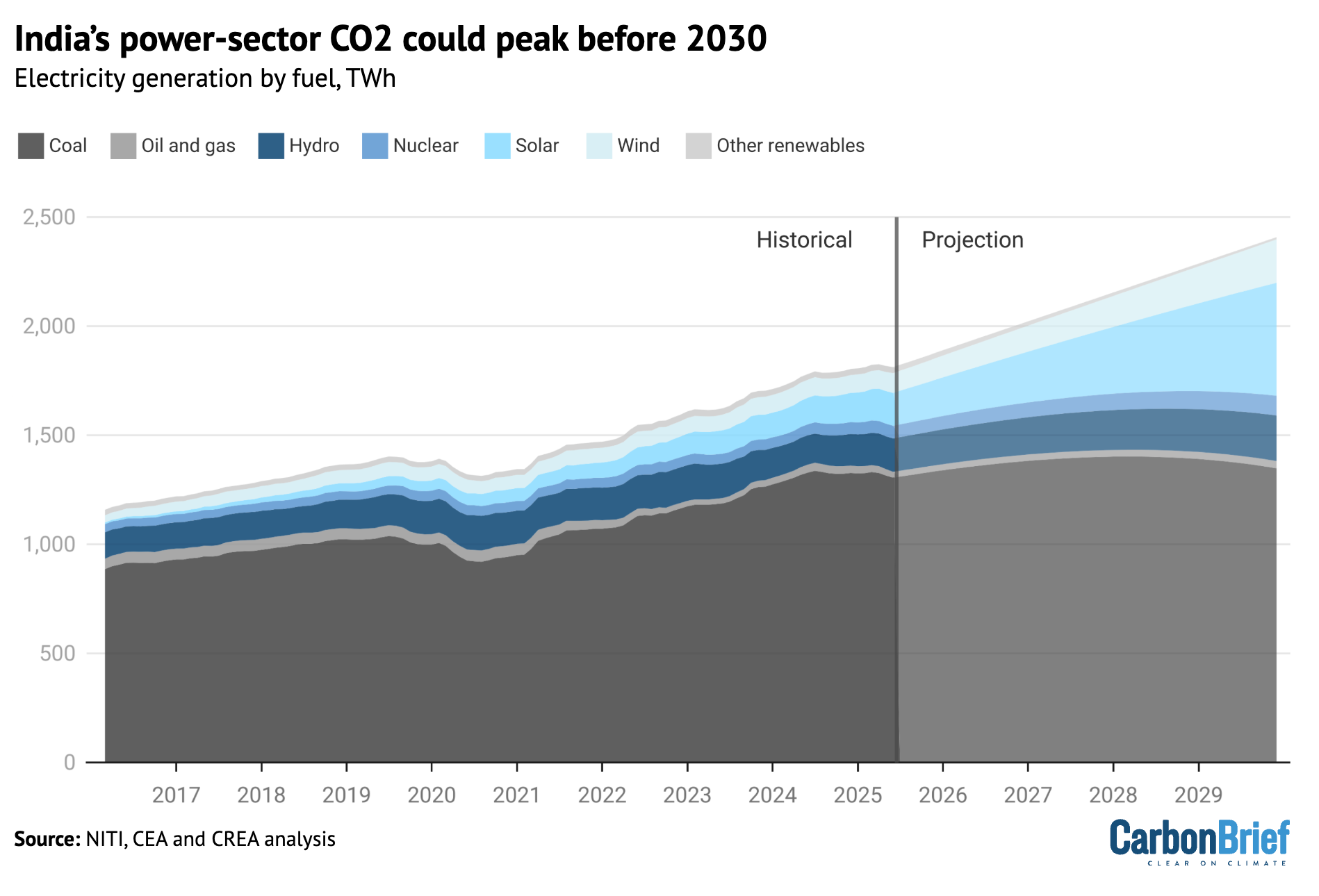
16. India’s emissions will rise faster than China’s will fall. While 2025 marked the first year since 1973 that coal-fired power generation dropped for both China and India, don’t expect this trend to last long for the latter of the two countries. India has 226 gigawatts of coal-fired generation online now and another 59 GW in the pipeline, which pales in comparison to China’s coal capacity, but it also has a small fraction of China’s solar and wind capacity necessary to reduce coal utilization. As India’s electricity demand expands by around six percent annually, much of this increased demand can be attributed to the widespread adoption of air conditioning, which will fortunately help households across India withstand the crushing heat. Ironically, this development will marginally increase global emissions and therefore average global temperatures, but I’d take that deal any day. Remember: Reducing emissions is a means to the end of improving quality of life for as many people as possible, not the end in itself. Influence over India’s greenhouse gas emissions extends beyond the tug-of-war between the country’s rapidly expanding renewables portfolio and its steadily expanding coal fleet. While cement contributes only a modest amount to India’s overall emissions, this year’s calm El Niño relative to last year’s heavy monsoon season should open the door for more construction projects throughout the year, and therefore more emissions.
17. Public acceptance of nuclear power will continue to rise both in the U.S. and around the world, including in places like Japan. As recently as 2020, 43 percent of the American public supported development of new nuclear plants, but by 2025, that figure had risen to 59 percent. While Republicans support new nuclear at a higher rate than Democrats (69 percent versus 52 percent), it is the least politically contentious energy source in the U.S. according to Pew Research Center polling. This bipartisan support has shown itself in settings as high up as the White House, as it is one of the few areas Biden supported that Trump has doubled down on in the last year. Support for nuclear power is growing beyond the U.S., too. The average net opinion of E.U. citizens grew from neutral to +21 percent between 2021 and 2024, and even a majority of the Japanese public expressed positive attitudes toward nuclear power less than a decade and a half after the Fukushima nuclear disaster. I expect this support to continue growing around the globe, if only because a supply bottleneck for data center power sources will continue putting upward pressure on electricity prices.
18. Natural gas will continue dominating new data centers’ onsite power generation. The leading gas turbine OEM, GE Vernova, has an 80 GW backlog of orders that CEO Scott Strazik expects will take around four years to fill. Other OEMs are riding the tsunami of increased demand, too: Siemens Energy’s Gas Services business grew 43 percent from FY2024 to FY2025, and Mitsubishi Heavy Industries is doubling its gas turbine manufacturing capacity between 2025 and 2027. While number 6 in last week’s post posited that renewables should see a data center bump from the fact that solar and wind are the fastest energy resources to develop, manufacturers of gas turbines are so far the winners of the AI data center buildout.
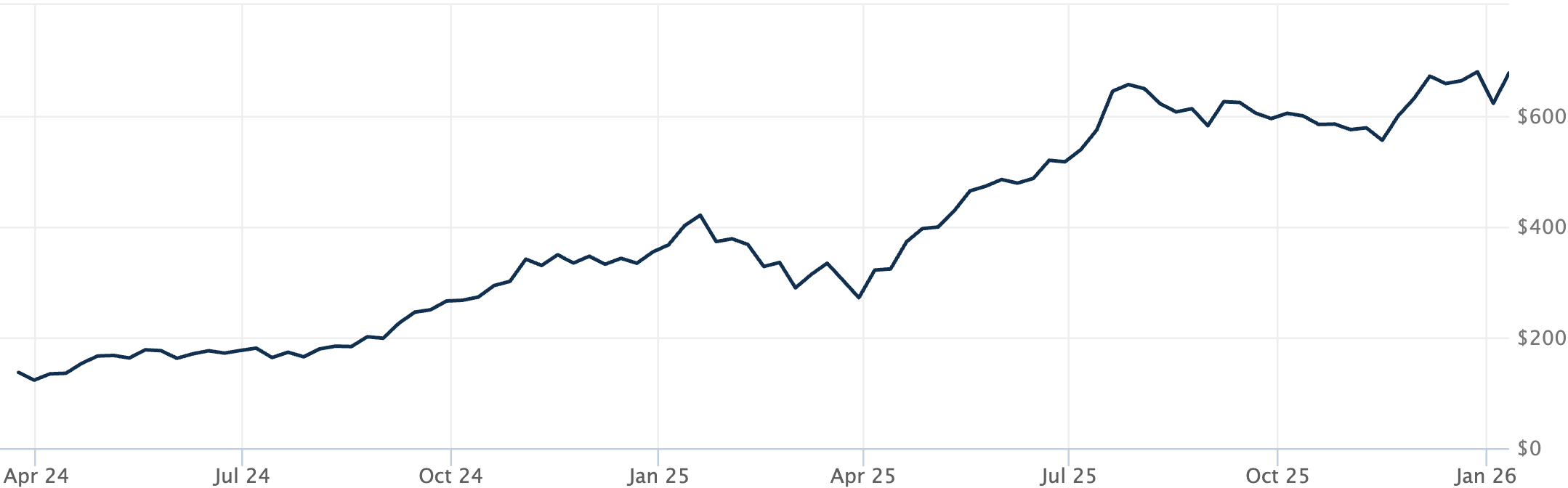
19. Despite hushed corporate net-zero commitments, we’ll see progress in carbon capture and storage (CCS) development. U.S. data centers required around 25 GW of power in 2024 and will likely require over 100 GW of power by 2035, so it’s all but inevitable that natural gas will play a major role in this expansion. While hyperscalers may not tout their sustainability commitments and risk falling out of favor with the Trump administration, they will keep those initiatives in place and direct resources toward reducing the emissions intensities of their new gas generators. According to analysts from Goldman Sachs, data center developers are generally willing to pay a premium of around $40 per MWh over the baseline cost of natural gas for constant low-carbon power. The bank published this at the tail end of the Biden administration before the 2024 election, so maybe sentiments have changed, but I doubt it. Data center developers plan for the long term, and they know the public (and the administration in the White House) will someday give credence to sustainability commitments – and actions – in a way we don’t see at the moment.
20. Direct air capture will face a reckoning. DAC has long been the poster child of carbon removal, attracting more investment than all over CDR categories combined over the last five years. At some point, the bill will come due, and I’m afraid the DAC ecosystem won’t have enough receipts to continue justifying significant investment. The biggest roadblock remains energy input. Even if some companies can reduce their energy demand to one megawatt-hour per ton of CO2 removed, a single MWh of baseload clean energy costs around $100 or more (nothing bothers me more than energy input cost assumptions of $20 per MWh), and there’s no realistic pathway to pull this figure down by much. Perhaps some entirely new designs, requiring only a fraction of the energy that incumbent designs require, will come out of the woodwork. I truly hope this happens, because if it doesn’t, DAC may be bound for a short future.
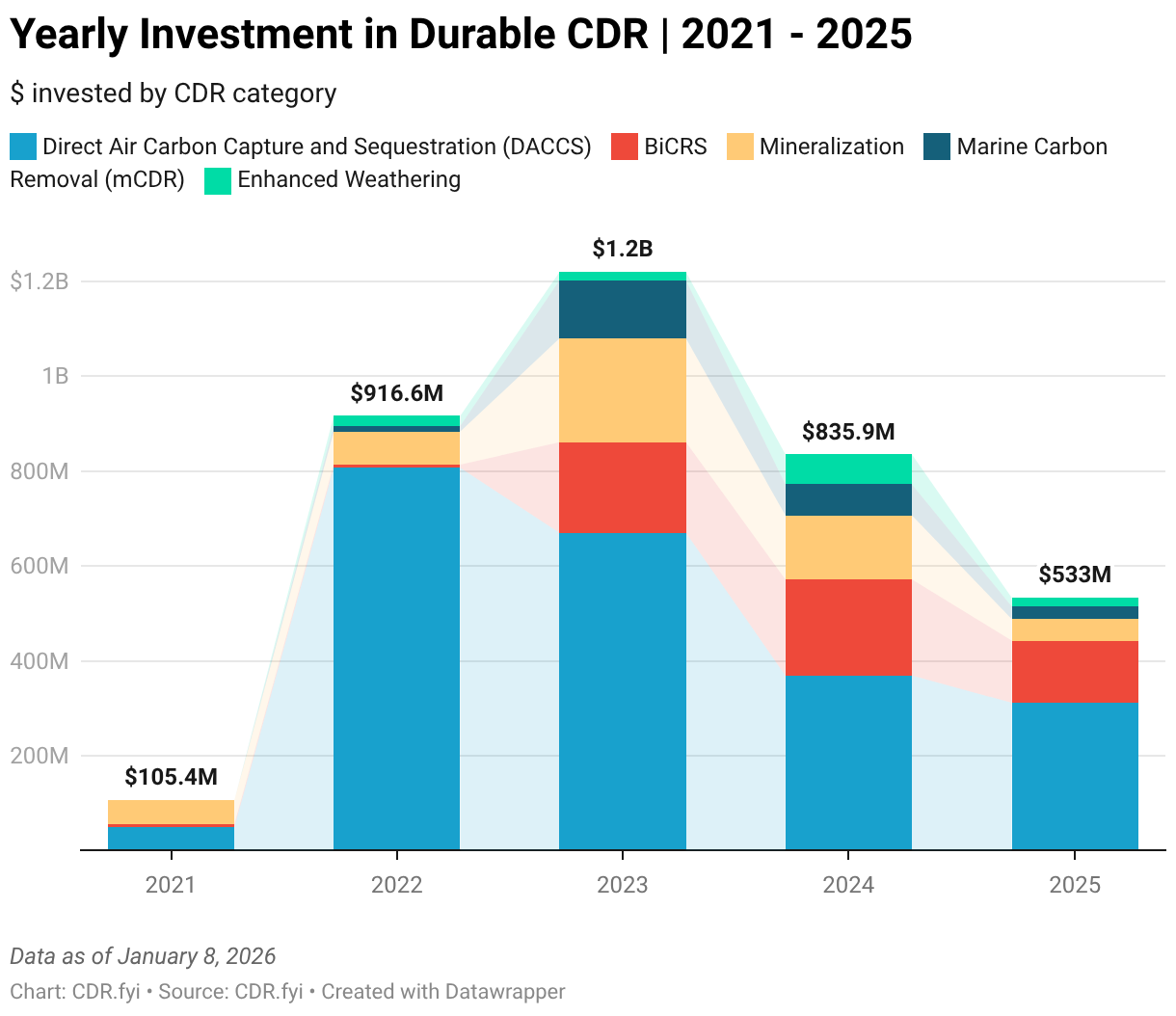
21. But bioenergy with carbon capture and storage (BECCS) will continue to thrive. It has two things DAC does not have: an association with energy production – as opposed to energy consumption – and available CO2 concentrations much higher than 0.04 percent. According to CDR.fyi, under a quarter of 2025 CDR investment went to biomass carbon removal and storage (or “BiCRS,” which includes BECCS and other CDR methods, like biochar), but 98 percent of 2025 CDR purchases went to BiCRS and 98 percent of deliveries came from BiCRS. In other words, the fact that BECCS is far more ready for commercial deployment than DAC is becoming more and more clear to carbon removal buyers like Microsoft and Google. DAC has a far higher ceiling than BECCS in terms of total potential because there are only so many bioenergy facilities to add CCS to (and only so much bio-feedstock to sell to those facilities), but this won’t bottleneck BECCS deployment for a long, long time. As mentioned above, unless DAC technology developers can make significant breakthroughs in energy efficiency, the gap between BECCS and DAC will only widen. The best way for these developers to survive is to pivot toward BECCS.
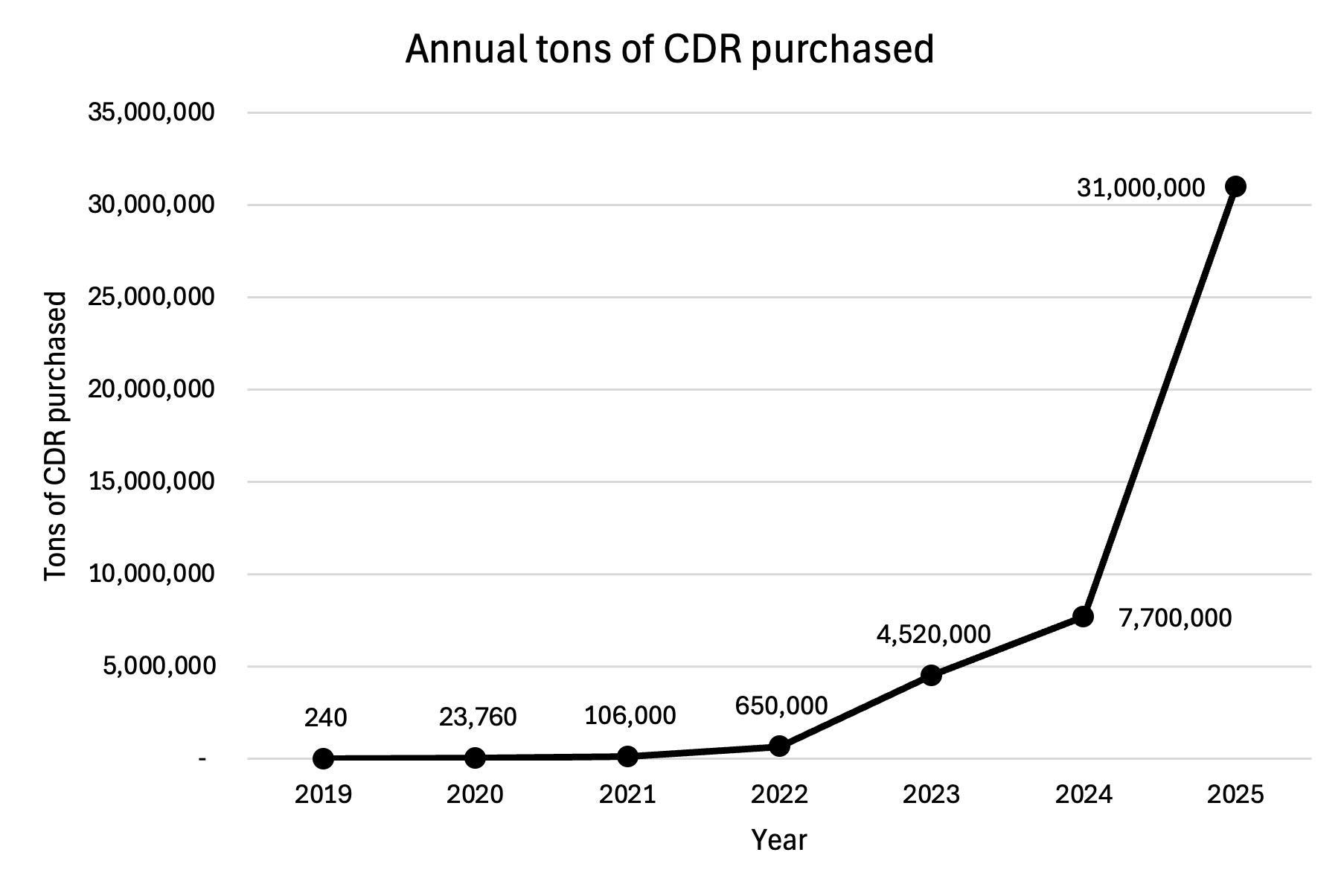
22. For the first time ever, we’ll see less carbon removal purchased than in the previous year. A couple of trends will cause this temporary deceleration. First, Microsoft, which has so far accounted for 79 percent of all CDR ever purchased, will have to slow its pace at some point. Assuming Microsoft’s CDR purchases are close to the historical average per-ton cost of $261, the company spent at least several percent of its annual net income on carbon removal in 2025. Say what you will about corporate responsibility, but this is not sustainable in the long term, especially for a company that aims to catalyze growth across a variety of innovative energy technologies. This brings us to the second trend: Hyperscalers purchasing CDR will continue to shift their energy- and sustainability-related messaging from net-zero goals to firm clean power procurement and will therefore spend more on nuclear, geothermal, and natural gas with carbon capture. We should have a better idea of how these companies will prioritize investing in new energy projects versus purchasing carbon removal to achieve net-zero or net-negative carbon emissions once the dust settles from the ongoing AI data center explosion.
23. The U.S. will set a new annual record for domestic rare earths production. Some have compared the necessary expansion in rare earth element (REE) mining, refining, and manufacturing capacity to the Space Race of the 50s and 60s. Others have compared it to the more recent Operation Warp Speed, which yielded a Covid-19 vaccine in under a year. Either way, the U.S. certainly feels pressure to shift its REE supply chain away from China, ideally with as much domestic refining capacity as possible. As I wrote about in December, the Trump administration has taken a surprisingly hands-on approach to developing the domestic REE supply chain, leaning on things like procurement commitments, price floors, and even government equity stakes in private companies. I have one more post in my four-part series on REE coming soon, so keep an eye out for that in the next week or two.
24. The U.S. will set a new annual record for electric vehicle sales. The 30D and 25E tax credits – for new clean vehicles (up to $7,500) and used clean vehicles (up to $4,000), respectively – expired at the end of September 2025. By now, since EVs are more or less at cost parity with internal combustion engine vehicles even without subsidies, this is far from a death knell for automakers leaning into the EV transition. If anything, the tax credits did exactly what they were intended to do: stimulate enough consumer EV demand to scale manufacturing volumes, reduce production costs for manufacturers, and reduce purchase prices for consumers. Don’t let the recent announcements by multiple American automakers regarding their retreats from all-electric trucks scare you. For now, they’re shifting gears to “extended range” EVs, which, according to Kelley Blue Book, “function much like EV trucks, using only electricity for propulsion and recharging from EV chargers. But they carry a gasoline engine that functions as a generator to recharge the truck on the go when needed.”
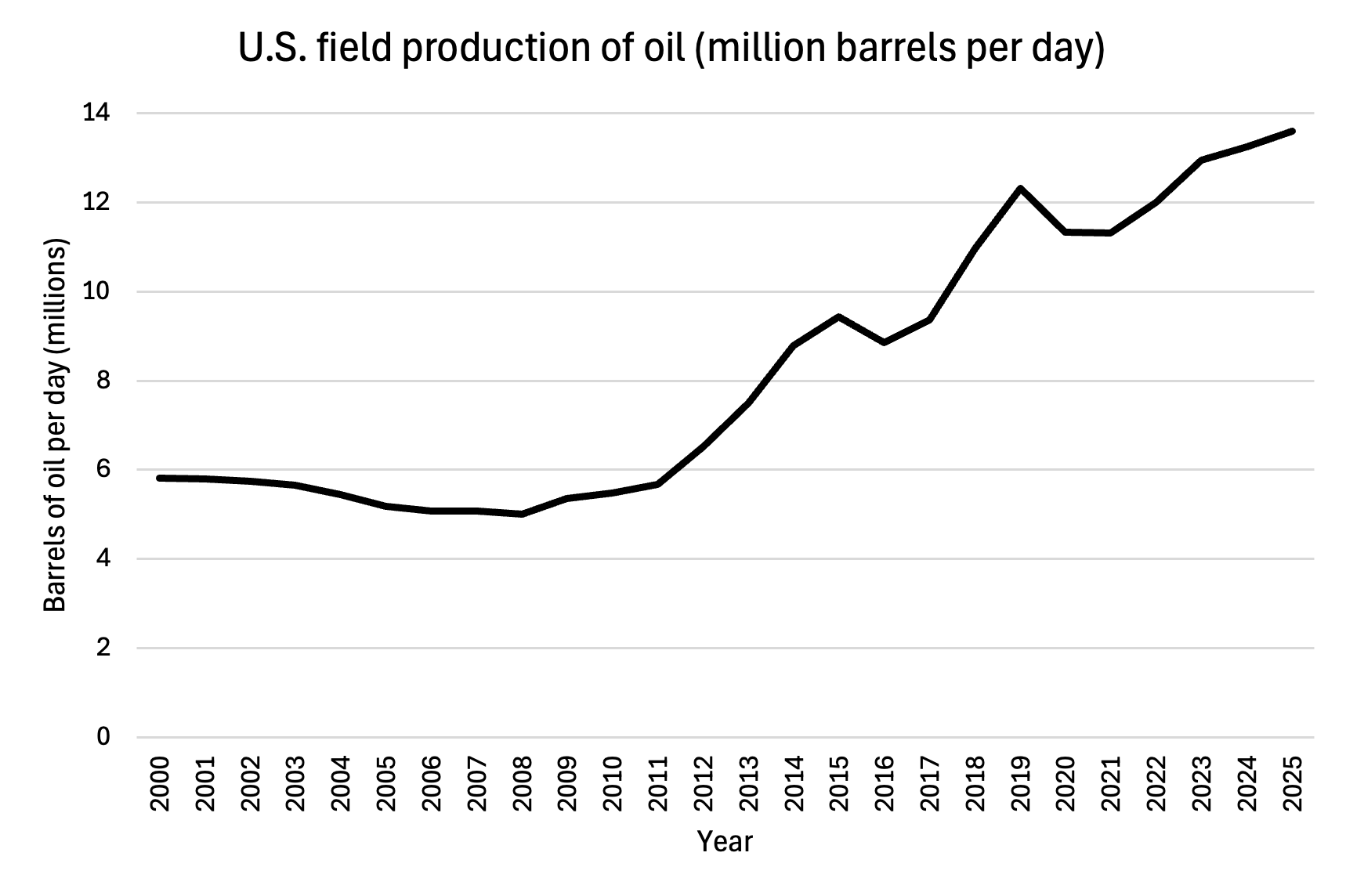
25. There will be less oil production in the U.S. under Trump than there was under Biden. If we use the years from 2017-2020 as a proxy for Trump’s first term and the years from 2021-2024 as a proxy for Biden’s term, Biden actually oversaw 13 percent more oil production than Trump. While estimated 2025 production (13.6 million barrels per day) edged out the previous record of 13.2 million barrels per day in 2024, the EIA expects 2025 to stand as the high point before a slight dip down to 13.5 million barrels per day in 2026. If Trump gets what he wants and crude goes as low as $50 per barrel, supply may respond and shrivel to the point at which Trump’s second term would oversee less oil production than Biden’s term did.
26. There will be more clean energy additions in the U.S. under Trump than there were under Biden. The EIA estimated in August that the U.S. would install 33.3 GW of utility-scale solar capacity in 2025, good for more than half of new electricity generation capacity and hardly short of the record-holding 36.4 GW installed in 2024. Just last week, the agency forecasted that nearly 70 GW of solar capacity would come online across 2026 and 2027. Consider modest growth in wind, increased adoption of natural gas with carbon capture as well as geothermal, and a potential uptick in nuclear, and the period from 2025-2028 is looking pretty good for clean energy regardless of which party controls DC and which geezer occupies the White House.
These last couple of predictions are perhaps the most optimistic, but why shouldn’t they come true? The data is there to back them up. And to paraphrase Honest Abe: The best way to predict our future is to create it.
So, how do you like these predictions? Are any of them insane? Obvious? If you have thoughts, I’d love to hear them. At the end of the year, I’ll come back and revisit the 26 predictions spread across the last two posts and grade myself (as long as my score bears some resemblance to a decent batting average).
Here’s to the remaining 49 weeks of 2026, and frankly, here’s to hoping they don’t look like the first three.
Rock ‘n’ roll afterword
Disclaimer: The opinions expressed in Renaissance Carbon are my own and do not necessarily reflect the opinions of any employer.
Contact: ryandavidson911@gmail.com
Comments
Nothing yet. Say the first thing.
Sign in to join the conversation.