
Going into the holiday season, I started jotting down some predictions for what I thought 2026 might bring in terms of energy and climate. I quickly realized I wouldn’t be able to push this post out before New Year’s Day, but it’s not like anything of consequence was going to happen in the first week or two of the year, right? Hmph.
Either way, here are the first 13 of my 26 predictions about 2026.
1. Contrary to some projections, the world will set another annual record for installed solar capacity. After averaging a 50+ percent annual growth rate from 2021 to 2024, annual solar installations only grew 10 percent from 597 gigawatts in 2024 to around 655 gigawatts in 2025. Keep in mind that these numbers show the amount installed per year; the world now has well over 2,000 GW of solar capacity installed. Several factors, including the U.S. government’s pullback on renewables support, China’s shift from feed-in tariffs to competitive markets, and general transmission constraints, make it seem as though the world may install less new solar capacity in 2026 than it did in 2025. This makes sense given the Chinese National Energy Administration’s target of only 200 GW of solar additions per year from 2025 to 2027, but other huge markets (like India and, yes, the U.S.) will continue accelerating deployment.
2. The world will set a record for the most offshore wind capacity added in a single year. After 2025 broke the record for most wind capacity (onshore and offshore) added, Wood Mackenzie forecasted that onshore wind additions in 2026 wouldn’t quite reach 2025 levels. This is largely due to the end of China’s 14th Five-Year Plan, which included aggressive onshore wind deployment targets from 2021 through 2025. Now, after a slow several years in offshore wind construction worldwide, 75 percent of the 2026 capacity additions are already under construction. Over 21 GW of offshore wind came online in 2021 (the vast majority of which came from China because the country phased out its offshore wind subsidy at the end of that year), and I think we’ll see at least 22 GW come online this year.
3. The U.S. will set a domestic record for the most offshore wind capacity added in a single year. Yes, that’s right. As of the end of 2025, the U.S. had 824 megawatts of operational capacity: 132 MW from South Fork (New York), 30 MW from Block Island (Rhode Island), 12 MW from the Coastal Virginia pilot (Virginia), and 650 MW from the not yet fully complete Vineyard Wind (Massachusetts). The Department of the Interior issued stop work orders for all five offshore wind projects currently under construction (including the remaining 156 MW of Vineyard Wind) on December 22, but multiple developers filed lawsuits within days. The back-and-forth starting and stopping of construction will likely continue throughout 2026 and beyond, but I’m holding out hope that the need for more electrons will prevail and the White House will quietly concede. This need for more electrons is especially clear in states like Virginia, where the Coastal Virginia project expansion is nearly complete and will provide 2.6 GW of power to the state with the highest concentration of data centers in the country. Left to their own devices, the U.S. offshore wind industry would absolutely increase cumulative installed capacity multiple times over in 2026.
4. The U.S. will finally enact new energy permitting legislation. After Senators John Barrasso (Republican from Wyoming) and Joe Manchin (Independent from West Virginia, now retired) ran out of time to pass their Energy Permitting Reform Act of 2024 in the 118th Congress, energy permitting reform remained high on the Congressional priority list going into the 119th Congress. The Standardizing Permitting and Expediting Economic Development Act, or SPEED Act, passed the House of Representatives on December 18 with 11 Democrats voting in favor. It faces a steeper hill in the Senate, where it must gain 60 votes for passage (Republicans hold a 53-47 majority), and where Democratic Senators like Sheldon Whitehouse (Rhode Island) and Martin Heinrich (New Mexico) have spoken out against the bill in response to the administration’s actions against offshore wind. It won’t be easy, but ultimately, I think some sort of energy permitting legislation will pass. Each side will have to cede territory, and the legislation will be far from exhaustive (the SPEED Act focuses on NEPA reform), but it will be a step in the right direction.
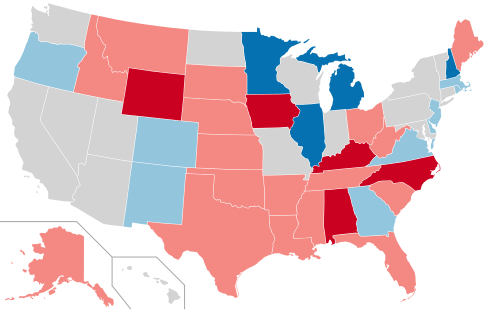
5. Energy affordability will play a central role in the 2026 midterm elections, in which the U.S. House will flip back to the Democrats and the U.S. Senate will stay with the Republicans… but just barely. With a five-seat advantage in the House, Republicans can only yield two seats and maintain their majority; since World War II, the majority party in the House has performed better than this only twice. The Senate is far more interesting, and the 2026 electoral map doesn’t do Democrats any favors. Their best bets lie in North Carolina, where Republican Thom Tillis is retiring, and Maine, where Republican Susan Collins will face a difficult Democratic challenger in either Governor Janet Mills or oysterman Graham Platner, assuming Collins wins the primary. Even if Democrats pick up these two seats, they’ll be two short of a Senate majority, so they’ll need to win at least two of the three Senate races across Iowa, Ohio, and Texas, which is a longshot (and they’ll have to keep all their current seats, which is not a given in states like Georgia and Michigan). Therefore, the 120th Congress will be a split Congress, and for a couple of years we won’t see any landmark legislation reminiscent of Biden’s Inflation Reduction Act or Trump’s One Big Beautiful Bill Act.
6. Anti-data center movements will grow on both the left and the right, but the middle will prevail, giving moderate Democrats and Republicans something to agree on. From a very high level, the urban left wants to check the sector’s resource intensity (across both energy and water) and the rural right draws upon NIMBY tactics. Each side is valid for their concerns, and we certainly must address them, but the truth is that these concerns alone will not be enough to halt our insatiable and exponentially growing demand for compute. My guess is that legislation requiring data centers to bring their own generation, ideally easing costs on non-data center customers, will garner the most support. Since solar and wind tend to be the fastest projects to build, a happy side consequence of such legislation might be more renewables projects coming online, which could potentially even send excess power back to those non-data center customers currently bearing the brunt of rate increases.
7. The AI bubble will finally pop, but it won’t be as bad as many are predicting it will be. Despite what I said in the previous prediction, one key factor will be a shortfall of power generation capacity. More worrying, though, is the circular nature of spending by AI giants like Microsoft, OpenAI, Oracle, and the chip provider at the center of it all, Nvidia. If AI companies, particularly those outside the largest few, fail to get enough paying customers soon, this whole web of intersecting purchases and investments could start to unravel. The good news is that if (or when) this happens, it shouldn’t be nearly as bad as the dot-com bubble burst in the early 2000s. Cisco, for example, saw a P/E ratio over 200 right before its stock lost nearly 90 percent of its value between March 2000 and October 2002. For all the speculation, even Nvidia has a P/E ratio under 50 right now.
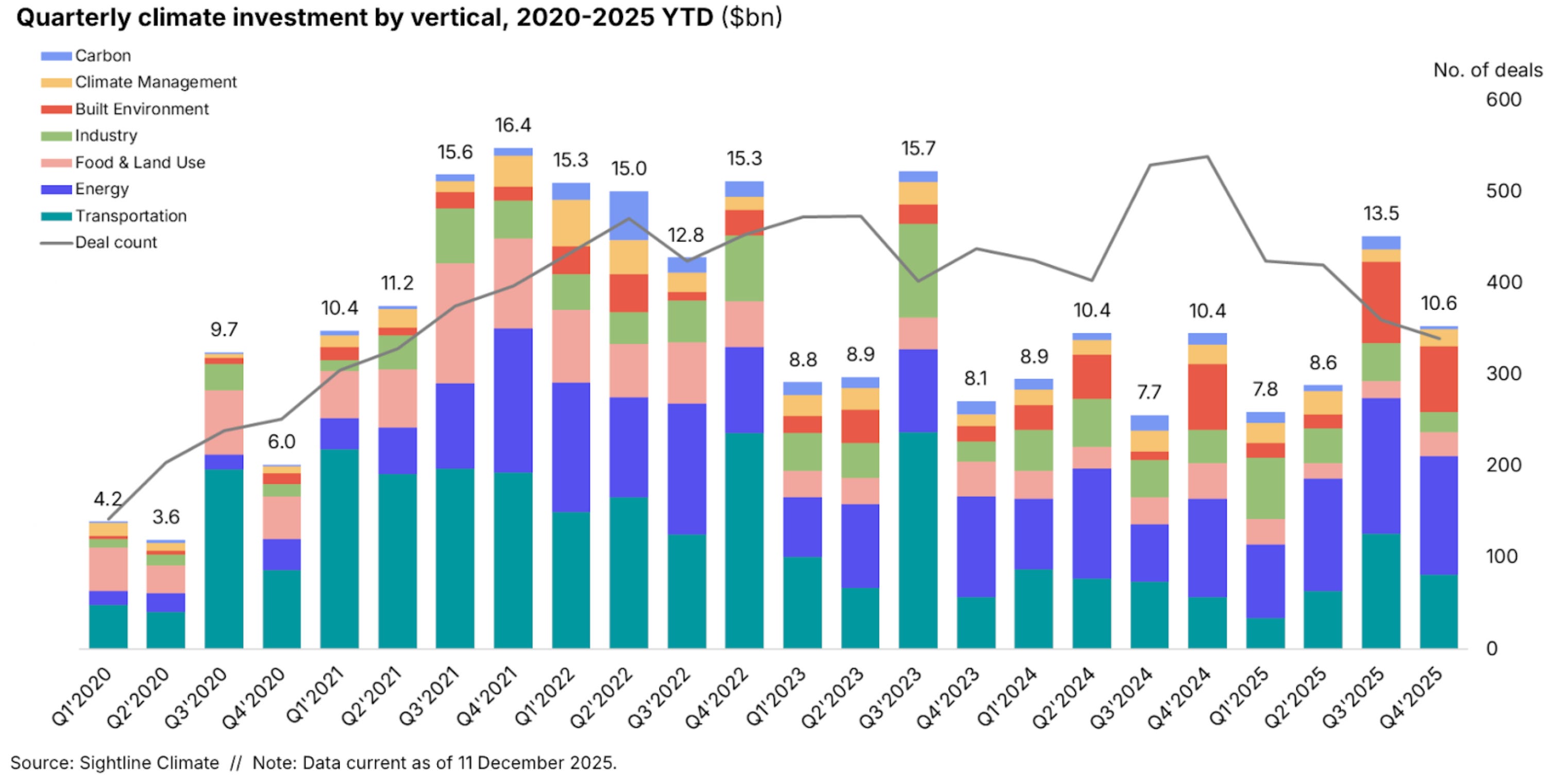
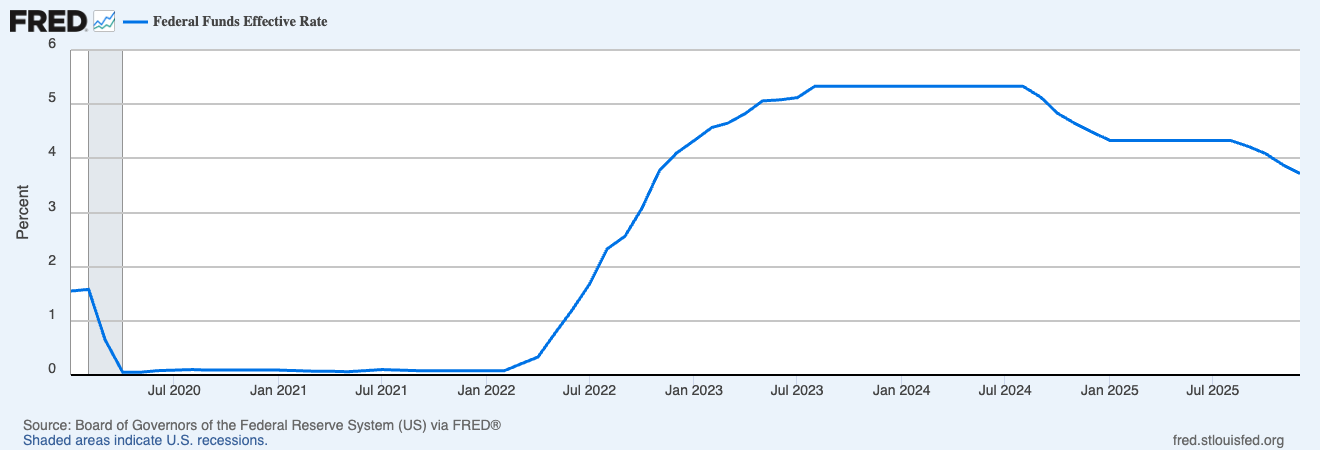
8. Clean energy investment will surpass 2025 levels. After a red-hot period in 2021 ($53.6 billion) and 2022 ($58.4 billion), climate investors signed checks more sparingly from 2023 through 2025, signaling the end of the “Climate tech 2.0” era. In all fairness, the investment craze couldn’t last forever. While it might intuitively feel like it should be harder to raise venture capital for clean energy and other climate-related technologies during the Trump administration than during the Biden administration, think again. According to CTVC, climate investment actually increased eight percent during Trump’s first year back in office compared to Biden’s last year in office. If we put a graph showing climate investment from 2020 to 2025 next to a graph showing the Federal Funds rate over the same period, a clear trend appears: Move the investment graph back by about a year to account for due diligence processes, and it’s essentially the inverse of the Federal Funds rate graph. This makes sense; VCs are more likely to put capital to work when that capital is relatively cheap. Trump will continue pushing for lower interest rates, and with a new Fed Chair, he’ll probably get what he wants more often. For better or for worse, this should lead to increased investment, including in climate tech.
9. The DOE Office of Energy Dominance Financing (EDF), formerly known as the Loan Programs Office (LPO), will have a big year and make at least 15 conditional commitments for loans. After LPO closed 14 loans or loan guarantees and made 15 conditional commitments in 2024, movement slowed to a trickle in Trump’s first nine months back in office before three conditional commitments were announced in the fall. While Project 2025 proposed shuttering LPO completely, the White House is taking another approach, retooling (and renaming) the office to focus on baseload power and resource extraction. Of the 15+ conditional commitments I’m predicting this year, I bet we’ll see at least one for each coal, critical minerals, geothermal, natural gas, nuclear, and transmission infrastructure. Trump’s EDF may have different motives than Biden’s LPO, but the results may not be all that different. Aside from a few fossil fuel projects, the office will enable the U.S. to lead a lower carbon energy future.
10. The line between energy security and national security will grow more and more blurred, both in the U.S. and around the world. This is no less true when removing Venezuela from the conversation. The clearest example is the growing tension between China and much of the rest of the world, from the U.S. to Australia to Japan and others, regarding access to rare earth elements (REE). Their unique magnetic properties make them critical for a variety of energy applications, like electric motors and wind turbine nacelles. At the same time, REE are indispensable for defense technologies. As I wrote last month, “according to the DOD, F-35 fighter jets each require 900 pounds of REE, Arleigh Burke DDG-51 destroyers each require 5,200 pounds of REE, and Virginia-class submarines each require 9,200 pounds of REE.” In the first quarter of the 21st century, the intersection of energy security and national security focused on hydrocarbons. In the second quarter, it will focus on rare earths.
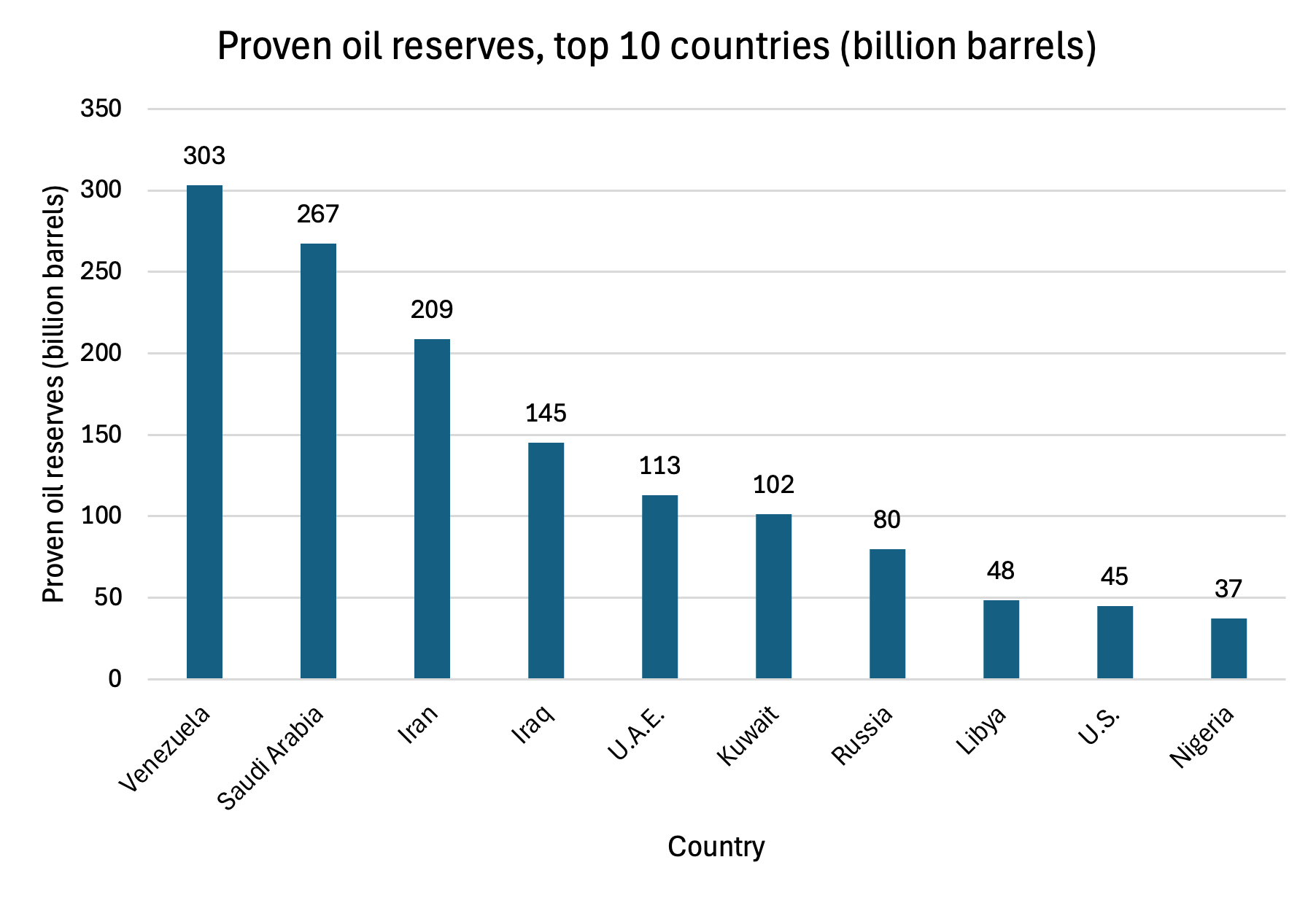
11. Venezuela will remain in the headlines all year, but not much will happen regarding the country’s oil infrastructure. Production won’t budge; considering the development timelines required for the necessary infrastructure upgrades, that much is given. But outside of Chevron, which already operates in Venezuela, it’s a longshot for American oil companies to invest in Venezuelan infrastructure at all. ExxonMobil and ConocoPhillips used to operate there, until Hugo Chávez kicked them out and nationalized their assets in 2007. Why would they risk investing (and losing) billions more dollars in the midst of such a volatile political situation? ExxonMobil CEO Darren Woods even called the country “uninvestable” unless the legal system changes significantly. WTI crude oil currently sits below $60 per barrel, far below the threshold for companies to break even on massive new projects in a country with dilapidated infrastructure and relatively heavy crude (and, of course, the volatile political situation). It’s tough to imagine American oil companies investing $100 billion in Venezuela over the next decade, regardless of its claim to the most oil reserves in the world (303 billion barrels) and the fact that U.S. Gulf Coast refineries are well-equipped for heavy crude. As global oversupply continues to push prices down, this will become even more clear.
12. Imperialist talk will continue beyond Venezuela, and U.S. energy access will remain the throughline. The “Donroe Doctrine,” a corollary to President James Monroe’s (1817-1825) foreign policy in Latin America, reasserts the U.S. status as the police force of the Western Hemisphere and sends a signal not only to Europe, but to China and Russia, that they better tread carefully in the Americas. Trump has already hinted at interventions in Colombia and Mexico and has said he believes the Cuban regime will fall without access to Venezuela’s oil. But the country perhaps most likely to fall into the fray has hardly been mentioned: Guyana. Venezuela’s neighbor to the east has the fastest growing economy in the world, spurred on by ExxonMobil’s 2015 offshore discovery of 11 billion barrels of light, sweet crude. Venezuela has provoked the country over its oil reserves in recent years, and there’s no reason to believe the U.S. will leave it completely alone.
13. Greenland will remain a focal point of the Donroe Doctrine, but not for any oil reserves. Trump has frequently expressed interest in taking over the Danish territory for its rare earth elements and other critical minerals, like nickel and copper (and its strategic position in the Arctic), and the administration has stepped up its rhetoric in the first two weeks of this year. At the end of the day, though, not much will happen. Building any sort of infrastructure, much less mining infrastructure, in such a remote and unforgiving environment is often prohibitively expensive, and it’s not like the U.S. doesn’t have rare earth deposits of its own (more on this in a couple of weeks). The U.S. has had a military presence in Greenland since World War II, and if Trump wants to develop rare earth production capacity and expand the military’s presence on the world’s largest island, Denmark will allow it.
I’ll wrap up this post for now, so stay tuned next week for my second batch of 2026 predictions.
You won’t want to miss it; a few of them are sure to raise eyebrows.
Rock ‘n’ roll afterword
Disclaimer: The opinions expressed in Renaissance Carbon are my own and do not necessarily reflect the opinions of any employer.
Contact: ryandavidson911@gmail.com
Comments
Nothing yet. Say the first thing.
Sign in to join the conversation.