
This is the final post in a four-part series on rare earths. The first three posts can be found at the following links:
Part I: A series on the most important resources we almost never talk about
Part II: How the U.S. ceded dominance in rare earth mining
Part III: The U.S. is a day late and a dollar short
I finished Part III of this four-part series on rare earth elements (REE) with a question:
Is going head-to-head with China the only option for the U.S. to regain the edge it held decades ago?
Theoretically, no.
But humor me for a minute, and let’s consider what it might look like for the U.S. to go it alone against China. American REE production jumped from nothing in 2017 to 45,000 tons in 2024, good for 11 percent of global market share:
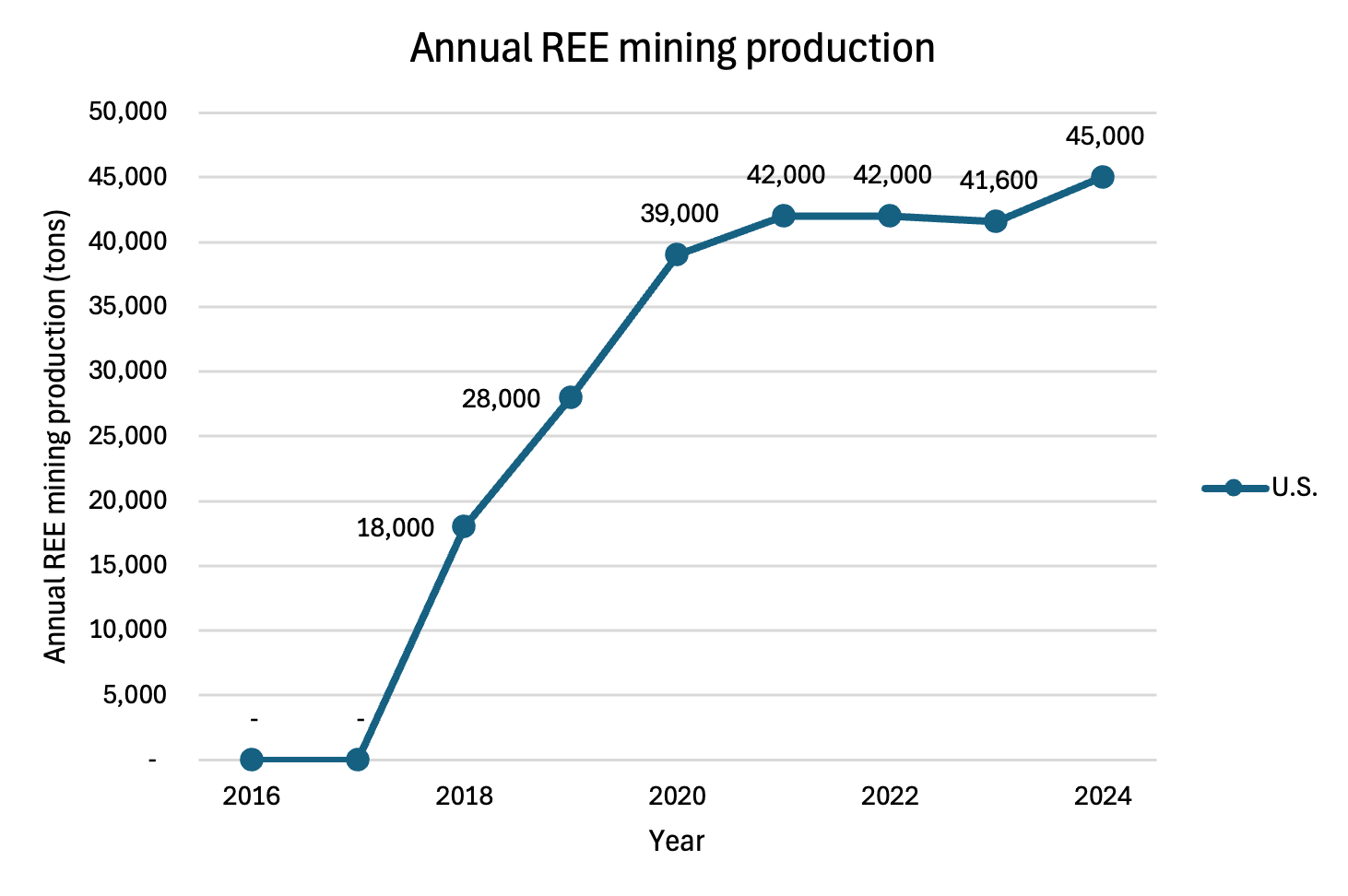
It’s not like this jump came from the revitalization of an industry with a nationwide footprint; Mountain Pass, operated by MP Materials in California’s Mojave Desert, is still the only commercial-scale REE mine in the country. Plus, this jump doesn’t account for any of the Trump administration’s supportive measures for MP Materials announced in July 2025:
A 10-year procurement commitment
A price floor of $110 per kilogram of neodymium-praseodymium (NdPr) oxide, 33 percent above the current market price
A $700 million investment for a 15 percent equity stake in the company
Don’t get me wrong. This is good news. But let’s not forget just how dominant China has become over the past three decades:
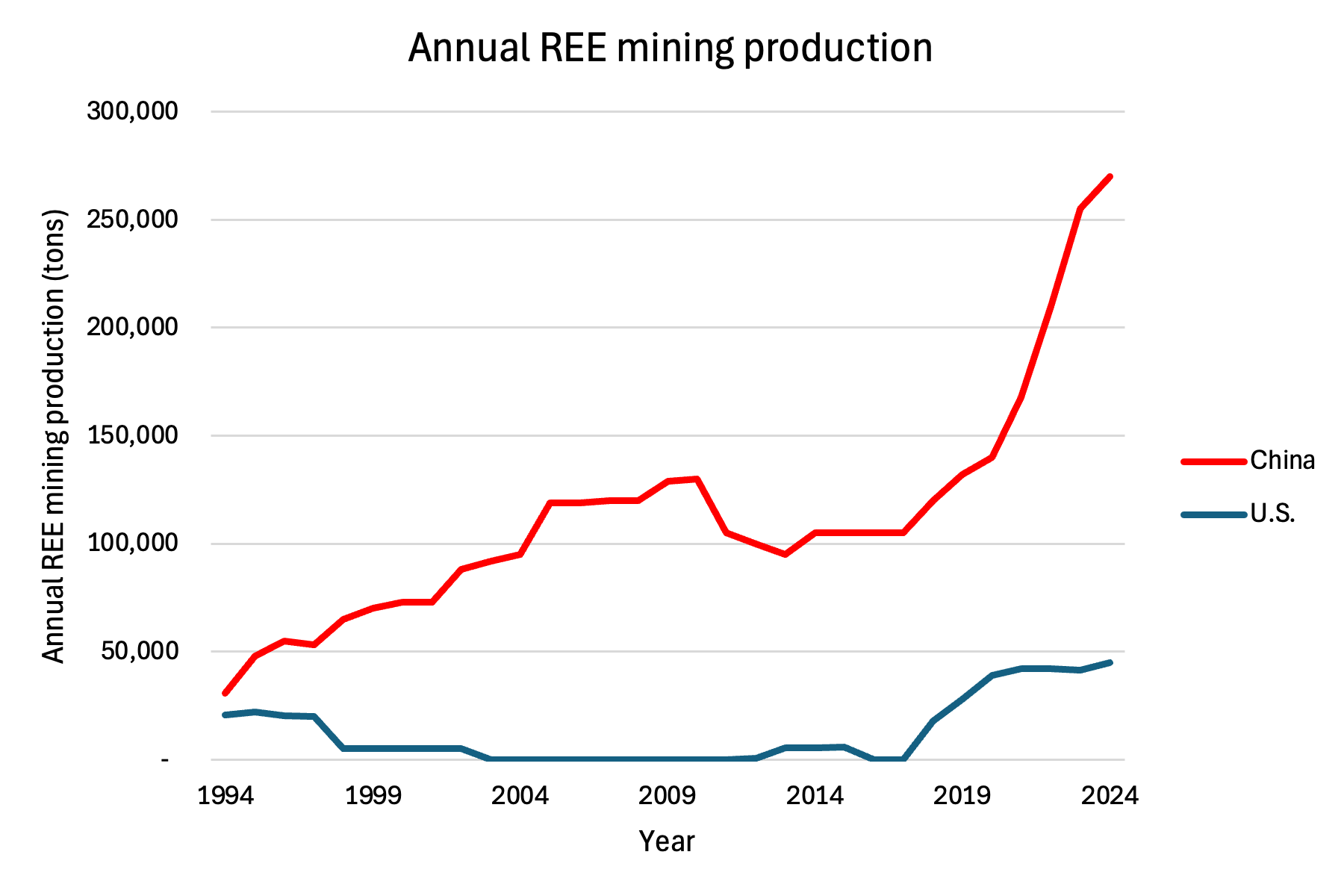
Even after restarting what used to be the most productive rare earth mine on the planet, the U.S. produces only one sixth what China produces, and China shows no signs of slowing its growth. Apparently, that’s scary enough to make Trump adopt a semi-socialist stance toward reshoring REE production. As weird as it feels to admit, that’s probably the right stance given China’s obvious superiority.
In 1992, former Chinese paramount leader Deng Xiaoping said:
“The Middle East has oil; China has rare earths.”
This may seem to imply that China holds dominion over rare earth availability. While the country has gained a significant majority of REE mining market share by effectively leveraging its natural resources and largely bypassing environmental reviews that Western countries tend to prioritize, it is not inevitable that China will always mine more rare earths than the rest of the world combined. As I said in Part I:
“It’s worth noting that REE are not particularly rare, but they tend to appear in low concentrations…”
These low concentrations are spread somewhat evenly throughout the Earth’s crust, meaning the U.S. has plenty of REE available to mine. We just don’t have a thorough understanding of where and how we can access these resources at minimal cost, both financially and environmentally. However, we do have an idea of where some commercially viable deposits may be located:
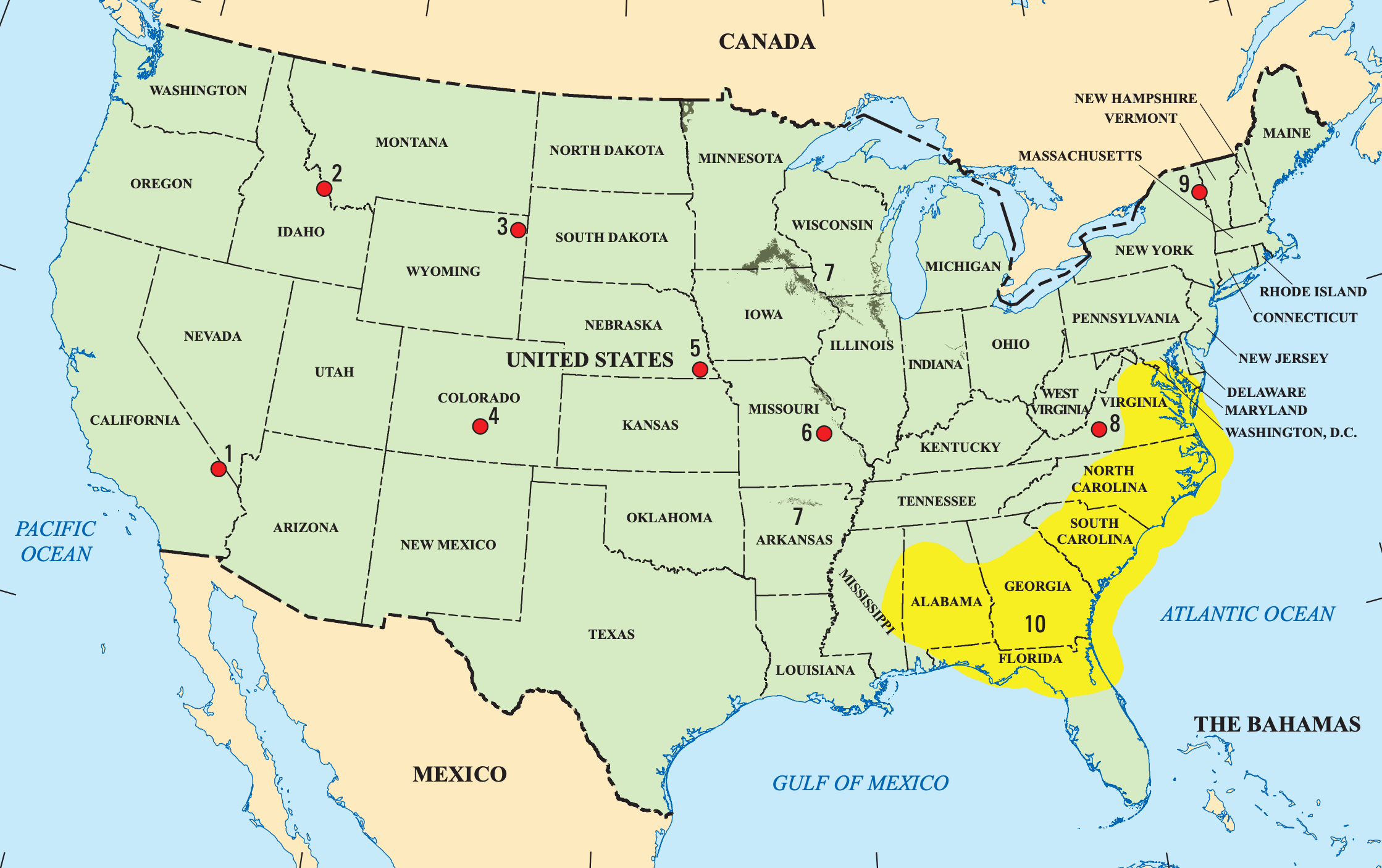
The 2019 USGS report “Rare Earth Element Mineral Deposits in the United States” lists 11 known REE deposits in the U.S. Mountain Pass is one of them, and some of the others have unique characteristics of their own that could help close the gap between the U.S. and China. Here are just a few:
Bear Lodge, Wyoming, which is scheduled to begin full operations of a demonstration facility in early 2026, is located near other potential REE development sites: Halleck Creek and Beaver Creek. This clustering may enable mining companies to more economically scale up a local supply chain in Wyoming.
Elk Creek, Nebraska has a mineral deposit with high concentrations of both rare earths and niobium, a metal used to make lighter and stronger steel. Because the deposit is buried under 200 meters of sedimentary rock, a facility there would be less environmentally impactful than an open pit mine.
Pea Ridge, Missouri has especially high concentrations of heavy REE, like terbium, dysprosium, and holmium, while most other deposits – particularly those in the U.S. – can only offer light REE. The huge kicker, though, is that Pea Ridge is already permitted because it is a brownfield site that operated as an iron mine from 1964 to 2001.
This USGS map doesn’t come close to painting the full picture of undeveloped rare earth deposits in the U.S. Round Top, Texas – whose majority owner, USA Rare Earth, just scored a $1.6 billion deal with the U.S. federal government – may yield 16 of the 17 rare earths. Sheep Creek, Montana has an estimated total rare earth oxide (TREO) concentration of around nine percent, making it one of the most concentrated REE deposits in the world. We have surely not found the last of the attractive locations to mine for rare earths.
But let’s come back down to Earth now.
Even if Chinese production of REE were to flatline (it won’t), we’d need five additional mines as productive as Mountain Pass just to match China’s production. Our rare earth mining capacity could grow multiple times over, and even if we fast track through the environmental review process to do this (we won’t), we’ll fall short in the 2040s of where China stands in the 2020s… and China will themselves advance by leaps and bounds between the 2020s and 2040s. Keep in mind that the U.S. has the second longest average mine development time in the world at 29 years, second only to Zambia’s 34 years. As things stand now, for a new deposit discovered in 2026, we’d need to develop the mine 17 percent faster than average just to achieve first production by 2050.
Put simply, developing new rare earth mines in the U.S. will be necessary, but by no means sufficient, to challenge China’s dominance. We’d need nothing short of a miracle to put American REE production in the same ballpark as Chinese REE production. But like I said: We shouldn’t need that miracle at all.
As I mentioned in Part II, the story of rare earths is in many ways a story of two behemoths – China and the U.S. – but I’d be remiss to omit the fact that the long cast of characters surrounding them will decide who ultimately secures hegemony. And as I argued in Part III, the U.S. can’t possibly face China on its own. These side characters must take on more responsibilities if the world is going to pull the REE supply chain from China’s death grip. Of course, this assumes the U.S. allows them to, but we’ll finish with that.
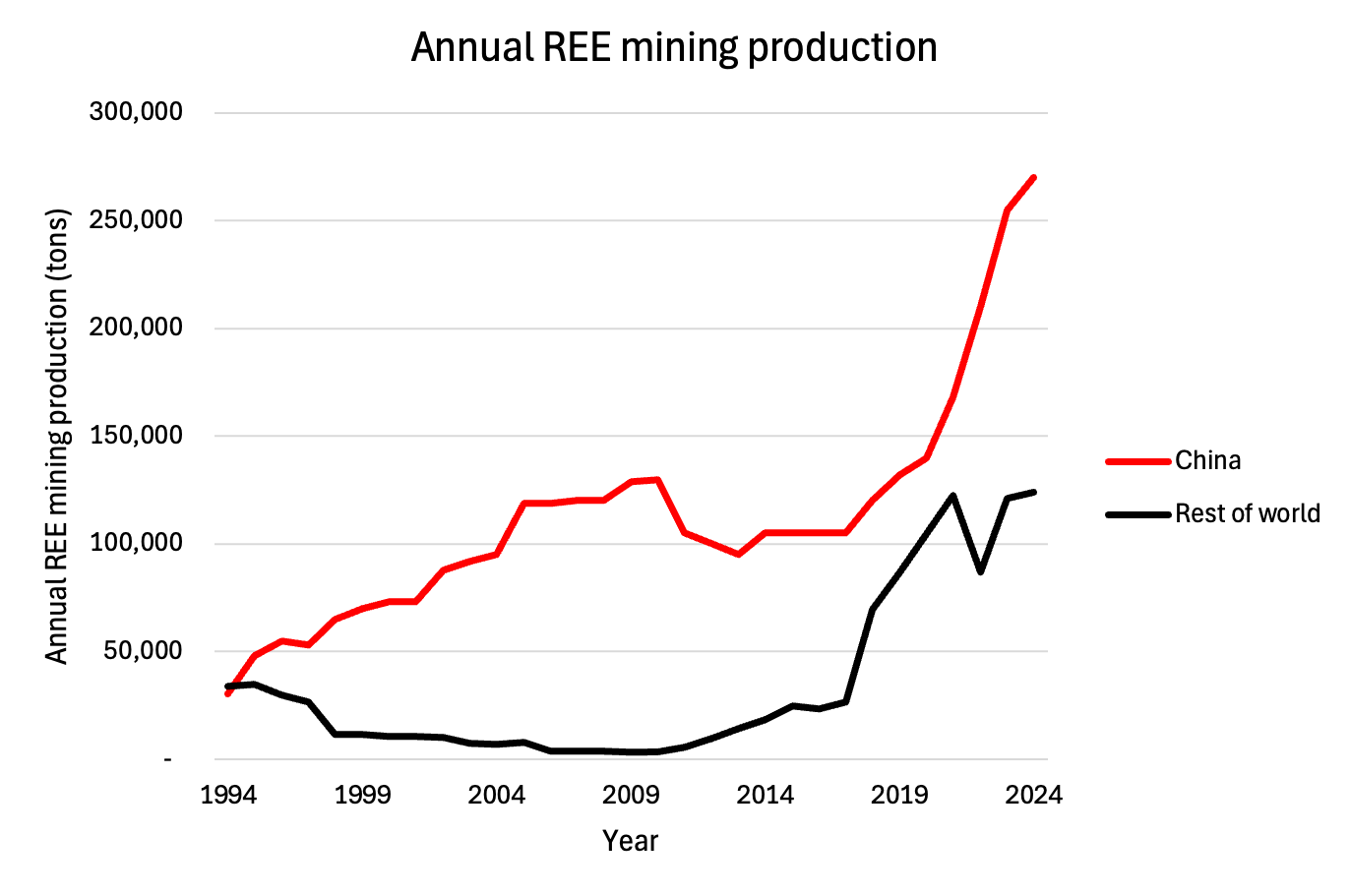
You may remember “comparative advantage” from introductory economics, when Country A specializes in apples because it can grow apples at a low cost, Country B specializes in bananas because it can grow bananas at a low cost, and the two countries trade based on their relative demands for the two fruits. For as many countries to contribute to the global REE supply chain as possible, they must leverage their respective comparative advantages when it comes to rare earths. This is the only way we can start to change this graph:
Let’s grossly oversimplify things and assume we can break the rare earths supply chain into three main phases:
Mining
Refining
Manufacturing
Countries with a comparative advantage in one phase may not hold a comparative advantage in another. What might we look for when deciding which countries have the greatest comparative advantages in each phase?
Mining: While rare earths are distributed somewhat uniformly throughout the Earth’s crust, some areas are still more attractive than others. That’s why we can single out locations like Bayan Obo in China and Mountain Pass in the U.S. Plus, environmental regulations, or lack thereof, play a key factor; lax rules are largely what enabled China to grow so dominant in this space to begin with. Institutional knowledge around mining, in countries like Australia and Brazil, help as well.
Refining: If not for the fact that China controls around 90 percent of global REE refining capacity, the best indicator that a country has a comparative advantage in REE refining would be its REE mining capacity; after all, it makes sense for mining and refining facilities to co-locate and share labor and infrastructure. Other factors will gain relative importance as the global rare earths supply chain matures, too. Availability of cheap local energy, particularly cheap clean local energy, will enable countries like Saudi Arabia and Australia to expand their REE refining capacities as they expand their industrial capacities in general.
Manufacturing: Developing countries actively building out their industrial bases will be well-positioned to manufacture valuable final products from refined rare earths. Intellectual property will also play a role; while China dominates IP around mining and refining, Japan is more focused on the actual products that require rare earths, with companies like Hitachi and Mitsubishi leading the way. Proximity to demand for those final products, of course, is also a big deal, and nobody comes close to China in that regard. And maybe it goes without saying, but lower labor rates across the board (not necessarily specific to manufacturing) will support assertions of comparative advantage.
More than a handful of countries from around the world must play key roles in building rare earth supply chains that operate independently from China and China’s sphere of influence. Who are they, and how must these countries work together?
Myanmar (Burma): The Kachin State in Myanmar, which shares a northern and eastern border with China and a western border with India, has one of the heaviest concentrations of REE mines in the world, specializing in heavy rare earths like dysprosium and terbium in ionic adsorption clay deposits. However, given the active civil war, the Kachin Independence Organization’s opposition to the junta, and the country’s close ties with Beijing, aligning Burmese interests with American interests may not be in the cards.
Australia: Lynas’s Mount Weld rare earths deposit, about 450 miles northeast of Perth, has been Australia’s only commercial REE mine for 15 years. The country has other projects approaching first production, though, across multiple states and territories, including the Dubbo project by Australian Strategic Minerals in New South Wales (rare earths, zirconium, niobium, and hafnium) and the Nolans project by Arafura in the Northern Territory (rare earths, phosphate, uranium, and thorium).
Brazil: In terms of rare earth reserves, Brazil stands second in the world behind China. The Serra Verde facility in the state of Goiás, about 150 miles north of Brasília, focuses on neodymium and praseodymium (light REE) and dysprosium and terbium (heavy REE). With support from a recent $565 million financing package from the U.S. International Development Finance Corporation and an option for the U.S. government to acquire a minority stake in Serra Verde, the facility is expected to produce 6,500 tons of rare earth oxides annually by the end of 2027.
India: Like the U.S., India has recently prioritized building self-sufficiency in rare earths production. The Union Budget 2026-27 announced the creation of “Dedicated Rare Earth Corridors,” which will cover the south and southeastern coastal states of Andhra Pradesh, Kerala, Odisha, and Tamil Nadu and will cover research, processing, and manufacturing in addition to mining. Plus, recently discovered hard-rock deposits in Gujarat and Rajasthan on the other side of the country should contribute to the country’s domestic production.
Greenland: I predicted last month that despite Greenland’s prominent position in the “Donroe Doctrine,” not much will happen in terms of REE mining infrastructure development in the autonomous territory of the Kingdom of Denmark. Sure, the White House may strike a deal with Denmark over mineral rights. But the U.S. and allies in more hospitable climates are fast-tracking REE development already, and the remote locations of Greenland’s deposits may render rare earths from the largest island on the planet prohibitively expensive.
Just as the U.S. aims to vertically integrate its rare earths supply chain, other countries, like Australia, Brazil, and India are attempting to do the same. For example, the Dubbo project in New South Wales, Australia is planning for a “mine to metals” business model, which will co-locate refining and manufacturing infrastructure alongside the newly developed mine. While this collective isolationism may at least provide some security at the national level, it just looks a bit like a heavily marked up insurance policy at the international level.
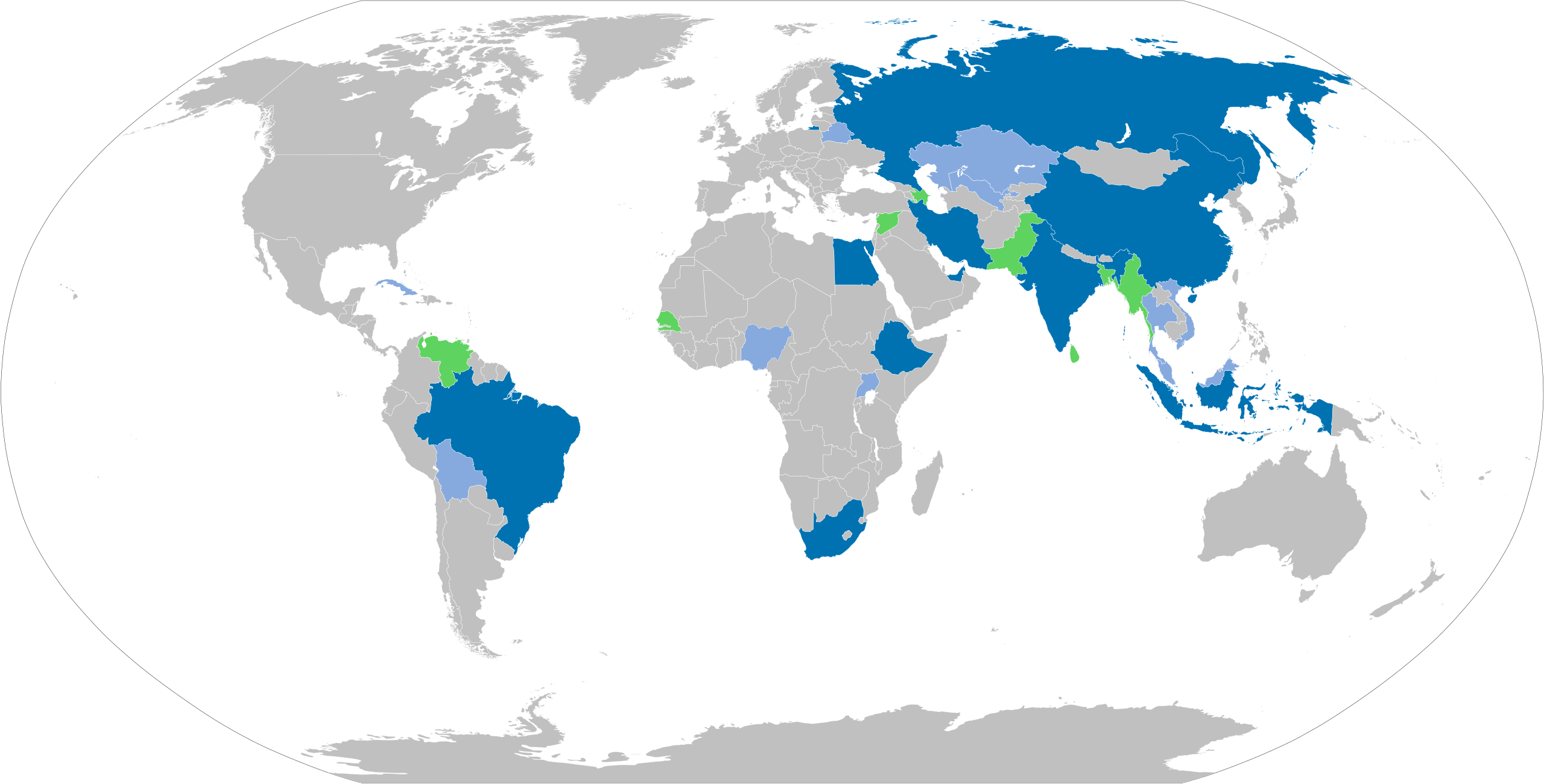
Saudi Arabia: While Saudi Arabia may have an attractive endowment of heavy rare earth deposits, according to the Center for Strategic & International Studies, “the kingdom is positioning itself to become a global hub for refining and midstream capacity across a broader suite of critical minerals” than just REE. The Saudi mining company Maaden recently formed a joint venture with MP Materials and the U.S. DOD, and with its affordable and abundant clean energy resources, the country will serve as a processing hub between mines in Africa and magnet manufacturing facilities in the West.
Malaysia: Lynas Malaysia has long imported concentrate from the Lynas Mount Weld site in Western Australia, and since the Malaysian facility contributes 11 percent of the world’s refined rare earths, it is the primary reason China doesn’t hold a complete monopoly over rare earths refining. By banning the export of raw REE, Prime Minister Anwar Ibrahim made it clear that Malaysia will increase its refining capacity as it increases its mining capacity.
Vietnam: Like Malaysia did a couple of years ago, Vietnam recently approved a law that would ban raw exports of REE, as well as strictly control REE exploration, mining, and processing. While Vietnam has significant reserves of its own to refine, it almost appears to be positioning itself not only as a regional alternative to China, but as a regional competitor to Malaysia.
Canada: The fact that Canada already generates around 80 percent of its electricity from non-fossil sources is a huge boon for its REE refining sector. The E.U. carbon border adjustment mechanism (tariff on the embedded emissions of imported goods) entered full force in January 2026, the U.K. CBAM will follow suit in January 2027, and even the U.S. is making some noise about adopting a CBAM at some point. While rare earths are not yet included in the E.U. or U.K. systems, they very well could be in the future. If (or when) they are, European importers will be incentivized to import from Canada and its low-emission electricity mix.
Australia: As mentioned above, Australia has historically sent its rare earths to Malaysia for processing, but that is bound to change soon. Lynas Rare Earths has established the first REE cracking and leaching facility down under, allowing the output from the Mount Weld site to be processed domestically. Plus, Iluka Resources is expanding its scope beyond titanium oxide and zircon and will soon process rare earths at its new refinery in Western Australia.
China mines far more REE than any other country, but they hold an even stronger advantage in refining. Mining powerhouses like Australia and Brazil are attempting to break away from this dependency by vertically integrating their domestic rare earth supply chains. Other countries, like Saudi Arabia, may serve as midstream hubs between the mining and high-tech manufacturing stages elsewhere. Bottlenecks in decoupling from Chinese REE supply chains won’t involve mining as much refining.
Germany: Because Germany is the manufacturing center of Europe, and especially because it focuses on building technologies like wind turbines, electric vehicles, and missile guidance systems, it is highly exposed to global rare earth supply shocks. Since the country has no significant reserves of its own, it is starting to lean on “urban mining,” or… recycling. The largest REE recycling facility in Europe (expandable to 1,200 tons per year) opened recently in Saxony-Anhalt, and German think tanks are pushing for increased R&D funding for rare earth recycling.
Estonia: Despite Germany’s longstanding position at the forefront of the European advanced technology sector, Canada-based Neo Performance Materials recently opened Europe’s leading facility for manufacturing rare earth magnets in the Baltic country of Estonia. The manufacturing center is located in the city of Narva, which is nestled in the northeastern corner of Estonia and therefore along the E.U.’s border with Russia. While somewhat risky – Russian military jets flew into Estonian airspace the same day Neo’s facility opened – the provocative move shows Europe is willing to go to great lengths to decouple itself from Russia and China.
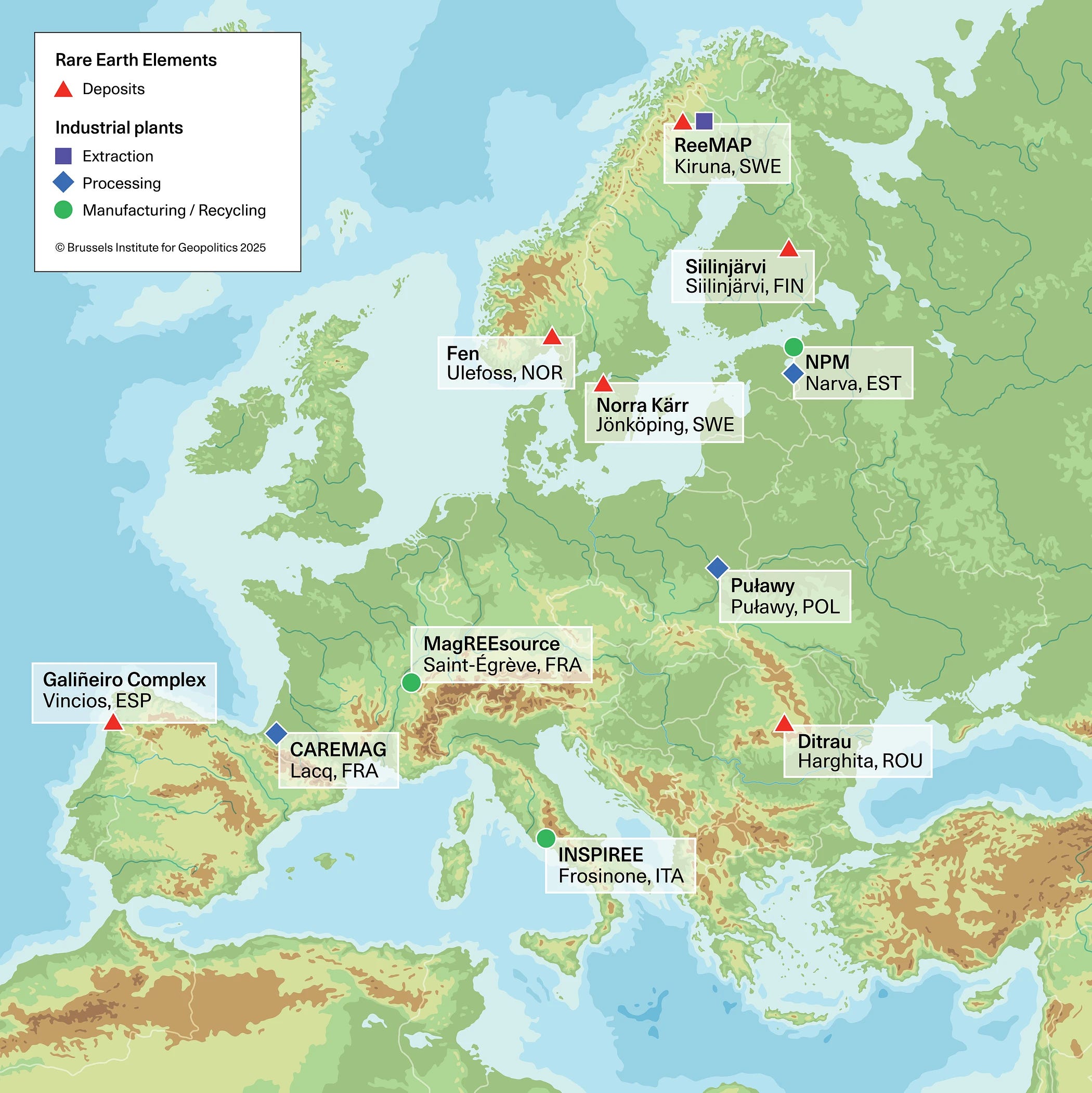
Japan: Like Germany, Japan doesn’t have notable REE reserves in its soil, so the country is also a global leader in urban mining from electronic waste streams (unlike Germany, however, Japan has pushed the boundary of where it will actually look for reserves: for example, 6,000 meters below the surface of the ocean near Torishima Island, about 300 miles south of Tokyo). More impressive, though, is that Japanese companies like Honda have pioneered neodymium magnets that do not need heavy rare earths at all.
South Korea: Unsurprisingly, South Korea also has robust capabilities to recover REE from discarded electronics. To increase Korean firms’ access to rare earth feedstock, however, the country is taking a stance reminiscent of Trump’s by both pushing for state-backed investment in overseas projects and building up a domestic stockpile in case of supply shocks.
Malaysia: As mentioned above, Malaysia and Vietnam are kind of acting as competitors in REE refining in that they are each positioning themselves as the first alternative to China, but the relationship between the two ASEAN countries goes deeper than that. While Vietnam’s extensive reserves make it a strong candidate for upstream mining activities, Malaysia’s existing refining capabilities make it a strong candidate for downstream manufacturing activities.
A variety of countries will contribute to the rare earth manufacturing sector, including China and the U.S. Some, like Japan and Germany, will leverage their heavy industrial prowess to grow their existing magnet manufacturing capacities. Others, like Malaysia, are better equipped to build out domestic mine-to-magnet supply chains. As I hope I’ve made clear in this post, building resilient global rare earths supply chains will require cooperation among countries with various motivations and capabilities.
I started putting this post together in the olden days of December 2025, back when the half-life for seismic shifts in the global order was actually longer than the time it takes to say “Greenland.”
All jokes aside, the game of geopolitical ping pong between diplomats the world over at least provides the opportunity for a reset. This is especially true given Trump said at Davos that the U.S. would both A) not use force in Greenland and B) walk back the new tariff threats against eight European countries. The reset could look something like this:
Trump’s new Board of Peace attracts countries from all over the world to contribute to rebuilding Gaza, and he joins the ranks of American presidents responsible for organizing global coalitions for peace.
The president reduces tariffs on countries in return for joining and championing an international organization he chairs.
The momentum continues, and several of the countries listed in this post (perhaps Brazil, India, or Saudi Arabia) establish or expand agreements with the U.S. around rare earths specifically or critical minerals generally.
Regardless of your political affiliation, this scenario would be a massive win. Is it far-fetched? Maybe. But at least it’s within the realm of possibility, and for now, I’ll take that.
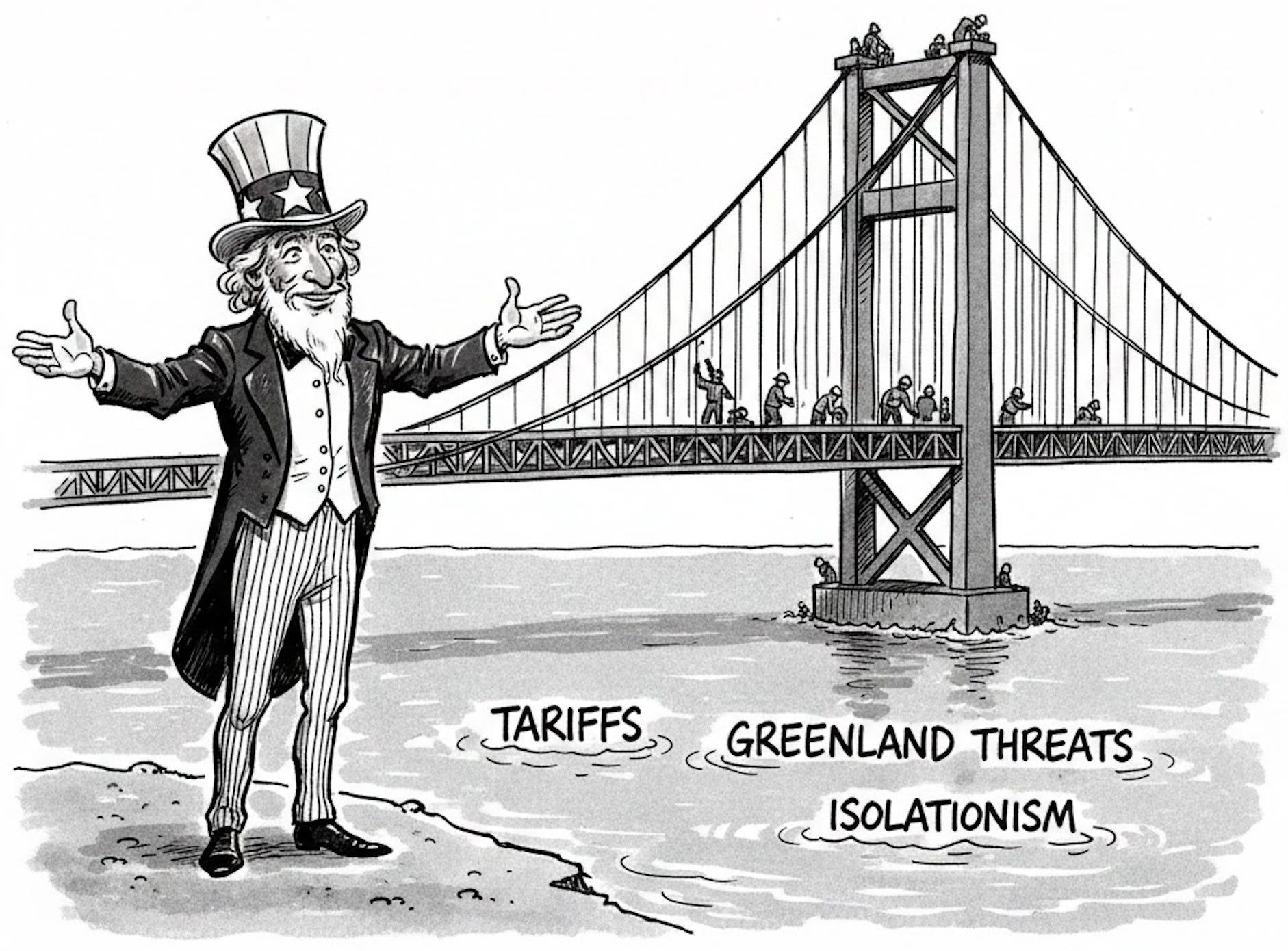
At the end of the day, America has recently shifted back toward an isolationist stance not seen since the 1930s with its Smoot-Hawley Tariff in response to the Great Depression and its Neutrality Acts in response to growing aggression in Asia and Europe. The Trump administration’s National Security Strategy, released in November, did not quell fears that the Stars and Stripes would continue burying itself inside a cloak of economic solitude. And while the White House recently announced Project Vault, a $12 billion initiative to build a domestic stockpile of critical minerals (including rare earths) for industrial purposes, this is only a strategic reserve and should be treated as nothing more than a rainy day fund.
To an isolationist, we just need to produce enough for ourselves. But to maintain our global influence and achieve “energy dominance,” so to speak, we must position the U.S. (or a U.S.-led bloc) as the primary supplier for the rest of the world. This means leveraging our competitive advantages, and leveraging our competitive advantages means keeping friendly with as many of our traditional allies and trading partners as possible.
Therein lies the opportunity to catch up to China and permanently hold them at bay: Make sure our friends remain our friends. The U.S. will demonstrate its strength not by building fortresses, but by building bridges. Fortresses measure their strength in terms of years. Bridges measure their strength in terms of centuries.
To build a secure world full of safe, reliable, and clean energy, we must build as many bridges as we can.
Rock ‘n’ roll afterword
Disclaimer: The opinions expressed in Renaissance Carbon are my own and do not necessarily reflect the opinions of any employer.
Contact: ryandavidson911@gmail.com
Comments
Nothing yet. Say the first thing.
Sign in to join the conversation.