
Modern software engineering has increasingly become a “subscription management simulator,” where developers feel pressured by cloud vendors to stitch together a fragile web of highly specialized microservices. To build even a basic app, teams often wire up Redis for caching, Kafka for jobs, Elasticsearch for search, and a dedicated vector database for AI.
However, PostgreSQL—a “boring” 30-year-old open-source tool—can serve as a single, unstoppable source of truth that cannibalises these architectures.
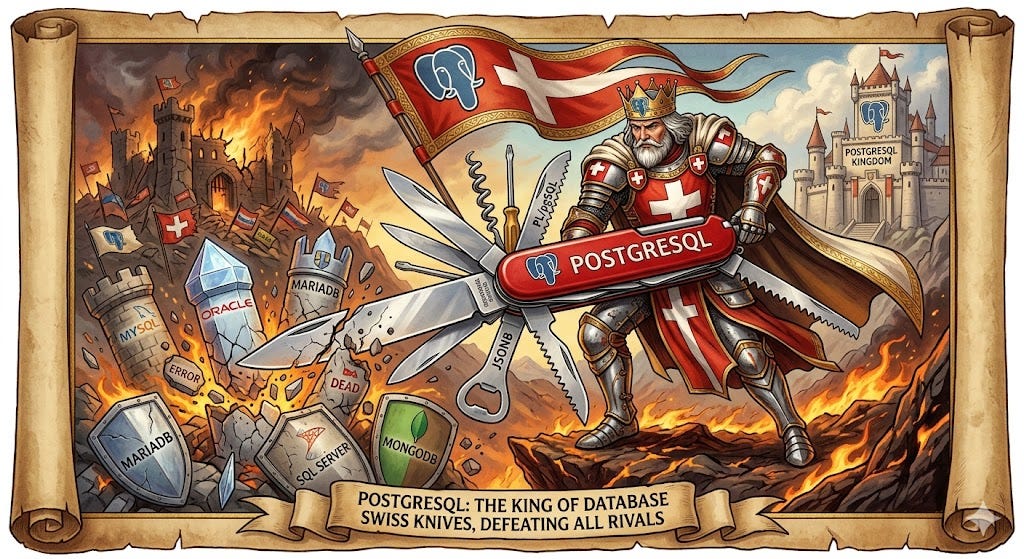
Postgres is the “King of all databases”: a rock-solid, ACID-compliant foundation that can be aggressively modded through its massive ecosystem of extensions to do exactly what you want.
The following table compares specialized industry tools with the PostgreSQL features or extensions that provide equivalent functionality, backed by industry-proven implementations.
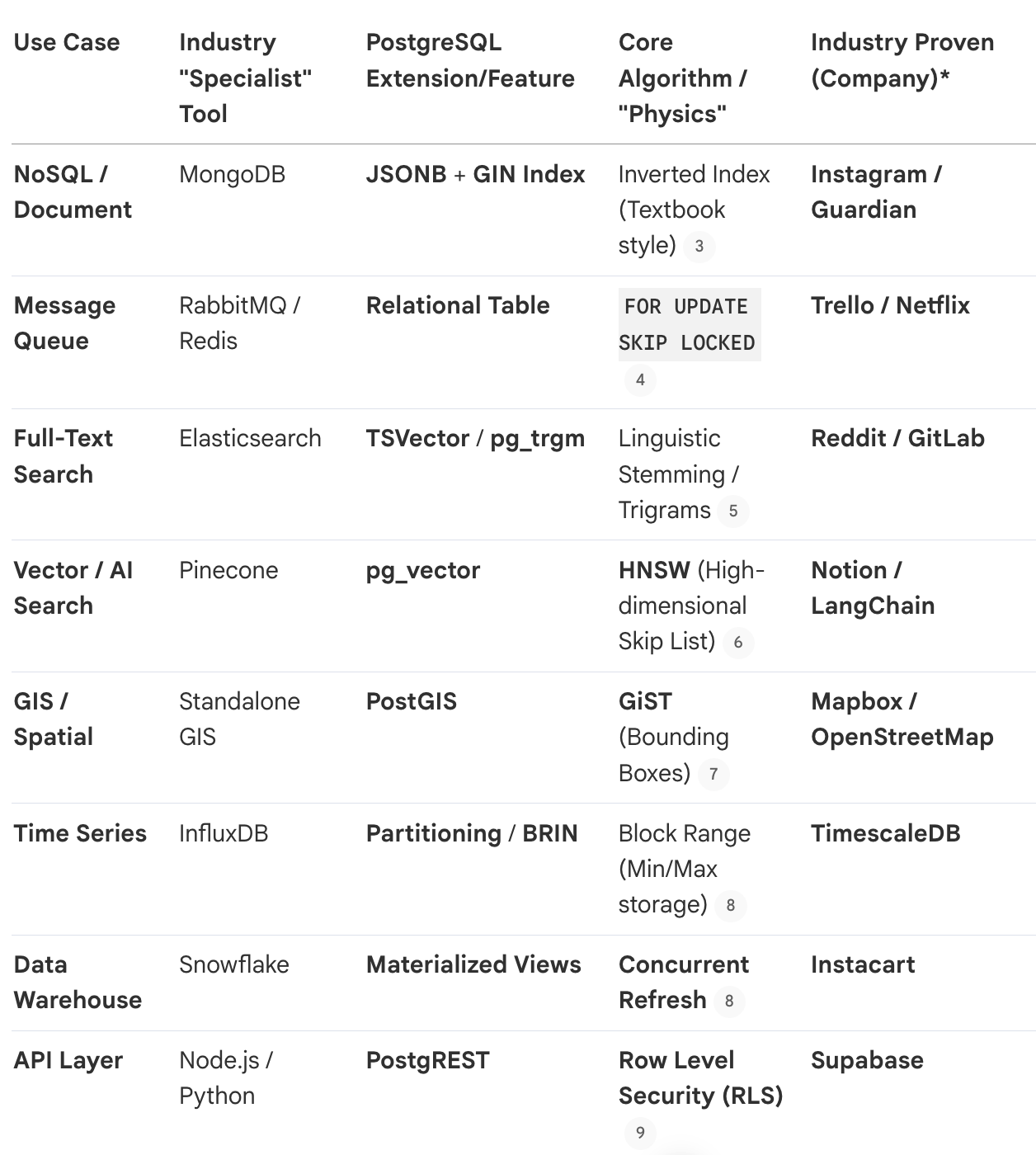
For system design, it is essential to understand the underlying mechanics that allow Postgres to replace specialized stacks.
Postgres offers native support for unstructured data through the JSONB (Binary) data type.
The Logic: Unlike standard text, JSONB converts payloads into a decomposed binary format at the moment of insertion.
The Algorithm: It uses a GIN (Generalized Inverted Index), which works like the index at the back of a textbook. Instead of scanning every row, the index maps keys directly to row IDs, allowing for instant queries on deeply nested properties.
Building a queue in a standard SQL database usually leads to deadlocks, but Postgres solves this with FOR UPDATE SKIP LOCKED.
The Physics: This clause changes the query physics: the engine grabs the first available row and locks it. If a worker hits a row already locked by another process, it doesn’t wait; it simply skips to the next one. This creates a wait-free queue capable of thousands of jobs per second.
Postgres strips language to its roots using TSVector and TSQuery.
Stemming: It removes “stop words” and applies linguistic stemming (e.g., “running” becomes “run”).
Trigrams: For typos, the pg_trgm extension breaks words into three-letter chunks. The database finds overlapping patterns to return correct results even if a user misspells a query (e.g., “Postgress” vs “PostgreSQL”).
The pg_vector extension solves the “hybrid search problem”—the nightmare of cross-referencing relational data with vector data over a network.
The Algorithm: It uses HNSW (Hierarchical Navigable Small World), a graph-based algorithm for approximate nearest neighbor search.
How it works: It organizes vectors into a multi-layered structure that acts as a high-dimensional skip list. It navigates through “neighborhoods” of similar data points, starting at sparse top layers and moving to dense lower layers to find results in milliseconds.
PostGIS is considered the undisputed industry gold standard for maps and routing.
The Algorithm: It uses a GiST (Generalized Search Tree) index. Instead of doing raw math on every coordinate—which would crash a server—it draws overlapping bounding boxes. The database discards millions of points that aren’t in the boxes first, only performing precise geometric math on the remaining handful.
For massive telemetry logs, Postgres uses declarative partitioning to split data into daily or monthly chunks.
The Algorithm: The BRIN (Block Range Index) is a “superpower” for sequential logs.
The Logic: Rather than a bloated B-tree, BRIN only stores the minimum and maximum timestamps for physical blocks of data on the disk. This allows Postgres to skip millions of irrelevant disk pages instantly.
Postgres is not a silver bullet. It scales vertically with exceptional grace, but horizontal sharding for extreme scale introduces massive complexity. If your application must ingest millions of events per second or requires sub-millisecond caching for millions of concurrent websockets, specialized distributed tools are necessary. However, until you reach that massive enterprise scale, leaning on the battle-tested mechanics of Postgres is the smartest and most cost-effective engineering decision you can make.
No posts
Comments
Nothing yet. Say the first thing.
Sign in to join the conversation.