
Unless you are living under the rocks, agentic workflow is now the new norm and just recently to back this up further, temporal team releases Google ADK integration with Temporal
To provide a technical assessment for an engineering audience, we must look past the marketing “AIOS” terminology and focus on the architectural mechanics of the Google Agent Development Kit (ADK) and its integration with Temporal’s Durable Execution.
The core of this integration addresses the Reliability Gap in LLM-based applications. In standard agentic workflows, long-running processes (multi-step reasoning, tool-calling, or human-in-the-loop) are prone to failure due to transient network issues, process crashes, or API timeouts.
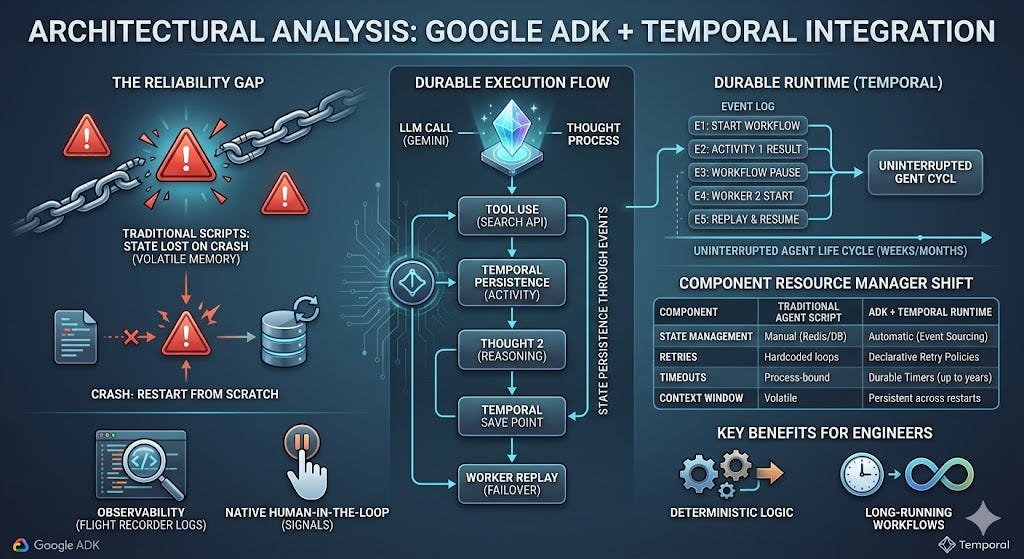
In a standard Python script, an agent’s state is held in volatile memory. If the process crashes during a multi-step tool execution, the state is lost.
By using Temporal as the runtime for Google ADK, the execution becomes durable:
Event Sourcing: Temporal records every “Activity” (e.g., a call to a Gemini model or a database write) in an append-only event store.
Workflow Replay: If the worker hosting the ADK agent fails, a new worker picks up the history. It “replays” the previous steps—skipping the activities that already succeeded by retrieving their results from the history—and resumes execution at the exact point of failure.
State Persistence: The “thought process” of the agent (its local variables and stack) is effectively persisted without the developer writing manual database save-points.
While “AIOS” is a high-level metaphor, the engineering reality is a shift in the Resource Manager:
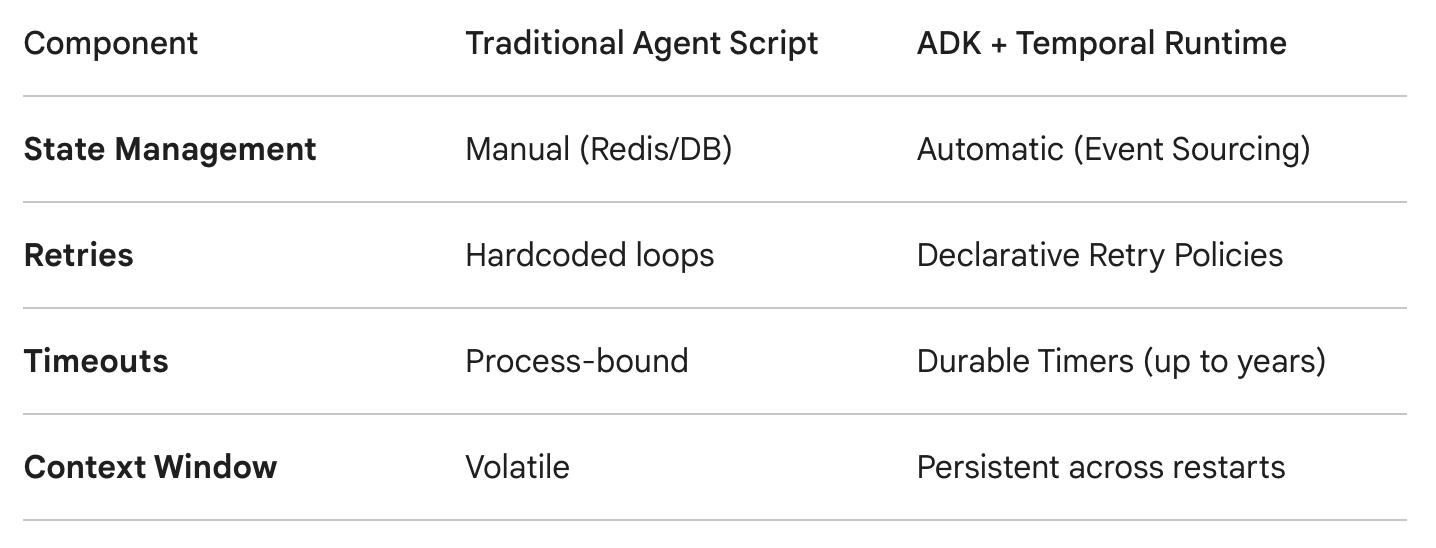
Deterministic Execution in a Non-Deterministic World: While LLM outputs are non-deterministic, the sequence of tool calls and logic branches is managed deterministically by Temporal.
Native Human-in-the-Loop: Engineers can use Temporal
Signalsto pause an agent’s execution indefinitely (e.g., waiting for a manual code review) without holding a thread open or losing the execution context.Observability: Every step of the ADK agent is logged in the Temporal history, providing a flight-recorder-style audit trail of exactly why an agent made a specific decision or where a tool call failed.
How does the ADK handle non-deterministic agent behavior during a Temporal “Replay” if the LLM produces a different response for the same prompt? (Note: Usually handled by side-effecting the LLM call into a Temporal Activity).
What are the latency implications of persisting every agent step to the Temporal Cluster compared to a stateless FastAPI endpoint?
How does the integration manage token-limit constraints during long-running workflows where the history might exceed the LLM’s context window?
In a production environment, how do you handle versioning of agent logic when you have “in-flight” workflows that were started on an older version of the ADK prompt?
No posts
Comments
Nothing yet. Say the first thing.
Sign in to join the conversation.