
Part three of my series of posts from my Japan trip is about my visit to Net Protections, a self-managing ‘buy now, pay later’ firm. You can read part one here and part two here.
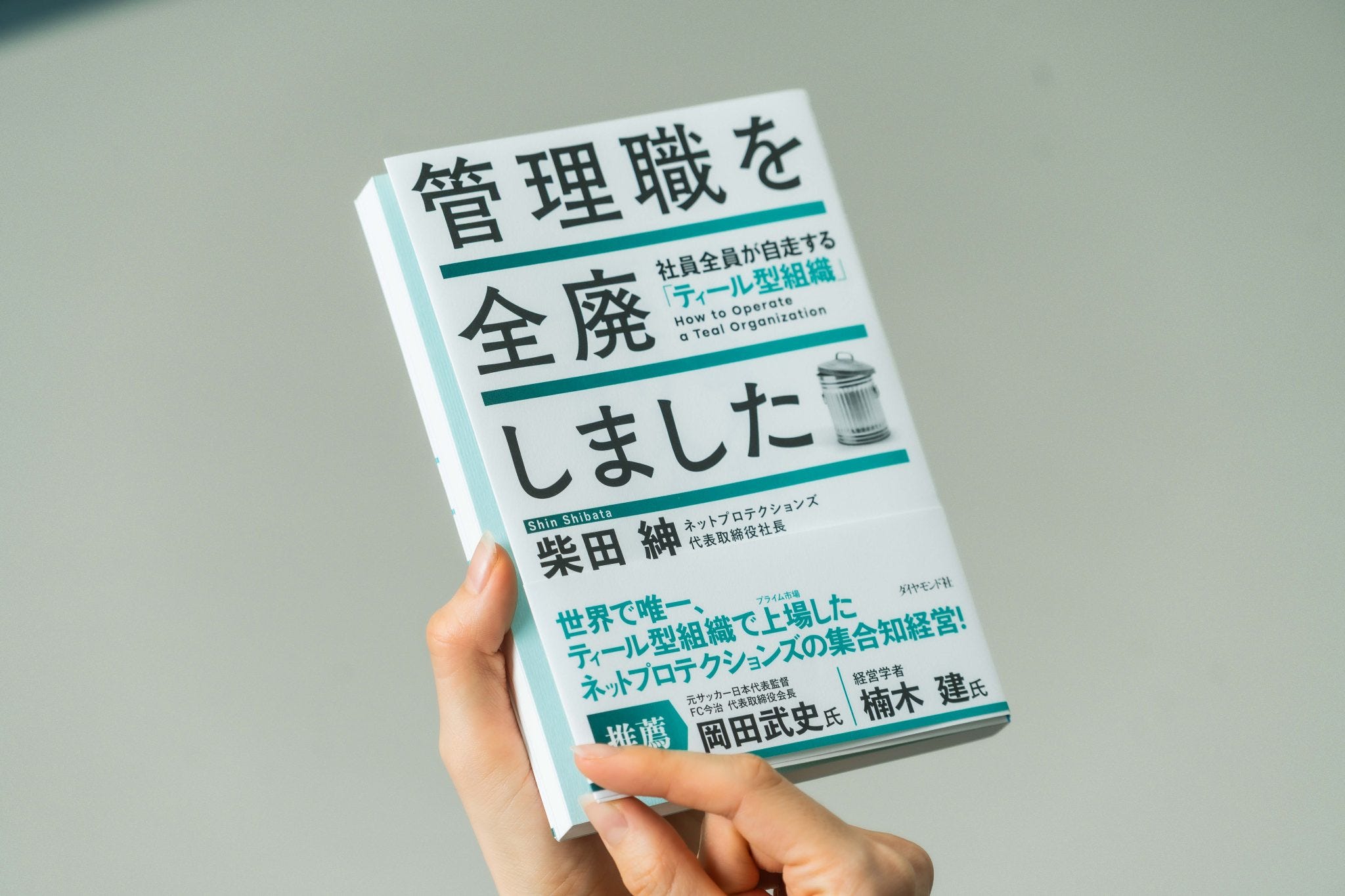
I’m sitting in a cafe in Tokyo reading the book We Abolished Managers, hoping I’ll finish it in time before meeting the author – CEO and founder of Net Protections Shin Shabata – in less than an hour’s time. The location of the company’s headquarters is Chiyoda City, home to Edo Castle, built in 1457, and later replaced by the Imperial Palace. Today it’s the financial and political centre of Tokyo. Yet tucked away in the midst of all this history is an extremely modern company.
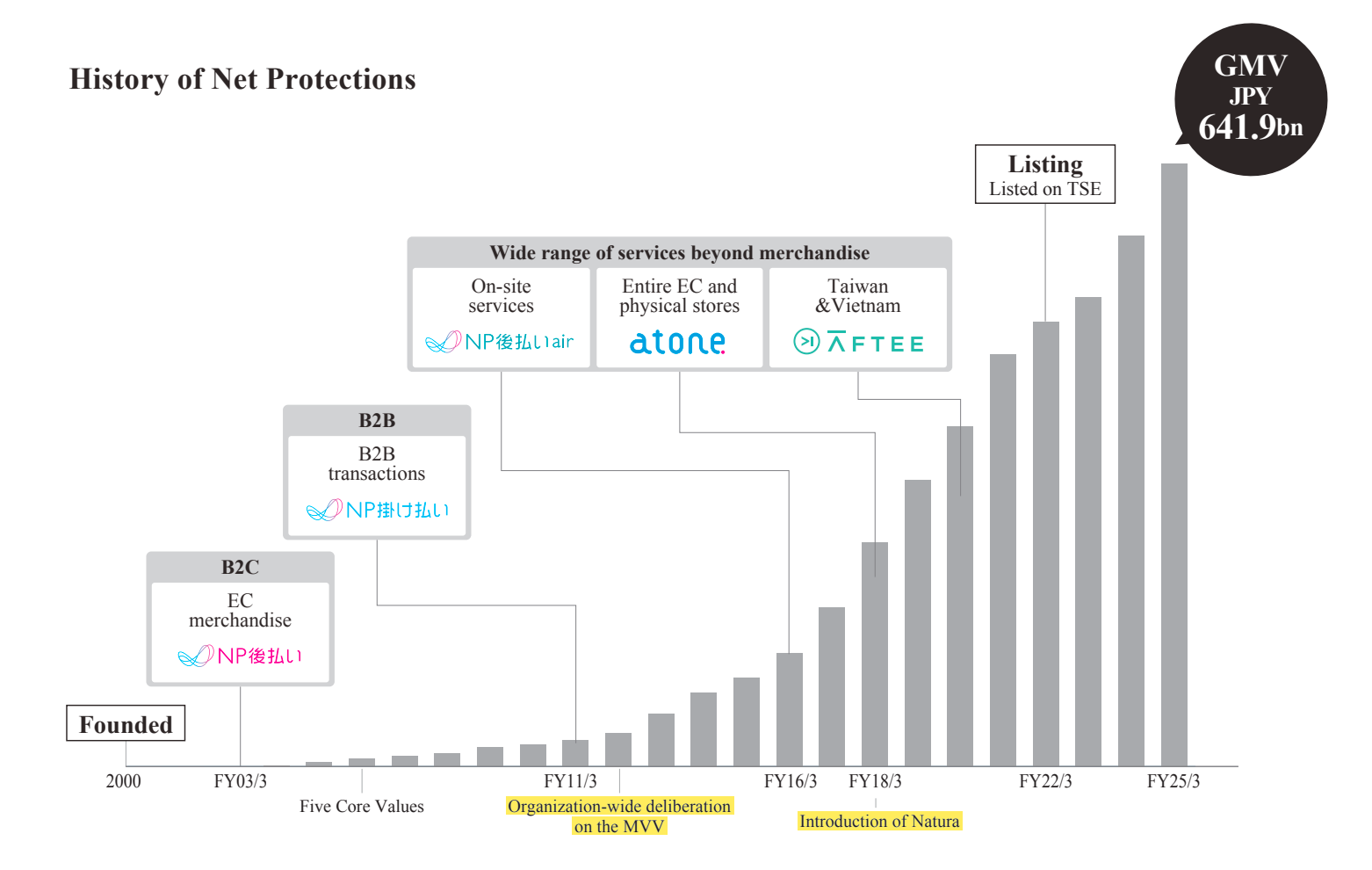
Net Protections is a pioneer in the BNPL (Buy Now, Pay Later deferred payment service) and has been operating for twenty-five years. Today it holds the top domestic share in this market and is listed on the Tokyo Stock Exchange with 400 employees around the world. Eight years ago they took the decision to abolish managers.
What intrigues me most about Net Protections is that they didn’t copy an organisational model from a book or another company and their journey to self-management is not a straightforward one.
When Shibata became CEO of what was then the new business acquired by the investment firm he worked for, he was met with a group of people who were less than impressed with a twenty-something year-old with big ideas. In fact, they were sometimes downright hostile towards him. Although they were trying to enter the BNPL market, none of the twenty employees had any experience in that market.
Funnily enough, the path to self-management started with the opposite – Shibata basically doing everything himself! After five months of working tirelessly, he managed to launch a prototype for the BNPL service. But it would be several years before they started to see a profit, and the personal toll was heavy. “After coming home exhausted, there were many times when I simply could not stop crying,” Shibata writes. “I had never been so disliked by people, and that was far harder to face than establishing the foundations of BNPL.”
“How did you keep going?!” I ask him. He says he doesn’t know exactly. He simply had an unshakeable belief in the potential of this company and felt he’d never again get this chance to be the first to enter a market. What I’m curious to know is: if it wasn’t a book or another company that sparked the interest in self-management, where did the seed come from?
Shibata explains that it was mainly born out of necessity: no one had experience in the BNPL market because it was so new. He just about survived the first few months doing everything himself, but that was clearly not sustainable. So he had to start recruiting people who could work autonomously and learn on the job. This meant there was no hierarchy of experts.
He also had happy memories of being an officer at a large tennis club in his university days. There was an atmosphere of fun and no hierarchy, and yet they were able to achieve amazing results. Why couldn’t a workplace be like that, he thought?
By 2012, Shibata had managed to delegate a lot of tasks, but with mixed results. Some managers were better at delegating than others and he began to notice fiefdoms forming. He had written up five core values in 2006, but because they were his words, people still deferred to him, despite his best efforts to delegate.
And so he decided to facilitate a dialogue. Shibata explained to the fifty or so employees at the time his ambitions for the company, asking them to go away and think about how to translate those aspirations into a vision. They divided into seven or eight groups, each with a budget of around 300,000 yen, and over the course of the next few months, they prepared a presentation on what they felt the company should be.
The process took longer than Shibata thought, deliberating with ten leaders from those groups for a further nine months at various retreats. There were debates about what the vision should be and three leaders in particular were very critical of Shibata’s approach. He describes it as one of the most painful experiences of his life.
Eventually, everyone converged around seven organisational norms, that are still in place today. Norms like: ‘Everyone, as a responsible stakeholder, builds and nurtures both the business and the organisation.’ Or ‘We make respecting and integrating diverse perspectives and personalities the driving force for organisation building.’ But what I see is more than just a standard ‘Mission, Vision, Values’ exercise.
Shibata and his colleague Shun Akiyama have seen me give talks about the metaphor of apps and operating system, and this metaphor feels apt here.
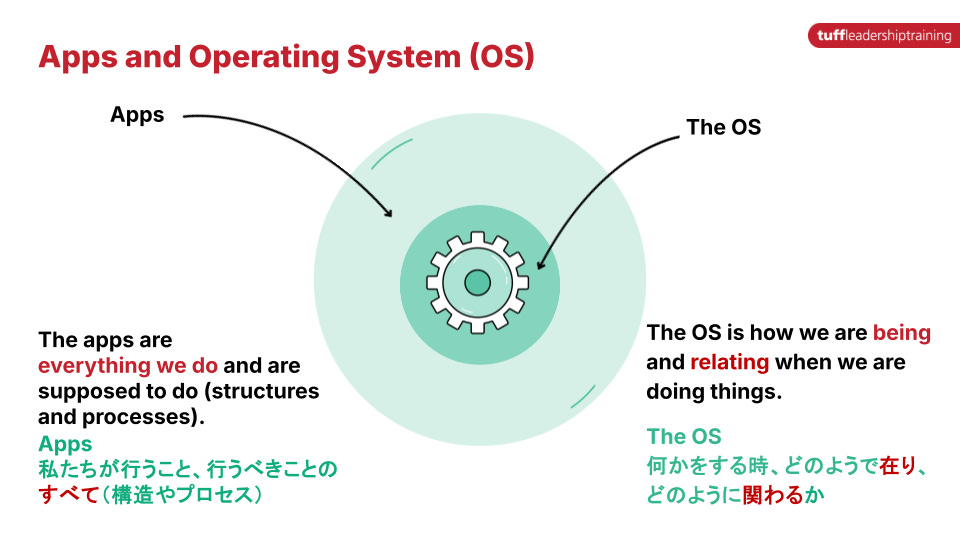
Most organisations that want to decentralise focus on installing new ‘apps’: Agile processes, Holacracy, decision-making methods like The Advice Process and so on. But if we install those apps onto an outdated operating system, none of those apps will work. The default OS in all organisations is characterised mainly by what you could call a parent-child dynamic, where the leaders tend to be overly-responsible, and the individual contributors end up in a state of dependence. Without also upgrading the OS (our mindset, way of being, way of relating), any new ‘apps’ we install will end up being like a parent doing Agile, or a parent doing Holacracy, meaning that we cannot experience the full potential of distributed leadership or responsibility.
During my visit to the Net Protections office, we remarked that this Mission, Vision, Values moment in 2012/13 was a turning point in starting to upgrade the OS. Many people, especially managers, didn’t like the upgrade. Around half of the members of those eight working groups left over the next two years. They were mostly, Shibata says, the ones that wanted power. This is pretty common in self-management transformations; usually 10-20% of the workforce leave when the social contract changes.
As for the apps part, that wouldn’t come for another few years. In the meantime, Shibata was able to recruit people into the newly established organisational norms and more and more members became aligned with the MVV. From this fertile soil, a bottom-up proposal emerged from the HR team in 2017: “Let’s abolish managers.”
I ask Shun, who originally joined as Head of HR in 2009, how he felt about the suggestion to abolish managers. Did he felt insulted or threatened at all? “I was happy!” he told me, “And surprised. I’d had the same idea myself for some years but didn’t dare suggest it because I thought there would be resistance.”
He explained that perhaps the reason for a lack of resistance was that although the proposal started as abolishing managers, the framing became the inverse: make everyone a manager. People were inspired by this.
So what are some ‘apps’ that Net Protections has since developed as part of their progressive organisational model?
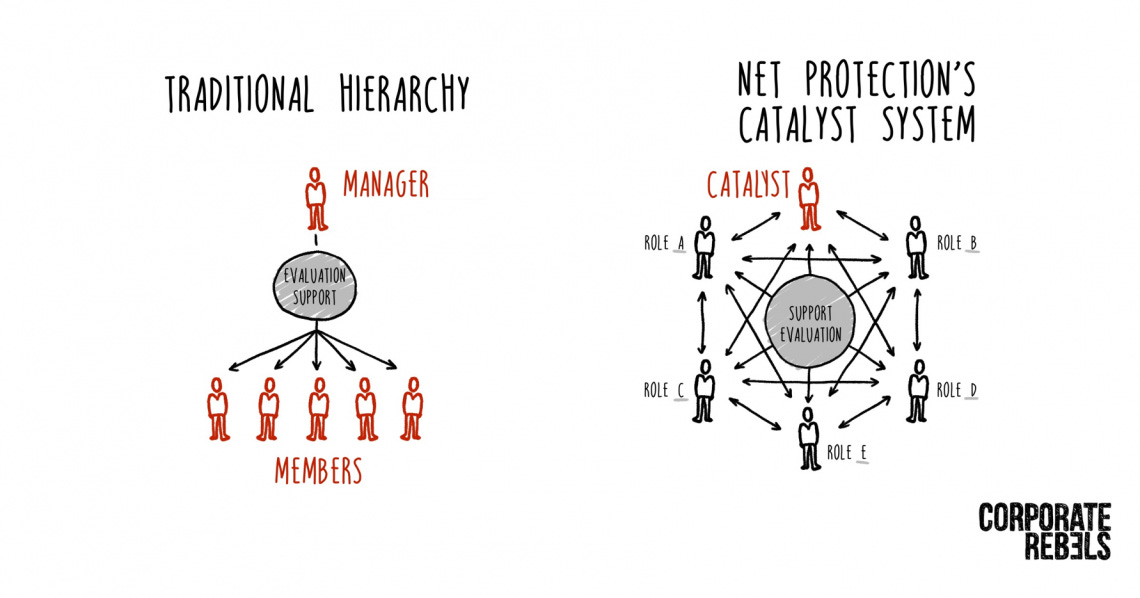
In 2018, Net Protections established Natura as an institutional framework. It’s a performance management system with a twist. Having abolished managers, the next logical step was for everyone (not just managers) to be involved in discussing how to achieve targets, allocate work, evaluate each other’s performance and drive their own professional development.
A new and fluid role emerged: the Catalyst. Every department has one or more Catalysts who help facilitate information flow and flow of resources, not in a top-down way, but in a supportive way. What’s more, Catalysts are decided by consensus in the teams, not appointed top-down. It’s also common for a Catalyst’s role to rotate naturally.
Natura also includes 360-degree reviews. Twice a year, team members are evaluated by five to ten peers – even Shibata, the CEO. Employees choose which team members will evaluate them.
There are a number of Working Groups in Net Protections where people can choose work on projects outside of their day-to-day work. One initiative that arose from one of these groups was a virtual family system called Fami-Tsuku. The idea was to help build relationships across the company and avoid siloed thinking.
When a new member joins Net Protections, they are assigned a ‘family’ of four to five people outside their team to provide mentorship. Fami-Tsukus usually gather every few months, with the help of a discretionary budget (‘family wallet’), to discuss work challenges and personal life.
Every one to two months, Shibata facilitates CEO Roundtable Sessions. Some might see it as a costly use of his time, but he sees these sessions as his top priority. I also think they are a cornerstone of Net Protections’ self-managed culture.
Established in 2015, the idea is that a small group of new graduates and mid-career professionals join a virtual roundtable discussion with Shibata. Each person has a one-to-one conversation with the CEO while the rest of the group listens. Minutes from the meetings are shared transparently so anyone can learn from them.
The magic of these sessions lies in Shibata’s facilitation. He asks each person to share how things are going, inviting them to outline challenges and asking questions about how they might move forward. It’s not about providing answers (though sometimes he might offer advice), it’s much more about his way of being. A living example of the culture. As Shibata puts it: “It creates an opportunity for everyone to hear me say, face to face, ‘Work as you like, run as you see fit. It’s more enjoyable for everyone that way and enables the whole company to grow.’”
It also deepens relationships – between Shibata and the team members, as well as amongst each other. “I always want to avoid walls between departments and teams,” he told me.
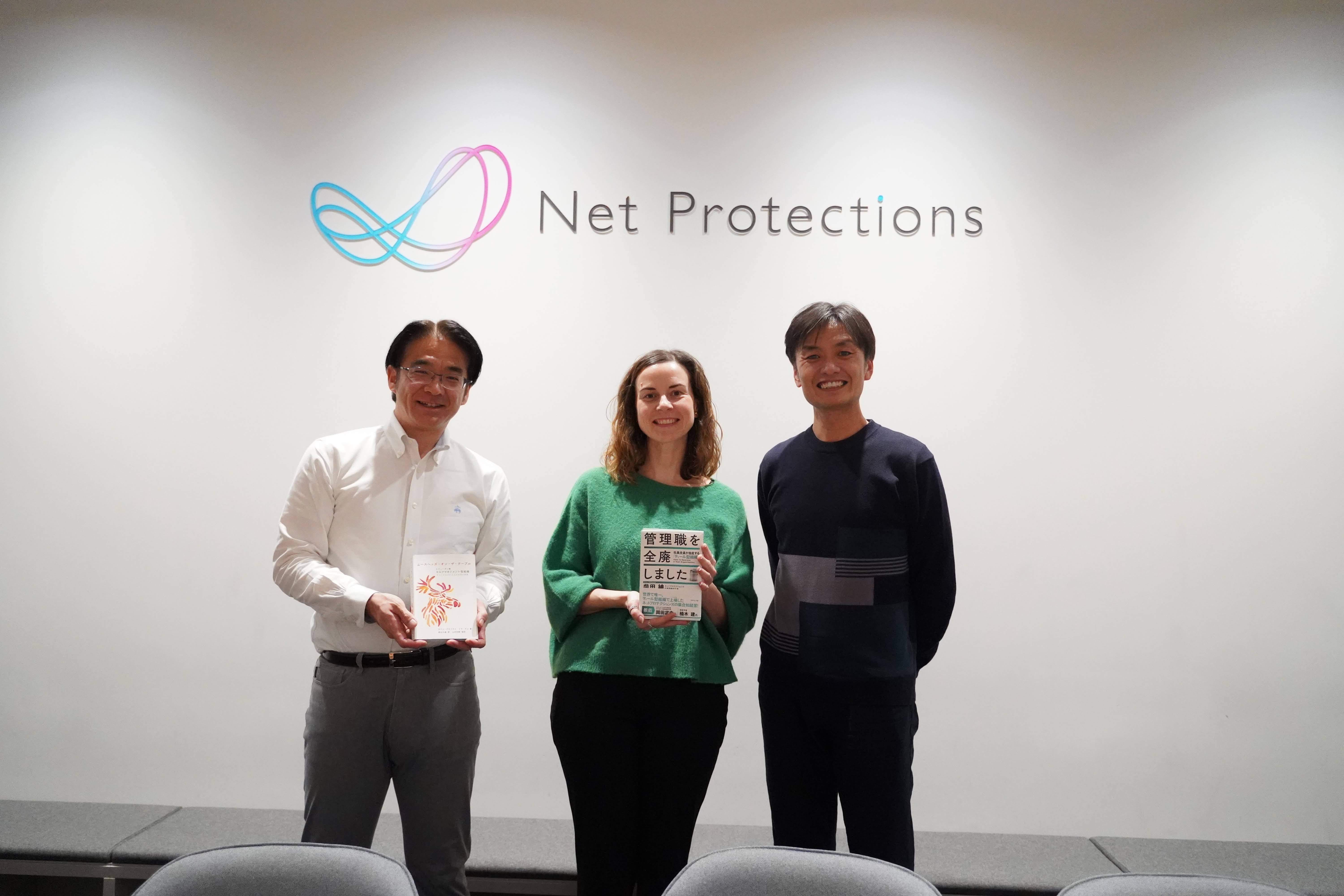
In writing this book about Net Protections’ journey, Shibata is keen to show that there is another way to run businesses.
“I hope to see a Japan where the stifling, repressive organisational culture [of what’s sometimes disparagingly called a JTC – Japanese Traditional Company] can finally be transformed, and where people can act autonomously, raise their voices without fear of consequences, and pursue their own wellbeing and happiness while still delivering strong results for their companies.”
He has become involved in the ‘teal’ and new ways of working movement in Japan, although he makes it clear that they were not aware of Frederic Laloux’s work on ‘teal’ organisations when they began abolishing managers. When the Japanese edition of ‘Reinventing Organisations’ came out in 2018, it was reaffirming for Net Protections. Though they had been unaware of these other organisations, they clearly embodied the three breakthroughs of a teal organisation: self-management, wholeness and evolutionary purpose. Shibata also attended a retreat in Japan that Frederic was invited to in 2019. Today he prefers to identify as a ‘teal-style’ (rather than teal) organisation, since it wasn’t a direct influence. The book, however, is a useful reference for new employees unfamiliar with this way of working.
Whilst promoting the benefits of being a decentralised organisation, Shibata doesn’t want to create any illusions that it’s easy: “We did not become a teal-style organisation overnight, and it was by no means smooth sailing.” One of the things I appreciate about his book is that it’s a warts-and-all tale of the ups and downs of this messy process.
Between the lines I sense he also wants to test the resolve of CEOs who are considering embarking on a similar transformation. The process itself was deeply painful for him at times. And today, although he clearly feels deep pride in what the organisation has achieved, there’s also a strange sense of not feeling needed.
“I find it fascinating and stimulating to take what feels something like a ‘stroll’ through the company, stopping to chat with various employees. All around me, in places of the business I may not have been aware of, new ventures I could never have imagined are constantly emerging and expanding.
The feeling I get could be likened to picking up a manga series you have been too busy to follow for a while and thinking, “What? The story’s moved on this much? That’s amazing—what an incredible plot development!” What is also incredible is that the employees at the centre of these developments are mostly in their twenties and thirties.
Many have only been with the company for two or three years. We also have mid-career hires, of course, as well as people from overseas, women who have returned after maternity or childcare leave, people who work for us only fifty per cent of the time—all kinds of talent. Employees with diverse skills and characteristics cooperate and inspire one another, forming a collective intelligence that generates new business possibilities in a continuous, ongoing chain.”
“Do you ever feel lonely?” I ask Shibata. He tells me: yes, he does. He’s very careful about not creating jealousy, as he puts it. So he never goes out for beers or dinner with any of his colleagues, lest someone might interpret it as favouritism. But, he says he does have his Fami-Tsuku, as everyone in the company does. So he gets his social and relational needs met in that context. Still, he says it is strange to see the company running itself. For so long he has been holding tightly the responsibility for an organisation where human potential can flourish and great results are achieved. Now, for the first time, he feels those things are stable and he can finally let go.
“What’s next?” I ask him. He doesn’t know, but he’s excited to find out. “If this was the first 25-year phase of the company, what could the next 25 years bring?” He smiles.
Yuji Yamada’s blog for Corporate Rebels about Net Protections
You can read the English version of the book We Abolished Managers here
No posts
Comments
Nothing yet. Say the first thing.
Sign in to join the conversation.