
Welcome, new subscribers! I don’t know what Katharine Hayhoe has been up to lately, but a bunch of you seem to be finding this newsletter through her Substack. Hello and welcome. In case you’re wondering, refugia are places where life persists and renews amid severe disturbance. We’re trying to be people of refugia here, by healing the earth, renewing our spiritual communities, and serving as life-giving places in our cultural systems. Glad to have you join us.
I always begin with a wee personal update. This week, after turning in the book manuscript for Refugia Church (release next spring!), I’ve been puttering about in a bit of a daze. Turns out I like puttering, though. Amazing how fast the day goes by when you putter through it.
In a weird frenzy last night, spouse Ron and I decided to Reorganize Our Books. Well, one batch of them. While alphabetizing my “high access climate-y books” (it’s important to use the correct technical terms), I discovered that apparently most climate-related authors have last names beginning with A-M. Hunh. Come on, N-Z authors! Where are you?
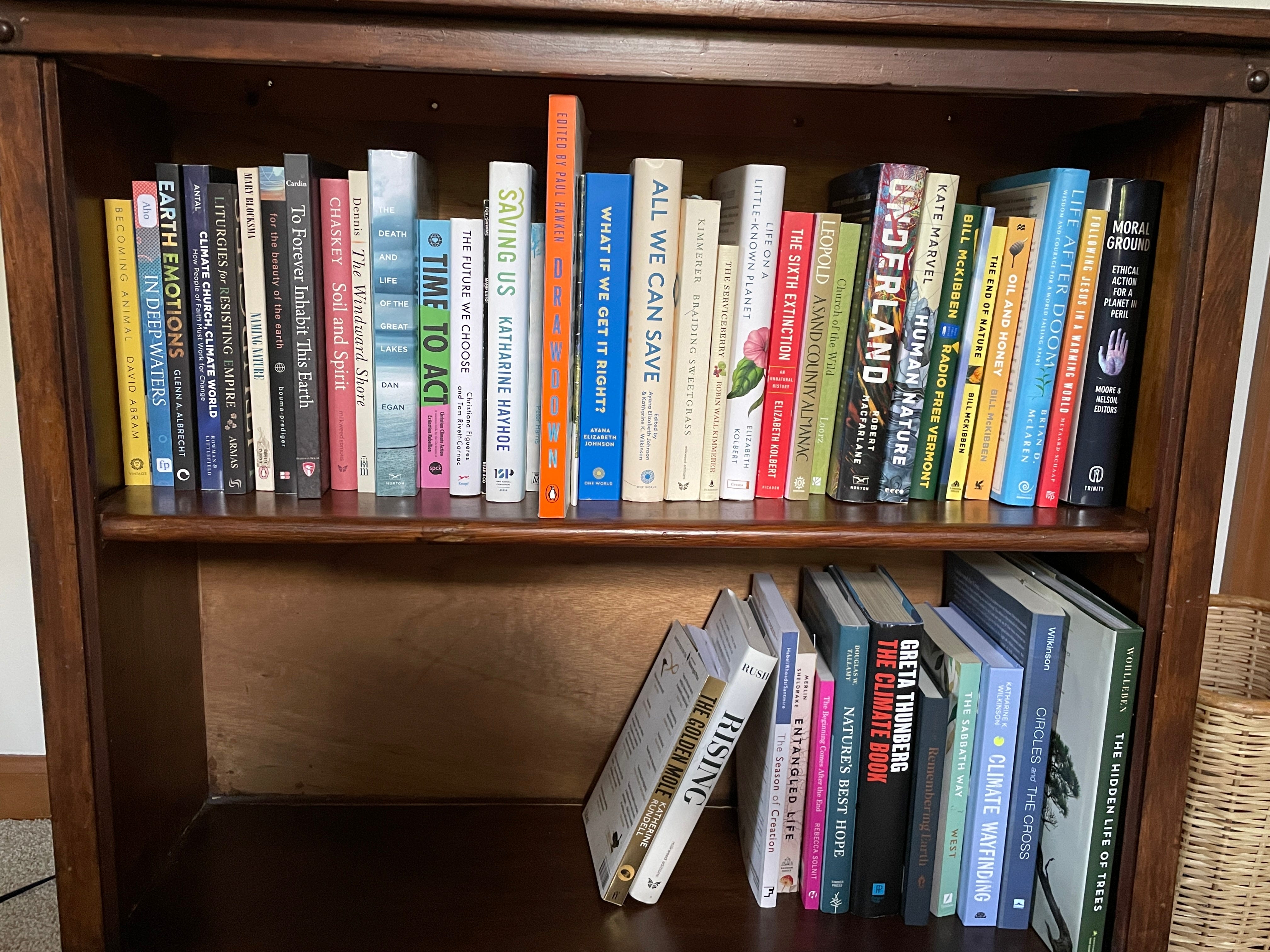
This is only half of the high-access climate-y books. A-M on top, N-Z on the bottom. I had to move all the M’s down below to fit the rest of the high-access books (not pictured). And of course, Ron and I have many, many, many, many other books in the house. Not to mention in our offices at our respective work places. Sigh.
We’ve also spent some lovely time at the Lake (that’s Lake Michigan, for you non-Michiganders), and I’ve been experimenting with my new/old fancy camera some more.
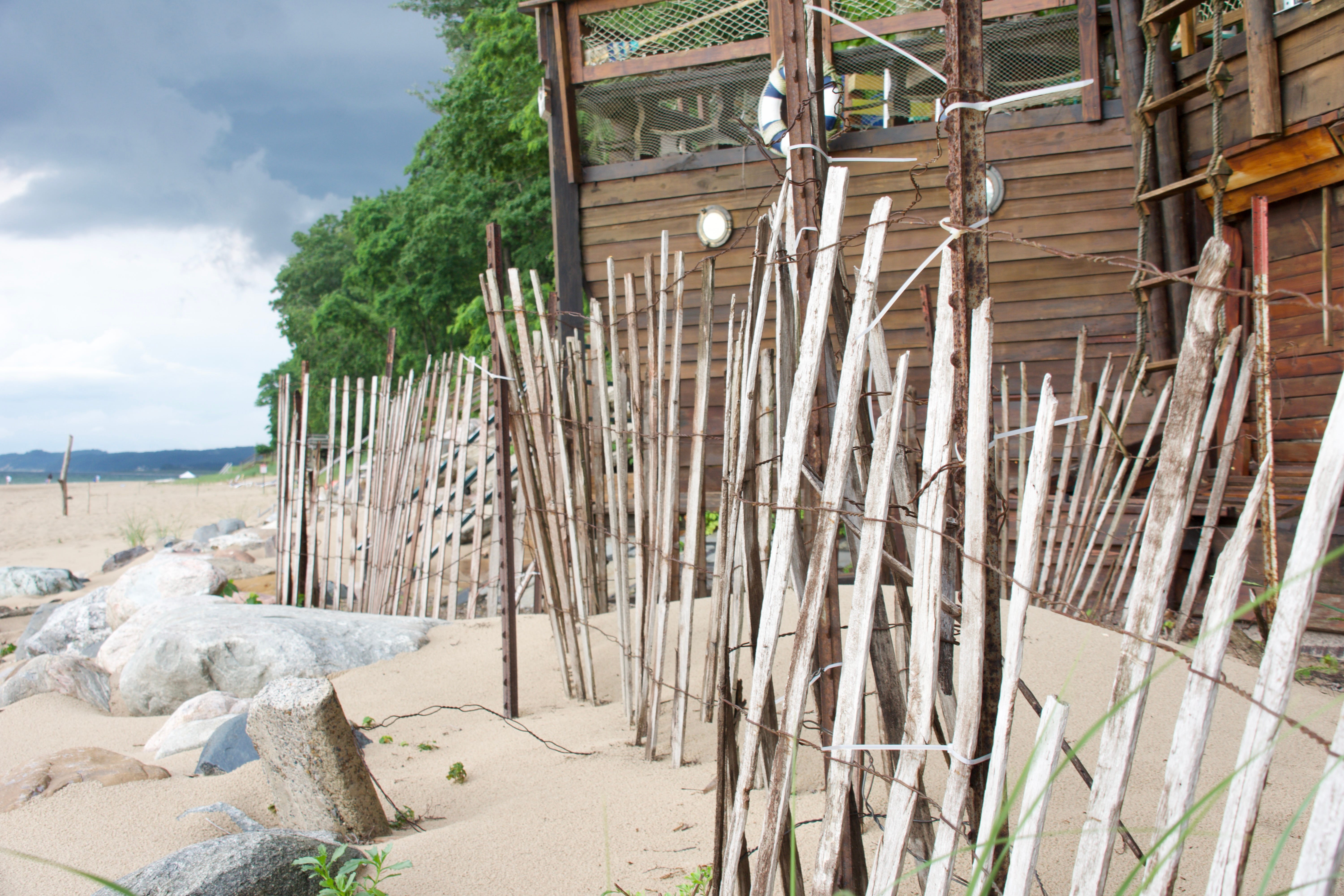
I do not know what I’m doing (yet), but I thought this one was kinda cool.
OK, now I’ve got some recordings to share and invitations to extend. I promised I would share the recording of part 2 of my interview with Bill McKibben on the Earthkeepers Podcast, with thanks to host James Amadon and producer Forrest Inslee for the invitation. Earthkeepers Podcast, by the way, is produced by the good people at Circlewood in the Puget Sound area.
Next, below is the recording of Third Act’s Hope & Joy series, hosted by the lovely and gracious Dan Quinlan. This series is meant to soothe your weary spirit, wherever you are in your spiritual journey. Dan asked some beautiful questions about my own spiritual journey, and I did my best to answer.
Now for invitations. Please join us on July 28th for another Third Act event, this one hosted by the Faith working group. I serve on the Coordinating Committee for Third Act Faith, and we have a terrific series planned on the theme: “How do our spiritual commitments influence our voting patterns?” Our first guest is Adam Russell Taylor, to be interviewed by Jim Antal. I’ll keep you up to date on future events in the series.
Finally, if you are a preacher, and you wish you could preach more confidently with ecological realities in mind, please consider joining the EcoPreacher cohort now forming for the upcoming year. This is an established, research-based cohort program “of robust community support and education for preachers who want to integrate or sharpen their climate-conscious, justice-centered preaching.” The people involved are absolutely top of the line. Highly recommend! Here’s an example of the kind of research they consider and discuss as a cohort.
Speaking of Katharine Hayhoe, she linked to this super-cool, dynamic global temperature monitoring tool from Reuters. Actually, I should call it super-hot, because that’s what it tells you: just how much hotter it is than normal. On the landing page, you see a nifty spinning globe showing temperature patterns, and then you can search for any location you like to see how much hotter than normal it is there.
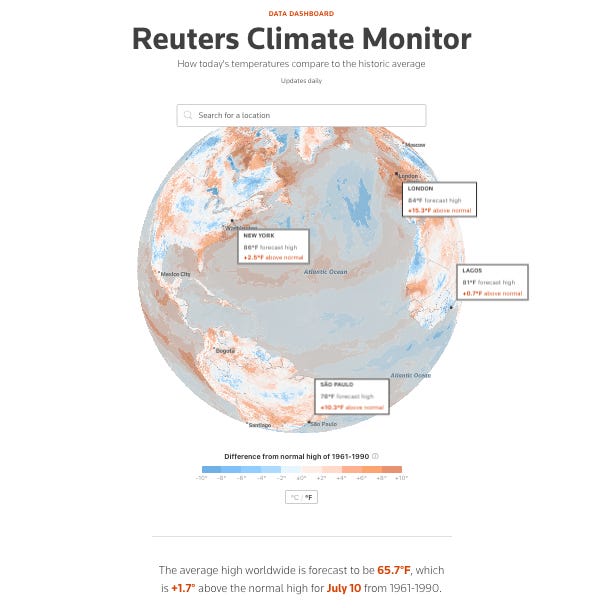
Focus is fuzzy on that globe because this is a screenshot, and on the site, the globe is gracefully spinning.
You’ve read about the extreme heat in the US and around the world in the headlines. Very possibly, you have felt it searing down in your own community. So I’m not going to go over the headlines about what has become “danger summer” in the Northern hemisphere. Instead, we’re going to talk about money.
Who is paying to continue propping up the fossil fuel industry? You are. The taxpayer. I’m sorry to tell you this, but this essay by David Fickling in Bloomberg explains the icky details. Fickling begins:
To judge by the way many people discuss the energy transition, we’re engaged in a fight between green idealogues in government and academia on the one hand, and a more realistic private sector that recognizes the innate superiority of fossil fuels on the other.
Follow the money, and you’ll see precisely the opposite picture. The share of private energy investment going into oil, gas and coal has slumped from about 50% to 28% since 2015, according an International Energy Agency database. The public sector, meanwhile, still invests most of its money in dirty power — 53%, down more marginally from 67% a decade ago.
That actually understates quite how bad things are, because the state doesn’t just fund carbon-based energy by investing in its production. It also pumps out subsidies to make it artificially cheap. That encourages us to use more polluting energy, and deters us from making the switch to cleaner, more affordable alternatives.
In the US, don’t forget the $700 million of your tax dollars spent to prop up coal mining and the $1 billion to pay off wind developers to abandon their projects. But the US is not the only problem (though we are currently an egregious part of it). Public investment in fossil fuels is still robust around the world. Fickling’s recommendation: “Governments must stop throwing sand in the gears of the energy transition.”
Meanwhile, the “green economy” is growing. If you want to be a good capitalist, that’s where you want to look for action right now. Ajani Stella reports for Inside Climate News:
The group of companies that derive significant revenue from environmental solutions, known as the green economy, has topped $10 trillion in market value, a new report found.
That milestone was tied to a 5.3 percent growth in green revenue last year, according to the London Stock Exchange Group’s report, released Wednesday. Green companies—those with at least one-fifth of their revenue coming from environmentally focused activities—outperformed the broader market by around 12 percent over the past decade.
This whole article is worth reading, especially if you understand finance better than I do.
The bottom line here: The markets are telling us that investing in the fossil fuel industry amounts to throwing good money after bad. Investing in the green economy is where the action is, now but especially in the mid- and long-term.
One more news-related thing, this one fun. What to do about that stupid Reflecting Pool debacle? Skip the “chemical warfare” and “bring back the swamp”—that is, turn the thing into a natural wetland! Michael J. Coren, writing for the Washington Post, has it all figured out (free link). All you need is a “well-designed system of running water, gravel, microbes and wetland plants.” No problem; there are companies who can make that happen. The article goes into all the delightful details of how it could be done. What do you think?

Perfectly lovely, right? “Natural pool firm Bionova created AI-assisted renderings of the Lincoln Memorial Reflecting Pool with natural filtration systems. (Courtesy of Bionova).” Image and caption credit: washingtonpost.com.
All right. It’s time for another rant about the corruption of the fossil fuel industry. Sometimes ranting is appropriate, I’m afraid, and this is one of those times.
Bill McKibben covered this story in detail in his Substack. The story was researched and written by a team from ProPublica and Drilled, including the intrepid Amy Westervelt. The story begins with a paper released in 2004 by two Princeton University professors working out of the Carbon Mitigation Institute (CMI), who “found” that the globe could totally manage climate warming if we would engage in 15 “wedges.” Those wedges included burning biomass, burning hydrogen, shifting from coal to natural gas, and engaging in lots of carbon capture and storage. No problem! They also set a very easy baseline of comparison and a very high tolerance for carbon in the atmosphere.
Turns out, the CMI researchers were basically putting their credentials behind an “invented” future (their words) in which fossil fuels would still be 50% of the energy mix for the next 50 years. Why? Wait for it. Because BP was funding their work. In fact, a BP exec was actually involved in editing the study report.
This fib-for-dollars scheme was entirely clear in the documents uncovered by the ProPublica/Distilled reporters:
When the university and BP revisited their relationship for a 2016-2020 funding renewal, the parties made it explicit: “A premise from the outset was that CMI’s job was to invent a future where the fossil fuel industries have not disappeared,” the renewal document said. “This is still our job.”
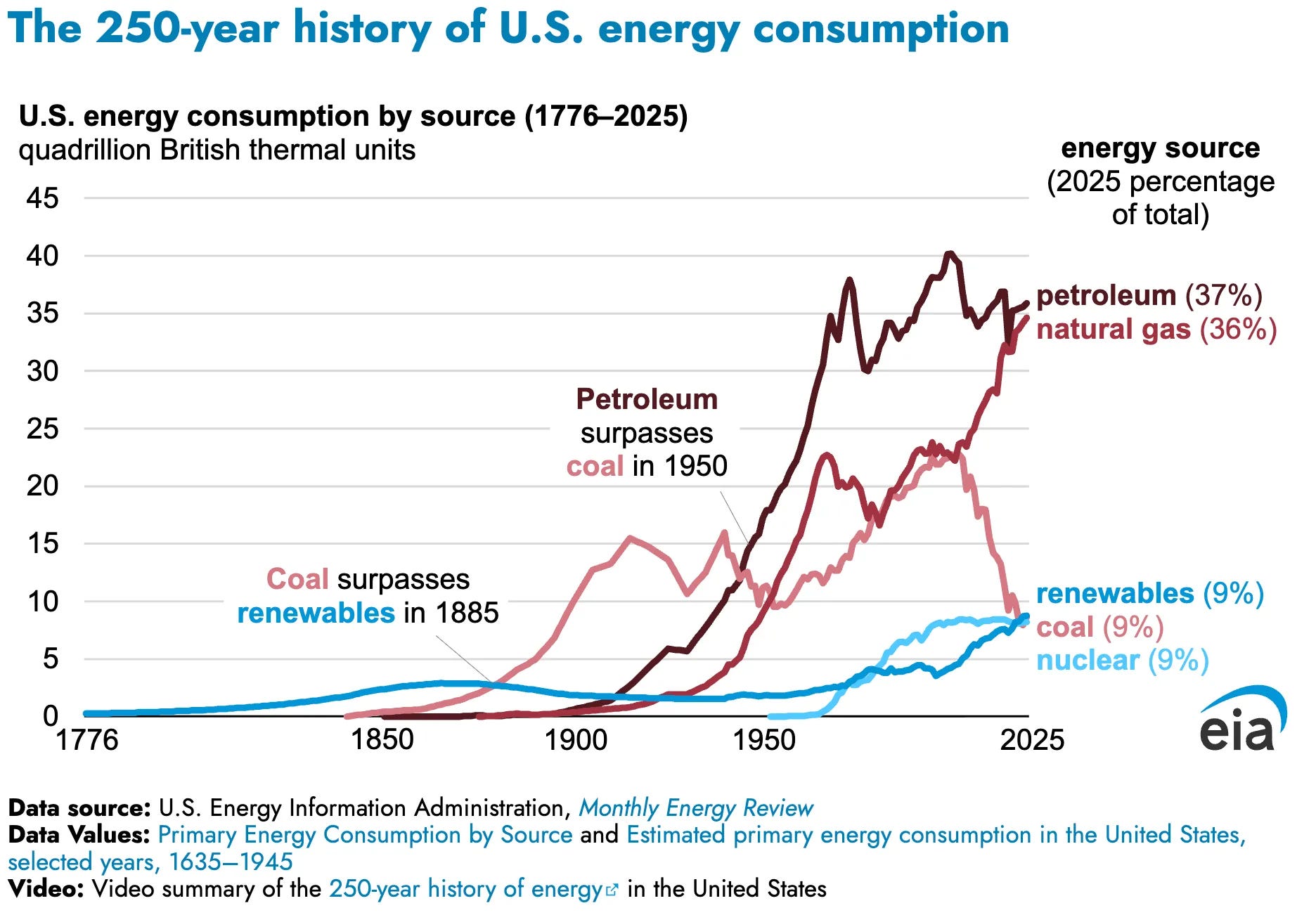
So. This paper had real results, costing real taxpayer dollars and causing real pollution and environmental damage. All that fracking since 2004? A result of fabricated projections. Note the red and pink lines on the graph below. See how coal goes down and gas goes waaaay up, kinda suddenly?
What about all those investments in carbon capture and sequestration (CCS)? I mean, the welfare for the fossil fuel industry that your tax dollars are paying? How is our massive investment in that CCS project going? Are we getting results? Hmm. Look at the red line below.
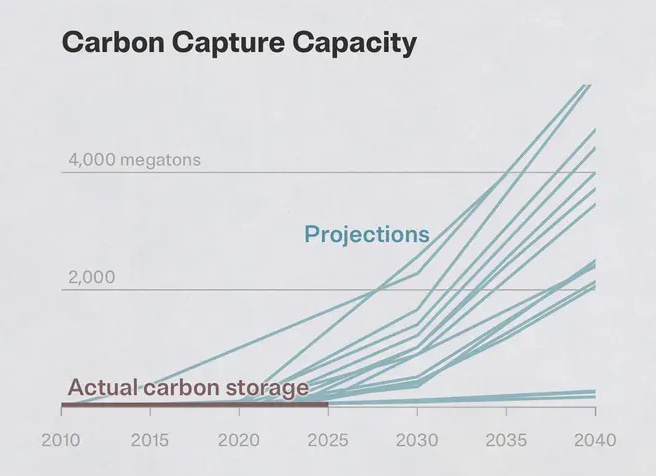
That graph is from this long report, also in ProPublica, about the “progress” on CCS. Conclusion: “there is no conceivable way this can work.” The article explains, patiently and with beautiful graphics, that the math just doesn’t math for CCS. This would be a good one to share with people who have imbibed the idea that we can keep burning fossil fuels because CCS is on its way to save us. Nope.
Meanwhile, the fossil fuel industry is making a last-ditch effort to extract oil and gas and extract profits. Here’s Jonathan Watts for The Guardian:
So, while the world burned and conflicts raged, BP’s profits more than doubled in the last quarter.
It is a similar story elsewhere. The six European oil majors increased their combined profits in the same period by 43% to the highest level – $22bn – since 2022. Most have backtracked on green energy commitments in recent years and ramped up production plans. Norway’s state oil company, Equinor, has lifted its oil and gas output target by 6% by 2030. Brazil’s Petrobras is aiming to supply 21% more oil by 2030. Almost every country and company, it seems, is racing to produce the last barrel of oil.
Now you see why I had to rant a bit. There’s more. There are ways for oil majors to sue governments for lost profits if governments promote clean energy. Seriously. It’s called “investor-state dispute settlement.” So governments face a disincentive for those green policies when they can be sued for “lost profits.”
The idea that fossil fuels are necessary and inevitable is less true than ever. And yet. Sigh.
OK, after all that, we need some signs of life and hope, yes?
And I’ve got some good stuff for you today. In fact, I have rather a backlog in the refugia sighting department. So we’ll just choose a few celebrating plants.
First, New York City announced their first-ever urban forest plan. The goal is to increase tree canopy across the boroughs to 30% by 2040. The initiative, which comes from the Mayor’s Office of Climate & Environmental Justice (they have one of those!) and involves multiple city agencies, “outlines measures to protect existing canopy, expand planting in streets and public spaces, promote tree planting on private property, and strengthen workforce and stewardship programs that engage New Yorkers in caring for the urban forest.”
Tree canopy is critically important for mitigating heat and managing stormwater. Trees also improve air quality and cheer people up. Recognizing the unequal distribution of green spaces in most urban areas, the plan takes environmental justice concerns into account, too:
At the core of the UFP is the City’s commitment to addressing unequal distribution of tree canopy as a critical matter of racial and environmental justice. Environmental Justice communities have approximately 19% canopy cover, compared to 26% in non-Environmental Justice areas.
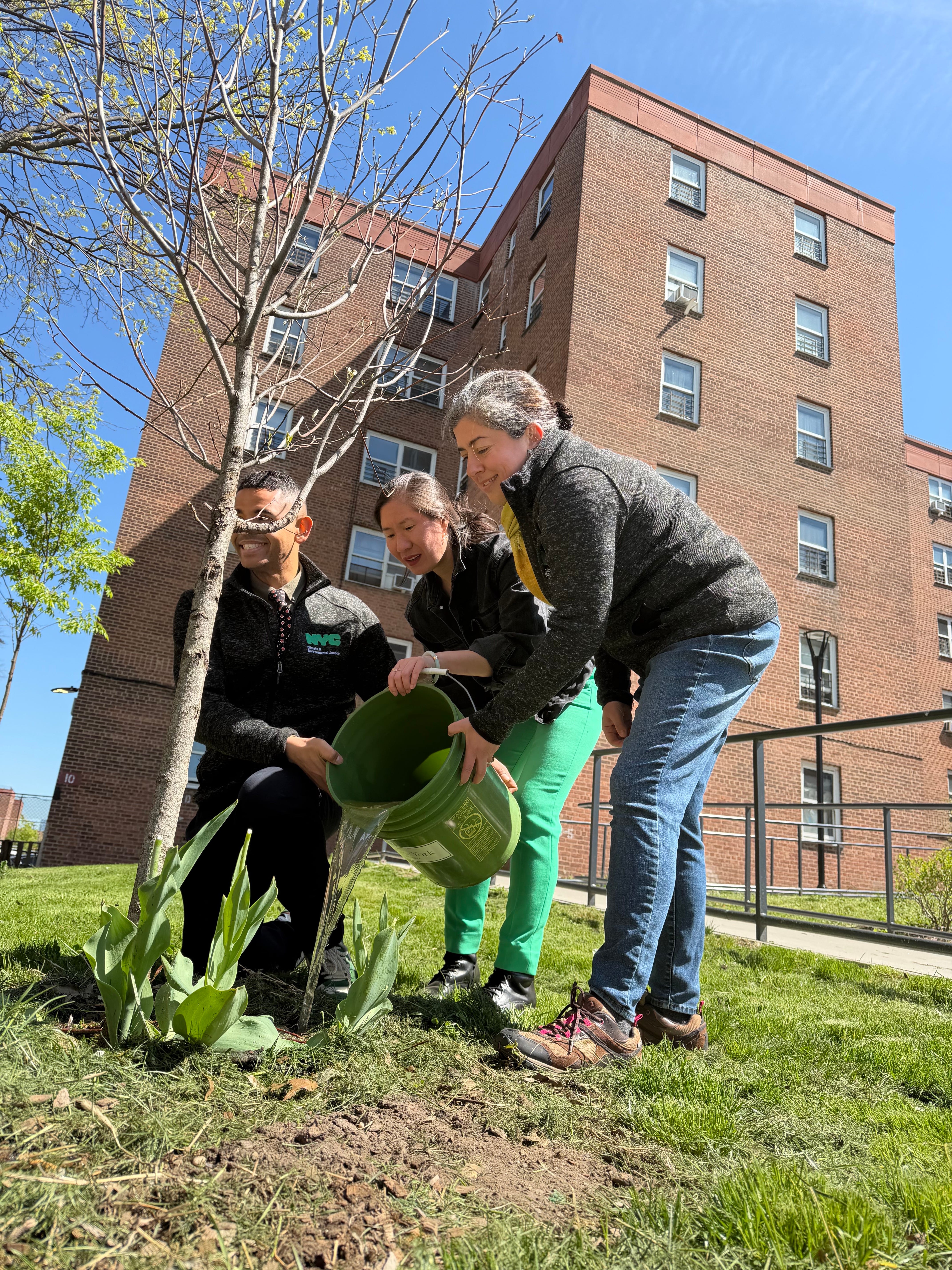
Image credit: nyc.gov. The person in the middle is New York City Chief Climate Officer Louise Yeung (they have a chief climate officer!).
In case the urban forest initiative seems like merely feel-good, PR-generating silliness, there’s actually a strong return-on-investment for urban green spaces. At least, that’s what the people at the nonprofit Trust for Public Land say in a new report:
We found that every $1 invested in parks and recreation returns, on average, at least $3 in local economic benefits each year, stemming from reduced stormwater treatment costs; lower healthcare costs; improved public health outcomes; consumer savings on fitness and recreation; rising tax revenues, and a boost in public-private partnerships, among other things. [bold original]
No one is claiming that more trees and flowers will “solve climate change”—they decidedly won’t—but they sure help us cope, both practically and spiritually. Speaking of trees and flowers, the next story is about all those native plant gardens you’re probably starting to see. Are they really such a big deal for the planet? Well, in their way, yes. They help repair biodiversity loss by rebuilding biodiversity from the foundational level with plants and insects, especially when we create many patchwork quilts of them. Plus they’re beautiful. And fun.
Environmental writer Ferris Jabr published a beautifully written piece in the New York Times Magazine this week (free link) about his and his husband’s quest to turn their new yard into a garden paradise. Jabr describes learning about the importance of native plants, becoming somewhat skeptical, and then visiting Doug Tallamy, the cheery, no-nonsense professor behind “Homegrown National Park,” a national initiative to encourage regular property owners to un-turf part of their lawn and plant native plants instead.
Jabr seemed skeptical because of some native plant puritanism he was encountering, which is completely fair. In fact, Tallamy himself and his organization are not puritanical about natives either. If you are considering doing a native garden at your home or house of worship, read Jabr’s article and also the response from Homegrown National Park. You’ll get a fuller picture, but remain, I think, extremely enthusiastic about the prospect.
Besides, everyone is doing it, at least according to the explosion in sales of native plants.
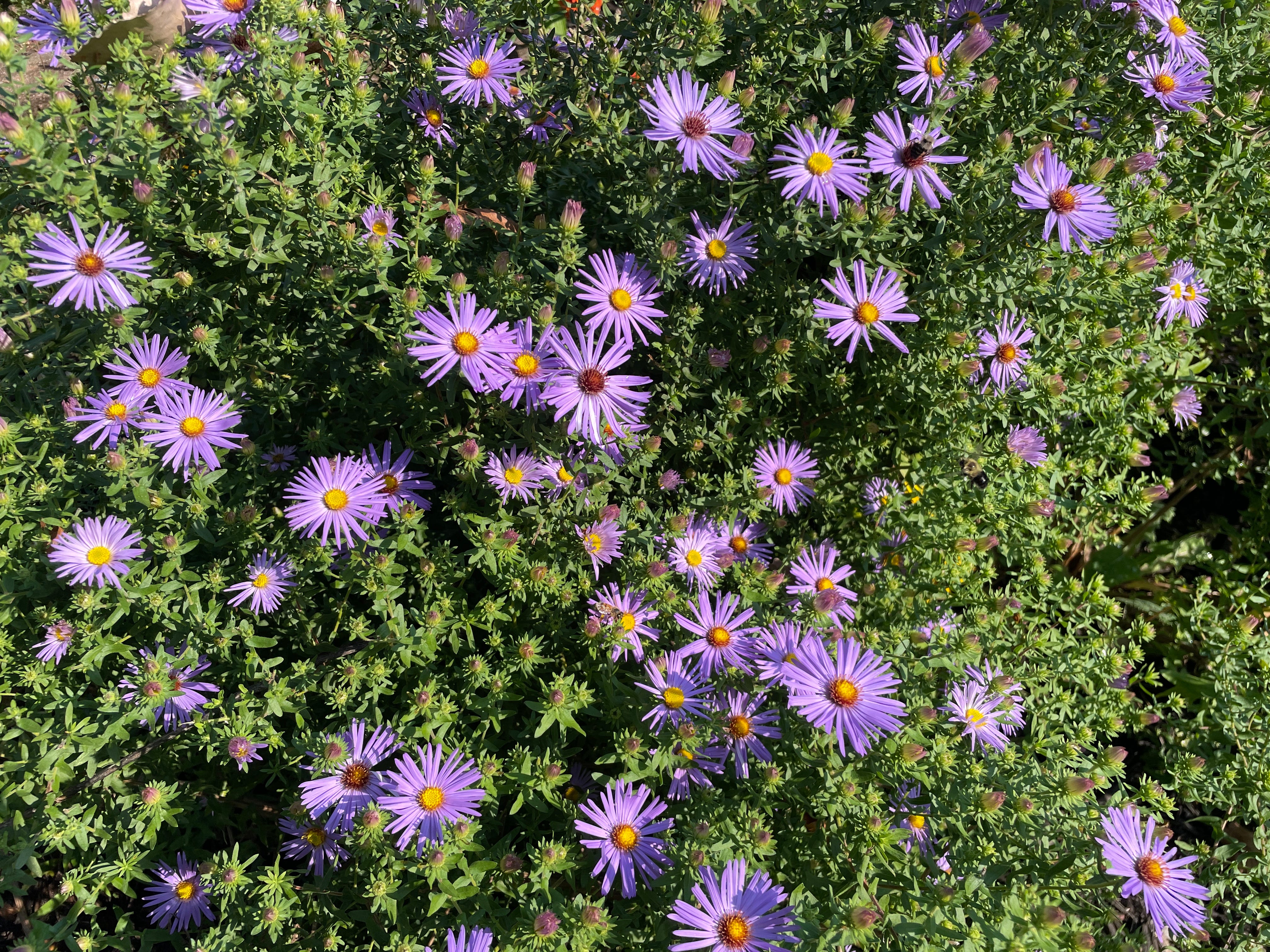
No shortage of photos in my cache from my own native plant gardens. These are New England asters from last summer.
In case you’re wondering to yourself, “What is the actual status of the globe’s plant and fungus biodiversity,” well, wonder no more. You can read the report released last month from the center of the world when it comes to plants: the Royal Botanic Gardens at Kew (outside London). (Note: one of my favorite places ever to visit.)
The report announces “the complete digitisation of our Herbarium and Fungarium— together representing one of the world’s largest collections of plants and fungi.” This was a massive effort, and an essential one because
This vast, interconnected, global metacollection of digitised specimens is an expanding source of information for understanding the geographical distribution of species in the past, present and future. Linking this biodiversity information with other measurements and models representing key environmental threats, such as climate change, agricultural expansion and deforestation, is enabling us to not only document changes but to take timely action, designing the most effective ways to safeguard biodiversity for the wellbeing of people and all life on Earth.
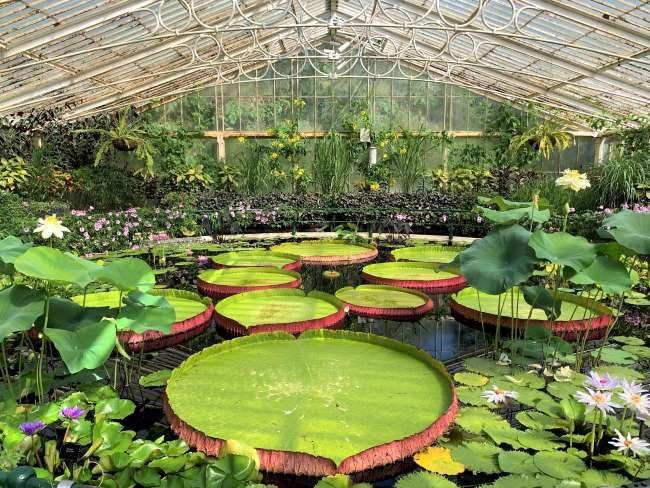
Among other wonders, you can see the world’s most amazing lily pads at Kew. Image credit: piccoloexplorer.com.
I’ll end with a report on a very pleasant outing this week to my university’s honeybee refugium. That’s not the official name, but that’s what I’ll call the lush little piece of property adjacent to campus where some hidden, scruffy, small-scale refugia business hums along (bee pun). There are numerous in-ground garden plots rented (cheap) to university staff and neighbors, a sort-of hydroponics hut a neighbor is building with and for students, and six thriving beehives.
My colleague and friend Tom Steenwyk is the man behind our beekeeping “operation” right now at Calvin University, and he invited me to stop by and visit the bees. Here’s what I learned about beekeeping: it’s addictive. And it’s a whooooooole world—of experts, suppliers, keepers, conferences, equipment, techniques, and technical knowledge. I also learned that honeybees are amazing and weird and pretty wonderful.
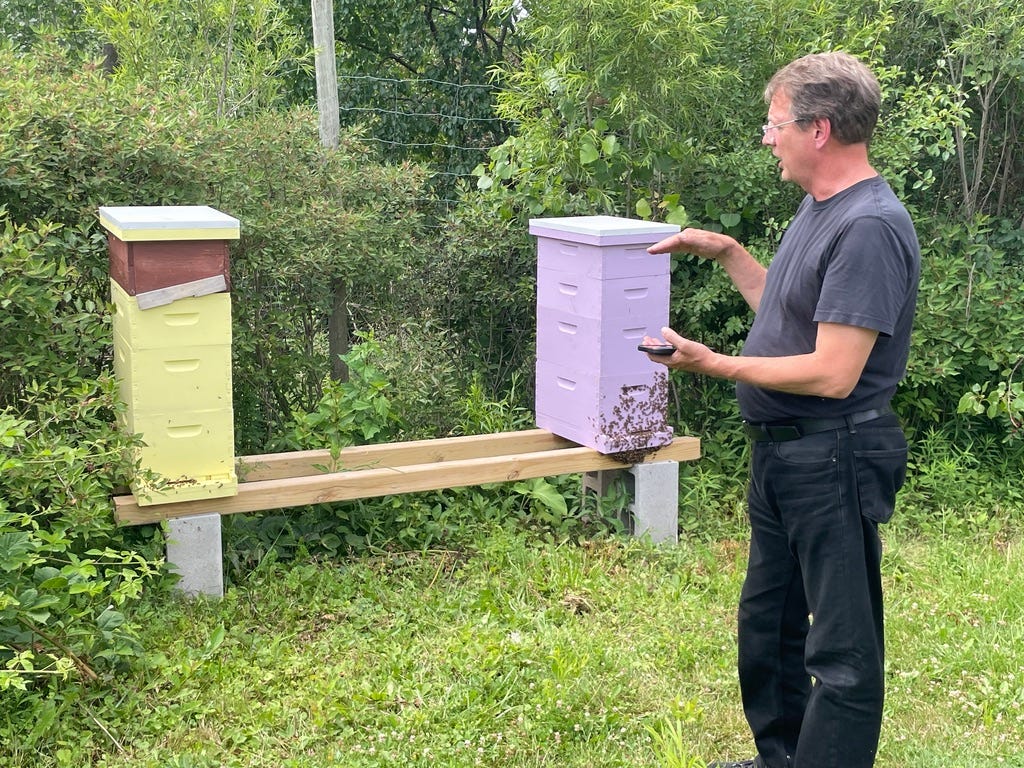
Tom explains the provenance of each of our hives. Students painted the boxes different colors to help distinguish them from each other.
Tom got into all this about four years ago after reading a beekeeping book given to him by his daughter. With a gleam in his eye, he soon found a local dealer—a bee supplier who works out of his garage—and now beekeeping has become an obsessive and joyful hobby. He tends two beehives at home plus the six at school, which he checks on several times a week. He also, incidentally, runs the university’s Center for Student Success.
“This campus is heaven for honeybees,” Tom told me. Our campus has excellent biodiversity of trees, shrubs, and native wildflowers, plus a whole field of clover right in the bees’ front yard. Bees can fly 1-2 miles from the hive if they need to, but why bother when they have such a short and easy commute to the local grocers?
Tom told me that our 300,000 bees (I know, right?) are producing about twice the amount of honey his bees at home are making. Perhaps, I suggested, they are “overachieving Calvinist bees.” More likely they’re just feasting on our campus abundance.
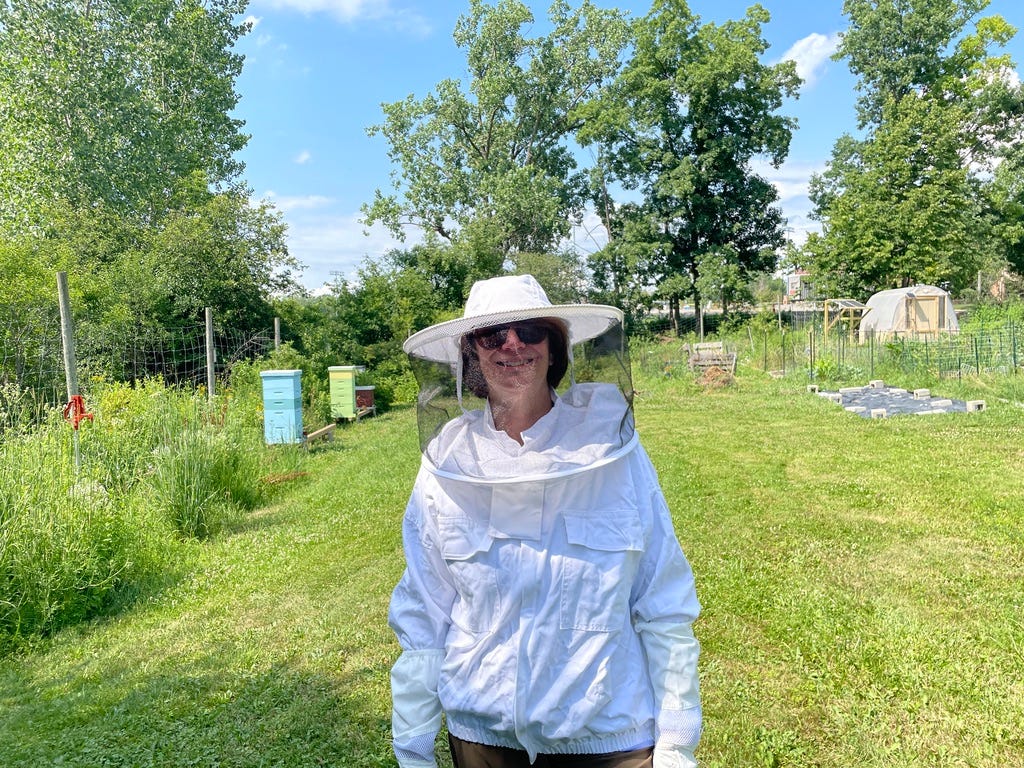
Yes, Tom got me all suited up, and I got close to the bees—even held one of those frames. The bees were docile and didn’t bother us. But I’m glad we were safely en-netted!
Tom cheerfully explained complex aspects of beekeeping such as splitting hives, buying packages of bees-with-caged-queen, managing mites, helping hives overwinter, watching carefully when to add layers of frames. If the bees start to feel crowded, they will swarm, and if they do create a “bee tornado,” well, you might end up climbing an apple tree (as Tom recently did), chopping down the branch where they’ve set up shop, and shaking the bees off into a new hive.
Tom has a loyal “following” of about 30 passionate students who have caught the bug (sorry) and will come and help out whenever needed. One enthusiastic senior this year turned up on Commencement Day to work with the bees, then put on her cap and gown and went off to graduate.
We did not neglect the niceties of bee reproduction in our chat, either. The queen, it turns out, is the only one who lays fertilized eggs. She goes off to mate once, where “she’ll meet some drones up in the air”—as if she were out clubbing one night or something. Then she’ll lay for 2-3 years, laying 1-2000 eggs a day. I mean, wow, girl. If workers find themselves queenless, they will make a queen by feeding one larva “royal jelly.” (They’re committed to monarchy, it seems.)
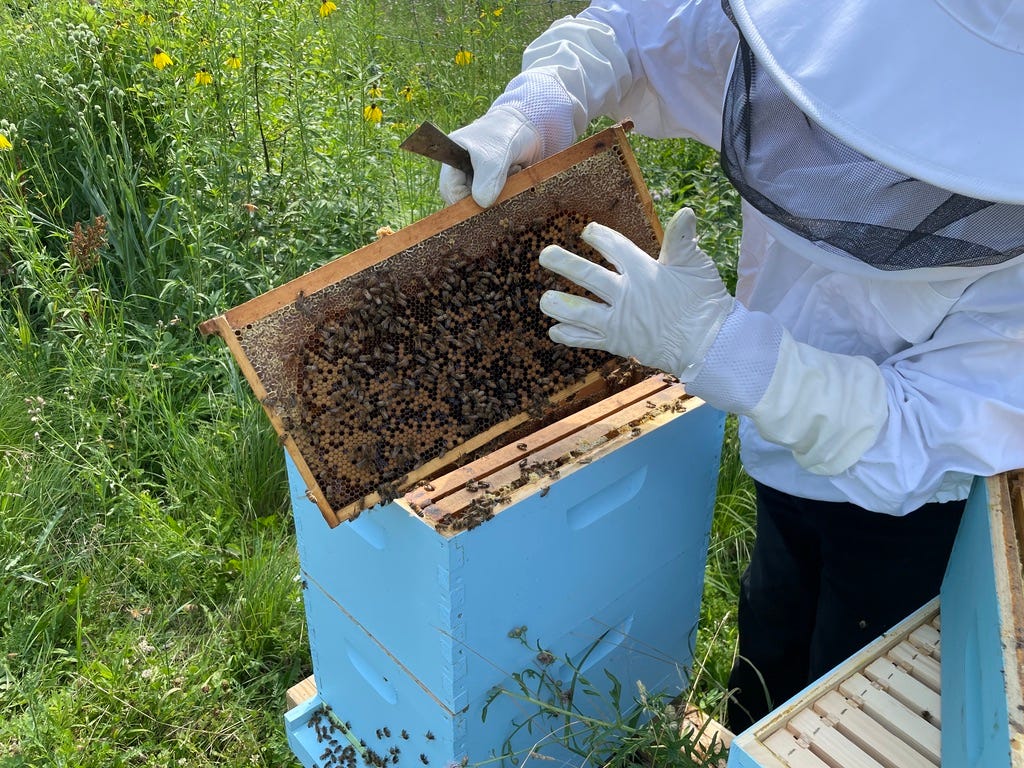
Tom points out capped honey cells, capped brood, and capped drone babies. Honeybees have a complicated division of labor. We are not talking about a democratic society here.
I asked Tom how we’re going to harvest the 150 pounds of honey or more the bees are producing this summer. He explained the whole process: you remove the frames and persuade the bees to vamoose (there are various ways). Then, preferably in a garage or something, you shave off the wax with special tools, spin the frames in a special spinner that extracts the honey by centrifugal force, then filter the honey, then bottle. He’s planning to label the bottles and sell the honey. Any ideas for how to brand the honey made on the campus of Calvin University? What do we put on the label? Extra points if you can work in a Reformation pun.
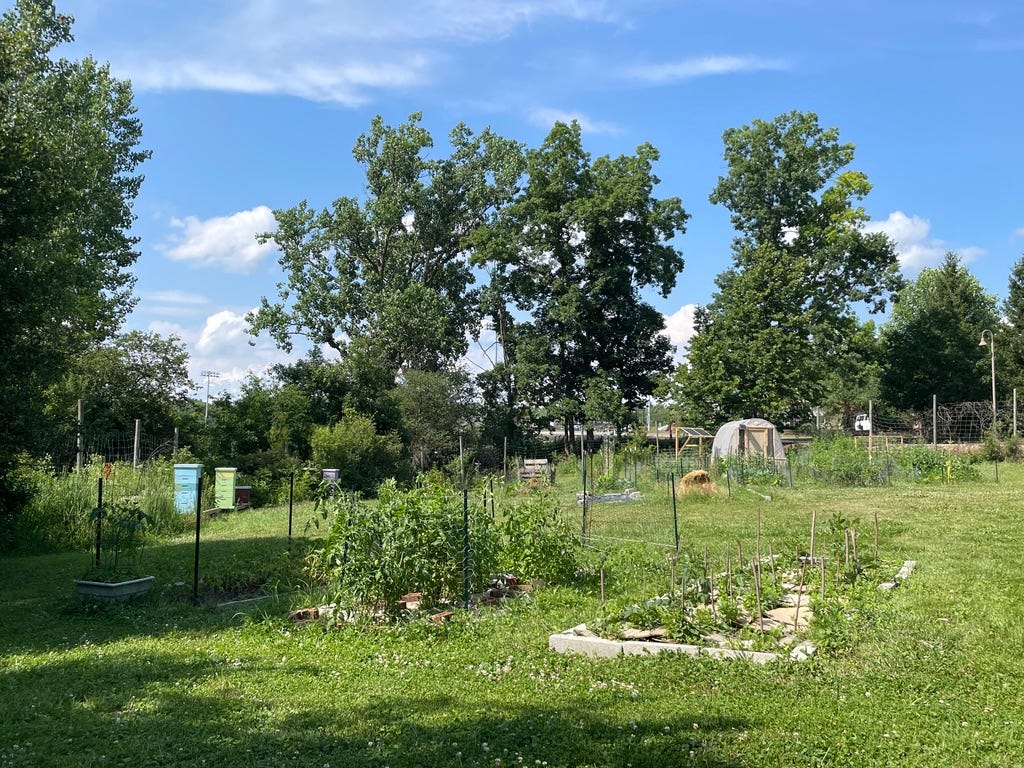
Once we finished our bee seminar, we relaxed in the two adirondack chairs stowed on the property for just such a purpose, and enjoyed this peaceful spot.
Many thanks to Tom for his generous hospitality and fascinating explanations. And thanks to the bees, too. I hope to put some of your honey in my tea this fall.
Thanks for reading. I hope you can enjoy some refugia peace in the next weeks to sustain you through the storms. Until next time, be well.
Note: Bold text in quotations is added unless otherwise indicated.
Note: I typically include the names of the writers whose work I quote in order to honor the importance of good climate journalism and the people who do this vital work.
No posts
Comments
Nothing yet. Say the first thing.
Sign in to join the conversation.