
This time of the summer normally feels to me somewhat dreamy, as if time itself pauses to sigh in summer delight. Instead, in the past two weeks, we’ve had apocalyptic skies from wildfire smoke, more nasty shenanigans from our federal government, and two—count ‘em two!—yellowjacket nests in the woodpile right outside my back door!
I attempted to deal with the nests myself, and got decent results after a harrowing nighttime stealth operation with some insecticide powder. The next day, when I discovered a second nest in a cardboard box full of newspaper, I nervously suited up for more night ops, this time with the spray-from-a-distance stuff. Kinda worked, but not really. So I called in a professional. Chris was very nice and deftly removed both nests in about 30 minutes. Whew!
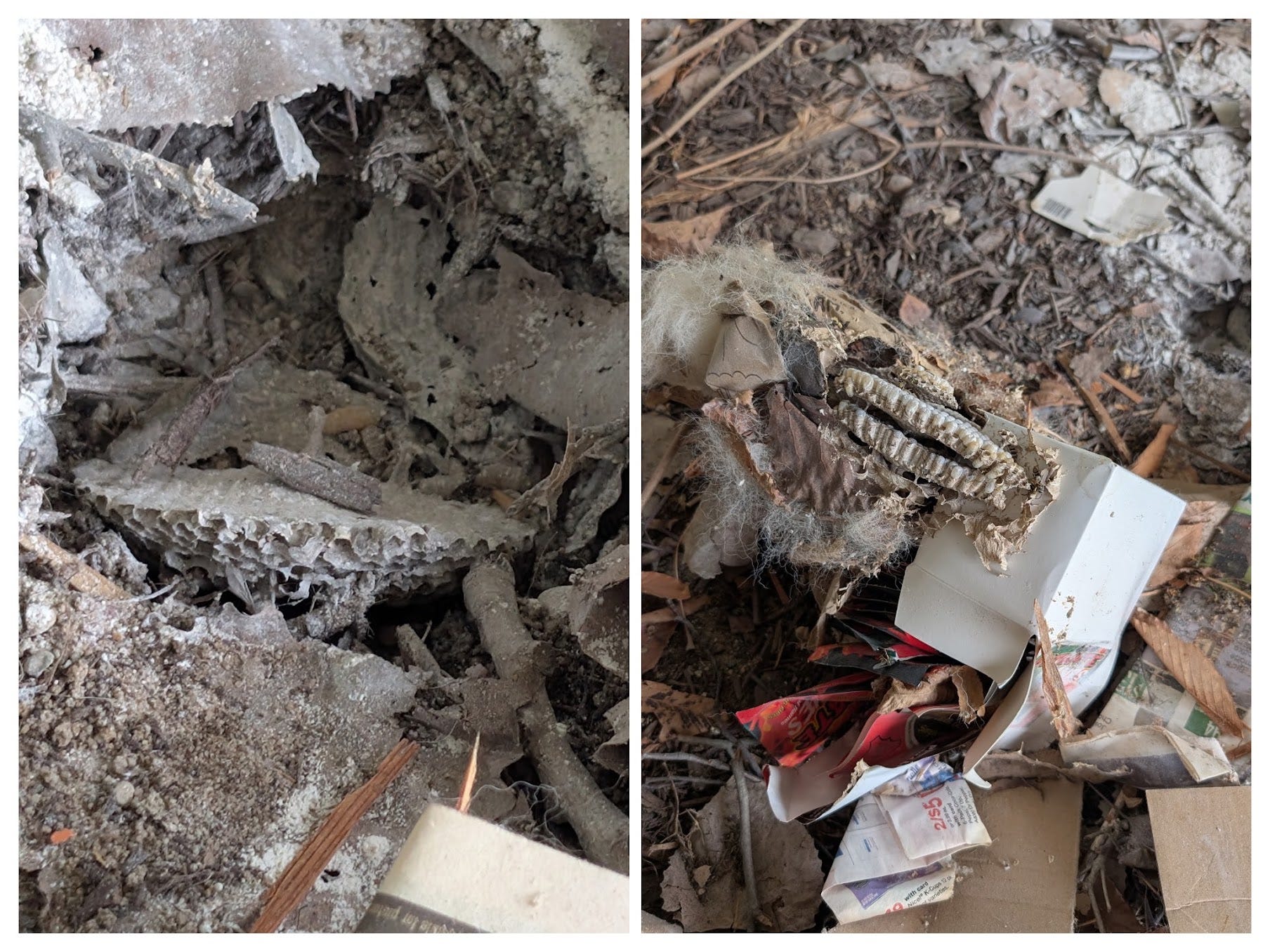
The carnage. Photos by Chris Monroe of Grand Rapids Pest Control. Thank you, Chris!!
We’ve learned our lesson: don’t leave a bunch of boxes of kindling and newspaper and other crap right outside the back door, you dummies! Fine. We’ll clean it all up and probably cover this spot in gravel. Or maybe steel.
In the insect department elsewhere on our tiny estate, we have lovelier things happening, such as this:

A monarch and a bee politely sharing the zinnias in one of our pollinator gardens. Image credit: Ron Rienstra.
Nothing much happening in refugia-related gigs in the last two weeks. Just working on plans for fall engagements. I did record another episode for the Green Lectionary podcast—I’ll let you know when that one is released.
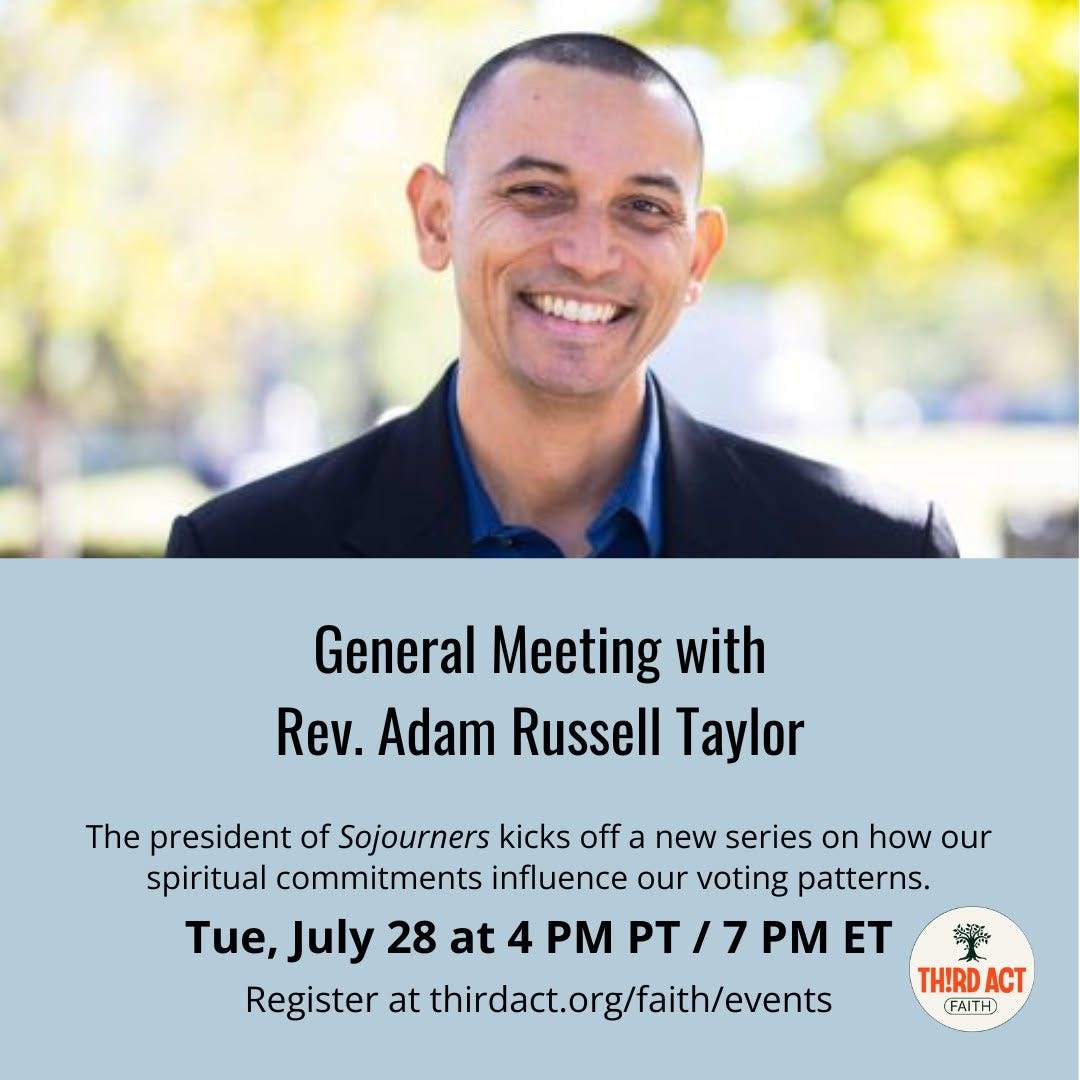
Next week, I hope you’ll consider joining us for yet another great Third Act Faith event, this one with Adam Russell Taylor. This is the first in our “how do spiritual commitments influence voting patterns” series. To find out more and register, visit this site. It’s free!
Also! Many thanks to reader Samuel Y. Chiu for referring three friends to this newsletter. You’ve earned an appreciative shout-out. Thank you!
Spouse Ron and I spent last weekend “up north” in Traverse City, Michigan, visiting our daughter and son-in-law. Normally, we spend our time up there enjoying the outdoors, hiking Sleeping Bear Dunes National Park perhaps. Not this time. We had to stay indoors the whole time because of wildfire smoke rolling in from Canada. The air outside was dangerously thick with particulates, worse than 2023 as I recall it. I’m just grateful we were all safe, unlike people who lost their homes and communities to these fires.
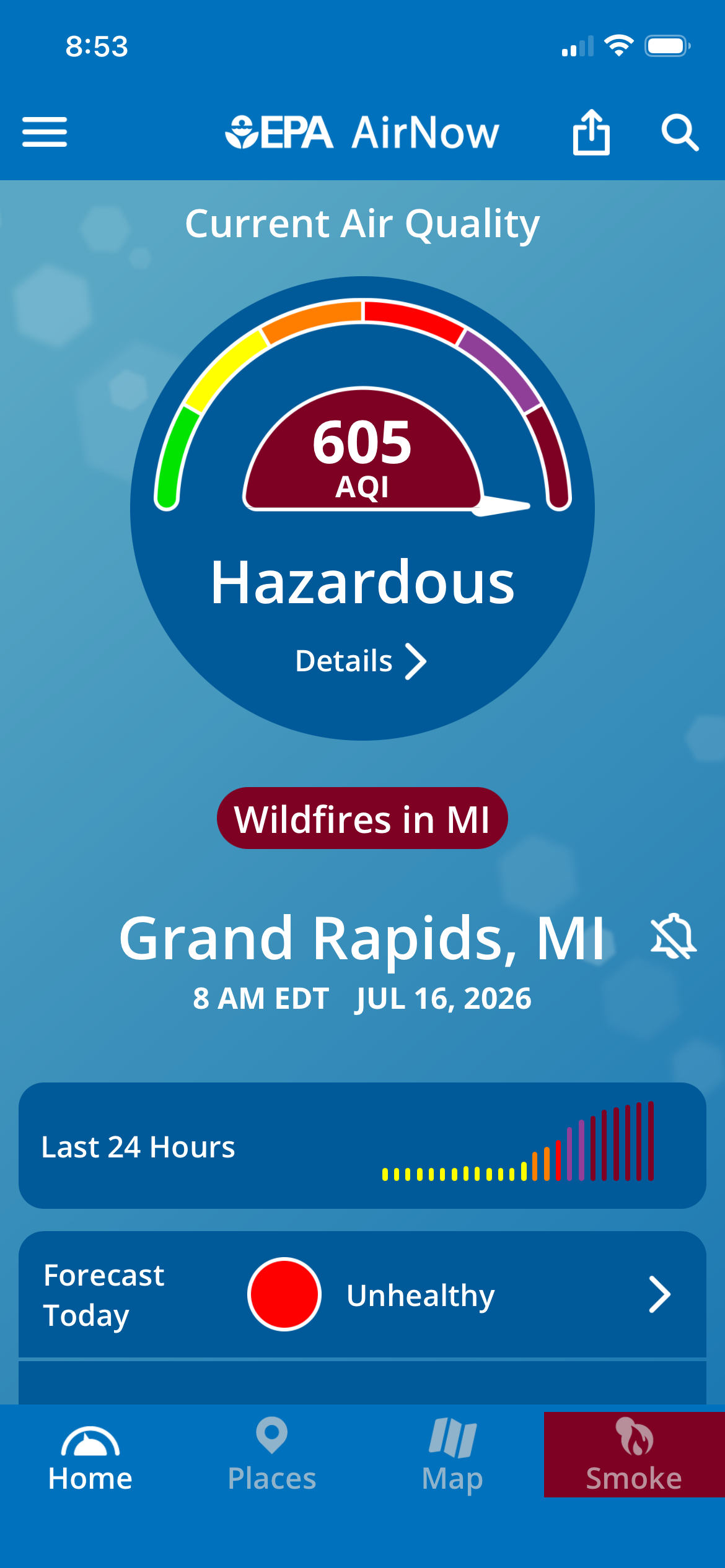
If you don’t have this app on your phone, you should. We’ve been checking it frequently lately. Remember when we didn’t know what AQI was? I learned in 2023 that the Air Quality Index is now a vital tool. Not perfect, as Daniel Engber explains in detail for the The Atlantic, but certainly better than nothing.
No doubt you have heard a lot of nonsense about how this wildfire smoke is all Canada’s fault for not managing their forests properly. Wrong. That’s just bad-faith political theater.
Here comes the science. Zeke Hausfather explains what’s going on, complete with chapter and verse from the scientific research literature. Bottom line: it’s not about management. It’s about climate change.
It’s true that management protocols have been an issue in America’s western forests, where fire suppression over a few generations ended up allowing brush and dead branches to build up on the forest floor, making fires bigger and hotter. Fortunately, we have been doing better on management strategies since the 1970s and 80s. But in Canada, we are not talking about these kinds of forests. We are talking about boreal forests that burn across the canopy. That’s what these forests do naturally. Brush-clearing on the forest floor wouldn’t help. Anyway, they’re waaaaaay too huge to manage. Hausfather writes:
The boreal is on the order of three million square kilometers. You are not going to thin or prescribe-burn your way across it, and the crown fires that produce the smoke wouldn’t stop at a fuel break anyway.
Wondering why our Canadian neighbors aren’t putting out all the fires is, among other things, a failure to comprehend the scale in question.
A better question: why are the fires so bad right now? Because it’s hotter and drier, thanks to climate change:
Canadian fire seasons (May through September) have warmed about 2.2C on average since 1959. Canada warms at roughly twice the global rate, and its north at roughly three times. That warming matters for fire through a well-understood mechanism: warmer air is exponentially “thirstier” (saturation vapor pressure rises ~7% per degree), so it pulls moisture out of live vegetation and dead fuels alike, priming the landscape to burn. It’s the same fuel-drying pathway that Abatzoglou and Williams (2016) found had roughly doubled cumulative forest area burned in the western US.
Hausfather continues: “In addition, parts of the northwestern boreal are now burning at rates that do appear to exceed anything in thousands of years.” These fires are not caused by careless campers or arsonists, by the way. They’re overwhelmingly caused by lightning (90+% of the 2023 fires were caused by lightning). Lightning setting boreal forests on fire is a natural process. Climate change is simply making it all worse: “Because warming is expected to increase high-latitude lightning, climate change can contribute to both the fuel dryness and the ignition side of the equation.”
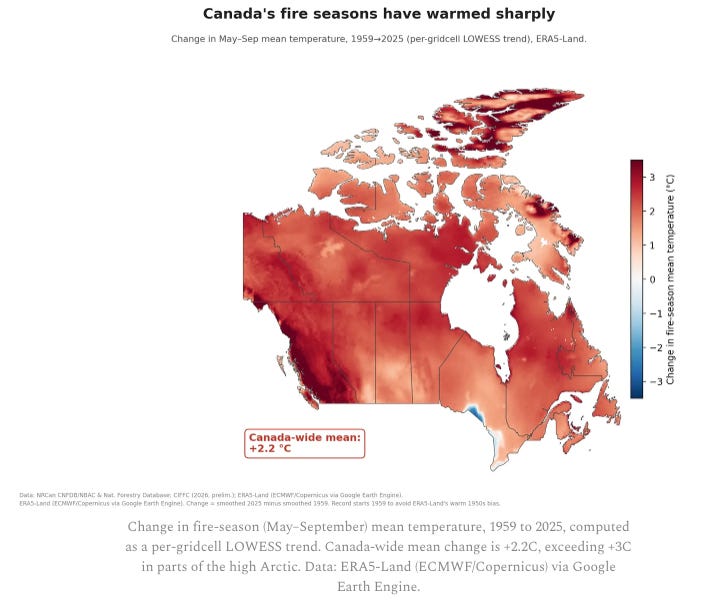
Yep. Canada is a lot hotter.
Let’s do a little more myth-busting, shall we? People not only hear misinformation about fires, but also about the reasons the planet is getting hotter. They have many reasons for believing these myths, but it’s important to keep putting the actual facts out there.
Thus I’m grateful that Jonathan Watts of the Guardian interviewed renowned climate scientist Ed Hawkins to assemble a terrific, simple guide to busting myths about extreme heat. Hawkins offers solid, understandable, science-based answers to myths like “Aren’t heat waves caused by natural weather cycles?” and “Scientists disagree on how much humanity is affecting the climate, right?” This is Climate 101, but very useful if you are having conversations with people who are unsure what to believe.
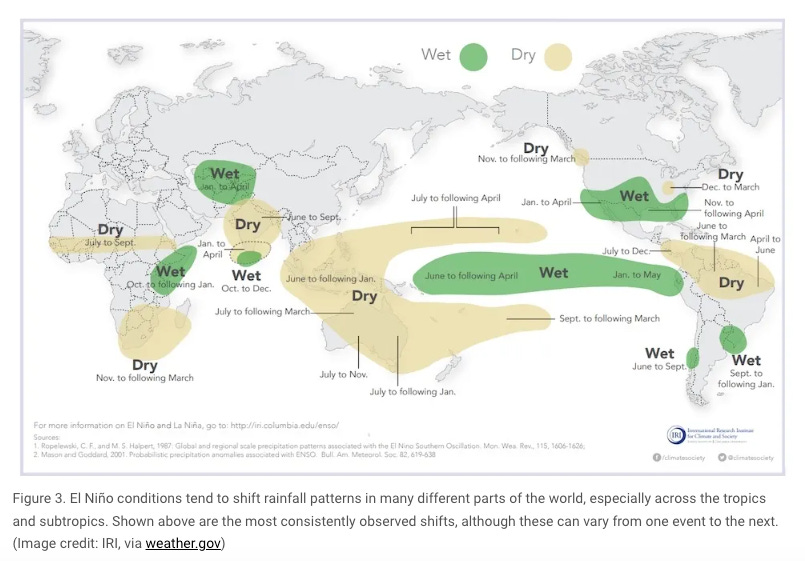
It’s confusing, isn’t it, that climate change seems to be causing both heat/droughts and huge rain events? But that is correct. This is why climate scientist Katharine Hayhoe has long referred to “climate weirding” rather than “global warming.” The average global temperature is indeed warming, but we experience that as weird weather whiplash. This year’s El Niño cycle is an example of how this works. This year’s El Niño is more and more certain to be record-shattering, peaking around the end of the year.
Bob Henson explains in Yale Climate Connections that while El Niño is a “normal” pattern that shifts heat and moisture around in short-term cycles, climate change is making the cycles far more extreme: waaaay too dry, waaaay too wet, way too everything:
El Niño—a periodic warming of the waters of the eastern tropical Pacific—is the world’s single biggest shaper of global temperature and regional climate over periods of a few months to a year or more. Heat that’s stored in the ocean during the cool counterpart phenomenon, La Niña, rises from the eastern tropical Pacific during El Niño. The result is a spike in global temperature, as well as climatic reverberations that typically include drought over Indonesia and parts of South America and Africa, wet winters over the southern U.S., and a shift away from Atlantic hurricanes toward North Pacific hurricanes and typhoons (a shift already in progress).
This map helped me understand better how different regions experience these cycles:
OK, let’s balance all that gloom with some encouraging developments: time for this week’s clean energy update.
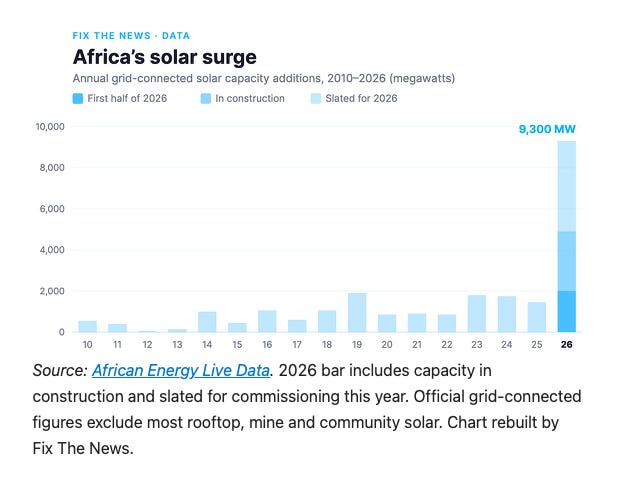
First: solar! Africa is definitely engaged in a solar revolution. The good people at Fix the News reported on a new analysis from African Energy Live and created this graph to tell the story. Note that the graph only accounts for grid solar, excluding the panels people all over the African continent are installing on their roofs or farms:
Meanwhile, in the US, the excitement over balcony or plug-in solar continues to march across the states. Is plug-in solar legal in your state yet? Here’s a reminder of that terrific tracker website where you can check. If you’re in one of the lucky ten states so far, here’s a deal for you from Bright Saver: buy yourself some solar panels at cost, plug ‘em in and start offsetting your electricity costs.
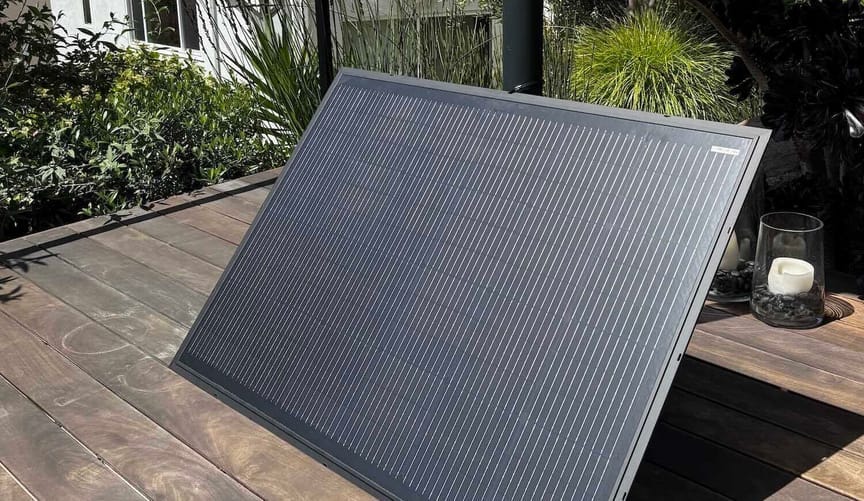
Easy-peasy. Just plug this thing into an outlet and it starts producing electricity for your house. It’s OK: it won’t hurt anything. Keep in mind that Germany now has 4 million plug-in solar systems like this operating.
Bright Saver is a nonprofit group, and they are aiming to give this beginner solar strategy a big boost in the US by offering excellent deals. Wait: Is plug-in solar safe? Yes. You can read all about it here. The bottom line for this Bright Saver deal:
Bright Saver sells a 180-watt kit for about $285 and a 360-watt kit for $414. To access these prices, you first have to become a member, which costs $29 annually (with renewal optional). Otherwise, a 180-watt kit is $499, and a 360-watt kit is $699.
The organization aims to be the Costco of clean energy; only members can access the deep discounts. And more product deals are coming. Bright Saver plans to offer plug-in home batteries that work with balcony solar kits as soon as next year.
Finally, a battery update. Clean-energy-producing tech like solar and wind need pairing with batteries to be “firm”—that is, producing energy that’s available at all times. So developments in battery tech are a big deal, and although sodium ion battery tech has been around for a while, it hasn’t hit the scale we need. Perhaps until now, thanks to—you guessed it—China.
Batteries based on sodium promise to be cheaper, safer and much more environmentally friendly than lithium-ion cells. And this year could mark the start of the sodium era.
In April, Chinese firm CATL—the world’s largest battery producer—announced that it will start mass-producing sodium-ion batteries before the end of 2026. CATL, which is headquartered in Ningde, added that it had signed deals to sell the batteries both to a car manufacturer and to a provider of energy-storage stations for electricity grids.
OK, folks. Fasten your seatbelts because we are going to take a stab at some complicated and infuriating stuff about: data centers. Yes. I’m sorry. I hate this topic, but we’ve got to deal with it. Hang in there, and we’ll get to some good news.
As you probably know, we are experiencing a remarkable bipartisan backlash against data centers in the US, especially so-called “hyperscale” data centers. In both red and blue communities, no one wants data centers, and for fairly obvious reasons: they’re huge and ugly, they don’t create many jobs once built, they suck enormous amounts of energy and water, and they drag on the grid and raise energy costs. Meanwhile, Big Tech keeps telling us that AI is inevitable! Soon AI will be sentient! Everything will be better with AI! Trust us because we are smarter and more powerful than you!
People are not impressed. We are sick of being pushed around by billionaires and megacorps.
The bad news is that companies invested in AI are nevertheless doing everything they can to force through their data center ambitions. If you want to understand all the complexities better, I highly recommend this bracing explainer by energy analyst Jeremy Symons.
Among many nefarious aspects of this whole AI phenomenon: Big Tech is collaborating with the fossil fuel industry to power data centers with gas, locking in more gas-burning for decades.
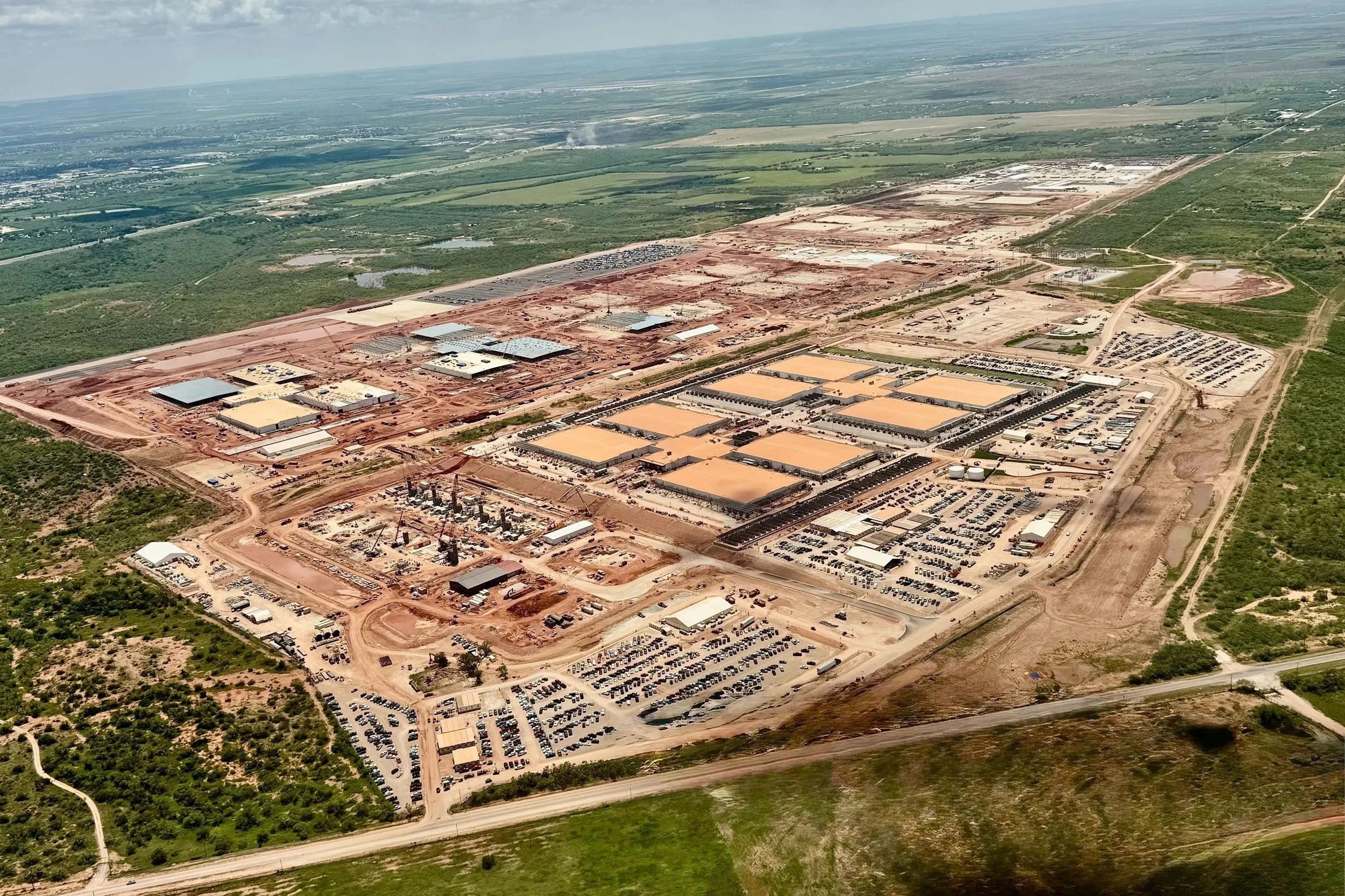
A data center campus in Abilene, Texas. Image credit: Crusoe via Inside Climate News.
Here’s one case in point:
Microsoft recently signed a deal with Chevron that will co-locate a hefty 2.7 gigawatts of gas-fired power next to a planned data center in Texas. The new power plant would rank among the 20 largest power stations in the United States and produce power equivalent to the electricity used by about two million homes.
The AI companies are also getting around various environmental regulations by favoring “‘behind-the-meter’ gas turbines built as part of the AI data complex, or co-located nearby, instead of going through the steps necessary to connect to the existing grid.” Sure, nice that you’re not dragging on the grid, but you’re still burning gas!
To get data centers online faster, both AI companies and fossil fuel industry lobbyists are pressuring legislators to help override local objections and loosen permitting and regulating structures.
As Symons explains, we ought to be skeptical when we hear politicians touting an “all-of-the-above” strategy for energy. This amounts to an excuse to keep subsidizing the fossil fuel industry, building fossil fuel infrastructure (especially LNG), and keeping the industry swimming in profits. “We need so much more power for data centers!” is often the excuse. However, we can, in fact, achieve “energy abundance” without locking in fossil fuels for decades to come. Other countries are moving fast toward that goal.
We also need to watch the “permitting reform” fight carefully. Legislation now floating around Congress proposes making permitting easier both for clean energy and for fossil fuels. Many clean energy advocates are tempted to take this deal, hoping that market realities will help clean energy surge and fossil energy fade. Unfortunately, it’s not quite that simple, as Symons explains. Moreover, if we were really facing facts about market realities, energy security, pollution, and climate disruption, we would be eliminating permits for any new fossil fuel development.
Action item: Call you federal reps and tell them not to pass any legislation that overrides community protests over data centers, and to resist any legislation that makes permitting easier for fossil fuel infrastructure. Symons offers the details so you can speak about specific proposed legislation.
More good stuff to read or listen to for a deeper dive on all the issues related to data centers:
This really, really good episode of the Volts podcast, “Making Sense of the Data Center Backlash” with David Roberts, Jigar Shah, Jamie Nolan, and Arnab Pal. This one covers public opinion, energy markets, psychology, media ecosystems—it’s fascinating. They also discuss a way to build data centers while actually benefitting communities and pushing the clean energy transition forward. It’s possible! That’s not what’s happening, but it could be.
This also really, really good episode of Volts, in which Hawaii state senator Chris Lee explains that state and local legislators typically do not know much about clean energy (or energy systems in general)! They just don’t know! His group is trying to fix that, but keep in mind that when you pressure your state and local reps toward clean energy, you are doing them a service.
A deft, short essay by Sambhav Shankar on why Trump’s “energy dominance” strategy means dominance for the oil companies and a terrible deal for everyone else.
Now for the good news: public opinion on climate.
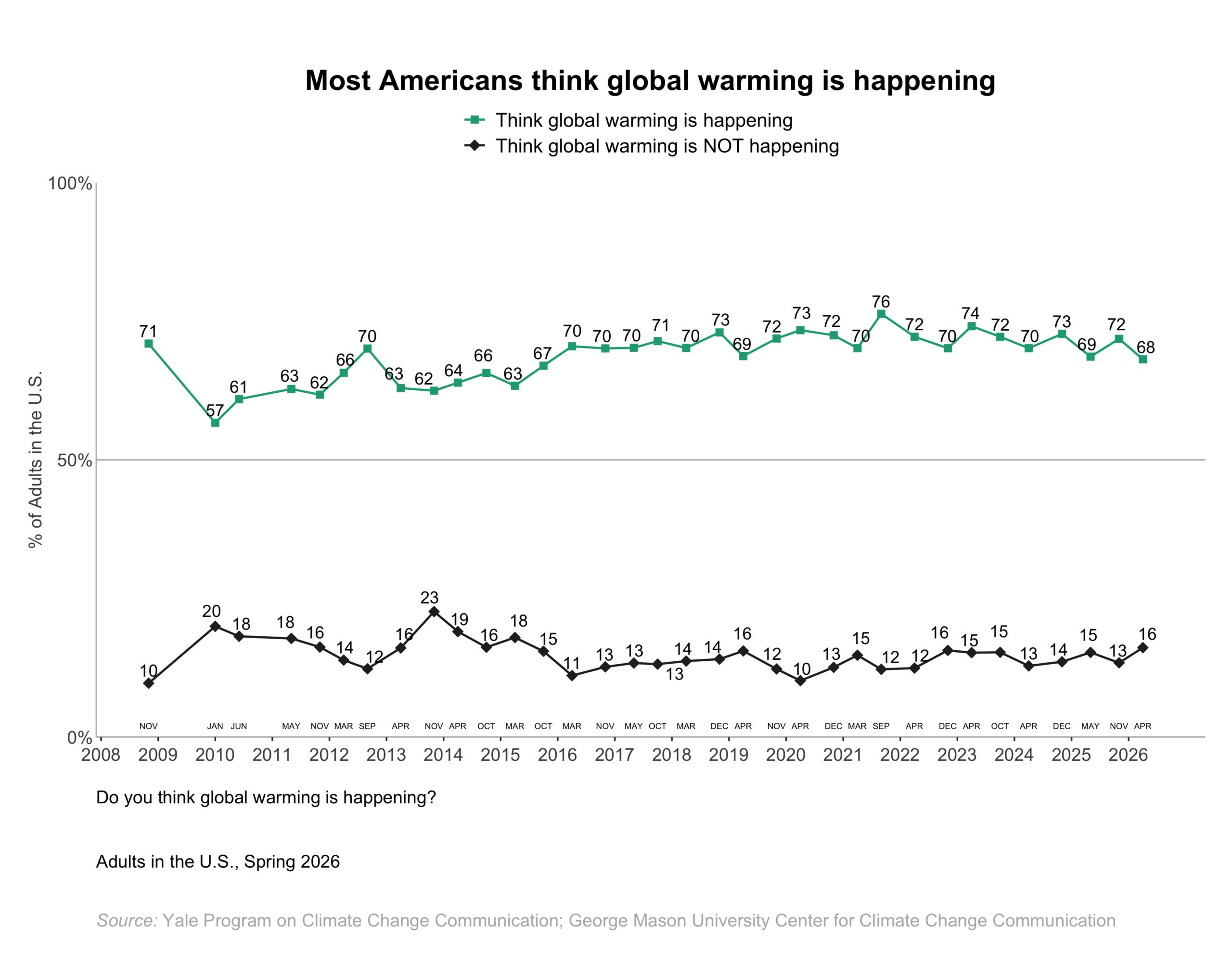
You are not alone. A big majority of Americans believe that climate change is happening and human-caused. A majority also link the increase in extreme weather events to climate change. In other words, despite all the mis- and dis-information floating around, most Americans understand what’s happening. They also want action.
Two recent polls bear this out. First, a poll done in April by premier climate research group Yale Climate Communications. Some juicy tidbits from their executive summary.
Americans who think global warming is happening outnumber those who think it is not by a ratio of more than 4 to 1 (68% versus 16%).
By a 2 to 1 margin, more Americans think global warming is mostly human-caused (59%) than mostly caused by natural changes in the environment (27%).
65% of Americans say the issue of global warming is “extremely,” “very,” or “somewhat” important to them personally, while 35% say it is “not too” or “not at all” personally important.
Majorities of Americans say they are worried their local area might be harmed by extreme weather events or related impacts including water pollution (79%), diseases carried by mosquitoes and ticks, such as Lyme disease and West Nile Virus (79%), electricity power outages (78%), air pollution (77%), extreme heat (77%), droughts (72%), water shortages (70%), wildfires (63%), and flooding (63%), and 45% are worried about hurricanes.
Most Americans also want more media coverage of climate-related stories (for most issues around 70% want more). Unfortunately, as we’ve known for a long time, only about 34% of Americans ever talk about climate change. So don’t be shy! Most people agree with you and want to talk about it—they just don’t dare.
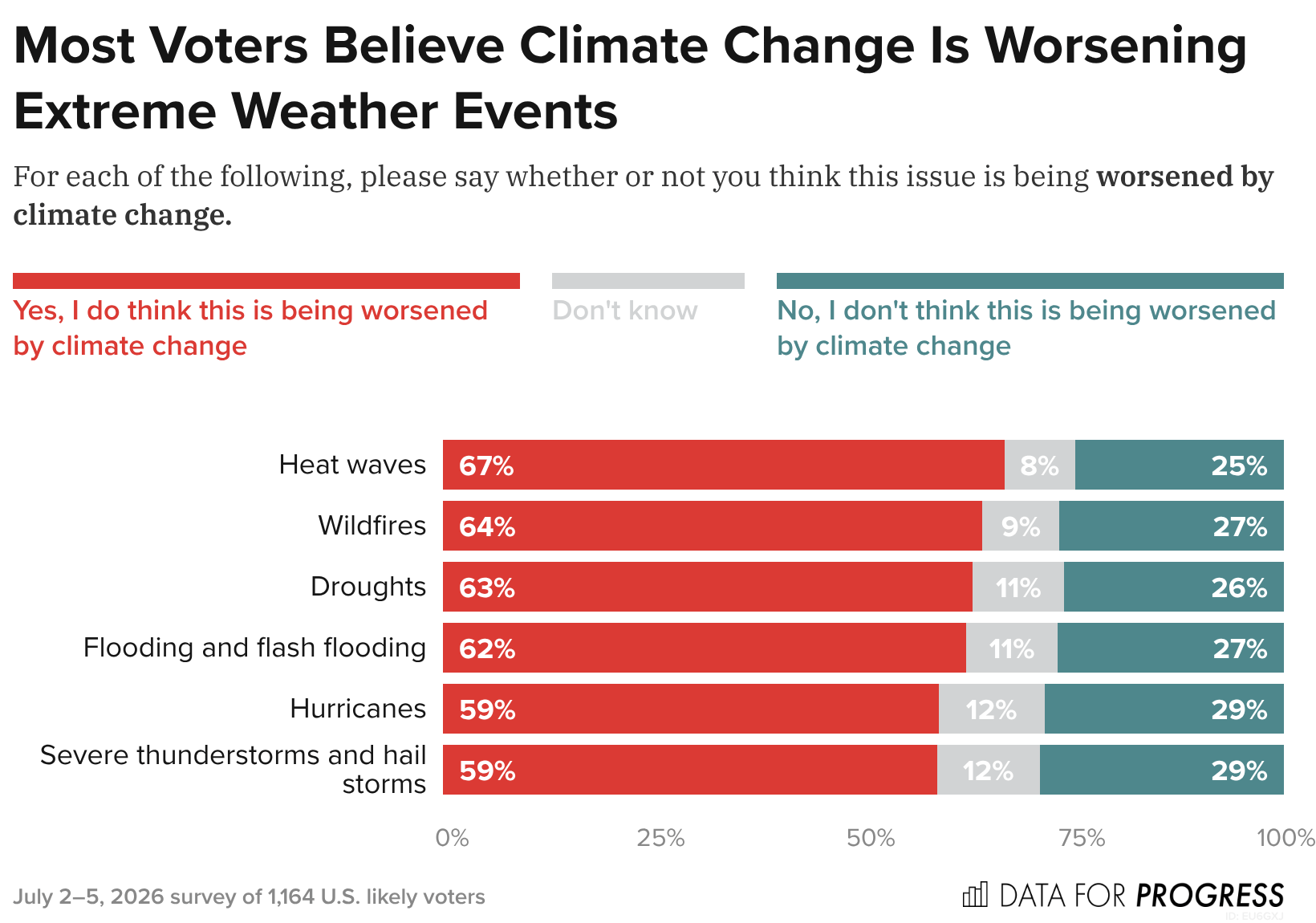
Here’s more: American voters understand that extreme weather events are worsened by climate change. This from a recent poll by Data for Progress of likely voters across parties. From an article on the poll by Dharna Noor in The Guardian:
About 61% of likely American voters believe extreme weather events have become more frequent over the past five years…. That includes 72% of Democrats, 63% of Independents, and nearly half—46%—of all Republicans.
You know, instead of reducing their climate-related coverage, as many major US outlets have done since 2024, they could be following Japan’s lead. Perhaps you remember that huge global survey finding that 89% of the world’s population wants government action to combat climate change. Well, Japan is making sure no one forgets:
At a time when some US news outlets have retreated from the climate story, hundreds of news organizations in Japan are headed in the opposite direction.
Inspired by Covering Climate Now’s 89 Percent Project, every television network and station in Japan this spring began a two-year program of airing public service commercials pointing out that 89% of people in Japan support climate action, “so people shouldn’t be afraid to talk about it.” …
Now, 136 of Japan’s media outlets have gone further, joining a public awareness project called “I am one of the 89% who want to stop global warming.” Organized by the UN Information Center in Japan, the project aims “to make visible the voices of prominent figures and people from all walks of life who want to stop global warming, and to amplify them into a collective voice of society.”
Imagine if the US news media did this. Sigh.
Now for this week’s featured refugia: those places where life and life-giving systems persist amid crisis. By reading this newsletter, you join the many people striving to be people of refugia, working in their communities toward a more just and sustainable future.
We’ll begin today with a passel of examples from the folks at Blessed Tomorrow, an interfaith alliance inspiring and equipping faith communities to work for earth-healing and climate justice. They’ve released a series called “Caring for the Earth: Stories from Faith Communities.” These seven short films feature a range of people, communities, and actions all aimed at connecting faith commitments with climate action. Here’s the whole series and here’s a 3-minute trailer:
Next: indigenous land stewardship. We’ve known that lands stewarded by indigenous peoples tend to be healthier and more biodiverse. Is it simply because they’re more sparsely populated? No, instead it’s about indigenous beliefs, knowledge, and practices. New research helps deepen our understanding of why indigenous people must be involved in land management and conservation decisions not only in their own territory but as part of larger global efforts. They are a source of experience and wisdom.
Researchers interviewed 49 Indigenous leaders from six continents about how they steward their land, which ranged from the Amazon rainforest to East African savannas and Pacific Islands. They found that traditional management practices like avoiding overfishing, maintaining sacred spaces, watching for fires and other threats, and direct resistance against extraction contribute to the remarkable health of Indigenous territory. … Shrestha [the study’s lead author] stressed that although each Indigenous community is distinct, there are shared lessons the entire world can learn from.
The study builds on years of research that shows, among other things, that the world’s healthiest forests are on Indigenous lands and conservation efforts are more effective when they incorporate Indigenous autonomy and decision-making at every step.
Finally, emergency beehives. Not what it sounds like! Instead, these beehives are a portable energy strategy designed to assist during disaster or disruption. Katie Myers writes in Grist about projects in North Carolina designed to build better energy resilience. After Hurricane Helene in 2024, people are keenly interested in better preparation.
One strategy is the solar microgrid. Solar microgrids combine solar with battery storage and can serve when needed as resilience hubs, providing emergency power even when the main grid is down. These stationary grids are popping up all over the country.
“Beehives,” however, are fleets of trailers that can go out as “bees,” carrying mini-solar/battery power wherever needed. According to the nonprofit Footprint Project, “Hives are semi-permanent, centralized solar microgrid sites installed for six months to five years or more. Hives are strategically placed within a community to maintain and dispatch the Bee fleet.”
Myers quotes the CEO of Footprint Project:
“Cooler bees” include fridges and freezers for medications and food, “power bees” provide charging stations for phones and other devices, and “water bees” filter water. “Because they are mobile, these bees can be towed immediately to communities hardest hit in disasters,” said Footprint Project CEO Will Heegaard.
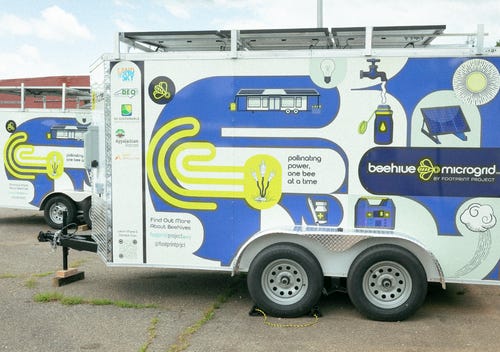
Trailer-mounted solar/battery ready to go where needed. Image credit: footprintproject.org.
I actually knew about these beehives from an interview I did while researching Refugia Church. I spoke with Jenny Phillips, Director of Environmental Sustainability at General Board of Global Ministries of the United Methodist Church—and she told me she works with The Footprint Project, “a disaster management organization that develops and deploys sustainable infrastructure networks to empower community resilience.” Cool.
You can read more about Beehive Microgrids on the Footprint Project’s website. You can even support them with contributions!
Whew! That’s enough for today. I’ll leave you with another delightful photo of some pollinator garden action.

This female bee is collecting pollen into her pollen baskets—or as I call them “bee jodhpurs.” Image credit: Ron Rienstra
Wishing you some good rest, delights small and great, and strength for another day. Till next time, be well.
Note: Bold text in quotations is added unless otherwise indicated.
Note: I typically include the names of the writers whose work I quote in order to honor the importance of good climate journalism and the people who do this vital work.
No posts
Comments
Nothing yet. Say the first thing.
Sign in to join the conversation.