
There is a word from linguistics that I discovered some years ago and recently came back to when I try to explain what inclusion actually is and what it actually does.
That word is polysemous.
Something is polysemous when it carries multiple, deeply connected meanings at the same time, attached to the same thing, in a way where understanding one meaning helps you understand the others.
A polysemous word doesn’t mean one thing or another. It means several things simultaneously, and those meanings are not accidental ingredients.
They are entwined.
Inclusion, properly understood, is polysemous. This is not a cute metaphor from a consultant trying to justify his work with an obscure word that is unfamiliar to most. We’ve had enough of that in the people and culture space and if you’ve ever read my book, Reconstructing Inclusion, or anything else I’ve written you know I suffer no fools when it comes to bullshit terms, approaches, or silliness.
That inclusion is polysemous is a concise and precise way to describe what makes inclusion strategically irreplaceable and why, at the very moment organizations are cutting back, they are diluting something that needs to be at full strength.
My working definition of inclusion: any action that creates the conditions for people to thrive and organizations to be generative or to generate “thick value.”
Notice what that definition does not say. It does not say “representation.” It does not say “belonging programming,” or “ERG participation,” or “unconscious bias training.”
It says any action, that is, a daily manager habit, a design decision, a meeting norm, a promotion criterion. And it says that action has a dual purpose: human thriving and organizational value generation.
Not one, then the other. Both. Simultaneous consequences of the same act.
Let me be precise about what I mean by “creating the conditions for people to thrive.” else skeptics rightly (and/or conveniently) push back.
The practitioners who ran the programs now being dismantled also believed they were creating those conditions. So what makes this different?
The difference is in what the conditions are designed to produce.
Orthodox DEI created conditions for representation; that is, getting people in the room. What I am describing creates conditions for contribution, getting what people know into the decisions that matter.
Representation asks who is present. Emergent inclusion (my framing of the work I’ve done for many years) asks what is being surfaced, by whom, and whether the organization is structurally (structure creates behavior) capable of receiving it.
Those are not the same question, and the distance between them is where most inclusion efforts have quietly failed.
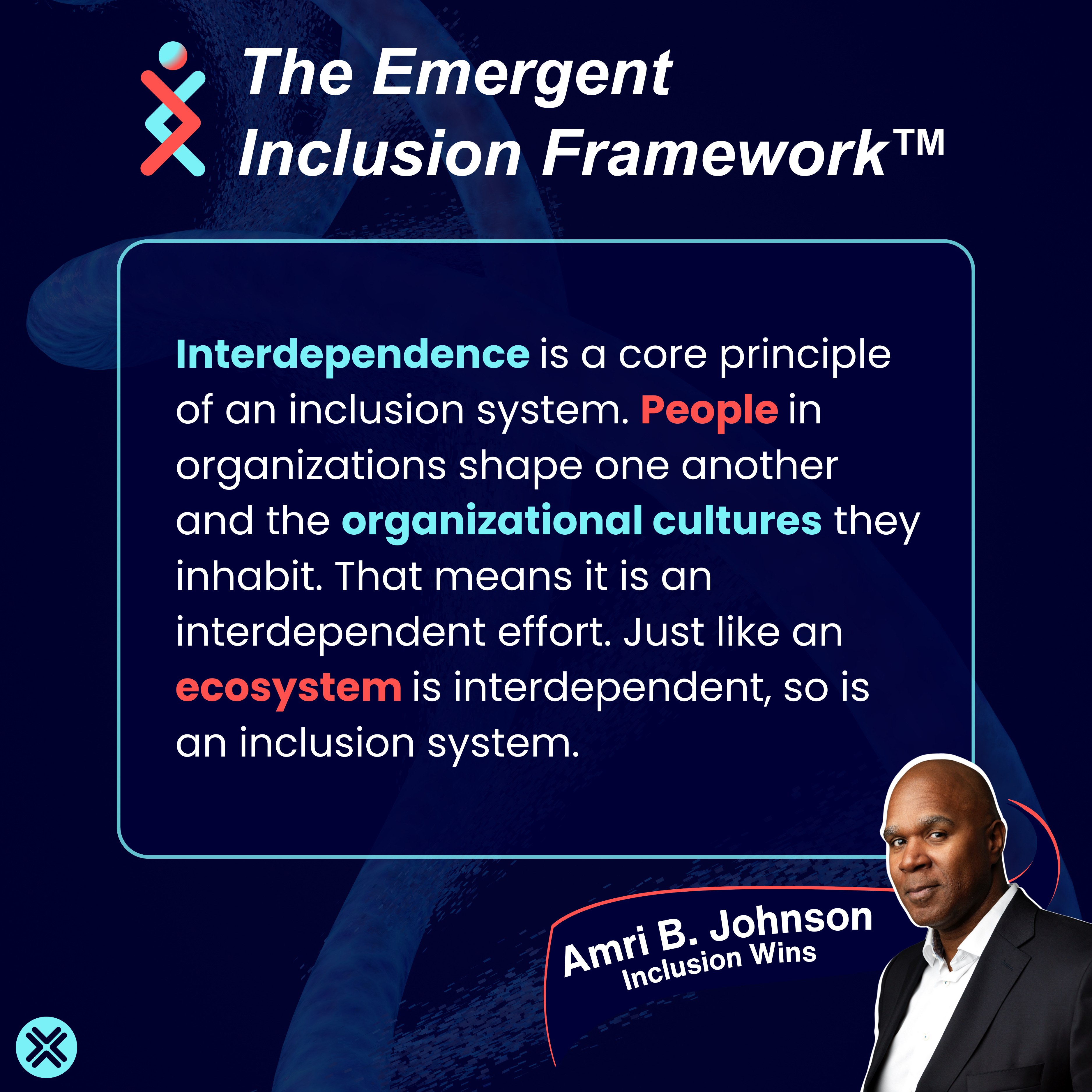
Simultaneity and interdependence are core principles in which the elements of a system have various multilinear connections, acting on one another and the system as a whole. The web of causality metaphor lands well with polysemy and thus inclusion.
Share Reconstructing Inclusion
In 2009, Umair Haque began writing about what he called thick value: the deep, enduring human worth of a thing to everyone, as opposed to thin value, the isolated monetary value of a thing to shareholders.
Anthropologist Clifford Geertz had explored the concept even earlier, observing that any object or behavior carries not just functional or material value, but symbolic, emotional, social, and aesthetic value all at once.
One fitting image Haque’s idea offers is baklava. You cannot eat baklava one layer at a time. You cannot separate the phyllo from the nuts and the honey and call what remains baklava. The layers are enfolded. They are the thing.
This is how thick value works: the financial, functional, emotional, and social layers of value don’t stack politely on top of each other. They are fused and infused with one another in an inseparable way; otherwise, naming the separate pieces of the collective thing and still calling it the thing would be inaccurate. They are the ingredients, not the collective, stick-to-your-teeth yuminess of baklava.
When you reduce an exchange to its price tag alone, you haven’t analyzed it. You’ve damaged it.
I spent nearly two years observing a senior leadership team at a global pharmaceutical company. Once a month, they gathered for a decision board meeting: physicians, PhD scientists, department heads, all evaluating drug discovery projects at various stages of the pipeline. My colleague called it one of the most expensive meetings in the organization. He wasn’t wrong.
My role was to observe how they engaged with the junior teams who came in to present their science. Their levels of curiosity. Their ways of expressing institutional preference. Whether they were genuinely asking questions or simply delivering verdicts. Then I gave them feedback, in real time, throughout the day.
At first, it was exactly what you might expect from a room full of accomplished experts. They were critical. They weren’t curious. They told people what to think rather than asking what they needed. The presenters left with answers, but not always with clarity, and especially not with new questions to consider in their work going forward.
Over time, things shifted. The senior leaders started opening presentations differently: “What would be most helpful to move your project forward today, from us?”
They started asking about the teams behind the science, not just the science itself. They started seeing what was between the lines.
What changed was not the science. The science was always there. What changed was their ability to read the map that the junior teams already had. Those teams, the ones closer to the ground and closer to the actual experimental work, were the ones who could see around corners. They always could. But the senior people around the table had not consistently created the conditions for that intelligence to surface.
Once those conditions existed, the value that had been sitting dormant in the organization began to move.
That is the gold in the building. And the senior leaders, for all their expertise, were not the only ones who could find it. In fact, they were often the last ones to see it, until inclusion created the conditions for it to become visible.
I remember one afternoon stepping out of one of the all-day meetings I was there to observe to work with a more junior team on cognitive bias, specifically confirmation bias, and how it was shaping the way they evaluated options on their projects.
When I returned to the senior leadership room, the dynamic had unraveled. The head of that disease area, a brilliant and deeply decent human being, had gotten into his zone. He was loud, forceful, filling the room with his certainty; he even pounded on the table as I was heading to my seat. And nobody was fully following him.
I sat down behind him, and all of a sudden, the eyes in the room started to gaze past him toward me. He turned around. “Oh, shit. Hi, Amri.”
He laughed. So did the room. But what that moment did, quietly and without drama, was remind him of everything we had been working on together. The behaviors shifted almost immediately. It wasn’t anything I’d said. Rather, it was a result of the conditions we had built together over months, which were real enough to be activated by a single reminder.
That is what thick value looks like inside an organization that is genuinely building inclusion habits.
It doesn’t always look like a transformation. Sometimes it looks like a turn of the head and an “Oh, shit” moment.
What happens when a people manager or influential contributor genuinely practices inclusion? They create conditions for contribution, lower the social cost of dissent, and signal that a person’s viewpoint is not just tolerated but needed.
Functionally, the organization gains access to ground-level intelligence it cannot buy or manufacture. Managers get better data. Unknown risks surface before they compound. Decisions improve and stick.
Emotionally, the person in that exchange experiences something that researchers like Zach Mercurio and Isaac Prilleltensky call mattering, the felt sense of being noticed and affirmed as a unique contributor.
This is not a soft perk. It is one of the most powerful drivers of discretionary effort, motivation toward purpose, and retention available to any organization.
Socially, trust accumulates. The norms of a team shift. It becomes safer for others to tell the truth. The ecosystem changes, and the change is compounding.
These three layers are not separate outcomes of three separate interventions. They are the same actions, generating multiple simultaneous meanings. That is polysemy. That is thick value.
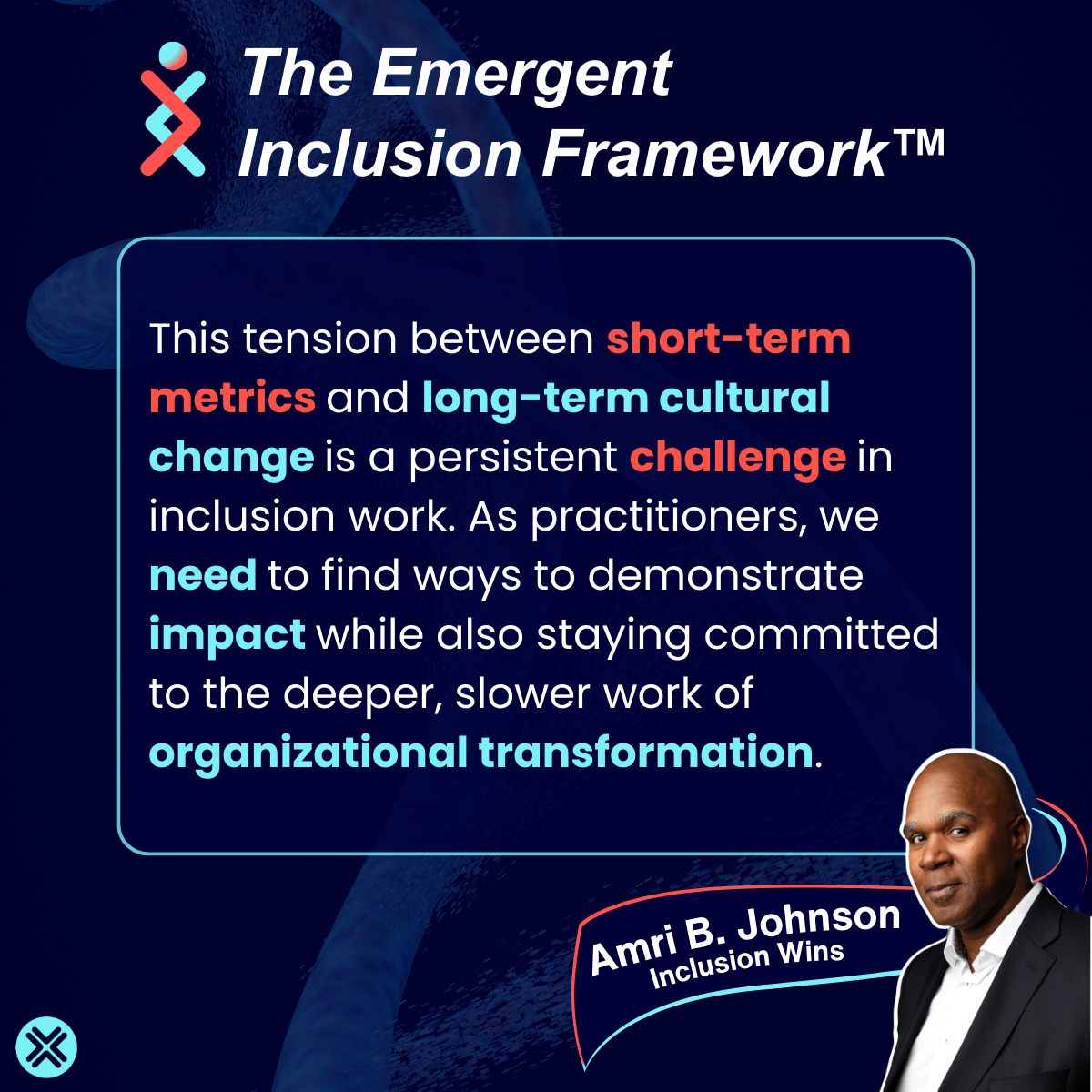
And this is exactly why inclusion cannot be fully financialized. You can measure engagement scores, retention rates, decision quality, and revenue per employee, and you should. But those metrics are traces of something that cannot be reduced to any one of them. The moment you try to “prove ROI” (unless it includes return on intangibles—the other ROI) by collapsing inclusion to a single strand, you are describing baklava by its calorie count and wondering why the recipe is unconvincing.
Let me also address something directly, because executives have asks me this, and they are right to.
Everything I have described — curiosity, lowering the cost of dissent, noticing contribution, surfacing what people know — sounds a lot like what we used to call good leadership. So why call it inclusion at all?
Here is why. Leadership, as it is typically developed and evaluated, is interpersonal. It operates at the level of one manager and their direct relationships. What inclusion adds is the systemic dimension. It asks whether the organization’s structures, norms, and habits are built to receive truth from people who are not already in the inner circle.
A brilliant manager can create a pocket of thick value inside a system that (mostly without knowing) suppresses it everywhere else. Emergent inclusion is the work of making that pocket the norm rather than the exception.
Good leadership operates at the level of the organization/complex adaptive system, not just the individual parts. Parts and whole. That distinction matters enormously when you are trying to build something that holds under pressure.
Julia was a high performer. Her team loved her. Then Carrie arrived.
Carrie was extroverted, vocal, immediately visible in every room. Julia was quieter, the kind of person who waited until everyone else had spoken, then said the most incisive thing. For a while, that had been recognized. After Carrie arrived, it stopped being noticed. Including by their manager.
The thing is, in this case (and I would say the majority of others), there was no villain. Carrie didn’t do anything to Julia. Julia’s manager wasn’t indifferent. They were just not paying close enough attention to what was changing. That inattention or selective attention is the point.
The anti-mattering cycle rarely begins with an act. It begins with drift. A quiet shift in who gets seen, who gets called on, whose energy fills the room. And because it is gradual, nobody flags it until the cost is already compounding.
Julia began to check out. Not dramatically. Not in a way that showed up immediately on any dashboard. But I ran into her one day, and she was flat, which was never her. She was always the person who had something warm, bright, and helpful to say. Instead, she told me she had a new team member, she didn’t like her, and she was going to stay away from her.
My response: I told her to spend more time with Carrie. She didn’t like that answer. She stopped our informal check-ins for a while.
Some months passed. Carrie relocated to the Cambridge, Massachusetts, site where Julia and I worked. I suggested again that this might be the moment. A few weeks later, I started seeing them together in passing.
Another month or so after that, Julia told me she had become Carrie’s onboarding buddy. They were working on projects together. The team noticed. They knew Julia hadn’t been fond of Carrie, and they watched her show up consistently and generously anyway.
What followed was a promotion. Travel to other sites. Access to the kinds of projects that change a career trajectory.
Julia won. Not because the organization fixed something. But because she understood, intuitively (and perhaps with a bit of my encouragement), what the research confirms: mattering is reciprocal.
You add value to those around you; in return, you receive value. When she created the conditions for Carrie to thrive, she re-entered the mattering cycle herself.
The work bestie that emerged, and the research on work friendships as one of the strongest predictors of contribution and satisfaction, was not a nice outcome on the side. It was made possible through the mechanism of mattering.
That is an anti-mattering cycle interrupted. The cost of not interrupting it, in disengagement, in the quiet withdrawal of the best thinking, in talent that simply stops contributing at the level it is capable of, is the return on intangibles that organizations are hemorrhaging right now, quietly, without a line item to show for it.
Among S&P 500 companies, use of the acronym “DEI” dropped by 68% from 2024, and 21% reduced or removed DEI-related metrics and targets. Companies halved the number of DEI metrics tied to executive compensation, and mentions of DEI in S&P 500 annual filings averaged about four times in 2024, down from twelve and a half times in 2022.
The rollbacks are real.
And honestly, some of what is being rolled back deserved/needed to go. Orthodox DEI, with its near-exclusive focus on group identity, grievance, and performative programming, was largely hollow. The focus on ERGs as endpoints rather than starting points was at best decorative. The unconscious bias training that peaked, plateaued, and repeated itself for two decades without changing the conditions that produce bias was compliance-grade at best.
It wasn’t all bad, it just got stuck. It became like a tree whose soil eroded, without roots deep enough to sustain it as the substrate disappeared.
When something is that unanchored from real organizational function, it is easy to remove. It was post-it-noted on, not built-in.
What is being lost alongside it? This should concern every leader, regardless of where they stand politically, as inclusion is a set of capabilities that allows people to surface reality, influence one another, and create the conditions for thick value. That is a structural need and reality that we are dismantling at precisely the moment we need it most.
When I reach out to prospective clients now, I watch something revealing happen in real time. They see the word “inclusion.” Most times they only see “DEI” as a loose idea framed by pro versus against binaries without distinctions beyond such narratives. And before they have read the next sentence, the door closes. “We’re not in the market for that right now.”
One person put it to me with unusual honesty: “Our leadership got spooked, or they never fully understood or believed it in the first place.”
That sentence, if one can say it about their organization, is a self-diagnosis. If your leadership never fully understood or believed inclusion needed mindful prioritization, what they were practicing was always skin-deep. And skin-deep things, in the organizational sense, almost always collapse under pressure. That goes beyond the political and straight into value.
Here is the argument I have sparsely and feel deserves far more attention than it is getting.
I will use the cliche that “we are in a period of extraordinary investment in AI adoption.”
The organizational priority, across virtually every sector, is speed: how quickly can we integrate these capabilities, how fast can we move downstream with them? I understand the urgency. I also think it is creating a dangerous and growing blind spot.
AI is very good at finding patterns in what people have already said, documented, and recorded. What it cannot access is what people are choosing not to say. And in most organizations, the gap between what people know and what they are willing to put on record is significant.
That gap is not a technology problem. It is a conditions problem. It is the accumulated weight of every meeting where the truth was too costly to speak, every decision where the person closest to the problem stayed quiet because the room did not feel safe enough for candor.
The further downstream your AI adoption travels without aligning with what I call the organizational mind — the aggregate of your internal stakeholders’ mental models with all of their influences, preferences, conditions, and unspoken realities — the further you get from capturing your greatest value.
Your AI is not working with incomplete data because the technology is limited. It is working with incomplete data because the people feeding it have learned, rationally and experientially, that telling the full truth carries a cost. A cost that many, especially now, see no benefit in paying.
Inclusion, as I define it, is the platform that changes that calculation. It lowers the cost of honesty. It raises the value of dissent. It creates the conditions where the organizational mind becomes legible to itself and to the tools it is deploying. Without it, you are running the most sophisticated pattern-recognition technology in history next to a dataset that has been quietly edited by every person in your organization who stopped trusting that speaking up was worth it.
The return on intangibles that organizations are chasing right now, the differentiation, the adaptability, the capacity to move with complexity, cannot be extracted from a workforce that feels it has stopped mattering. You cannot have one robustly without the other.
Orthodox DEI has largely operated as though inclusion were fragile: a compliance layer, a sentiment metric, a PR posture in reaction to heated moments. This is how it gets cut in a downturn despite years of investment and earnest effort. Brittle things are easy to remove because they were not built to carry stress, especially the unexpected kinds.
What I call emergent inclusion, inclusion designed to actually produce the conditions for human thriving and organizational thick value, is structurally different. It is load-bearing precisely because it is polysemous. You cannot remove it without simultaneously degrading your decision quality, your organizational trust, and the mattering experience of your people.
The layers go together.
I have been pushing this boulder uphill for a while. When I wrote Reconstructing Inclusion, my working definition was already in a naturally deliberate contrast with what the field was selling.
I started doing this work in 2003, at the forefront of unconscious bias work, when it occurred as genuinely new and genuinely useful. I watched the field narrow over the following two decades. I watched the anti-racism wave of 2020 accelerate the narrowing because it brought in practitioners without discipline, without long-term thinking, without reckoning with the trade-offs.
Now, what I believe is that there has never been a better time for a reframe. The very thing that cleared the field, the collapse of orthodox DEI under its own hollowness, is the opening for emergent inclusion to step into. If we can help organizations understand what they are actually losing, not symbolically but structurally, we can advance this work to a place where it has never been before.
Emergent inclusion is accessible to everyone. It is a ‘we’, not an isolated ‘me’ or a ‘them’. It is actionable because it is explicitly there to create value for the organization and return that value to its people. It is sustainable because it is aligned with organizational purpose. And it transcends geography. Context leads. The principles stay constant; the practices adapt to the territory.
When organizations get this right, inclusion wins. And when inclusion wins, everyone wins.
One of the reasons I use this definition of inclusion rather than the more conventional ones is that it refuses thinness. It insists that any action worth calling inclusive must create conditions. It must do something structurally generative, not merely representationally symbolic. And it names both the human and the organizational stake in the same breath, because they are always present together — in every decision, every conversation, every moment when someone chooses to speak or stay quiet.
When inclusion is polysemous, you can no longer treat it as one thing you trade off against another. You cannot say “we prioritize performance or inclusion” any more than you can say you prefer the nuts or the honey in your baklava.
The layers are enfolded.
That is exactly the point.
Comments
Nothing yet. Say the first thing.
Sign in to join the conversation.