
I have been sitting with a distinction for a while now that I think is extremely relevant for the moment we are in. It is the difference between belonging and mattering.
First, I want to be clear: I am not here to knock belonging. Being welcomed, included, seen as part of something real, that is foundational. None of what I am about to say changes that.
But belonging alone is not enough for what is happening in the world of work right now. We need to face that reality.
Belonging asks: Am I welcome here?
Mattering asks: Am I consequential here?
Those are measurably different questions. You can belong to something and still feel peripheral to it. You can be warmly included and still feel like a cog in the always-on organizational machine.
I have talked to people and worked with teams that performed as a team that gets along well, said the culture was fine, that nobody was being excluded, and still felt like their presence was not meaningfully changing anything.
That is an acutely discomforting place to be. And it is more common than many who have anchored on the belonging conversation, particularly in the rush to rebrand so-called DEI efforts, tend to acknowledge.
Isaac Prilleltensky, one of the leading mattering scholars, defines mattering as: feeling valued by the people around you and adding value to the people around you.
That two-part definition is important. It is not just about being appreciated. It is about contributing something that people actually receive. Something that changes outcomes. Something that would be missed if you were not there.
Right now, with the reshaping of human contribution, organizations are wrestling daily with trade-offs about their workforce. Many people are genuinely asking themselves whether their role still counts. It is a mattering question that sits differently from a belonging question. People are not just asking if they belong somewhere. They are asking if they are unique. Those are not the same thing, and we must stop treating them as if they are.
Share Reconstructing Inclusion
I have been working in the people experience, culture, and inclusion space for a couple of decades, across many industries and local and global cultures. The recurrent pattern is clear: when people do not feel valued and useful, they protect themselves. They stop saying what is true. They say aye! in meetings and let decisions drift. They go quiet exactly when the team needs them at their most incisive and vocal.
When truth disappears inside a team, delivery suffers. Every time. That is not an abstract culture problem. It is a mattering problem. People do not show up fully in rooms where they do not believe their presence is making a difference.
I recently ran open sessions with over a hundred professionals in and outside of the HR, culture, and inclusion space from around the world and asked them to say in one word: What shows up most when pressure rises at work?
What came back was: conflict, egos, fear, micromanagement, silence, avoidance. Every one of those is a symptom of people not feeling valued, secure in role, or significant enough to bring the truth into the room. They are protecting themselves because the environment is not confirming their mattering.
Let me also comment on AI directly, as it is almost a requirement when writing about organizations. AI does what it does increasingly well and exponentially faster than humans.
What it cannot do is the sense-making that happens when a colleague finally reveals what they were holding back and the room has to digest it. No machine can output what a unique mental model that doesn’t exist beyond an individual’s embodied experience can.
Moments of realness shift conversations and are irreplaceable. The people who create those moments are the ones who feel like they matter. They believe their voice will land somewhere, with someone, on something of significance. That is leadership. Title and hierarchy are beside the point.
We stack two things in the culture and inclusion pile fairly naturally: emotional intelligence (EQ) and cultural intelligence (CQ).
EQ, in Goleman’s framing, gives you self-awareness, self-regulation, empathy, and social skills. Through the lens of mattering, EQ helps you know, with confidence that comes from deliberate practice, what you bring to the table each day. Without self-awareness, you cannot accurately read your own contribution. Without emotional regulation, you cannot receive honest feedback about it. Without cognitive and/or compassionate empathy, you cannot create the conditions for others to recognize how they matter to those around them. Several components of EQ are foundational to the infrastructure that makes mattering possible.
But knowing what you bring is only half of it. The other half is believing you can actually deploy it. That is the self-efficacy piece, and it is where many people get stuck.
Self-efficacy, the belief in your capacity to act and produce a [desired] result, is what turns awareness into agency. You can know your strengths and still hold back in a meeting because you have stopped trusting that your contribution will make a difference. That is especially common in environments where people have been laid off, roles are shifting, and AI is doing things that used to (and likely still does) require more of their expertise. People have self-awareness. Their agency has gone quiet. Without agency, mattering stays potential. That potential rarely, if ever, emerges fully expressed.
This is why creating the conditions for mattering is not just about recognition. It is about restoring people’s belief that what they do is consequential. That their judgment is needed. That what they are thinking of saying is worth saying. When that belief is alive, people act. When it is not, we get silence, drift, and avoidance.
Cultural Intelligence (CQ) in the Ang, Van Dyne, and Livermore framework adds what EQ alone does not fully cover. Your emotional attunement and relational skills have to be calibrated to context. What reads as empathetic in one culture can land as intrusive in another. What counts as strong communication in one organizational subculture might read as too blunt or not direct enough somewhere else. Your mattering has to travel. CQ is what makes it portable.
So here is the chain, not strictly causal but associated and likely correlated: EQ helps you know your value. CQ helps you deliver it across the tensions and complexities of difference and similarity. Mattering is the confirmation that it actually landed somewhere real, for someone real, and that you received something real back.
In a world where machines are taking on more and more cognitive labor, that human chain is the most important thing we can develop in ourselves and in the leadership we cultivate. Build all the agents you desire; the winners of the AI race will learn faster than their competition how relational humans drive the loop that AI accentuates. Not the other way around. Those taking this route will experience some version of FAFO.
One practice I use with teams is called ‘if it weren’t for you.’ It sounds simple. It is. But the impact is not simple at all.
You think of a colleague, a direct report, someone you work alongside. And you complete this sentence specifically, not generally: “If it weren’t for you…”
Not: you are a great team player. Not: I appreciate you. Specifically. What did they do? Why did it matter? What would have been missed, lost, or gone off the rails without them?
Here is an example (lightly edited to anonymize it) from a session with a financial services team. A senior researcher said to a junior researcher: “If it weren’t for you challenging my assumptions about transaction cost modeling, I would have recommended deploying a strategy with negative expected returns after costs. Your rigor saved us from a potentially multi-million dollar mistake.”
The intention was not to give a compliment. The purpose is a confirmation of consequence and articulation of value. The junior researcher now knows, in concrete terms, that their presence changed an outcome. Mattering was made visible.
Here is another one from a life sciences team (also anonymized). A director to a regional salesperson: “If it weren’t for your clinical expertise and that challenging conversation with the cardiology department, we wouldn’t have secured their partnership. Your ability to translate complex science into clinical value is irreplaceable.”
That word, irreplaceable, sticks to your ribs. It is durable and signals uniqueness. It is the direct opposite of cog in a machine.
What I want you to notice about this practice goes beyond the recognition itself. When someone receives a specific, consequence-named affirmation of what they did, it does not just make them feel good in the moment; it reinforces their belief that they can do it again. That their judgment is reliable. That their voice and contributions produce outcomes. That is self-efficacy being reinforced in real time, through a sentence. It is agency being mirrored for someone who may have quietly stopped trusting their own.
Picture someone to whom you can say this today. Who on your team needs to hear the specific version of how they matter?
Did a team, team member, or colleague come to mind while reading the above?
The one that looks fine until pressure hits.
Does that team know what it would lose without each person in it? Does each person know, specifically, what they uniquely bring and why it matters to the people around them? Not in a general way. Specifically.
That is the mattering question. And I think it might be the most important inclusion organizational capacity development and if I may, “inclusion” question we have right now. Not because belonging does not matter. It does. Belonging is the soil. Mattering is what grows in it and the fruit it produces, in a virtuous loop.
In the world we are in, the growth question is not just what grows. It is who grows. And “who” means everyone.
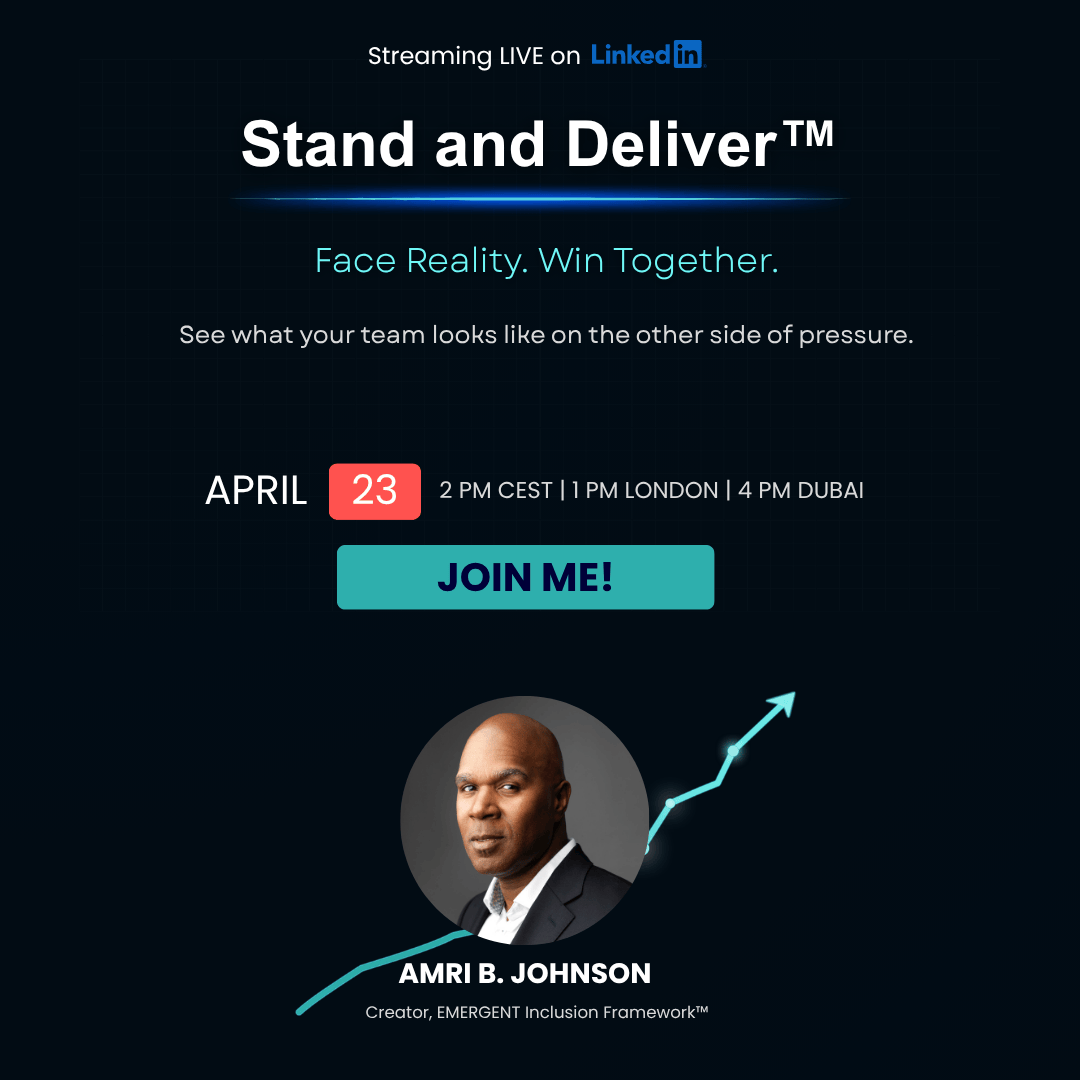
On April 23, I am hosting a LinkedIn Live session called Stand and Deliver: Face Reality. Win Together.
It is where this conversation gets practical. You will leave with at least one ritual you can bring into a real meeting that same week.
It is free. It is live. Bring the team that came to mind.
📅 Thursday, April 23 2:00 PM Zurich / 1:00 PM London / 8:00AM New York
Comments
Nothing yet. Say the first thing.
Sign in to join the conversation.