

I popped the trunk in a Dubuque hotel parking lot and immediately knew something was off.
The trunk was full. Completely full. Books stacked on books, wristbands shoved into every available gap, a pop-up sign crammed into a case that barely fit, a tablecloth, table signs, a change bag. It looked like I was running a mobile bookstore out of a Honda.
Surely it’s here somewhere.
And sitting right in the middle of all of it was one suitcase.
Just one.
I stood there for a second, staring at it like the second one might reveal itself if I gave it enough time. I closed the trunk, opened it again, and looked one more time. Same result. Full trunk. One suitcase. No clothing suitcase.
Five-hour drive. Speaking event the next morning. And somehow, with a car full of everything else, I had managed to forget the one thing I actually needed to wear. It takes a special kind of focus to pull that off.
Not the good kind.
And then my brain did what it does best. It went to work fast, aggressively, and with absolutely no interest in being fair.
How do you forget a suitcase? You had one job. How could you be so careless?!
I could feel it physically: the tightness in my chest, the heat behind my face, that mix of frustration and exhaustion where you can’t even tell which one is louder anymore. By the time I got to the elevator, I was already deep in it, running through every version of how this moment somehow said something bigger about me.
Halfway to my room, I had a very real thought: Maybe I should just go to sleep and deal with this tomorrow.
A friend stepped in and started helping me look up nearby stores, sending outfit ideas like we were in some kind of emergency fashion show. It was helpful, practical, exactly what I needed, and my first instinct was to shut it down.
I can figure this out myself.
That sounds strong out loud. Most of the time, it just keeps you stuck.
About an hour later, sitting on the edge of a hotel bed that wasn’t mine and staring at a situation I had very clearly created for myself, a different thought finally broke through. It wasn’t dramatic, and it definitely wasn’t a full mindset shift. It was just a quieter thought that somehow carried more weight than everything else.
I’ve spoken at over 250 events in the last ten years. One time, I forgot a suitcase. That’s 249 out of 250. And I built this trip with a buffer, arriving the night before specifically for moments like this.
Same situation. Same missing suitcase. Completely different conversation.
I wish I could tell you I handled that well from the start. I didn’t. My brain got a full hour to run wild before anything reasonable showed up.
But looking back, there are a few things I’ve learned to do in moments like that. In real life, when you’re tired, frustrated, and standing in a hotel room questioning your entire existence because of luggage.
That first wave hit me before I even got to the elevator. If you can catch it there, you save yourself a lot of damage later. Those thoughts build momentum fast.
“Forgetting a suitcase” turned into “you can’t do anything right” in about five seconds. Your brain loves to take one moment and stretch it into a full identity. Slow it down. Say what actually happened.
Forgetting a suitcase is not a character flaw. Nobody wakes up hoping to mess something up. When something goes wrong, look at the system. Do I need a checklist? Do I need to load the car in a different order? Fix the process instead of attacking your identity.
When my friend offered help, my instinct was to prove I didn’t need it. That didn’t make me stronger. It just made the moment harder. Let someone else think clearly for a minute when you can’t.
You don’t need to flip everything positive. Just adjust the sentence enough to make it true. “This is so stupid” becomes “This is frustrating, but I’ll figure it out.” That shift creates space.
One mistake does not erase everything that came before it. I’ve done over 250 events. One forgotten suitcase doesn’t rewrite that. Look at the full picture, not just the latest moment.
You don’t need to fix your mindset instantly. Some moments just need time. The goal isn’t to win every thought. It’s to stop making a hard moment harder.
The next day, I walked into that event wearing $19 American Eagle jeans, a polo from Dick’s Sporting Goods, and the only pair of tennis shoes I had. Not exactly what I had planned, but it worked.
More than 150 people showed up. I shared my story the same way I always do, thinking less about what I was wearing and more about the people sitting in front of me. At the end, a boy came up, gave me a hug, and said something I won’t forget.
“I had a childhood like yours, and this is the first time someone’s told me it’s going to be okay.”
Standing there, I had a realization that felt almost obvious in hindsight. None of that moment depended on a suitcase. It could have been shaped by something much smaller and much more dangerous: the way I was talking to myself the night before.
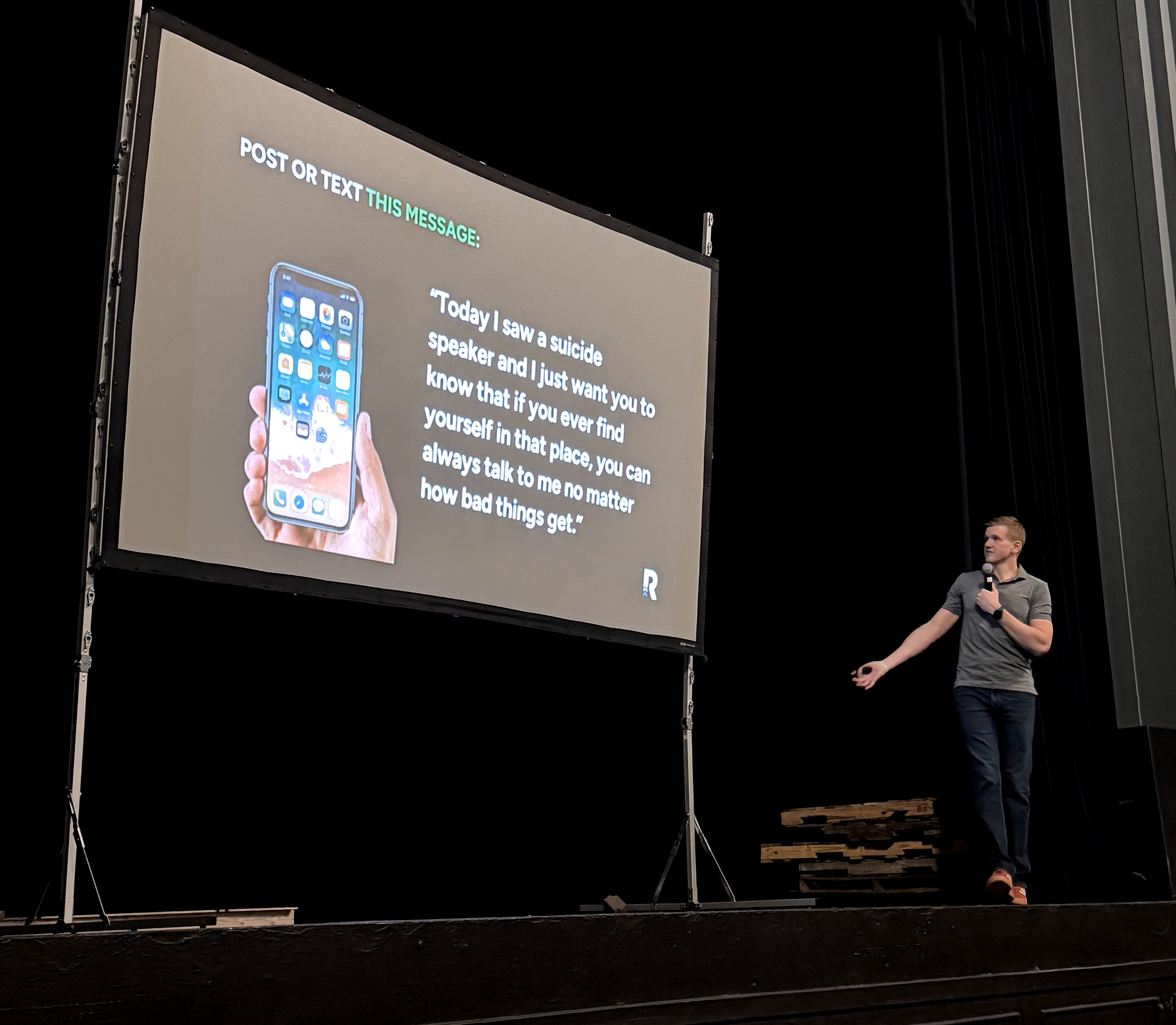
That kind of moment probably isn’t unfamiliar to you, either. Maybe your version didn’t involve a hotel parking lot or a missing suitcase. Maybe it showed up in the middle of an ordinary day. But you felt it. The shift. The spiral. The way your thoughts can stack so quickly that it starts to feel like you’re already out of options.
There’s a conversation happening in your head all day long. It sounds like you. It reacts fast. It has strong opinions about what things mean, especially when something goes wrong.
For a long time, I treated that voice like it was telling the truth. When it went negative, I followed it. When it jumped to worst-case scenarios, I went there too. No one had shown me how to slow it down or push back, so it kept getting stronger.
Things started to change when I learned how to respond in real time. When my brain goes after me, I answer with something grounded. “This is a hard moment, and I’m still here.” “I’ve made it through days like this before.” That shift gives me just enough space to stay present instead of letting the moment take me out of it.
That’s how self-talk works.
You catch one thought before it turns into a full spiral. You bring in a sentence that keeps you anchored. Over time, that response shows up faster. It starts to sound more like your voice instead of something you have to force.
So when that moment shows up again, keep it simple. Pay attention to what your mind is saying. Answer it with one steady sentence. Not a perfect one. Not a polished one. Just one that keeps you grounded in what is actually true.
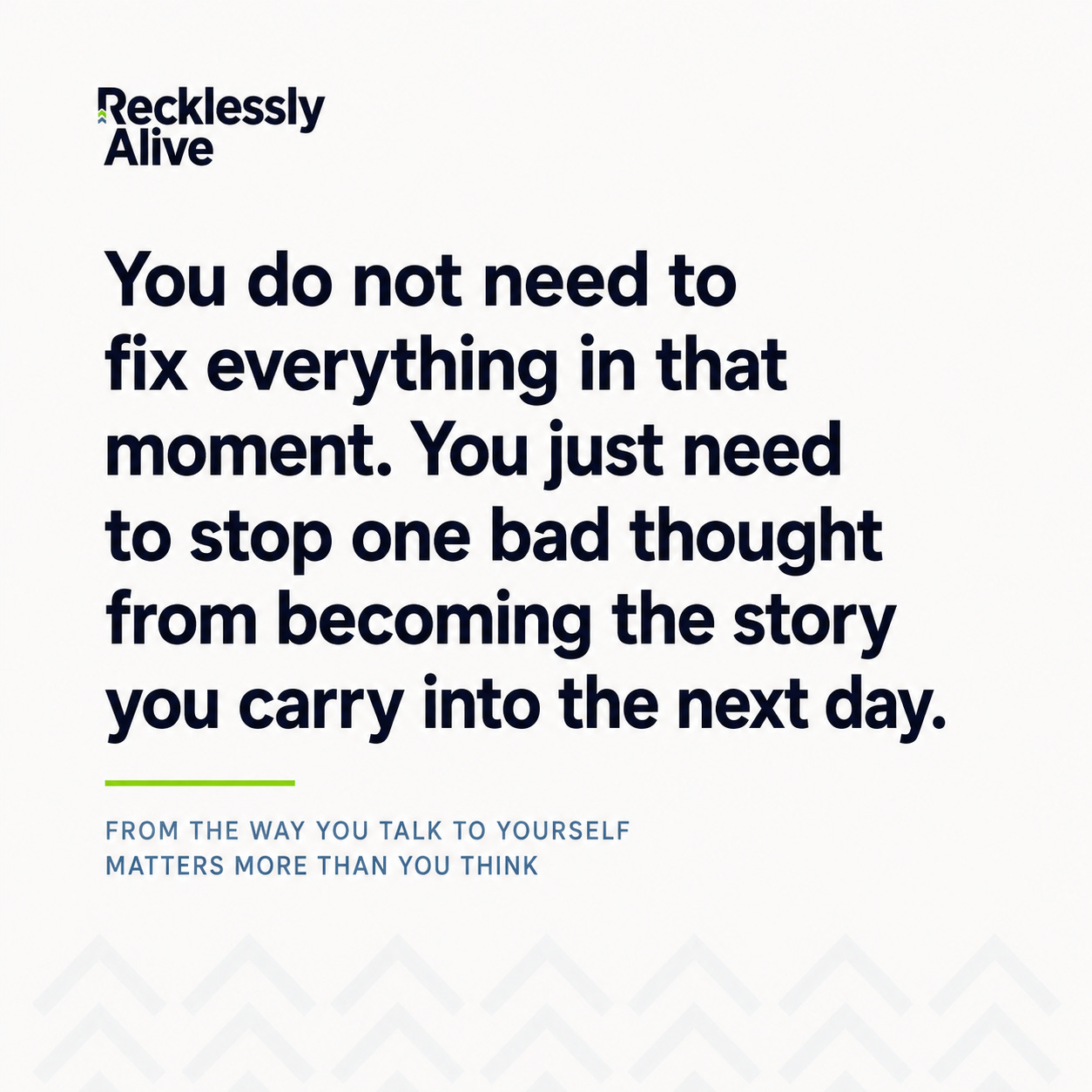
You do not need to fix everything in that moment. You just need to stop one bad thought from becoming the story you carry into the next day.

The way we talk to ourselves shapes more than we realize. It shows up in how we handle pressure, how we recover from hard days, and how we move forward when things feel uncertain.
That’s why I built You Can Do This the way I did.
It’s not just something you read once and put on a shelf. It’s designed to walk with you, day by day. Each week focuses on a core area that impacts how we live and show up — including an entire day each week dedicated to self-talk.
Because learning how to change that voice isn’t a one-time realization. It’s something we practice.
If you’ve been looking for something steady to come back to — on the hard days and the good ones — You Can Do This is for you. You can learn more about the book and grab your copy here.
Comments
Nothing yet. Say the first thing.
Sign in to join the conversation.