
Eight years ago, my therapist gave me one assignment.
Do one thing that week around other people.
That was it.
When you are building a life from zero, one feels impossible.
At the time, I wasn’t just lonely. I had lost my entire community. The people who once looked me in the eyes and said, “You’re one of us,” slowly stopped inviting me to birthdays, dinners, game nights, and holidays. One invitation at a time, my world grew quieter.
There are moments in life where somebody telling you that you matter becomes a knife when they later decide that you don’t.
After enough rejection, isolation starts to feel like protection. You stop reaching out. You stop making plans. You tell yourself you’re fine staying home because hoping for connection hurts more than expecting nothing at all.
The morning I decided to do the assignment, I sat on the edge of my bed staring at the floor.
Every part of me wanted to stay home.
I didn’t want to walk into a room full of strangers. I didn’t want to make awkward small talk. I didn’t want to risk feeling like I didn’t belong.
Still, I searched for something familiar and found an open gym volleyball morning at the community center where I grew up. I knew the building. I knew the sport.
I just wasn’t sure I could make myself walk through the door.
This story comes from my book, Healing Out Loud. I’m sharing it because I know some of you are rebuilding from zero too. Maybe you lost a relationship, a community, a job, or simply the version of yourself you used to recognize.
Sometimes the bravest thing you can do isn’t changing your whole life.
Sometimes it’s just showing up.
Cursing therapist Gary under my breath, I opened the much-too-heavy metal door of our 1970s community center at 8:32 a.m. on a spring Saturday. His homework for me this week was to stop feeling sorry for myself like a bitter Moaning Myrtle from Harry Potter and find one social activity to engage in. A social activity? What’s next? Open-heart surgery without anesthesia?
While the severe depression had lifted ever so slightly, and I wasn’t actively suicidal all the time, my least favorite symptom— feeling nothing at all—held on for dear life. Those who didn’t fail AP science classes may use this fancier word called anhedonia, meaning a reduced ability to feel pleasure. As if wanting to die all day every day weren’t enough, sometimes depression adds a pinch of nothing ever feels fun for good measure.
“So, what’s the cure?” I asked therapist Gary, whose kindness was so aggressive my push-everyone-away intuition insisted I resent him.
“We can look at another medication, or you can force yourself to return to hobbies you used to enjoy,” he replied.
After my two failed antidepressants, Gary sent me back to the doctor for one more. But when my suicidal thoughts intensified to an alarming degree, my primary care physician tersely explained, “Suicidal thoughts are one of the side effects,” and, “You should tough it out.”
“So how do we know if the medication is making it worse?” I asked, unable to meet his eyes. It had taken every ounce of energy to drag my body to this appointment, only for my concerns to be minimized. Eventually, he conceded that I remained on such a low dose there would be no adverse effects if I quit, although he noted in my chart that he strongly advised against stopping the medication. And I was noting in his chart that nobody liked him, and he was most likely dropped on his head as a child.
After seeing another doctor for a second opinion, it became clear the prescription should never have been taken on its own. When I couldn’t force myself to attempt a fourth medication, Gary encouraged stepping up my opposite-to-emotion tool. “Find one club, sport, or class to take, and start emerging back into the world. You don’t even have to stay the whole time, but I think it would be a positive step for your mental health,” he insisted.
After considering poisoning his oatmeal, I settled on registering for open-gym volleyball at my local community center instead.
For five dollars, I had the privilege of spending three hours with moderately grumpy, middle-aged adults who were about as friendly to outsiders as Iranian border agents. The rules on the wall read, “No premade teams,” yet upon entering the sizeable three-court gym, every net had groups hugging and high-fiving, their laughter bouncing off the walls. “Sorry, our team is full,” each one said, as I worked my way around the gym. Suddenly, I was back in the middle-school lunchroom with no one to sit by.
As I scanned the area, it became clear the only place I might be accepted was the small cluster of misfits staring at their shoes in the corner.
“Can I join you?” I whispered.
After a long, awkward pause, one guy shrugged, and I had a team. We all looked at each other, realizing no one had brought a ball for warm-ups. On the other side of our court, our first opponent ran professional drills that implied strong confidence that they could qualify for the Olympics. The sound of their volleying intensified as I looked on in horror; each hit, punctuated by their flexed muscles, made me fear for my safety.
A few minutes later, the round-robin tournament began unceremoniously as their server shouted zero-zero and launched the white projectile across the net. The other team racked up seven unanswered points without a hint of life from our side of the court. With each point, two men in their forties did a chest bump, yelling, “BOOM!” as if they had just dunked on LeBron James. When the next serve came, our back-row defense moved away from the ball like they thought they had signed up for an open-gym hot potato contest. Fred, a seventy-something man who hadn’t said a word to anyone, didn’t even move if the ball came close to him, watching it crash to the ground a mere inch from his immobile limbs.
A four-foot-eleven-inch soccer mom with pink leggings and spikey blond hair named Suzie emerged as our morale leader, exuding a level of optimism matched only by a Minnesota Vikings football fan after sixty years, four Super Bowl appearances, and zero rings. Her husband Mike’s sharp black knee pads properly communicated his above-average abilities on the court.
When the score hit 2–12, Anush began frantically telling everyone where to stand. Mai, our best and shortest player, signified her distaste for his neuroticism by making eye contact with me, circling one finger around her ear, and lifting her eyebrows. After Suzie passed the ball, Mai set it high to me on the outside, but as I jumped to swing, I missed the ball entirely. The other team laughed and pointed. “BOOM!” came another shout and chest bump. My wiry frame was so beaten down by the world it took every ounce of mental strength not to run out of the gym.
In our first two games, we scored an abysmal twelve points total, losing 5–25 and 7–25 in embarrassing fashion. After our third blowout loss, even Suzie struggled to muster up the energy to say, “Good try,” when Anush still hadn’t managed to serve a ball over the net. During the break between matches, the other teams talked about grabbing lunch together and future tournaments they were playing. I stood there in silence, feeling like even more of an unathletic loser than when I had arrived.
I stared at the gym exit and contemplated running for my life. Nobody will ever remember you were here; go to the bathroom and never look back. I looked at the clock: one hour and twelve minutes until I could leave, tell Gary how awful it was, and never return again.
An inexplicable phenomenon emerged during match four— our team miraculously stopped being a complete dumpster fire. Doses of hope started spreading across our side of the court when the score remained close for the first ten points. Pessimism crept back in, however, when Anush stepped back to serve. He launched the ball way too high, took several stuttering steps attempting to predict where it would land, and launched his tiny arms forward with everything he had. The ball clipped the top of the net, hung in the air for one second, and slid down the other side. Everyone on our team leaped in elation.
“Ace!” we shouted in unison. Except for Fred, of course. Fred remained emotionless, perhaps replaying John Wayne’s Stagecoach in his head.
After another serve by Anush, Mai executed a perfect set, and Mike swung, giving us our first lead in almost two hours. With his wispy white hair glowing in the fluorescent gym light, Fred stepped back to the service line and whispered, “Twenty-two to twenty-three.” No one on the court could fathom how we were only down by one point in the race to twenty-five. Other teams began to take note, and crowds gathered to heckle our opponents and cheer for their downfall.
The other team received the pass, setting up their attack. I reached my hands above the net, the opposing hitter swinging straight into my outstretched fingers, causing the ball to crash to the floor on their side of the net for a block. I threw my hands up to the sky in disbelief. Mike ran up to bump my chest and yelled, “BOOM!” while staring down our opponents on the other side.
“Twenty-three to twenty-three,” Fred muttered, as he served the ball again. This time, the hit missed my block and crashed back toward immobile Fred, but Mike’s knee pad investment paid off as he dove and saved the ball at the last second. Mai pretended to set Anush but dumped the ball onto the other side of the net, and it landed with a satisfying thud. Twenty-four to twenty-three. Game point.
Boiling with rage, the greasy muscle men on the other side of the court called a time-out. Their huddle involved shouting, cursing, and blaming. In contrast, our huddle was centered around Suzie giving hugs and high-fives to everyone. When she got to me, she wrapped her arms around my shoulders and held on for a few seconds longer than expected. Her arms increased the pressure on my back as if her spidey-mom sense was telling her what I needed.
After the time-out, Fred stepped back to the service line, launching the ball underhand to the other side. They lined up their best hitter, who swung with all his might straight for Fred— targeting our worst player. Fred outstretched one hand toward the sideline, his fist just meeting the bottom of the ball and sending it back over the net. The ball floated toward the back corner of their court, falling to the floor precisely on the line.
“In!” the crowd near the sideline screamed.
Our team of misfits jumped and hugged in a circle like we’d won the world championships. The corners of Fred’s mouth even inched upward ever so slightly. After high-fiving the other team, we walked toward the bleachers to claim all our bags.
“You’re coming back next week, right, Sam?” Suzie asked.
“You better!” Mai said with an intimidating glare that I wasn’t entirely sure was a joke.
As I walked back outside, the sun peeked through the clouds. I closed my eyes, took in a deep breath of fresh air, and realized the most surprising miracle: for the first time in months, thanks to a smelly old gymnasium, I didn’t feel alone.
***
One of the hardest parts of that tough season was learning that few things are as painful in this human experience as loneliness. After losing my entire church community, I built thick walls. I started saying phrases like “I don’t like people” and “I’m more of a loner,” eventually believing the lie that I was better off alone. C.S. Lewis captures this sentiment perfectly in:
To love at all is to be vulnerable. Love anything and your heart will be wrung and possibly broken. If you want to make sure of keeping it intact you must give it to no one, not even an animal. Wrap it carefully round with hobbies and little luxuries; avoid all entanglements. Lock it up safe in the casket or coffin of your selfishness. But in that casket, safe, dark, motionless, airless, it will change. It will not be broken; it will become unbreakable, impenetrable, irredeemable. To love is to be vulnerable.
—The Four Loves, 1960
His words show that trying to shield ourselves from pain will only leave us feeling more isolated and alone. In our world, loneliness often carries a sense of shame, so when I admitted that I was trying to make new friends, I faced judgmental glances instead of the compassion I needed. But it doesn’t have to be that way. Those of us who move a lot or have small families often find ourselves needing to reinvent our community. Regardless of the reason for seeking new relationships, good people are out there looking for someone like you.
If you’re in a season when you would like to expand your circle, I hope you push yourself to keep trying like Gary pushed me. Revisit the same places every week, join a shared-interest club or team, attend group fitness classes, introduce yourself to neighbors, or volunteer with a nonprofit organization. Move through social anxiety with phrases like “Hey, I’m Sam. I’m new here and am trying to meet new people.” If you’re somewhere you don’t know anyone, break the ice with “Hey, would you mind if I hang out with you for a few minutes? I don’t know anyone here.” People will almost always meet that request with a “Yes!” and “Let me introduce you to . . .” because, even though we don’t talk about it, we’ve all experienced that uncomfortable place.
Somewhere down the road, you might even be thankful for the people who abandoned you. Not thankful for the hurt, but glad they showed their true colors when they did so you could move on to people who love you the way you deserve. And if you’re not ready to go there, that’s okay, too. Come sit and tell me about that one friend from Oklahoma, and I’ll share my Cheez-Its.
Through every challenge you’ve faced, know this: There’s undeniable goodness within you. You’re worthy of friends who lift you up and share the beautiful journey of life. Embrace your authenticity and watch as the right people gravitate toward you, forming connections that illuminate your worth, enrich your life, and help you heal. Here’s to finding our people, seeking community in unexpected places, and pushing through all the lonely moments along the way.
If you’re in a season where showing up feels impossible, I hope this story reminds you that healing rarely arrives all at once. More often, it begins with one uncomfortable decision. One conversation. One class. One invitation. One Saturday morning when every part of you wants to stay home, but you go anyway.
You don’t have to rebuild your whole life today.
Just take the next brave step.
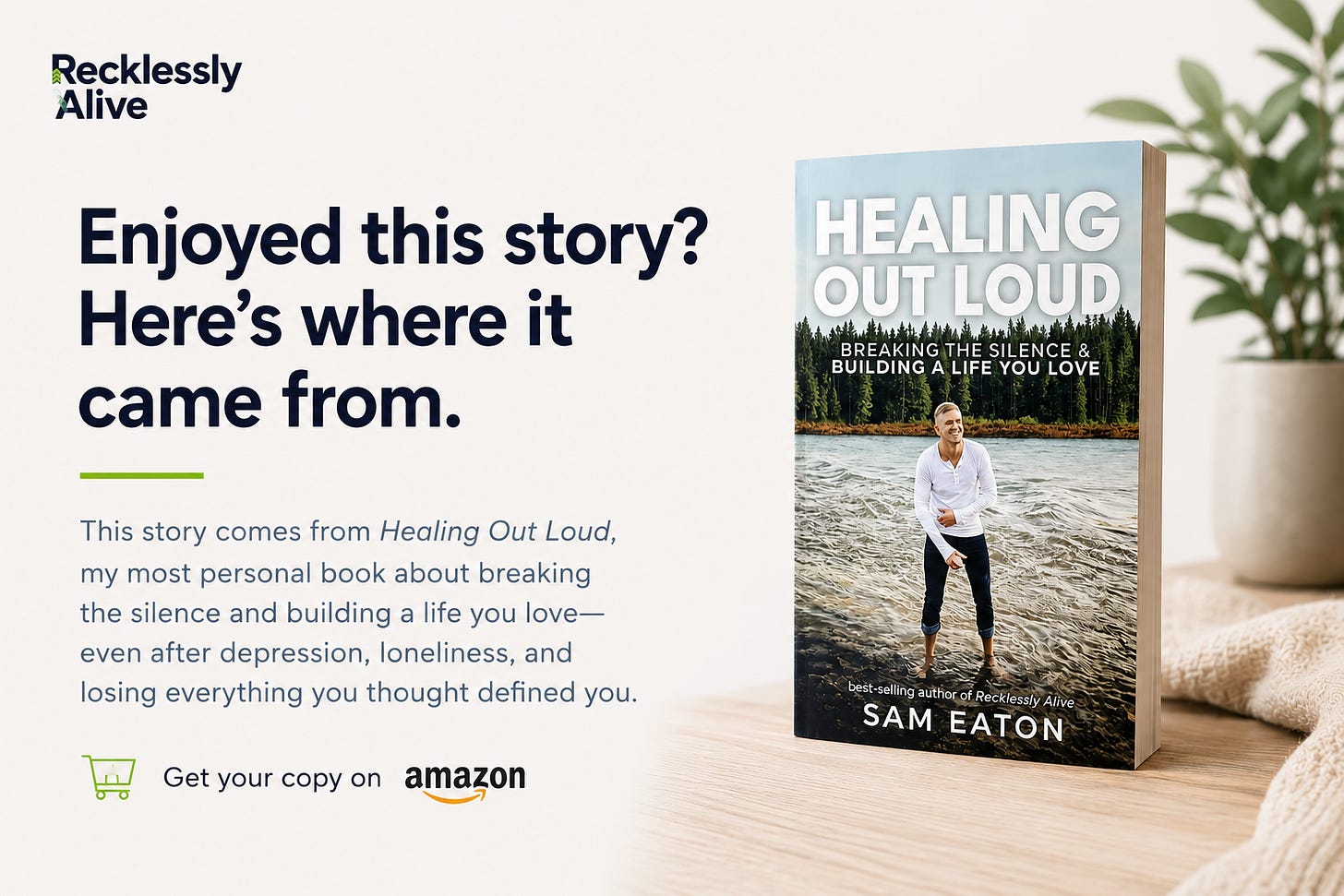
If this chapter resonated with you, Healing Out Loud: Breaking the Silence and Building a Life You Love is filled with stories just like this one. It’s the most personal book I’ve ever written, and my hope is that it feels like sitting across from a friend who reminds you that you’re not alone.
You can find Healing Out Loud in paperback, ebook or audiobook (narrated by me) here.
As always, thank you for letting me be part of your journey.
Love,
Sam
Comments
Nothing yet. Say the first thing.
Sign in to join the conversation.