
A disclaimer before we begin.
ChatGPT is not a therapist.
It is not a psychiatrist. It is not your best friend. And if it’s trying to convince you that it is, close the app and go rub grass between your toes (or whatever it is the kids say these days).
AI can make mistakes. It can be overly confident. It can tell you what you want to hear instead of what you need to hear. Like social media, it can become unhealthy if it starts replacing real life instead of supporting it.
If you’re in crisis, experiencing thoughts of suicide, or struggling to stay safe, this is not the tool you need right now. Please reach out to a trusted person or a qualified mental health professional instead.
Parents should also pay attention to how their children use AI. We’re still learning how these tools affect developing minds, relationships, and mental health. Just because something is helpful doesn’t mean unlimited access is harmless.
Over the past year, I’ve started experimenting with ChatGPT as one small part of my mental health toolkit. I use it to organize my thoughts, prepare for therapy, and find a clear next step when my brain feels tangled.
Sometimes I need help organizing the mess. Sometimes I need someone—or something—to ask the next good question.
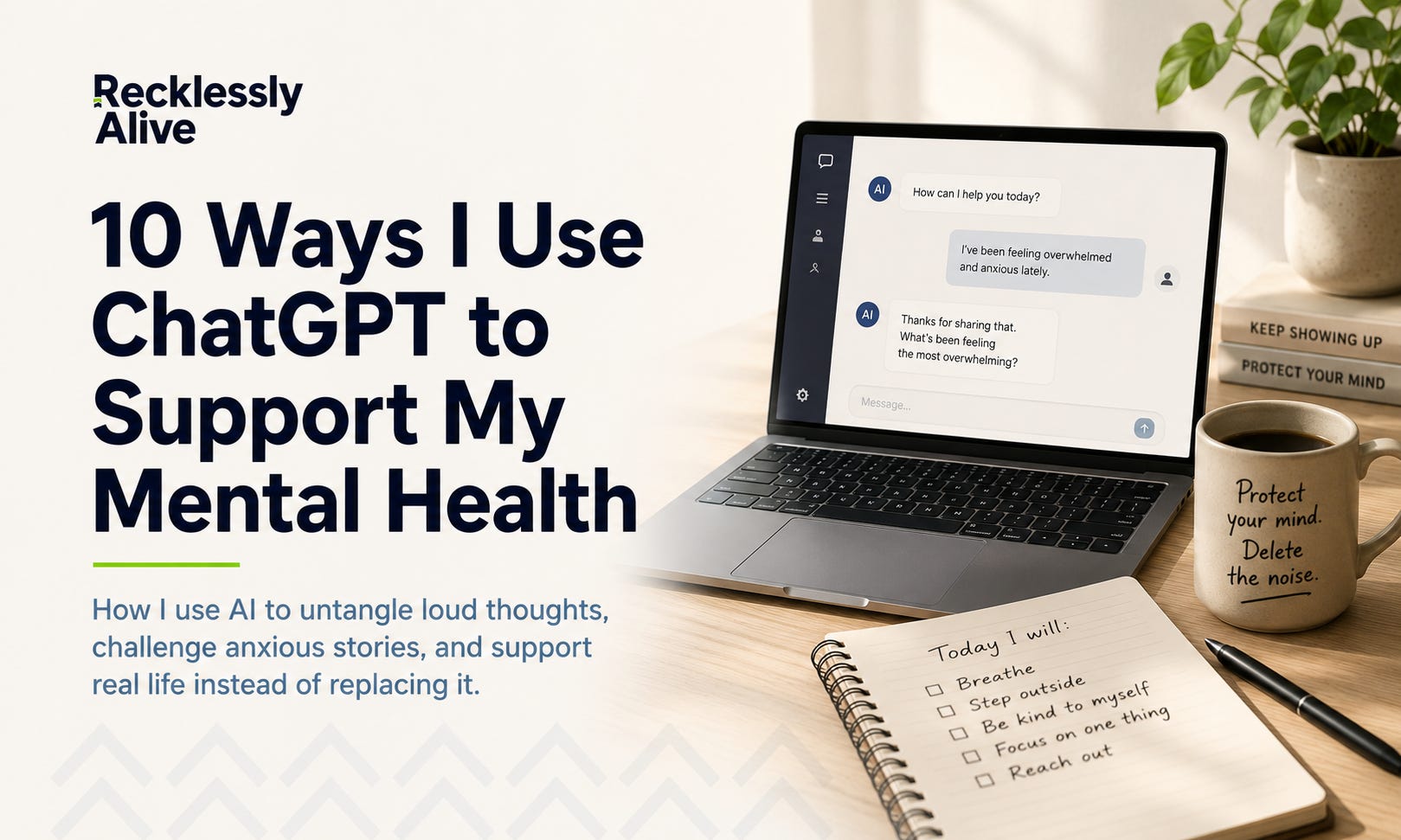
Here are ten ways I use AI as an encouraging presence in my life.
Some days, it feels like I have fifteen browser tabs open in my brain. One of them is playing music, three are frozen, and I cannot figure out where the mysterious beeping is coming from.
Everything feels important. Everything feels urgent. Nothing feels clear.
Instead of spiraling, I’ll type:
"I'm feeling overwhelmed, but I can't tell what's actually bothering me. Ask me one question at a time to help me untangle my thoughts. Don't jump to solutions until we've identified the real problem."
It slows my thinking down enough to separate the real problem from all the background noise.
Tip: Use it to discover your thoughts, not decide them for you.
When my anxiety gets high, my brain becomes a terrible lawyer.
It takes one unanswered text, builds a case out of guesses, and somehow arrives at a six-part HBO documentary about my complete social collapse.
"Here's what I'm thinking right now. Read it like a therapist would. Point out where I'm catastrophizing, mind reading, making assumptions, or treating feelings like facts. Explain what evidence supports my thoughts and what evidence doesn't."
Sometimes I don’t need a solution. I need someone to show me where the evidence ends and the story begins.
Tip: Use AI to challenge your thinking, not confirm it.
Hard conversations feel easier when you’ve practiced them. Before talking with my boss, a friend, or someone I love, I’ll say:
"Help me prepare for an important conversation. I'll explain the situation first. Then role-play the other person realistically, push back when appropriate, and coach me on communicating with honesty, confidence, and kindness."
I’ve walked into difficult conversations calmer because I had already said the words once, heard how they sounded, and worked through the places where I was likely to get stuck.
Tip: Use it to rehearse the conversation, not avoid having it.
Depression has a way of making every task feel enormous.
When that happens, I don’t ask ChatGPT to fix my life. I ask:
"I'm struggling to get started today because depression is making everything feel overwhelming. Help me identify the smallest possible next step. Stay encouraging, keep breaking tasks into smaller pieces, and celebrate progress with me as I go."
Sometimes the answer isn’t “Clean your condo.”
Sometimes it’s “Put one plate in the dishwasher.”
That plate will not transform my life. But it can help me begin moving again.
Tip: Ask for a step small enough that your tired brain cannot argue with it.
Depression is remarkably good at deleting evidence.
You can work hard all week and still reach Friday convinced you’ve done nothing, helped no one, and somehow wasted five entire days.
So sometimes I’ll list what I accomplished and ask:
"I'm going to tell you everything I accomplished this week. My depression tends to minimize my progress, so reflect it back to me objectively. Help me notice wins I would normally overlook."
Seeing it all in one place helps me remember that progress still counts, even when it doesn’t feel dramatic.
Tip: Keep a record of what you finished before your brain edits the week into a failure.
Anxiety loves uncertainty. Plans shrink uncertainty.
When something is weighing on me, I’ll ask:
"Here's what's making me anxious. Help me separate what I can control from what I can't. Then create a simple action plan that focuses only on the things within my control and ignores everything else."
That one question has saved me hours of mental spinning.
I can’t control tomorrow. I can usually control the next fifteen minutes. Turns out that’s often enough to get me moving again.
Tip: Don’t ask AI to solve your entire future. Ask it to help you navigate your next step.
A blank page can feel intimidating.
Instead of trying to write everything at once, I’ll ask:
"Act like an encouraging life coach. I'm going to brain dump everything that's on my mind using voice-to-text. After I finish, ask me one thoughtful follow-up question at a time to help me better understand what I'm feeling. Don't rush to solve my problems. Help me understand them first."
It feels less like homework and more like a conversation.
I’ve been surprised how often the fifth question uncovers what the first four completely missed. Sometimes the thing you’re feeling isn’t the thing you’re feeling.
Tip: Give yourself permission to ramble. Clarity often shows up after the polished version falls apart.
One of the most surprising ways AI has helped me is with identity.
Sometimes I lose sight of the values I care about, the habits I want to build, and the person I’m trying to become.
I’ll use a prompt like:
“I’m going to tell you about the person I want to become, the values I want to live by, and the habits I’m trying to build. Ask me five questions, one at a time, to help me define that person clearly. Then write a short reminder I can reread when I feel lost, discouraged, or tempted to give up.”
That reminder can completely change the direction of my day.
A hard day can make you question your entire identity. Sometimes you need help remembering the direction you already chose.
Tip: Save the final reminder somewhere easy to find and reread it when your mood starts rewriting who you are.
When I’m anxious, my instinct is often to scroll.
Unfortunately, the internet has never once responded to my anxiety by saying, “You know what, Sam? Here are seventeen calming and reasonable pieces of information.”
So I’ve started replacing some of that scrolling with curiosity.
I’ll ask:
“I’m feeling anxious about [topic]. Explain what is happening in simple language, using reliable information and no medical jargon. Separate what is known from what is uncertain. Then give me three practical takeaways. Do not diagnose me, and tell me when I should speak with a qualified professional.”
Or:
“Teach me how anxiety affects the brain and body. Use simple examples, correct any common myths, and finish with three things I can do today.”
Understanding something gives my fear fewer dark corners to hide in.
Tip: Ask for sources and verify important health information before acting on it.
This might be the biggest one.
ChatGPT has helped me build routines, meal plans, workout schedules, habit trackers, writing systems, business ideas, and daily dashboards.
Good systems help me organize my life and make healthy choices easier to repeat.
For someone starting from scratch, I’d use a prompt like:
“Help me build a simple weekly routine. My main goals are [list goals]. My current schedule is [describe schedule]. The things I struggle with most are [list obstacles]. Ask me any questions you need, one at a time. Then create a realistic plan with a morning routine, evening routine, weekly priorities, and a backup version for low-energy days. Keep it simple enough that I will actually use it.”
For a specific system, you can make it even clearer:
“Help me create a habit tracker for [goal]. Limit it to five habits. Explain why each habit matters, suggest a realistic target, and create a weekly check-in that helps me adjust without treating one bad day like total failure.”
The easier I make healthy choices, the more likely I am to make them.
A good system makes the next right choice easier, especially on the days when your energy, motivation, and executive function have all left the group chat.
Tip: Tell ChatGPT about your real schedule, energy, budget, and obstacles. A plan built for your fantasy life will be abandoned by Thursday.
ChatGPT cannot love you.
It cannot notice the change in your voice, sit beside you in a waiting room, bring dinner when getting out of bed feels impossible, or recognize the look on your face that says you’re hurting more than you’re admitting.
It cannot replace the people who know you, the professionals trained to help you, or the kind of human connection that reminds you that you still belong here.
Sometimes my brain gets loud, tangled, or exhausted. In those moments, I need help finding one clear next step.
I don’t use AI to escape my life. I use it to help me return to it.
Use it carefully. Protect your privacy. Question its answers.
Pay attention to whether it helps you engage with your life or slowly starts replacing parts of it.
Then close the app.
Call someone. Step outside. Tell the truth. Ask for help. Take the next small step.
What are your thoughts on AI and mental health? Do you think it’s okay to help people navigate it or should we avoid it altogether for this part of our lives? Let me know in the comments.
Remember what I said at the beginning: the healthiest relationship you’ll ever have with AI is one that keeps pointing you back toward your life.
And if today feels heavy, confusing, or overwhelming...
Whatever you are facing, You Can Do This.
Love, Sam.
⸻
Mental Health Resources
If you or someone you know is struggling, these organizations can help:
988 Suicide & Crisis Lifeline (U.S.): Call or text 988 any time for free, confidential support.
Crisis Text Line: Text HOME to 741741 to connect with a trained crisis counselor.
NAMI (National Alliance on Mental Illness): Education, support groups, and mental health resources for individuals and families.
If you live outside the United States, search for your country’s national crisis hotline or mental health services.
Comments
Nothing yet. Say the first thing.
Sign in to join the conversation.