
I have found myself almost indifferent to the news for weeks now. My usual flooding of current events – newspapers over breakfast, podcasts with walks and dishes, checking my phone constantly - has been reduced to a mere trickle. I barely glance at the headlines. For now, at least.
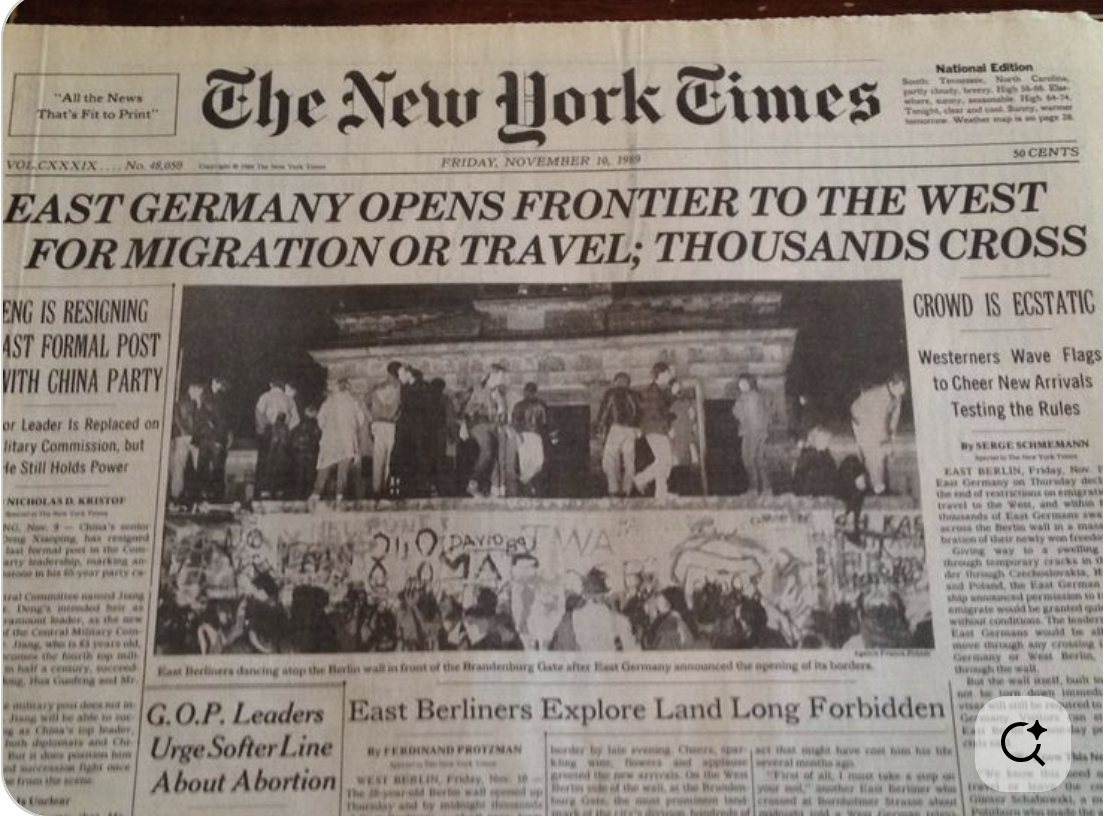
It’s been like this since my father died two months ago. Which is ironic, because current events and what to do about the problems of the world was such a big part of my relationship with him. When I was growing up my father would come in from his early morning walk carrying the New York Times, the Wall Street Journal and the San Francisco Chronicle in hand, which he would then read over his morning coffee. By the time I was in high school I was also reading the paper – mostly the New York Times, imbibing stories about the great big world out there.
This was the late 1980s and what most captured my attention was the dramatic transition of the Soviet Union and the ripple effects throughout Eastern Europe and the Balkans, the First Intifada, Tiananmen Square and almost any story about communism, democracy, conflict and oppressive regimes. I’d then talk everything through with my father, trying to make sense of it all. And thus, it continued until our last conversations.
So it’s odd to find myself so apathetic about world events.
Of course, the world seems to keep spinning, regardless of whether I’m paying attention to it. And I find myself with thoughts like: what difference does it make anyway? I don’t trust any of the statements or actions of any of the leaders – neither near or far, neither Israeli or America nor any of the others in the region or arenas whose decisions will affect my life, the lives of my children or those around me. Actually, I’m quite confident little of it will be good for us and we’ll be paying the prices for all of it for quite a long time to come. So why follow?
It’s kind of like someone gave me a lobotomy.
I guess grief strikes in odd ways.
But when this comes up in the course of conversation with people, I am surprised by how many people tell me they, too, have stopped paying attention to the news. They just can’t bear it any longer. It’s all too dark.
Each time they say it, my body freezes and my stomach plunges.
On the one hand, I get it. I really do. The world is in such a difficult place right now. Many of us don’t need the latest research to point out the connections between media, especially social media, and the state of our mental health – we see it in our bodies, our attention span, our moods.
But I’ll be honest: I am also horrified by this response. We can’t become civic delinquents. Not now, when we need - more than ever - to be paying attention! Acting! Democracy needs this! Our countries need this! It’s our civic responsibility to be aware, knowledgeable, to have a chance of doing something – whatever that might be - about what’s happening out there.
Which is, perhaps, the heart of the problem. The sheer quantity and scale of so many of today’s issues make many people feel like it’s all too awful and too big to be able to do anything about. It’s totally disempowering. Without any sense of agency, we withdraw.
There’s research that offers helpful insights to this response. In her fascinating essay, Complicating the Narratives, Amanda Ripley examines the problem of how much of today’s media engages through generating fear. It might be good for media moguls’ bottom line, but the rest of us – as individuals and as societies – are losing because of it. Fear messaging that scares you without showing what is or can be done about the issue often triggers denial, avoidance or disgust. It takes away our sense of agency. But, on the flip side, when people are shown possible solutions which they can sufficiently agree with and act on they are more open to internalizing the issue at hand.
I had a eureka moment when I first read Ripley’s article. I knew that feeling so well! Not just the overwhelm of troubling, seemingly insoluble issues. But also, the feeling I sometimes get of wanting to grab the nearest passerby and say, “hey, listen to this!” when I read about people doing work that somehow helps make a difference, or hear stories from friends or colleagues working on any one of the many issues out there.
Which is why, a few years ago, I became obsessed with solutions journalism, which was just a few mouse-clicks away from the Ripley essay. It’s basically journalism with a wide-angle lens: not just reporting on how terrible things are, but examining a given problem through the wider lens of what people are trying to do to try to tackle a given problem. It’s not about putting on rose-colored glasses or pretending that there are silver bullet solutions to big problems. Rather, it simply helps you step into the shoes of those doing something about it, toolbox in hand. That active effort can be enough to instill in the reader – and the citizen - a sense of agency. Look we can do something about this! Sure, it might not solve everything, but it’s better than the alternatives. It shrinks the sense of overwhelm just a little bit.
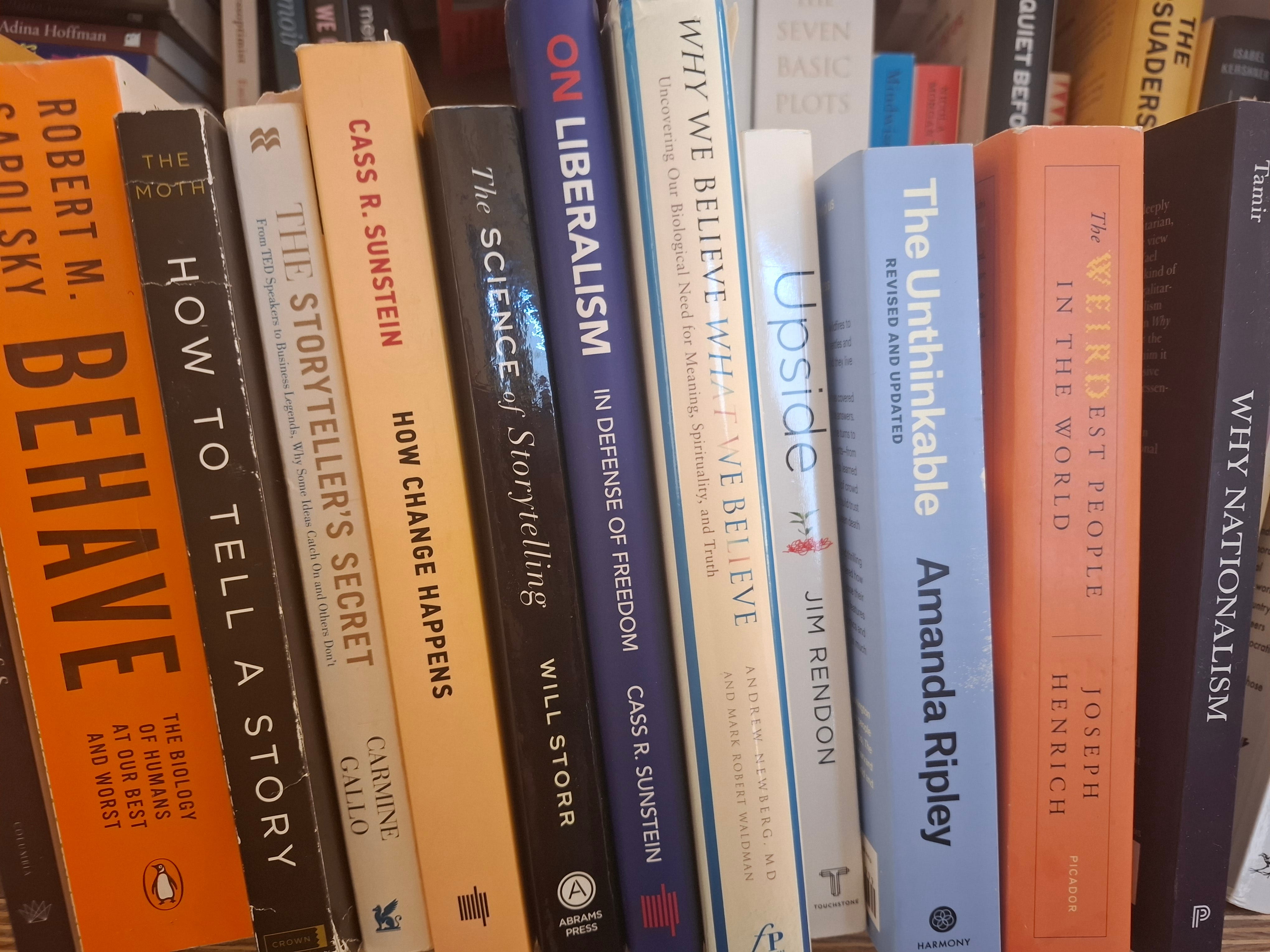
On one of my father’s last visits to me here in Jerusalem, we talked a lot about all of this, as he picked up the books from my shelf which I had delved into as I explored these issues, including Ripley’s High Conflict: Why We Get Trapped and How We Get Out; some great books on the neuroscience of storytelling which explain why we experience what we do when reading good stories; and Cass Sunstein’s How Change Happens.
And I would have loved to talk with him about the books I found on his desk and study bookshelves when I was at home two months ago, hoping I had come back just for another medical emergency that would turn out to be just another close call. So now I’m reading those books - Cass Sunstein’s On Liberalism: In Defense of Freedom; Why we Believe What We Believe by Andrew Newberg and Upside: The New Science of Post-Traumatic Growth by Jim Rendon – and wondering what specifically led him to pick these books and what he might have said if we’d had a chance to talk about them together.
In the meantime, there are some exceptions to my news withdrawal. Those mostly come in conversation and media exchanges with my own kids, especially my middle son, who has developed into an avid consumer of current events and analyses. He likes drawing from a wide range of sources – both those which feel familiar and comfortable, and also those which challenge his – or my – thinking. Just like his Saba, my father.
Nothing makes my day like when I pop into the kitchen to grab a cup of coffee and we end up in a long conversation about the upcoming elections, a particular political development, or the nuances of the argument made by a recent interviewee on one of the podcasts we both listen to.
I guess there’s a sort of tradition we’re carrying on.
From generation to generation.
I can’t wait to see what he does with it. And for us to continue the conversations.
In these days of mourning – for my father, for the state of the world - I take a lot of comfort in that.
No posts
Comments
Nothing yet. Say the first thing.
Sign in to join the conversation.