
On July 30, more than 72,000 Muslims surged from Morocco into Ceuta, leaving at least 96 dead, and prompting Italy to impose targeted border controls on arrivals from Spain.
But just as Italy tries to protect itself, Italians continue to be bombarded with a very different story about their past: mass migration and multiculturalism, they are told—particularly from the Islamic world—are part of the very essence of Italy, especially Sicily.
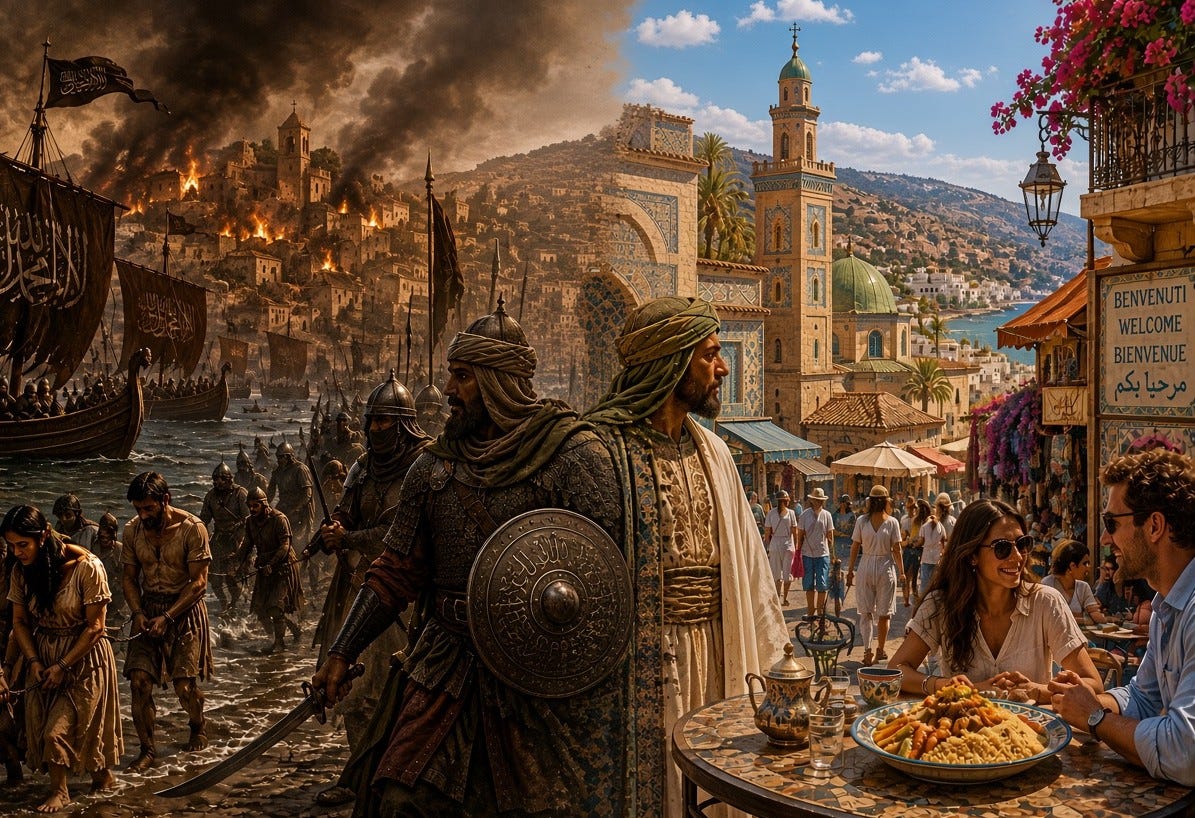
Consider one National Geographic article, “From Kasbahs to Couscous—How Sicily Has Celebrated Its Diversity Through the Centuries.”
Sicily, we are told, is the “Gates of Europe,” an island whose identity has always been shaped by foreigners: “immigration is not a footnote to Sicilian history; it’s part of the essence of an island shaped by outsiders.”
There is, however, one problem with this narrative: it treats jihadist conquests as mere episodes of “immigration.”
Thus, while discussing Mazara del Vallo, now home to Italy’s largest Arab community, the magazine asserts that modern Tunisian migration represents merely “the latest wave in a history of immigration from North Africa that goes back to the 9th century CE.”
And what sort of “immigration” occurred in the ninth century?
In National Geographic’s very next words, “a Tunisian-led army invaded Sicily, turning it into an Islamic emirate for the next 200 years.”
Read that again, in full context:
But this [modern Tunisian migration into Sicily] was just the latest wave in a history of immigration from North Africa that goes back to the 9th century CE, when a Tunisian-led army invaded Sicily, turning it into an Islamic emirate for the next 200 years. Mazara’s kasbah was built then, and it was later sacked by subsequent Christian rulers. Today, it’s been restored and is once again home to a majority Tunisian population.
An Islamic army invaded Sicily, brutally conquered its Christian inhabitants, and incorporated the island into the Islamic world—and this is now presented as an earlier “wave” in Sicily’s multicultural “history of immigration.”
Indeed, the only “bad guys” in this narrative are the “subsequent Christian rulers” who “sacked” Muslim-occupied Mazara. This wrong has apparently been righted as Mazara is “once again home to a majority Tunisian population.”
So now military conquests are being recast as “immigration.”
This semantic sleight of hand is significant, particularly because the article explicitly places this historical narrative alongside today’s migrant crisis. Modern Sicily, it notes, stands “at the vanguard of the modern European migrant crisis,” receiving migrants arriving from Africa. From there, the reader is taken on a tour of Muslim influences, Tunisian communities, mosques, couscous, Arabic words, and organizations assisting contemporary African migrants.
The message culminates in the words of a Sicilian guide: “In many places, people say, ‘You’re different — go away!’”
But Sicily, the guide continues, has another response: “You’re different. What can we learn from you?”
In other words, the past supplies a lesson for the present: Sicily was multicultural then; Sicily is multicultural now; and welcoming newcomers is simply an expression of Sicily’s authentic historical identity.
This interpretation is not confined to a travel magazine; academic and scholarly publications make the same claims.
There is only one problem with this utopic picture of diversity meant to shape modern opinions on Muslim migration.
It is completely ahistorical.
The Islamic presence in Sicily was not inaugurated by refugees peacefully arriving with couscous recipes and irrigation techniques. It began with invasion, massacre, rape, and enslavement—in a word, jihad.
Continue reading below.
If you value unflinching, historically grounded analysis that mainstream outlets soften or ignore, consider upgrading. Paid subscribers get:
Several new, full-length articles every week.
Carefully researched pieces you won’t find elsewhere.
Full access to the complete premium archive
Archive of in-depth writing, research, and commentary — all in one place.
Entry into the subscriber chat
A private space for serious readers and thoughtful discussion.
Comments
Nothing yet. Say the first thing.
Sign in to join the conversation.