
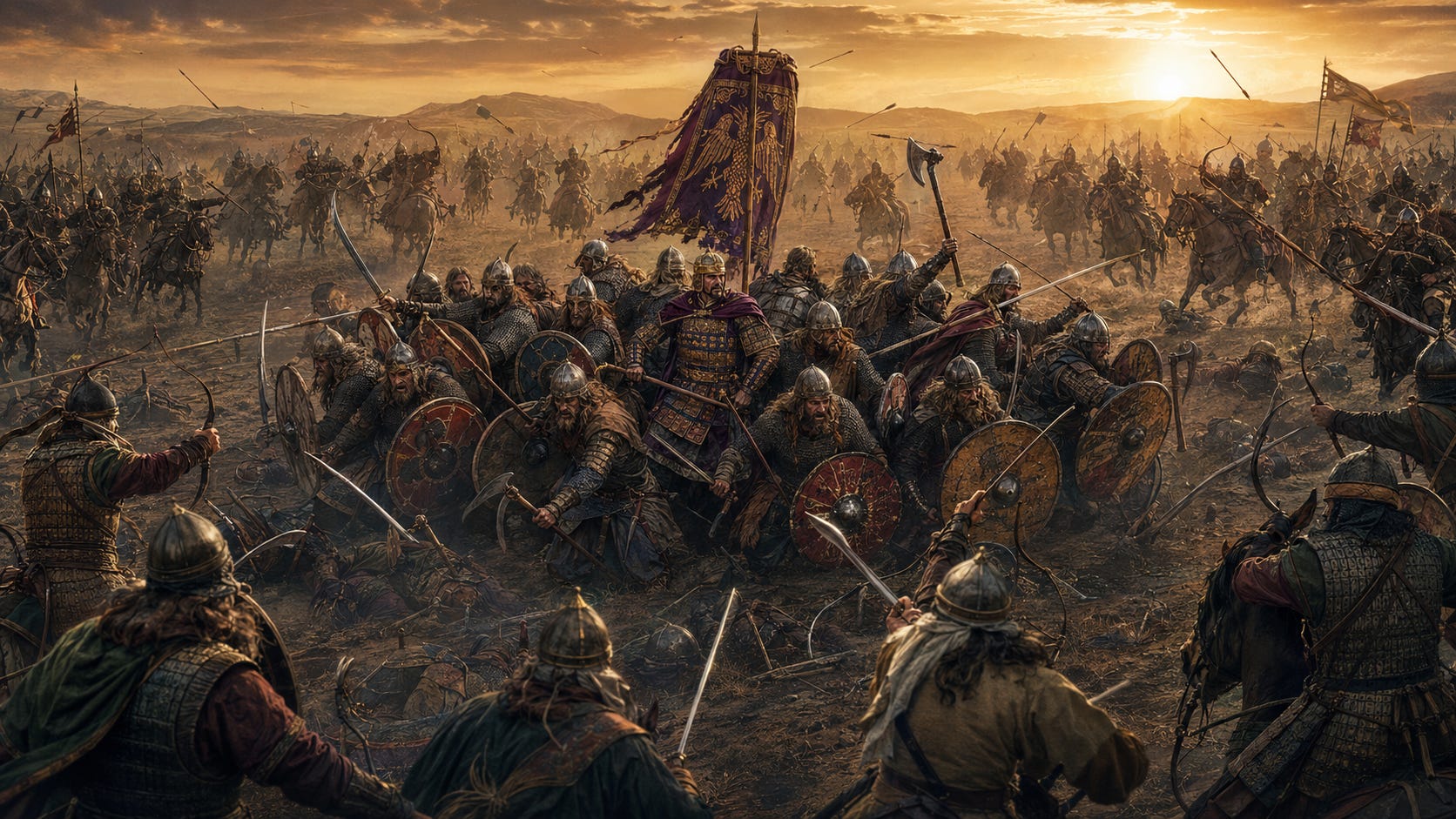
On August 26, 1071, one of the most decisive battles in all world history took place—that of Manzikert. It paved the way for the First Crusade, the subsequent Ottoman invasions of Europe, and creation of the modern state of Turkey atop formerly Christian Asia Minor.
It all began half a century earlier, in 1019, when “the first appearance of the bloodthirsty beasts … the savage nation of infidels called Turks entered Armenia … and mercilessly slaughtered the Christian faithful with the sword,” writes the chronicler, Mathew of Edessa.
In the ensuing years and decades, virtually the whole of Armenia was decimated: hundreds of thousands were slaughtered or enslaved, and thousands of churches torched or desecrated, including by being turned into mosques:
Everything was covered with blood. . . . Because of the great number of corpses, the land stank, and all of Persia was filled with innumerable captives; thus this whole nation of beasts became drunk with blood. All human beings of Christian faith were in tears and in sorrowful affliction.
Nor was there much doubt concerning what fueled the Turks’ animus: “This nation of infidels,” a military leader explained, “comes against us because of our Christian faith and they are intent on destroying the ordinances of the worshippers of the cross and on exterminating the Christian faithful.” Therefore, “it is fitting and right for all the faithful to go forth with their swords and to die for the Christian faith.”
Many were of the same mind; records tell of monks and priests, fathers, wives, and children, all shabbily armed but zealous to protect their way of life, coming out to face the invaders—only to be butchered or enslaved.
Nor were the Turkish hordes, under the authority of the ascendant Seljuk tribe, content with ravaging Armenia. They continued riding westward across the Anatolian plain, then part of the Eastern Roman Empire (“Byzantium”), leaving a trail of smoke and destruction in their wake.
On becoming emperor in 1068, Romanus Diogenes made it his priority to act. By 1069 he had amassed and marched a massive army deep into Asia Minor, liberating numerous cities from the Turks.
The two forces eventually met near the city of Manzikert, just north of Lake Van. The Turkic sultan, Muhammad bin Dawud—better known to posterity as “Alp Arslan,” or, “Heroic Lion”—sent a delegation to parley with Romanus on “the pretext of peace,” though in reality “stalling for time,” explained Michael Attaleiates, who was present. This only “roused the emperor to war.”
Romanus spurned the Muslim emissaries and commanded them to tell their sultan that “there will be no treaty . . . and no going home except after I have done in the lands of Islam the like of what has been done in the lands of Rome [Byzantium].” Then, having “dismissed the ambassador with the greatest contempt,” Romanus incited his men to war with “words of extraordinary violence.”
For his part, Muhammad exhorted his men to jihad and reminded them of its win-win scenario: “If we are given victory over them, [well and good]. If not, we will go as martyrs to the Garden [Islamic paradise].”
“We are with you!” cried the men in unison when he finished his harangue, followed by a barrage of “Allah Akbars” that reportedly “shook the mountains.”
Thus, as “martial music resounded from both sides and the dust of the battlefield billowed up like clouds in the sky,” the two armies met on that fateful Friday, August 26, 1071.
The battle ensued in the usual way: Turkic horseman, in a crescent formation that hid their fewer numbers, sped forward and unleashed volleys of arrows, before swiftly retreating. Throngs of Christian fighters and horses fell; some—especially mercenaries and other “vacillating” elements—broke rank and fled.
Undaunted, Romanus maintained the line and marched his forces forward; but because the Turks had unlimited terrain to fall back on, the Christian army never managed to corner and finish them off, even as the Muslims continued to engage in effective hit and runs tactics.
If you value unflinching, historically grounded analysis that mainstream outlets soften or ignore, consider upgrading. Paid subscribers get:
Several new, full-length articles every week.
Carefully researched pieces you won’t find elsewhere.
Full access to the complete premium archive
Archive of in-depth writing, research, and commentary — all in one place.
Entry into the subscriber chat
A private space for serious readers and thoughtful discussion.
Comments
Nothing yet. Say the first thing.
Sign in to join the conversation.