
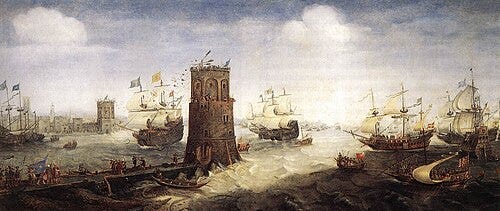
Today in history, on August 24, 1218, a crusader army launched a decisive assault that captured the Tower of Damietta, breaking the Muslim defenses across the Nile and opening the way for the Fifth Crusade’s advance into Egypt.
Not only was this a major breakthrough, but surviving accounts underscore the mighty travails that were always part and parcel of crusading. A summary follows:
Around AD 1200, Saladin’s brother Saphadin emerged victorious from the internecine struggles among Saladin’s heirs, displaced his nephews, and became sultan. Saphadin wasted no time in living up to the meaning of his name (“sword of the religion/Islam”).
In 1202, Philip of Plessis, the master of the Temple, wrote a letter describing how the new sultan was “most cruelly” persecuting Christians “with all his troops from Egypt, Jerusalem and Damascus and even with a horde of pagans from beyond the Euphrates.” The Christians were so surrounded by encroaching Muslims that, “if the enemies of the Christian cross left their castles in the evening they would be visible in front of our castles at the break of dawn.”
For their part, the Knights of the Temple responded by building the imposing castle of Atlit—also known as Pilgrim Castle (Château Pèlerin)—which jutted out into the sea, just south of Haifa. It served its purpose: “From this new castle the infidels suffer considerable damage, and they are forced to abandon their cultivated lands as they flee in terror of God.”

The depredations of Saphadin helped give rise to what would be known as the Fifth Crusade. The longtime belief championed by the military orders and other veterans that Egypt must first be conquered before Jerusalem can be secured was finally put into action.
A large crusading force of as many as thirty thousand men, including many newly arrived European pilgrims, assembled in Acre under the general leadership of John of Brienne (titular king of Jerusalem) and set sail for Egypt. On May 27, 1218, the first ships reached the Nile Delta, and the Crusaders soon established a fortified camp opposite Damietta.
Long known among the Crusaders as “the key to all Egypt,” Damietta was also immensely fortified, with three rings of walls, a moat between the first two walls, and twenty-eight strong towers.
The first task confronting the Crusaders was the massive chain stretched between the city walls and a fortified tower on an island in the Nile Delta garrisoned with three hundred Muslim fighters; it prevented access to the city’s harbor.
The assault began on June 24, when the Knights of the Hospital led a fierce charge against this chain tower. They sailed to the tower and, from their boats, set up ladders against its side, which they ascended one after the other. The attempt failed; the Muslims destroyed the ladders, thereby sending “to heaven soldiers who were vigorous and well-armed, wounded in body to the advantage of their souls, crowned with a glorious martyrdom,” to quote an eyewitness. “The overjoyed Egyptians, mocking us violently, raised their voices, beating drums and sounding sackbuts; gloom and sadness invaded the Christians.”
It is the Templars, however, whose martial exploits are repeatedly praised in the chronicles of eyewitness sources. For example, the bishop of Acre, James of Vitry, who accompanied the warrior monks on this expedition, “pays many tributes to the valor of the Templars at Damietta.” He likens them to those whom God “will encircle my house with” to “serve me in war.” (Zechariah 9:8).
Oliver of Paderborn, an eyewitness, especially singles them out for praise. During an early and especially fierce Muslim sortie on the Crusader camp, Oliver reports that the Christians were overwhelmed and nearly routed—if not for “the courage of the Templars.”
Continue reading below.
If you value unflinching, historically grounded analysis that mainstream outlets soften or ignore, consider upgrading. Paid subscribers get:
Several new, full-length articles every week.
Carefully researched pieces you won’t find elsewhere.
Full access to the complete premium archive
Archive of in-depth writing, research, and commentary — all in one place.
Entry into the subscriber chat
A private space for serious readers and thoughtful discussion.
Comments
Nothing yet. Say the first thing.
Sign in to join the conversation.