
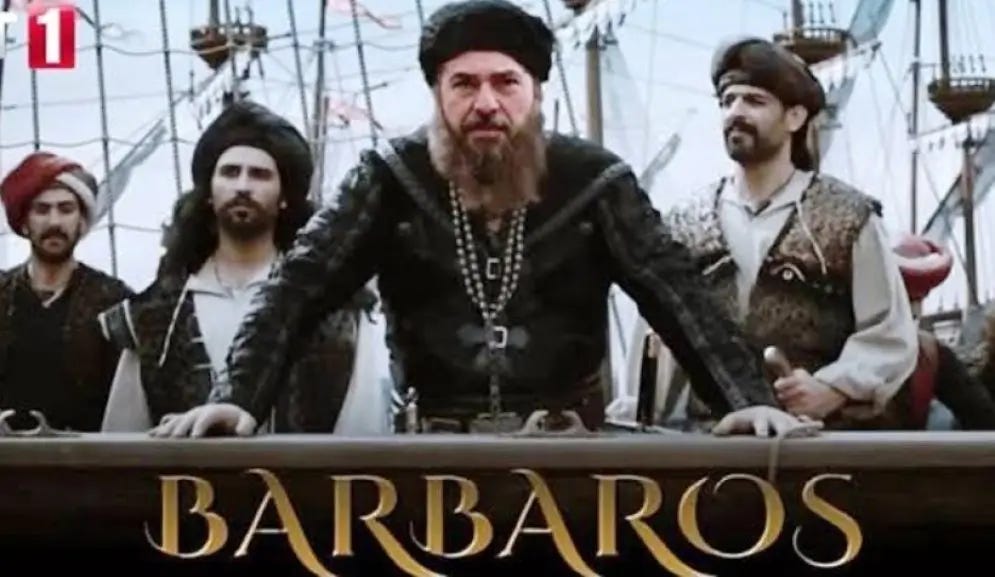
Riddle me this: Why does the Western world only make movies dedicated to demonizing its Christian past, while the Muslim world makes movies glorifying its jihadist past?
Take Barbaros: Sword of the Mediterranean, a 2021 television series written and produced in Turkey. The highly fictionalized series revolves around four real Muslim brothers, and their naval exploits and battles against the Christian maritime states of the Mediterranean.
While the series portrays the brothers as great and noble heroes who sacrificed much to “defend” the Ottoman Empire against Christian Europe, history — real, actual, recorded history — has a completely different tale to tell.
The brothers were born of an unholy union between a Muslim Turk and a Christian slave woman on the conquered Greek island of Lesbos. They exhibited an extreme hatred for Christians and engaged in vile and wanton behavior—shocking even for those times.
The eldest brother, Aruj, was notorious for such obscenities as biting into and tearing open the throats of his Christian captives—before devouring their tongues. He also once tied and twisted a rope around a Knight of St. John until his eyes popped out of their sockets.
The even more successful and sadistic slave raids launched by Aruj’s younger and much longer-lived brother, Khizr (1478–1546) were such that he was known among Christians as the “king of evil” and, by corollary, among Muslims as the “goodness of Islam”—“Khair al-Din, the sobriquet history remembers him by. He had vowed never to cease his raids on Christendom “until I have killed the last one of you and enslaved your women, your daughters, and your children.” Considering his long career, this vow naturally resulted in the capture of countless Christians over the years.
For example, from just the two hundred–mile coastline between Valencia and Barcelona, he seized and enslaved ten thousand Christians. In another devastating raid, he carried off three hundred children and nuns. Suleiman “the Magnificent” was so impressed by Khair al-Din’s raids—it was the sultan who first dubbed him the “goodness of Islam/khair al-din”— that he elevated this former pirate to the rank of grand admiral of the Ottoman navy in 1533.
Now, with the full might of the Turks’ navy, the terror he visited upon Christendom skyrocketed.
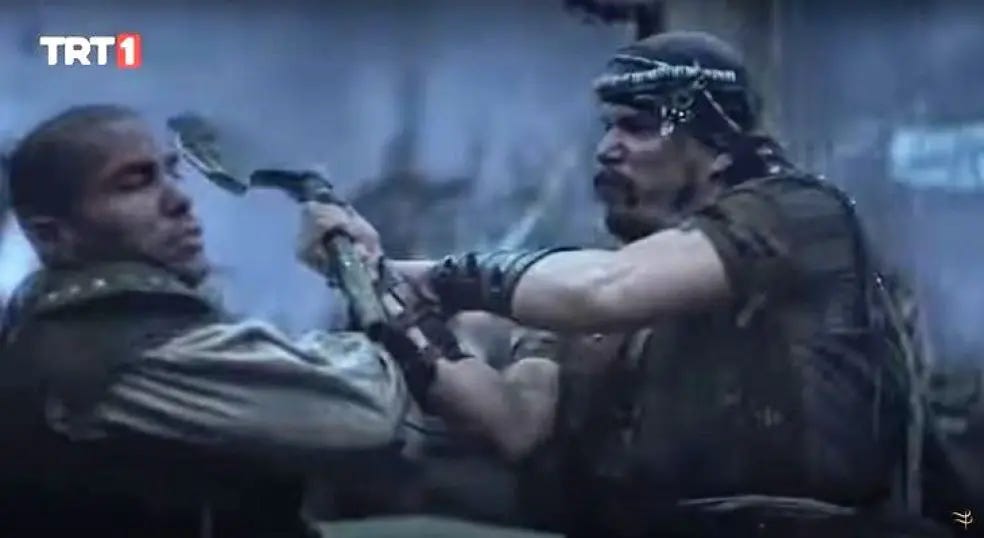
It may be hard to imagine how devastating these slave raids were, especially in the current climate, when slavery is often seen as an exclusively European enterprise. Suffice it to say, in the sixteenth century, the average number of Africans sold by other Africans to Europeans in one year (3,200) was about how many Europeans were enslaved by Muslims during just a few raids.
The surviving record of the Frenchman Du Chastelet reflects the terror and trauma Christians experienced when being enslaved by the denizens of Barbary: “As to me,” he wrote of the moment when he was captured, “I noticed a great Moor approaching me, his sleeves rolled up to his shoulders, holding a sabre in his large hand of four fingers; I was left without words.” He goes on to explain how his abductor’s foreign visage and demeanor “terrified me a good deal more than were frightened the first humans at the sight of the flaming sword at the door of Eden.”
Continue reading below…
If you value unflinching, historically grounded analysis that mainstream outlets soften or ignore, consider upgrading. Paid subscribers get:
Several new, full-length articles every week.
Carefully researched pieces you won’t find elsewhere.
Full access to the complete premium archive
Archive of in-depth writing, research, and commentary — all in one place.
Entry into the subscriber chat
A private space for serious readers and thoughtful discussion.
Comments
Nothing yet. Say the first thing.
Sign in to join the conversation.