
There are some things Crete teaches you gently, and some things it teaches you by placing a small plastic bin next to the lavatory and hoping you have enough sense to use it.
For many visitors, it is the first small shock of the island.
They arrive dreaming of blue seas, mountain villages, old Venetian harbours, lamb with lemon, raki in a tiny glass, and that impossible Cretan light which makes even a stone wall look as if it has been painted by somebody with a sense of humour. Then they go into the bathroom of a hotel room, a rented villa, a village taverna, or a ferry port, and there it is. A sign, usually polite, sometimes stern, occasionally written in alarming English.
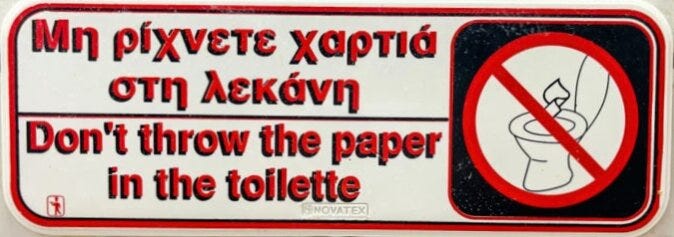
Please do not throw paper in the toilet.
At first, people think there must be some mistake.
Surely they do not mean toilet paper.
Surely they mean kitchen paper, wipes, nappies, cotton wool, or something more industrial. Surely the phrase has been badly translated. Surely, in a modern European country, in the twenty-first century, with airports and smartphones and contactless payments and cappuccino freddo in every village, one is not expected to put used toilet paper in a bin.
But yes, in many places in Crete, that is exactly what is meant.
And once you have lived here for a while, it stops being strange. In fact, it becomes one of those tiny pieces of local knowledge which separate the visitor from the person who has begun to understand where they are. You do not argue with the mountain road because it has a bend in it. You do not ask why the goat is standing in the middle of the lane as if it owns the place. You do not expect a village kafeneion to operate according to a printed timetable. And when the sign says not to flush the paper, you do not flush the paper.
You use the bin.
The rule is not there to embarrass anyone. It is not a peasant habit left over from old times. It is not a trick played on nervous tourists. It is not proof that Crete is backward, dirty, or incapable of modern plumbing. Quite the opposite. It is one of those practical customs that tells you a great deal about the island, its history, its old houses, its difficult ground, its fast growth, its seasonal pressures, and the quiet systems that keep everything working.
It is also one of those things that causes far more fuss among visitors than it ever causes among the locals.
Most Cretans do not see it as a subject. It is just what you do. The bin is there. It has a lid. It is emptied. Life goes on.
But beneath that little bathroom bin is a whole history of water, waste, settlement, tourism, engineering, and common sense. It begins not in the modern hotel bathroom, but in the Bronze Age palaces of Minoan Crete, where some of the most impressive water systems in the ancient world were already doing their work.
Crete has always had a complicated relationship with water.
From a distance, the island can look rich in it. Snow sits on the White Mountains, Psiloritis, and Dikti in winter. Springs burst out in unexpected places. Rivers run hard after rain. The land can be green and almost soft in spring, with orange blossom, wild fennel, damp earth, and that wonderful smell of herbs crushed underfoot.
Then summer arrives, and everything changes.
The island hardens. The hills bleach. Streams vanish into stones. Rain becomes a memory. Villages that look lush in April can look burnt by August. Cisterns, springs, wells, and channels have always mattered here because water has never been something to waste.
And where there is water, there is always the question of what happens after it has been used.
That is the part of civilisation people prefer not to discuss. We like to talk about temples, palaces, battles, pottery, trade routes, frescoes, and kings. We are less comfortable talking about drains. Yet drains are civilisation. So are toilets. So are pipes. So are the unglamorous arrangements that take waste away from where people sleep, cook, eat, and raise children.
The Minoans understood this very well.
At Knossos, Phaistos, Malia, Zakros, and other Minoan sites, archaeologists found evidence of sophisticated drainage and water management. There were clay pipes, stone channels, settling arrangements, rainwater systems, and methods for carrying wastewater away. The palace at Knossos is famous for many things, not all of them straightforward, but one of the most remarkable is its plumbing. The Minoans were not merely decorating walls and trading across the sea. They were solving practical problems.
They knew that a large settlement could not function without water coming in and dirty water going out.
This is worth remembering when people make jokes about modern Greek toilets. Crete was not late to sanitation. In some ways, it was early. Very early. The old Minoan engineers looked at slopes, rainfall, storage, gravity, and clay, and made systems that still impress people thousands of years later.
But ancient achievement does not mean an unbroken line of modern plumbing. History is never that tidy.
After the Minoans came the Mycenaeans, Dorians, Romans, Byzantines, Arabs, Venetians, Ottomans, Egyptians for a moment in the nineteenth century, then the Cretan State, then union with Greece, then war, poverty, tourism, migration, building, development, and the modern push to keep up with both local life and millions of visitors.
Every period left something behind. Some left aqueducts. Some left wells. Some left fountains. Some left public baths. Some left neglected villages and ruined channels. Some left houses built before modern drains had reached them. Some left dense old town centres where pipes had to be threaded under streets that were never designed for motorcars, let alone modern sewage infrastructure.
And all of that history eventually meets the visitor in the bathroom.
It meets them in a tiled room with a small bin and a notice on the wall.
The simple explanation is that many drainage systems in Crete, and in Greece more widely, are not designed to cope well with toilet paper.
That is the short version, and it is broadly true, but it needs a little care.
It is not that every pipe in Crete is ancient. It is not that every toilet will explode if a single sheet goes down. It is not that the whole island has one fragile Victorian-style system held together by prayer and plumber’s tape. Crete has modern wastewater treatment plants, municipal sewer networks, pumping stations, biological treatment systems, and serious engineering behind the scenes.
Chania, Heraklion, Rethymno, Agios Nikolaos, Ierapetra, Sitia, and other areas have varying levels of modern infrastructure. Some towns have systems that have been upgraded over the years. Many coastal resorts depend on networks designed to cope with large summer populations. There are wastewater plants that deal with domestic sewage, industrial waste, septic tank sludge, and seasonal changes in flow.
So why the bin?
Because the island is not uniform.
A new hotel beside a modern sewer network is one thing. A village house built in stages over seventy years is another. A beach taverna with a long pipe run and a septic tank is another. An old Venetian or Ottoman quarter is another. A mountain village with narrow roads and awkward gradients is another. A rented villa at the end of a lane, with its own tank, its own pump, and a pipe that snakes away beneath the garden, is another again.
Crete is full of “another agains”.
In many places, the pipes are narrower than British visitors expect. The bends may be sharper. The gradient may not be ideal. The pipe may be old, patched, extended, or shared. The system may depend on a septic tank, a cesspit, a small treatment unit, or a pumping arrangement that does not like paper. Even modern systems can struggle when too much paper, wipes, sanitary products, cotton buds, and other things are thrown into them.
Toilet paper is designed to break down, but it does not vanish the moment it hits water. It needs time, flow, and enough water movement to disperse it. In a system with narrow pipes, low flush volume, poor gradient, old pipework, or a small tank, it can clump. One clump catches another. Then hair catches. Then a wipe arrives, which is far worse. Then a little fat from a kitchen line joins the fun. Before long, somebody is standing outside with a hose, a rod, a pump, and an expression that tells you this is not their first battle with civilisation.
The visitor who flushed the paper may already be on the beach by then.
The owner, the cleaner, the next guest, or the plumber is the one left with the problem.
That is why the rule matters. It is not because one person flushing one piece of paper always causes a disaster. It is because thousands of people doing it, day after day, in systems never designed for it, eventually cause trouble.
Crete does not ask much from a visitor. Drive carefully. Do not block the village road. Do not wander into someone’s garden because the bougainvillaea is pretty. Do not treat a church like a theme attraction. Do not throw cigarette ends into dry grass. And do not flush the paper when the sign asks you not to.
It is a small courtesy. But small courtesies are what make a place work.
It is tempting to think of the toilet paper rule as a modern inconvenience, but in a way, it belongs to a much older Cretan instinct: respect the system because the system keeps life possible.
The Minoans did not have toilet paper in the modern sense, of course. Different ancient cultures used water, cloth, leaves, stones, bits of ceramic, moss, wool, or whatever was practical and available. But the Minoans did have the essential idea that waste must be managed intelligently.
Their palaces were not just ceremonial spaces. They were working centres. They stored grain, oil, wine, textiles, tools, and goods for exchange. They housed administrators, craft workers, ritual specialists, and servants. They welcomed visitors. They held gatherings. A place like Knossos, whatever one thinks of Arthur Evans and his restorations, was not a little villa with a view. It was a complex and busy organism.
Such places needed drains.
Water from storms had to be led away. Wastewater had to be removed. Floors had to stay usable. Courtyards had to dry. Food stores had to remain clean. The systems were often built with stone-lined drains, terracotta pipes, inspection points, and a keen understanding of slope and flow. Some of those clay pipes were shaped in tapered sections so they could be fitted together. The engineering may look simple to modern eyes, but it was clever, durable, and suited to the materials of the island.
Crete’s ancient water story is not only about grand architecture. It is about gravity.
Gravity has always been the quiet engineer of the island. Water comes down from the mountains. Channels follow the land. Villages gather near springs. Gardens survive because someone long ago understood how to guide a trickle from one place to another.
A good drain is just the reverse of a good water channel. It takes what must leave and sends it safely away.
That is the deep history behind the little bin. Not the bin itself, but the principle. Crete survives by respecting what its systems can bear.
When those systems are abused, they answer back.
The Romans were excellent at water and waste. They built aqueducts, baths, drains, and public latrines across their empire. In Crete, Roman Gortyn became the capital, and like other Roman cities, it needed substantial infrastructure. Water supply and sanitation were part of urban life. The Roman world had its own unpleasant smells and problems, of course, but it understood that towns needed systems.
Later, the Byzantines inherited some ancient structures, adapted others, and lived with the practical difficulties of shifting populations, changing defences, and changing priorities. When the Arabs took Crete in the ninth century, Chandax, later Candia and then Heraklion, became the great fortified centre. The Venetians then transformed Candia into one of the most important cities of the eastern Mediterranean.
Venetian Crete had fountains, cisterns, wells, channels, harbour works, military engineering, and urban density. Chania and Rethymno also developed as Venetian towns with tight street patterns and layered buildings. The Venetians were marvellous builders, but nobody in the Venetian period was designing bathrooms for modern tissue, modern flushing toilets, washing machines, dishwashers, high summer tourism, and thousands of people showering twice a day after the beach.
Old towns are beautiful because they are old.
That is also why they are awkward.
If you have ever walked through the lanes of Chania's old town, you will understand this immediately. Buildings lean into the street. Walls have been altered, repaired, cut through, plastered, painted, abandoned, revived, turned into shops, then restaurants, then guesthouses. Pipes and cables appear where they can, not always where an engineer would dream of putting them if starting from a clean sheet of paper.
Heraklion, too, is layered. The city is ancient, Arab, Venetian, Ottoman, modern Greek, wartime, post-war, and tourist-driven all at once. Rethymno carries its own layers. Sitia and Agios Nikolaos have their own growth patterns. Villages have grown by addition, not by blueprint.
In Britain, we sometimes forget this. We live in a country where many old drains are terrible, where Victorian sewers were heroic but often overloaded, where blocked pipes are hardly unknown, and where water companies regularly manage to disgrace themselves. Yet British visitors sometimes arrive in Greece with a faint air of superiority about plumbing. This is unwise.
Every country has its hidden mess.
Crete’s is simply more honest. It puts a bin beside the toilet and tells you the truth.
To understand the rule properly, one must leave the city.
A great deal of Crete is village Crete. Even people who now live in towns often have roots in a village, land in a village, family houses in a village, or memories of a village. Many village houses were not built as one complete modern unit. They grew. A room was added. A kitchen moved. A storeroom became a bedroom. A courtyard was roofed. A bathroom was installed where one could be fitted.
Older Cretan houses did not always have indoor bathrooms as we think of them now. In many places, especially before the second half of the twentieth century, sanitation was simple, rural, and external. People used outside arrangements, pits, animals, fields, ash, water, and all the ordinary methods of a less comfortable age. It was not romantic. It was just how life was.
Indoor plumbing arrived unevenly. Some houses were modernised early. Some much later. In remote villages, the change came gradually and often through family labour. Pipes were laid where they could be laid. Septic tanks were dug. Water heaters appeared on roofs. Bathrooms were tiled. The new conveniences came with compromises.
A septic tank is not a magic hole in the ground. It is a living system of sorts. It depends on settling, separation, bacterial action, and sensible use. It can cope with human waste and wastewater if properly built and maintained. It does not love paper. It hates wipes. It despises cotton buds, sanitary towels, nappies, and anything pretending to be flushable because some marketing department thought it sounded convenient.
In a village house, the difference between treating the system gently and abusing it can be the difference between a quiet summer and a deeply unpleasant afternoon involving a man with a tanker.
This is why the bin became normal.
It is not a grand cultural statement. It is a practical habit that grew from old systems, small pipes, septic tanks, limited water, and the cost of repairs. The habit then continued even where systems improved, because people knew from experience that not flushing paper caused fewer problems.
That is how customs often work. They begin as necessity, then become habit, then become common sense.
The toilet paper rule became more visible when tourism exploded.
Crete has always had travellers, pilgrims, traders, soldiers, sailors, archaeologists, artists, and wanderers, but mass tourism is a modern force. From the 1960s and 1970s onward, the island changed at extraordinary speed. Fishing villages became resorts. Dirt roads became hotel roads. Fields became apartments. Family houses became pensions. Then came larger hotels, package holidays, rental villas, Airbnbs, car hire, excursion buses, beach bars, airport expansion, ferry growth, and the annual summer swelling of the population.
The old systems were never built for that.
A village that once had a few hundred residents might suddenly have summer visitors using showers, toilets, washing machines, swimming pools, and restaurant kitchens. A coastal strip that once held fields and a few houses might become a resort with thousands of beds. The island had to build, connect, upgrade, pump, treat, and regulate at speed.
And visitors bring habits with them.
A British visitor, or a German, Dutch, Scandinavian, American, or Australian visitor, may come from a place where toilet paper always goes in the toilet. They do not even think about it. The action is automatic. One flush and finished. So the Cretan bathroom has to interrupt that automatic habit with a sign.
Please use the bin.
Some signs are funny without meaning to be.
Do not throw papers in the basin.
Do not put anything in the closet.
Please respect the toilet.
The last one is my favourite. It sounds as though the toilet has had a hard life and deserves a little dignity.
In truth, it probably has.
A hotel toilet in August works harder than some tractors. A beach taverna toilet at lunchtime may have to cope with people who have had beer, seafood, children, sandy feet, sun cream, and no understanding of Greek plumbing. The small sign on the wall is the only line of defence between a pleasant holiday and a flooded floor.
And still people ignore it.
Some ignore it because they are squeamish. Some because they think rules are for other people. Some because they assume it cannot possibly apply in a nice hotel. Some because they decide that if the toilet flushes once, everything must be fine.
That is not how drainage works.
A blockage can build slowly. The person who causes it may not be the person who suffers it. This is the moral problem of the toilet paper question. It is a small private act with a public consequence.
You flush. Someone else deals with the mess.
The bin is there to protect the pipes, the tank, the pump, the owner, the cleaner, the neighbour, and the next person through the door.
It is also there to protect the wider system.
Sewage systems are not just pipes. They are networks. They rely on flow. They include manholes, pumping stations, treatment works, filters, screens, settlement tanks, aeration systems, sludge handling, and outfalls. Anything that makes the waste stream harder to move or treat adds cost and risk. Paper is not the worst offender, but in places with narrow pipework or poor gradients it can be enough to start trouble. Wipes are far worse. So are sanitary items. So are nappies. So are cloths, dental floss, cotton pads, and the strange things people somehow persuade themselves are suitable for flushing.
The little bin is a simple local solution to a problem that could otherwise become expensive.
In a good bathroom, the bin has a lid, a liner, and is emptied daily. In hotels and rented accommodation, cleaning staff deal with it as part of the normal routine. In a private house, the household deals with it. Nobody makes a drama of it.
Visitors sometimes worry about the smell. In practice, if the bin is lined, lidded, and emptied regularly, it is rarely an issue. The paper is usually folded. Many people use a small amount and place it discreetly in the bin. Some use scented bags. Some bathrooms have pedal bins. Some have open bins, which is not ideal, but even then, the system works if emptied often.
The purpose is not to create discomfort. The purpose is to prevent a worse discomfort.
Anyone who thinks the bin is unpleasant has never had sewage come back up through a floor drain in August.
That is an education.
What about modern hotels?
This is where the subject becomes interesting.
Some modern hotels, especially larger and newer ones connected to stronger systems, may tell guests that flushing ordinary toilet paper is acceptable. Some private homes with modern pipework and proper connection may allow it. Some new builds are designed with wider pipes and better gradients. Some owners will say it is fine, especially if they have never had a problem.
So is the old rule outdated?
Not entirely.
The difficulty is that a visitor cannot judge the system by looking at the bathroom. A shiny new toilet does not tell you what lies beneath it. A marble sink does not mean the pipes are wide. A luxury villa may still depend on a septic tank. A renovated old house may have a beautiful bathroom connected to a very old route out. A hotel may have modern rooms, but a network that still needs careful treatment.
The safest rule is the local rule.
If there is a sign, obey it.
If the owner or hotel says use the bin, use the bin.
If there is a bin beside the toilet and no sign, it is usually there for a reason.
And if you are unsure, the polite thing in Crete is not to test the plumbing as if it were a competition. Use the bin and sleep peacefully.
One can make an argument that Greece should modernise everything to the point where paper can be flushed everywhere. In some places, that is happening. In others, it is not simple. Infrastructure costs money. Excavating old streets is difficult. Extending sewerage networks to scattered settlements is expensive. Mountain villages, coastal tavernas, and isolated houses cannot all be treated like new apartment blocks in a planned city.
Crete is not a laboratory. It is a living island.
It has old towns, villages, farms, tourist resorts, archaeological sites, mountains, gorges, wetlands, beaches, ports, and millions of people passing through each year. A single uniform rule imposed from the imagination of a visitor does not fit such a place.
The bin is not perfect, but it is practical.
And Crete is a very practical island.
Part of the problem is that nobody wants to talk about toilets.
We will happily discuss the fall of Knossos, the Battle of Crete, Venetian fortifications, Ottoman rule, mountain rebellions, olive oil, wine, and the price of lamb. But toilets make people nervous. They are private, bodily, faintly comic, and slightly embarrassing. This is why visitors often whisper about the bin as if they have discovered a scandal.
But there is no scandal.
Human beings produce waste. Every civilisation has to deal with it. The only difference is whether we deal with it honestly or hide it behind porcelain and pretend it has disappeared.
In Britain, flushing makes waste seem to vanish. It is one of the great illusions of modern life. Push a handle, and the problem goes away. But it does not go away. It enters a system. It travels through pipes. It reaches treatment works. It becomes sludge, effluent, odour, maintenance, cost, and environmental responsibility.
Crete makes that chain slightly more visible. It asks you to think for half a second before flushing. That is not a bad thing.
In fact, one could argue that the Cretan toilet bin is a small lesson in humility.
It reminds the visitor that places have their own rules. It reminds us that comfort is built on infrastructure. It reminds us that the modern world is not magic. It reminds us that water, drains, and waste are part of the story of any island.
And on Crete, islands matter.
The sea is never far away. Even when you are high in the mountains, the sea is part of the island’s mind. Wastewater treatment is not only about avoiding bad smells or blocked bathrooms. It is also about protecting coasts, beaches, fishing grounds, and the image of an island whose beauty is its livelihood.
A blocked private pipe may be a local nuisance. A strained public system is something larger. Good habits help.
So yes, it is only a little bin. But it belongs to a much wider story.
Every place has a small test.
In Crete, one test is whether you can accept that the road through the village belongs to the village, not to your hire car. Another is whether you can sit in a taverna without demanding the bill before the plates have settled. Another is whether you can understand that slow service may not be bad service. It may be the pace of a place that has not fully surrendered to the clock.
The toilet paper rule is one of these small tests.
It asks: Can you adapt?
Not dramatically. Not heroically. Just slightly.
Can you change one habit for the sake of the place you are visiting?
If the answer is no, Crete will still take your money and feed you well, but you will have missed something. Crete is not only a destination. It is a place with its own logic. The more you respect that logic, the more the island opens.
This is true of language, roads, meals, churchyards, water use, and the way people sit in the shade rather than marching about in the noon sun like boiled lobsters with backpacks. It is also true of bathrooms.
There is nothing humiliating about using the bin. The locals do it. Long-term residents do it. People who love Crete do it. Nobody is judging you. They are more likely to judge you if you refuse.
The bin is not a sign of poverty. It is a sign of local practice.
It says: " This is how this system works here.
A small thing, but Crete is full of small things that matter.
There is a lazy way of explaining the rule, which says: Greek pipes are bad.
That is too simple and not fair.
Some Greek pipes are old. Some are narrow. Some are badly laid. Some are modern. Some are excellent. Some are under strain. Some are perfectly capable. The problem is not some national inability to understand plumbing. Greece has engineers, treatment works, environmental regulations, major infrastructure projects, and a very long history of water management. Crete, as we have seen, was dealing with water and waste when much of northern Europe was still working things out in mud.
The real explanation is more layered.
Many buildings were not originally designed for modern bathrooms. Many places rely on septic systems. Many areas grew before infrastructure caught up. Many tourist pressures are seasonal and extreme. Many pipes are narrower than visitors expect. Many systems have low water flow. Many settlements are scattered. Many old streets are difficult to dig up. Many private owners sensibly prefer prevention to repair.
So the bin remains.
It is not glamorous. It is not what a tourist board would put on a poster. But it works.
In some ways, the bin is like the old Cretan habit of using everything and wasting little. Food scraps go to animals. Old doors become shed doors. Olive prunings become winter heat. A cracked jar holds basil. A plastic water bottle becomes a funnel. A piece of wire becomes a gate latch. Practicality is a form of intelligence.
The toilet bin sits in that same family of thought.
Do the simple thing now and avoid the complicated thing later.
The practical rules are easy.
Use the bin provided. Fold the paper. Keep the lid closed. Do not overfill it. In hotels or rented rooms, it will usually be emptied regularly. In a villa or private house, take the rubbish out as needed. If there is no liner, ask for one or use a small bag. If you are staying somewhere remote, be even more careful.
Never flush wet wipes, even if the packet says flushable. That word has caused plumbers more misery than almost any other. A wipe may leave the toilet bowl, but that does not mean it has safely passed through the whole system. It can catch, twist, bind, and help form blockages that are horrible to remove.
Do not flush sanitary products, cotton wool, cotton buds, nappies, condoms, dental floss, paper towels, tissues, cigarette ends, or anything else that belongs in a bin.
Use only modest amounts of paper. This is good advice anywhere, not only in Crete.
If you are in a modern hotel that clearly says toilet paper may be flushed, then follow that instruction. But do not assume. The presence of the bin and sign is enough.
And please do not complain to the owner as if the island has personally insulted you.
Owners have heard it all before. They know some visitors find it strange. They also know what happens when people ignore the sign. A blocked system in high season is costly, embarrassing, and unpleasant. A plumber may not come instantly. Parts may not be available. A room may be unusable. A family business may lose money because somebody decided the rule was beneath them.
One of the simplest ways to be a good guest in Crete is to use the bathroom properly.
It is not a grand sacrifice.
There is another side to this, and it deserves more attention.
Crete depends on clean water and clean seas. Tourism depends on them. Local life depends on them. Agriculture depends on them. The island’s beauty depends on them. Wastewater treatment has improved enormously, but every system has limits. The more unnecessary material people send into it, the harder it becomes to manage.
Good wastewater systems protect beaches, rivers, groundwater, and marine life. They also allow treated water to be reused in some places for irrigation, which matters on an island where summer drought is a real pressure. Crete has areas where treated wastewater has been used or explored for agricultural purposes, including irrigation of olive groves and landscape areas. This is not a romantic subject, but it is an important one.
Water is too valuable to treat carelessly.
The toilet paper bin may seem unrelated to the big environmental picture, but it is part of the same habit: do not put unnecessary strain on a system. Do not behave as though water and pipes can absorb everything without consequence.
Modern life often encourages distance from consequences. Crete, in its stubborn way, shortens the distance. It says: Here is the bin. Use it.
That is not backward. It is honest.
Of course, one must also admit that the whole thing is faintly funny.
British people in particular can cope with death, war, bad weather, tax, medical procedures, and railway strikes, but ask them to discuss toilet paper and they become Victorian maiden aunts. They lower their voices. They glance around. They ask questions in the tone of someone discussing espionage.
“What exactly are we supposed to do with it?”
The answer is: put it in the bin.
That is all.
There is something wonderfully levelling about the Cretan bathroom rule. It cuts through class, nationality, education, and pretension. Professors, backpackers, honeymooners, retired colonels, Instagram people, German hikers, French families, English villa renters, and Greek grandmothers all face the same small instruction.
Do not flush the paper.
Crete has always had a talent for reducing people to reality. The sun does it. The mountains do it. The roads do it. A village table with too much food does it. A strong raki does it. And yes, the little bin beside the toilet does it too.
It says: never mind your airs and graces. This is a practical island.
This subject is worth knowing because it is one of the quickest ways to understand the difference between visiting Crete and paying attention to Crete.
At first glance, the rule looks like a bathroom quirk. Look closer, and it reveals the island’s ancient engineering, old settlements, rural habits, seasonal tourism, water pressures, environmental concerns, and practical intelligence. It shows how history survives in ordinary life. Not as a museum label, but as a small daily action.
Crete is full of these survivals.
A shepherd’s path becomes a walking route. A Venetian storehouse becomes a restaurant. A Turkish fountain still gives water in a village square. A Minoan drainage channel sits under the feet of tourists who have come to see frescoes. A family house built before indoor plumbing became a summer rental with a sign in the bathroom. History is not only in ruins. It is in habits.
The toilet paper bin is a habit with roots.
It belongs to an island where water has always had to be managed, where settlements grew around springs, where old towns carry centuries beneath their paving stones, where village houses were adapted rather than replaced, and where tourism arrived faster than infrastructure could always follow.
It is also worth knowing because it prevents trouble.
There are subjects where cultural understanding is optional. This is not one of them. Get it wrong, and someone may have to deal with a blockage. Get it right and nothing happens, which is exactly the point. Good infrastructure is often invisible. Good behaviour helps it stay that way.
There is a kind of quiet citizenship in this, even for a visitor.
You are part of the island while you are here. Only briefly, perhaps, but still part of it. You use its roads, water, beaches, tavernas, ferries, paths, rooms, and toilets. The least one can do is not make life harder for the people who maintain them.
The sign on the wall is not accusing you. It is inviting you to cooperate.
Crete has never been an easy island, not really. Beautiful, yes. Generous, often. Harsh, certainly. The mountains are hard. The summers are dry. The history is heavy. The villages have known poverty, war, migration, and stubborn endurance. Cretans learned long ago that systems matter, whether that system is a terrace wall, an irrigation channel, a family network, a flock, a field, a road, a cistern, or a drain.
Use things properly, and they last.
Abuse them, and they fail.
That is the old lesson.
The toilet paper rule may not look noble, but it belongs to that same wisdom. It is not about shame. It is about care. Care for the house, the pipe, the tank, the cleaner, the plumber, the neighbour, the sea, and the island itself.
Once you see it that way, the little bin becomes less strange.
It becomes one more Cretan object with a story behind it. Like the blue chair outside a kafeneion, the black water tank on a roof, the olive net folded under a tree, the cracked pithari in a courtyard, or the broom made from branches leaning by a doorway. It is there because someone knows what works.
And that, in Crete, is often enough.
So when you come here, by all means, admire the mountains. Swim in the Libyan Sea. Walk the old lanes of Chania. Stand at Knossos and wonder what is original and what is Evans. Eat slowly. Drink the raki when it comes, unless you truly cannot. Learn a few Greek words. Listen to old men arguing about roads, goats, weather, and politics. Watch the light change in the White Mountains in the evening.
And when you go to the bathroom, notice the sign.
Do not be offended by it.
Do not test it.
Do not think you know better because things are different at home.
Use the bin.
It is one of the smallest acts of respect you can offer the island, and one of the easiest. Crete will not thank you out loud. It is not that sort of place. But somewhere beneath the floor, in the dark, narrow, unromantic world of pipes and water, everything will keep moving as it should.
And sometimes, that is civilisation at its finest.
Comments
Nothing yet. Say the first thing.
Sign in to join the conversation.