
The Fourth Crusade began with Jerusalem in its sights and ended with Crete in Venetian hands. That is the strange, almost outrageous path of the story. A holy war called to recover the sacred city of Christendom somehow became an armed expedition against fellow Christians, first at Zara and then at Constantinople. By the time the smoke cleared, the Byzantine Empire had been broken, its capital had been looted, and Venice had gained the island that would become one of the great pillars of its maritime empire.
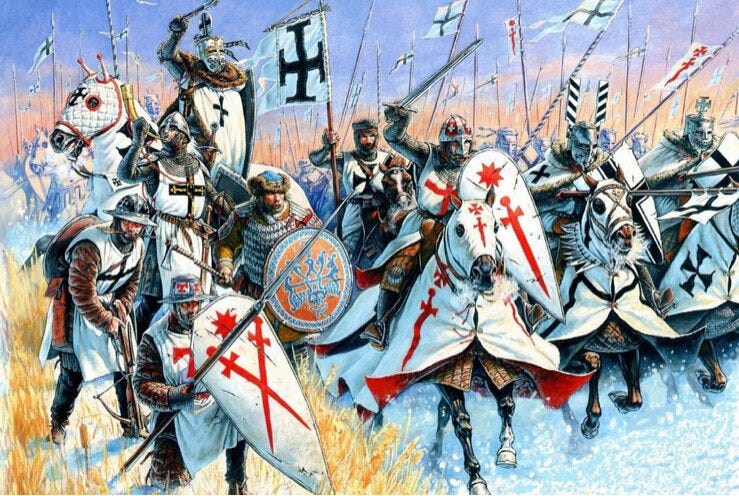
For Crete, this was not a distant European scandal. It was one of the turning points of the island’s history. Before 1204, Crete belonged to the Byzantine world. After 1204, it was pulled into the orbit of Venice, a sea republic whose wealth rested on ships, trade, ports, contracts, and a wonderfully cold eye for opportunity. The Venetian harbours, walls, arsenals, mansions, fountains and fortresses still visible across Crete today all lead back, in one way or another, to this crusade that lost its way.
The story began after the loss of Jerusalem. The city had been captured by the First Crusade in 1099, but in 1187 it fell to Saladin after the Battle of Hattin. The Third Crusade recovered parts of the coast, but it failed to retake Jerusalem itself. By the end of the twelfth century, the wound was still open. Pope Innocent III, young, energetic and deeply ambitious for the authority of the Church, called for a new crusade in 1198.
The plan was not to march straight to Jerusalem. The crusaders intended to attack Egypt, the military and economic heart of the Muslim Ayyubid world. If Egypt could be taken, Jerusalem might later be recovered from a position of strength. It was a strategic idea, not merely a religious one. But to reach Egypt, the crusaders needed ships, and there was only one power in the Mediterranean able to move an army on that scale: Venice.
Venice was already becoming something extraordinary. It was not a kingdom in the usual sense. Its power did not come from great inland estates or vast fields of grain. Venice lived by the sea. Its wealth came from trade routes, convoys, colonies, harbours, customs houses, credit, warehouses and contracts. Its merchants knew the eastern Mediterranean intimately. They traded with Byzantium, Egypt, the Levant and the ports of the Adriatic. When the crusaders came asking for transport, Venice saw not only a religious enterprise but also a commercial opportunity.
In 1201, the crusader leaders made a vast agreement with Venice. The Venetians would build and provide ships to carry thousands of men, horses and supplies. The price was enormous: 85,000 silver marks. Venice also agreed to contribute armed galleys and take part in the expedition, in return for a share of any conquests.
For Venice, this was no casual arrangement. The republic diverted labour, timber, shipyards and money into preparing the fleet. Ordinary trade was disrupted. Men were put to work building ships for an army that had not yet arrived. Venice had taken a risk, and Venice expected to be paid.
Then came the problem. When the crusaders gathered in 1202, far fewer men arrived than expected. Some had sailed from other ports. Some had never come at all. The army could not pay the agreed sum. The ships were ready, the crusade was waiting, and the money was missing. At that moment, the crusade became vulnerable to Venetian direction.
The Doge of Venice, Enrico Dandolo, was old, blind or nearly blind, and formidable. He proposed a solution. The crusaders could repay part of their debt by helping Venice capture Zara, a rebellious city on the Dalmatian coast. Zara, now Zadar in Croatia, had once been under Venetian influence but had placed itself under the protection of the king of Hungary.
There was one obvious difficulty. Zara was a Christian city, and the king of Hungary had himself taken the cross. A crusade called to fight for Jerusalem was now being asked to attack fellow Christians on behalf of Venice. Pope Innocent III forbade it, but the army went ahead. In November 1202, Zara was besieged and captured.
This was the first great moral collapse of the Fourth Crusade. Once the army had attacked one Christian city for reasons of debt and Venetian interest, the barrier had been broken. The crusade had learned how easily a holy cause could be redirected.
The next temptation came from Byzantium itself. The Byzantine Empire at the turn of the thirteenth century was weakened by court intrigue, dynastic struggle and deep internal distrust. In 1195, Emperor Isaac II Angelos had been overthrown, blinded and imprisoned by his brother, Alexios III. Isaac’s son, also called Alexios, escaped and sought western help to recover the throne.
This young prince made the crusaders an extraordinary offer. If they helped restore him and his father to power in Constantinople, he promised money, troops, supplies, and the submission of the Byzantine Church to Rome. To an unpaid, restless crusading army, it sounded like deliverance. To Venice, it sounded like an opportunity.
Venice already had a long and complicated relationship with Constantinople. Venetian merchants had enjoyed privileges there, but they had also suffered from Byzantine hostility. The massacre of Latins in Constantinople in 1182, when western merchants and residents were attacked, had not been forgotten. Venetian memory was commercial, political and personal. Constantinople was not only the great Christian capital of the East. It was also a place of wealth, rivalry and old resentment.
So the crusade turned away from the route to Egypt and sailed towards Constantinople.
To the crusaders, Constantinople must have seemed almost beyond imagination. It was the greatest city in Christendom, ancient, immense and glittering with wealth. Its walls were legendary. Its churches were filled with relics. Its palaces, monasteries, libraries, markets, bronze statues, silks, icons, jewels and ceremonial spaces spoke of a civilisation far older and richer than anything most western knights had known.
In 1203, the crusaders and Venetians attacked. With Venetian naval skill and Western military force, they compelled Alexios III to flee. Isaac II was restored, and his son became co-emperor as Alexios IV. For a moment, it seemed that the bargain had worked.
But Alexios IV could not fulfil his promises. The imperial treasury could not meet the enormous payments expected by the crusaders. The Byzantine population hated the presence of Latin soldiers and loathed the idea of submitting their Church to Rome. Alexios tried to raise money by seizing church valuables, which only deepened the anger. The city became tense, frightened and furious. Fires broke out. Anti-Latin feeling grew. Outside the walls, the crusaders waited, unpaid and increasingly hostile.
In early 1204, Alexios IV was overthrown and murdered. A new emperor, Alexios V Doukas, known as Mourtzouphlos, took power and prepared to resist. The crusaders now decided that Constantinople should not merely be pressured or controlled. It should be taken.
In April 1204, western crusaders stormed the greatest Christian city in the world. Constantinople fell, and the sack that followed became one of the most infamous acts of the Middle Ages. Churches were plundered, monasteries stripped, relics seized, icons broken or stolen, and treasures carried west. Hagia Sophia itself was violated. Sacred objects from Constantinople later appeared in churches across western Europe. The bronze horses associated with St Mark’s in Venice came from this plundered imperial world.
For Byzantium, the shock was almost beyond measure. Constantinople had stood for nearly nine centuries as the heart of the eastern Roman Empire. It had survived Persians, Arabs, Bulgars, Rus raiders and internal convulsions. It had never before fallen to a foreign enemy. Now it had been taken not by Muslims, but by fellow Christians.
The Fourth Crusade did not simply damage Byzantium. It broke it. A new Latin Empire was established in Constantinople, with Baldwin of Flanders chosen as emperor. The Byzantine world fragmented into successor states, especially Nicaea, Epirus and Trebizond. The Byzantines would recover Constantinople in 1261, but the restored empire was weaker, poorer and more fragile. The wound of 1204 never properly healed.
For Venice, the fall of Constantinople was a catastrophe for Byzantium, but a triumph of opportunity. The Venetians did not want a conventional land empire stretching deep into the Balkans or Anatolia. That was not their style. They wanted what a sea power always wants: harbours, islands, naval stations, customs points, trading privileges and fortified stepping stones.
Before the final assault, the victors had already agreed how the Byzantine Empire would be divided if they won. This arrangement, often associated with the partition of the empire, gave Venice an enormous share of the spoils. The republic acquired valuable rights in Constantinople itself and claims over islands and coastal positions across the eastern Mediterranean. This became the foundation of Venice’s Stato da Mar, its “state of the sea”.
Crete was one of the greatest prizes, though Venice did not receive it quite as neatly as people sometimes imagine.
Boniface of Montferrat, one of the leading crusade commanders, had expected to become Latin emperor. When the crown went instead to Baldwin of Flanders, Boniface received other territories and became king of Thessalonica. Crete came into his sphere of claims, but it was not especially useful to him. His ambitions lay in northern Greece and Macedonia. Crete was large, distant, difficult to occupy, and full of people who had no intention of quietly accepting a new Western lord.
Venice understood Crete’s value far better. The island lay like a great stone ship across the southern Aegean. It guarded the routes from Venice to Constantinople, Egypt, Cyprus, Syria and the Levant. It could feed fleets, shelter merchants, supply grain and wine, and serve as a naval base in the very waters that mattered most to Venetian trade. For a city whose life depended on the sea, Crete was not a luxury. It was a strategic treasure.
So in 1204, Boniface sold his rights over Crete to Venice. The price is usually given as 1,000 silver marks, together with other considerations. Yet this was not a peaceful purchase of an island from its inhabitants. Boniface was selling a claim created by conquest and partition. He did not securely possess Crete. Venice had bought the paper right to rule an island it still had to conquer.
At the time of the Fourth Crusade, Crete was still part of the Byzantine world. Its people were Greek-speaking and Orthodox. Its villages, monasteries, towns and local aristocratic families belonged to a long eastern Roman tradition. No Cretan assembly had invited Venice in. No local consent had been sought. The island had been transferred from one foreign claimant to another in the aftermath of Constantinople’s fall.
Nor was Venice the only power interested in it. Genoa, Venice’s great maritime rival, understood the island’s value just as clearly. If Venice controlled Crete, it would dominate a crucial route through the eastern Mediterranean. Genoa had every reason to interfere.
Around 1206, the Genoese adventurer Enrico Pescatore, Count of Malta, seized parts of Crete. He acted with Genoese support or at least in Genoese interest, and for several years the island became contested ground. Pescatore fortified positions and tried to establish himself. His occupation exposed the weakness of Venice’s claim. A legal purchase from Boniface was one thing. Real control over a mountainous, proud and resistant island was another.
Venice responded with the patience and force of a maritime empire. It sent fleets, soldiers and settlers. It fought Genoese influence, occupied key positions, and began the slow process of turning claim into possession. By around 1211, Venice had enough control to organise the island formally as a colony, though Cretan resistance would continue for generations.
Venice called its new possession the Regno di Candia, the Kingdom of Candia. Candia was the Venetian name for Chandax, today’s Heraklion, which became the capital of Venetian Crete. In time, the name Candia was often used not only for the city but for the whole island.
The Venetians did not treat Crete as a minor outpost. It was too important. They settled Latin colonists on the island and distributed land to Venetian nobles and soldiers, who were expected to provide military service. This created a colonial ruling class, Latin in religion and Venetian in loyalty, placed over a mainly Greek Orthodox population.
The system was feudal in shape. Land was divided into estates and military holdings. Venetian officials governed from Candia. The Latin Church was privileged, while the Orthodox hierarchy was restricted. Local Cretan nobles, especially those with Byzantine roots, found themselves pushed aside, watched, bargained with, or occasionally drawn into the new order.
This was not a gentle transformation. It created resentment from the beginning. Crete had never been an easy island to rule from outside. Its mountains, gorges, inland villages and strong local families gave resistance somewhere to hide and something to organise around. The Venetians had gained Crete, but they had not tamed it.
The first centuries of Venetian rule were marked by repeated revolts. Some were led by Greek noble families who resented Latin domination or had lost land and status. Others drew on wider local anger. The names of families such as Skordilis, Melissenos, Chortatzis and Kallergis belong to this turbulent period of resistance and negotiation.
The Kallergis family became especially important. The revolt led by Alexios Kallergis in the late thirteenth century ended with a treaty in 1299 that gave significant concessions to the local Greek aristocracy. This helped stabilise Venetian rule, not because Venice had won every heart, but because it had learned that Crete could not be governed by force alone.
Later came the Revolt of Saint Titus in 1363, one of the most revealing episodes in the island’s Venetian history. This was not simply a Greek rising against Latin rulers. Venetian colonists in Crete themselves rebelled against Venice, angered by taxation and distant control. They declared a kind of independent Cretan political identity under the protection of Saint Titus, the island’s early Christian patron. Venice crushed the revolt, but the episode showed that Crete had already begun to change its conquerors. Descendants of settlers were no longer merely Venetians abroad. Some had become Cretans of a Venetian kind.
That is one of the deep patterns of the island’s history. Foreign rule arrives with laws, soldiers and flags, but Crete works on it slowly. It absorbs, resists, alters and remembers. Venetian Crete was not a simple story of one people ruling another. It became a layered society of conflict, compromise, intermarriage, trade, religious tension and cultural exchange.
Venice held Crete from the early thirteenth century until the Ottoman conquest in the seventeenth century. That means Venetian rule lasted for more than 450 years, longer than the time between the Battle of Waterloo and our own day. It is almost impossible to understand the modern face of Crete without taking into account the length of that period.
The cities were transformed. Candia became one of the great fortified cities of the Mediterranean. Chania and Rethymno developed their harbour fronts, arsenals, noble houses, churches, fountains and defensive works. Venetian engineers, administrators, soldiers, merchants and craftsmen left marks that are still visible everywhere. The harbour of Chania, the Fortezza of Rethymno, the walls of Heraklion, the island fortresses of Gramvousa and Spinalonga, and the old Venetian buildings tucked into Cretan towns all belong to this long aftermath of 1204.
Yet the most interesting inheritance was not only stone. Venetian Crete became a meeting place between Byzantium and Renaissance Italy. Greek scribes, painters, priests, scholars and merchants moved through a world where eastern Orthodox tradition and western Latin power existed side by side. The Cretan School of icon painting flourished, blending Byzantine forms with Western influences. Domenikos Theotokopoulos, known to the world as El Greco, was born in Candia in 1541 before he travelled west and became the great painter of Toledo.
Cretan literature also flourished under Venetian rule. Works such as Erotokritos and Erophile came from this later Cretan Renaissance, written in the Cretan dialect and shaped by both Greek and Italian currents. The strange result of conquest was not only oppression or extraction, though there was plenty of both. It was also a cultural world of remarkable richness.
Venice never forgot why Crete mattered. Look at a map, and the reason becomes clear. Venice sat at the top of the Adriatic, while its wealth depended on the eastern Mediterranean. Its ships needed routes to Constantinople, Cyprus, Syria, Egypt and the Levant. Crete lay across those routes like a natural fortress.
The island could supply grain, wine, olive oil, cheese, honey and timber. It could shelter fleets and merchants. It could watch the southern Aegean and guard the road to the east. It helped Venice compete with Genoa and later gave the republic a crucial position against the advancing Ottoman world.
After Constantinople fell to the Ottomans in 1453, Venice’s eastern empire became more exposed. Cyprus fell to the Ottomans in 1571. Crete then became Venice’s greatest remaining eastern stronghold. When the Ottomans invaded in 1645, the war for Crete became long and brutal. Candia itself held out until 1669, after one of the longest sieges in history. Even then, Venice retained a few offshore fortresses for a time, including Spinalonga, Gramvousa and Souda.
That later Ottoman conquest is another story, but its roots lie in the Fourth Crusade. Venice’s possession of Crete began with the ruin of Constantinople. It ended only when a new eastern empire, the Ottoman one, broke the Venetian hold after centuries of struggle.
Was Venice lucky, or was it calculating? The answer is both. Venice did not control every event of the Fourth Crusade from the beginning. The crusade was shaped by unpaid debts, failed promises, dynastic intrigue, fear, greed, religious ambition and political improvisation. But Venice was better than anyone else at turning disorder into advantage.
The crusaders needed ships, and Venice had them. The crusaders could not pay, and Venice used the debt. Zara served Venetian interests. Constantinople opened the door to Venetian expansion. The partition of the Byzantine Empire gave Venice claims across the eastern Mediterranean. Boniface’s sale gave Venice the legal excuse to take Crete. Genoese interference forced Venice to fight for the island. Settlement, fortification and administration turned a claim into a colony.
For Crete, this meant a new age. The island remained Greek in language, faith and deep identity, but it was drawn into a Latin maritime empire. Its cities turned westward in architecture and government. Its countryside was reorganised around Venetian interests. Its Orthodox Church was pressured. Its nobles rebelled, negotiated and adapted. Its people endured, resisted, traded, married, painted, wrote and slowly created something neither purely Byzantine nor simply Venetian.
That is why the Fourth Crusade matters to anyone trying to understand Crete. It explains why a crusade preached for Jerusalem left its mark on Chania harbour. It explains why the walls of Heraklion belong to a story that began with the fall of Constantinople. It explains why Crete became one of the great cultural bridges of the Mediterranean, carrying Byzantine memory, Venetian ambition and Cretan stubbornness in the same breath.
The bitterest irony is that the crusaders claimed to be fighting for Christendom, yet they shattered the greatest Christian power in the east. Byzantium recovered Constantinople in 1261, but never recovered its old strength. The empire limped on until the Ottomans took the city in 1453. Venice gained magnificently from the wreckage, but the weakening of Byzantium also helped create the world in which Venice would later face Ottoman power almost alone.
The chain is stark. A crusade was called to recover Jerusalem. The crusaders hired Venice for transport. They could not pay. Venice diverted them to Zara. Byzantine politics drew them to Constantinople. The city was taken and looted. The empire was partitioned. Boniface of Montferrat received a claim to Crete. Venice bought that claim. Genoa interfered. Venice fought, settled, fortified and colonised. Crete became the Kingdom of Candia.
That is how Venice acquired Crete: not by invitation, not by discovery, and not by a clean purchase in any modern sense. It acquired Crete through the wreckage of a crusade and the dismemberment of Byzantium. It bought a claim from a conqueror, then made that claim real with ships, soldiers, settlers and stone.
For Crete, the Fourth Crusade was the beginning of four and a half centuries of Venetian rule. For Venice, Crete became a jewel of empire. For Byzantium, it was part of a great unravelling. And for anyone walking through Chania, Rethymno, or Heraklion today, it is a reminder that history often arrives sideways. Jerusalem was the destination. Constantinople was the victim. Crete was the prize.
Comments
Nothing yet. Say the first thing.
Sign in to join the conversation.