
Genetic architecture of postpartum psychosis: from common to rare genetic variation
Postpartum psychosis is considered a ‘psychiatric emergency’ due to the sudden onset following childbirth, fluctuation in symptoms, and risk to the mother and child. It is widely thought to be heritable but its rarity (1-2 per thousand births) makes statistical power tricky.
In this Swedish record linkage study, the familial-concordance-based-heritability was 55% (roughly in the same ballpark as bipolar disorder and schizophrenia).
Using genetic data from All of Us, the number of estimated risk genes (81) was smaller i.e. less polygenic than other psychiatric disorders - which bodes well for future studies that don’t have massive sample sizes.
Intriguingly, the biggest hit was for a gene HMGCR which is involved in cholesterol synthesis. There was substantial genetic overlap with bipolar and schizophrenia (expected) as well as autoimmune conditions (more interesting).
Overall, this left me optimistic about the potential for genetics to reveal the causes of postpartum psychosis and indeed other hormone-mediated psychiatric conditions.
A subgroup of women have a severe negative reaction to oral contraceptives. It’s not uncommon in my clinical work to hear patients say it made them suicidal. This study links ‘hormone-sensitivity’ to the pill with depression at other times of hormonal flux, postpartum depression and PMDD. More and more it is becoming clear that certain individuals are susceptible to these hormone fluctuations - next, we need to find out what causes this vulnerability.
Bidirectional Association Between Premenstrual Disorders and Psychiatric Disorders
Another Swedish record linkage study, this one confirming that premenstrual disorders are highly co-morbid with other mental disorders, particularly depression and anxiety. Almost half of women with a premenstrual disorder also had another mental health diagnosis, compared to less than a third of unaffected controls. It highlights that conditions like PMDD need input from psychiatry, we can’t leave their management solely to the gynaecologists!
Nice update on the psycho-biology of the menstrual cycle from three excellent authors, Ellen Lambert, Louise Nolan and Katja Schmalenberger.
PCOS is being renamed PMOS! I’m generally skeptical about name changes in medicine (remember dopamine dysregulation disorder for schizophrenia). However, if this can stimulate research and encourage us to look at PMOS beyond cystic ovaries, it should be welcomed.
Cognition and the menopause transition: cross-sectional evidence from a large community cohort
This large study (n=14,000) using the REACT-Long Covid Study found perimenopausal and postmenopausal women had more subjective cognitive complaints compared with a pre-menopausal group but there were minimal differences in objective cognitive measures.
The prenatal sex steroid theory of autism after 25 years
Simon Baron-Cohen looks back at his idea that sex steroids in utero can influence the development of autism.
Lithium: challenges of being king
British Journal of Psychiatry editorial extolling lithium and lamenting its under-use. Predictable response from Professor Moncrieff below:

Dr Joanna Moncrieff@joannamoncrieff
Psychiatrists love lithium because it is believed to be a truly targeted treatment that justifies the whole edifice of medical diagnosis. It is nothing of the sort. It is a toxic substance that suppresses nervous system activity but is too toxic to be useful as a sedative. Its
6:25 PM · May 7, 2026 · 113K Views
64 Replies · 89 Reposts · 324 Likes
Lithium effects on renal functioning: an expert opinion and management algorithm
A useful update on managing a genuine concern about long-term lithium, renal impairment. I’ve met more than a couple of patients who developed end-stage renal failure secondary to lithium; this paper is important for any prescriber. The big message is to dose judiciously, monitor levels and keep these on the lower side.
What caught my eye was the recommendation for the potassium-sparing diuretic amiloride for ‘lithium-induced arginine vasopressin resistance’ (formerly known as nephrogenic diabetes insipidus). It blocks lithium entry into the collecting duct principal cells via the epithelial sodium channel. The recommendation is based on limited evidence, but it hints that one of the biggest adverse effects of this medication could be ameliorated.
You wait for one psychiatric repurpose of amiloride, then two pop along at once. Preventing panic attacks is even more theoretical, but there’s only one way to find out if it works (a randomised controlled trial).
Another excellent paper from the PhD of Luke Jelen, this one looking at how pre-treatment with naltrexone alters regional cerebral blood flow associated with ketamine treatment.
Genotype-Guided Antidepressant Prescribing for Patients With Depression via Marios Georgakis
Various genetic markers are associated with metabolism and response to antidepressants. Prescribing a medication based on someone’s genetic profile is therefor an appealing idea. Unfortunately, it has yet to be translated to clinical practice and had a negative primary outcome in this randomised trial of 1460 participants.
Tell me lies, tell me sweet little lies: power calculations in clinical trials
Power calculations, as I long suspected, are mostly make-believe.
No significant differences between psychotherapy modalities for OCD. Another Dodo bird verdict.
Doctors discouraged from sectioning black patients
Prof Sir Robin Murray, one of the world’s leading researchers in psychosis at King’s College London, said there is “political pressure” to reduce the number of black people being sectioned, but added the reality is that physical and mental health issues affect racial groups differently.
“It’s akin to saying that it’s very unfortunate that so many black patients are having treatment for prostate cancer, so we should decrease the number having operations,” he told The Telegraph. “Black people have an increased risk of sickle cell anaemia and prostate cancer: we’re not saying urologists are racist.”
There has been a lot of coverage of the enquiry into the Nottingham attacks, including the suggestion that psychiatrists are being encouraged not to detain Black patients under the Mental Health Act (you can see my take here).
Vegan student’s vitamin deficiency ‘fuelled delusions’ before death
Tragic case of a young woman developing psychiatric symptoms linked to vitamin B12 deficiency, secondary to a vegan diet.
The Times goes with, How an arthritis drug could treat severe depression. The Telegraph report that it could help beat depression. The Independent runs the headline, Depression treatment breakthrough as arthritis drug could ‘help millions’
“This is one of the first randomised controlled trials to test immunotherapy for depression, the first to test IL-6R as the treatment target and the first to use a targeted approach to select patients most likely to benefit, and to show that it works.”
What did the study, a small (n=30) randomised trial of tocilizumab for depression associated with systemic inflammation actually show?
‘no results reached statistical significance’
See for yourself:
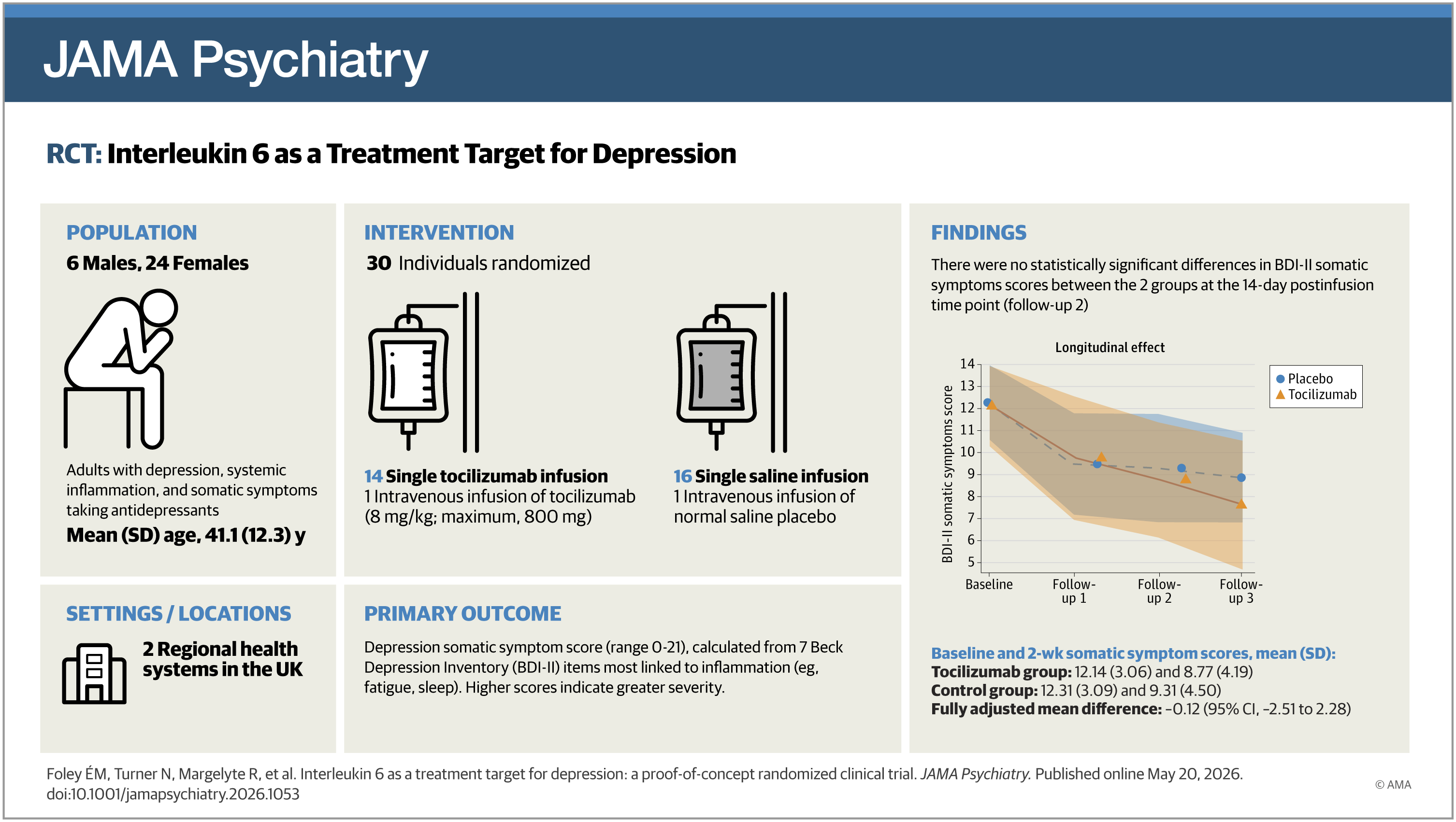
Over-hyping such results does everyone a disservice. It creates public mistrust in science, gives patients false hope and loses credibility for a field.
I’m a big fan of Lucy Foulkes, a psychologist at the University of Oxford, and have previously covered her work on the dangers of ‘mental health awareness’. Her Substack debut does not disappoint. Foulkes discusses her diagnostic odyssey, with remarkable vulnerability, ending in hypermobile Ehlers Danlos Syndrome. Required reading for clinicians.
From the new to the old. Everyone knows I’m a long-time Awais Aftab stan but he has really been on a hot streak in the past month:
Twilight of the Psychopharmacologists. The Szaszian Heart of MAHA Psychiatry. Make Deprescribing Boring. What I Wish People Understood About Mental Health Problems, The Brain Architecture of Schizophrenia-Bipolar Psychosis Spectrum
What really happened to Lisa Turtle?
An engaging discussion of the diagnostic boundaries between psychotic disorder from another Psychiatry-Substack stalwart Mike Halassa.
Musings on genetic and environmental causes of schizophrenia from Eric Turkheimer.
Drug development funnel: what I learnt building one from scratch
It’s kind of amazing that the pharmaceutical industry works to produce new drugs at all but there’s definitely ways to make it work better
Manifold: Embryo Selection and Frontier Genomics with Dr. Alex Young
Discussion of genomics from someone at the cutting edge. Alex also speaks about his ongoing cancer treatment; I was struck by the grace with which he is facing this serious illness.
Dwarkesh podcast: David Reich — How one small tribe conquered the world 70,000 years ago
The Reich lab is leading research into ancient DNA analysis and what it says about human evolution. No-one I’d rather be asking questions than Dwarkesh Patel.
Evolving psychiatry podcast: Overdiagnosis and AI Therapists | Allen Frances
I’ve long enjoyed this podcast by Adam Hunt. Here he talks to Allen Frances, a well-known skeptic of psychiatric expansion (as well as an architect of DSM-IV). He slightly lost me on discussing how good chatbots are as therapists - this is not my impression of LLMs.
All these risk factors are modifiable.

Samuel Hume@DrSamuelBHume
What proportion of cardiovascular events — heart attack, stroke, heart failure — happen in people with at least one of the 4 main risk factors (high blood pressure, high cholesterol, diabetes, smoking)? Almost all of them (>99%)

7:59 PM · May 11, 2026 · 16K Views
8 Replies · 37 Reposts · 202 Likes
Berkson’s paradox spotted in the wild.

Alex Strudwick Young@AlexTISYoung
Isn't this a collider bias phenomenon? If becoming an elite chess kid is due to some combination of IQ and chess skill not explained by IQ, then we'd expect a negative correlation between IQ and chess skill in the elite subsample.

winter @promotedpawns
🚨BREAKING🚨 Researchers from Oxford confirm what everyone on chesstwt already knows
12:33 AM · May 9, 2026 · 2.5M Views
55 Replies · 94 Reposts · 2.13K Likes
So much slop out there. We can all tell!

Freyy@Freyy_is
the em dash is no longer the clearest sign of ai-generated writing. honestly? it’s this.
6:47 PM · May 25, 2026 · 7.2M Views
628 Replies · 3.83K Reposts · 160K Likes
For the first time, one of my Tweets went viral and therefore my biggest contribution to the internet is a snarky line about surgeons.

Thomas Reilly@Rational_Psych
Ah yes surgeons, famously the smartest of all doctors

Leslie Douglas @lesliedouglasx
@KirkegaardEmil Interesting how surgeons, the smartest of all doctors, and overwhelmingly the part of medicine that is the most male, is the most right-wing.
8:34 AM · May 18, 2026 · 2.75M Views
367 Replies · 226 Reposts · 14.3K Likes
Non, je ne regrette rien
No posts
Comments
Nothing yet. Say the first thing.
Sign in to join the conversation.