
‘Why anti-racism kills’ was the headline in The Spectator. Similar sentiments were expressed in Unherd, The Telegraph, Wrong Side of History, and GB News. All refer to the Nottingham attacker, Valdo Calocane, who killed three people and injured several others. All refer to widely reported comments that Calocane was assessed for detention under the Mental Health Act (colloquially Sectioning) but ‘the team of professionals considered the research evidence that shows over-representation of young black males in detention’.
The point was expanded by sitting Conservative MP Neil O’Brien, Violent crime and mental health - lessons are not being learned, which covers changes to the Mental Health Act intended to increase autonomy and reduce restriction. A major focus of Professor Sir Simon Wessely’s report into modernising the Mental Health Act was the need to address racial disparities.
O’Brien makes the case that disparities are not necessarily indicators of racism and that public protection has been deprioritised:
For too long there has been an acceptance (without any debate) that any disparities in the rates of people sectioned must automatically reflect discrimination and be a problem.
This is odd, because we do not make this assumption in any other field of public health. We accept, and deal with, the fact that some communities are more likely to suffer from certain things, from sickle cell to diabetes. And in the case of potentially dangerous mental health cases, we have to think about not just the patient’s own wellbeing, but also the risk of harm to others.
O’Brien argues that the victims of attacks like those in Nottingham, which took the lives of Barnaby Webber, Grace O'Malley-Kumar and Ian Coates, should be prioritised over the rights of patients who are subject to detention and coercion under the Act.
The competing narrative is that the Act is disproportionally used against people of minority ethnicities, a demonstration of institutional racism. An oft-stated fact is that Black people are four times more likely to be Sectioned than White people, and are seven times more likely to be subject to restrictive Community Treatment Orders (which compels treatment following discharge from hospital). This narrative is encapsulated by a 2020 open letter to the Royal College of Psychiatrists, signed by more than 150 of its members:
Psychiatry, psychology, and psychotherapy are deeply embedded in the historical roots through which social systems and structures created by colonisation, slavery, and economic exploitation have become institutionalised and incorporated into our ways of life and perceptions of each other.
We share a history with psychology and psychotherapy of not just ignoring the effects of discrimination, but painting other cultures as psychologically primitive and casting their approaches to understanding distress as backward superstitions. For the Royal College of Psychiatrists to be able to advocate on behalf of those most marginalised in our society, it must first put its house in order and root out all examples of institutional racism and colonial mentality in its training curricula and various practice guidelines.
The perception that there are systemic biases against Black people with mental health problems isn’t just based on statistics. There are a a number of cases of Black men dying after being restrained by police following a mental health crisis. Men like Seni Lewis, Sean Rigg and Kevin Clarke in South London, or Sheku Bayoh in Scotland.
The question of whether British psychiatrists contribute to racism faced by Black mental health patients is topical but not new, it has been asked by previous generations of psychiatrists.
The disparity of diagnoses like schizophrenia were noted since the 1960s. Several facts point to this having an environmental (or societal) rather than a genetic cause. Firstly, rates of schizophrenia were higher in Caribbean immigrants to the UK, compared with both the UK baseline rate and their country of origin. Secondly, rates appear to be higher in second-generation than first generation immigrants. Thirdly, a number of replicated risk factors for schizophrenia, such as urbanicity, childhood adversity and social disadvantage, might seem to be more common in Black people. Another established risk factor, cannabis use, could be more common in the Black community, though this is a bit more disputed.
Could racism underlie the disparity in diagnosis? It’s certainly a hypothesis. In the 1990s, two young psychiatrists, now prominent professors at UCL, Glynn Lewis and Tony David, along with Caroline Croft-Jeffreys published Are British Psychiatrists Racist? in which they surveyed 140 psychiatrists on a clinical vignette, randomly changing the sex (male/female) and ethnicity (White/Afro-Caribbean) of the patient. While respondents were more likely to diagnose schizophrenia and to recommend antipsychotic medication in scenarios in which the patient was White, they were more likely to rate the risk of violence as high when the patient was Black.
Going beyond hypothetical scenarios, Professor Sir Robin Murray invited Professor Frederick Hickling to evaluate diagnoses of inpatients at the Maudsley Hospital in the study, A Jamaican psychiatrist evaluates diagnoses at a London psychiatric hospital. Prof Hickling diagnosed schizophrenia at roughly the same proportion as his White British counterparts, though the overall agreement as to which patients had the disorder was low.
One of the most instructive aspects of the ‘Jamaican psychiatrist’ study isn’t included in the paper but tells us something about British society of the day. Prof Hickling, recounts that when visiting the Maudsley, he rented a new Rover. The following day, he was stopped and accosted by three police officers who had suspected the car was stolen. Unfortunately, this was just one of a number of racist experiences Hickling had as a medical student and doctor in the UK. I wish things had improved but have heard similar stories from Black colleagues working in London today.

Prof Murray, the doyen of British psychiatry, clearly does not believe elevated rates of schizophrenia in Black people is down to racist psychiatrists. Instead, he highlights the multiple risk factors that may be experienced by Black people, including racism in wider society.
Even 20 years ago, psychiatrists were wary of the unintended consequences of what we now call anti-racism. Dr Lade Smith, who would go on to become the first Black president of the Royal College of Psychiatrists, spoke about an all White tribunal panel discharging one of her Black patients:
‘He was really at risk getting hurt because of the illness that he had, and the tribunal discharged him’, she says. ‘I don’t know what was going on in their minds other than they were too scared of thinking that they might be being racist towards him.’
‘Racism remains a problem for black people,’ she says, ‘and undoubtedly is one of the reasons why there are more black people involved in psychiatric services in the first place, but psychiatry is not where the problem starts.’
Disproportionate rates of mental illness in this population not being be due to racism was robustly argued by Professor Swaran Singh in a BMJ article, Race and mental health: there is more to race than racism. Singh (once treated as a persona-non-grata for his views but now experiencing a renaissance) argues that diseases are not egalitarian, that we see disparate outcomes in cardiovascular disease, diabetes, and indeed mental illness. He goes further, highlighting that false attributions of racism can further fuel mistrust between ethnic minority groups and psychiatric services in the UK.
However, as Post Liberal Pete pointed out on Twitter, diagnoses like schizophrenia are not comparable to diabetes or cardiovascular disease. People with schizophrenia may be detained in hospital without committing a crime, forcibly treated with antipsychotic medication (possibly by intramuscular injection), and compelled to continue medication in the community (or else be brought back to hospital). Diagnoses like schizophrenia are based on clinical assessment. They have fuzzy boundaries. They are, to an extent, subjective. Of course we should be extremely sensitive and wary if certain ethnic groups are more subjected to these powers.
I worry though, that in cases like the Nottingham attacks, polarising discussions of racism versus anti-racism can obscure other, more pertinent considerations.
I hear a lot of criticism about individualism in psychiatry. This is usually along the lines of us locating mental illness within the individual rather than in the context of wider societal factors. They say that for Western psychiatry, there is no such thing as society.
While this point is overblown (of course we take someone’s cultural background into context) it does have a kernel of truth. We do treat psychiatric disorders as originating within a person and we treat that person as an individual, rather than as a member of a ethnic, racial, religious, or socioeconomic group.
Can I shock you? I think individualism in this context is good. We should at least strive to treat each person on their own merits. Not regard them at higher risk of violence because of their ethnicity or conversely be less restrictive in an attempt to reduce inequalities between groups.
Having an individualistic approach to patients is an attempt to reduce the impact of someone’s race, religious background or gender on clinical judgement. They might not say so explicitly but I suspect most psychiatrists are individualistic in their assessments.
There is an uncomfortable balance between liberty and restriction at the heart of psychiatry. Restricting a person’s freedom can be necessary to protect the public or to protect the patient from him/her-self. Where we draw this line is a daily question for psychiatrists.
The decision isn’t just down to psychiatrists, though. We need to decide, as a society how much we weigh the protection of people from severe mental illness against restricting the liberty of these patients.
In the England, we are moving towards less restriction and more patient autonomy. Currently, the Mental Health Act Code of Practice states that treatment should be in the form of the least restrictive option. A major focus of NHS England has been in reducing restrictive practices, such as coercion, restraint, and involuntary medication.
Incoming changes to the Mental Health Act will increase the threshold needed to detain someone, going from ought to be so detained in the interests of the patient’s own health / the patient’s own safety / with a view to the protection of other persons to a higher bar of serious harm may be caused to the health or safety of the patient or of another person unless the patient is so detained.
It will reduce the duration of treatment detentions (Section 3) from six months to three months. It will increase the frequency of Mental Health Tribunals which have the power to discharge patients from detention. It will increase the use of advance choice documents and give patients more control over who is consulted if they are mentally unwell.
These changes to mental health legislation receive much less coverage than racism/anti-racism but will have a more tangible impact on the levels of restriction placed on those who are mentally ill and at risk to themselves or others.
Perhaps you are persuaded by Neil O’Brien and want to prioritise public safety, at the expense of the freedom and autonomy of psychiatric patients. Perhaps you think the threshold to detain someone in a psychiatric hospital should be lower and the duration of their treatment should be longer. I have bad news for you. We can’t do it. We don’t have the beds. And by beds, I mean money.
Deinstitutionalisation, the transfer of long-term inpatient care to community psychiatric services, began in the mid 20th century. The discovery of effective antipsychotic medication was the catalyst but not the sole reason. As asylums closed, funding was diverted to community mental health care. There is a moral case to be made for treating mentally ill people in society, rather than sequestering them in long-term institutions. However, like much of life, a lot of the incentive boils down to money.
To put it bluntly, the NHS has a relatively fixed amount of funding to cover all mental and physical healthcare. Inpatient beds are expensive. They require more overheads than outpatient services. A major motivation of NHS trusts (my opinion) is to break even. To do this, they are highly incentivised to reduce inpatient admissions and shorten the duration of admissions as much as possible (this is often euphemistically called ‘patient flow’).
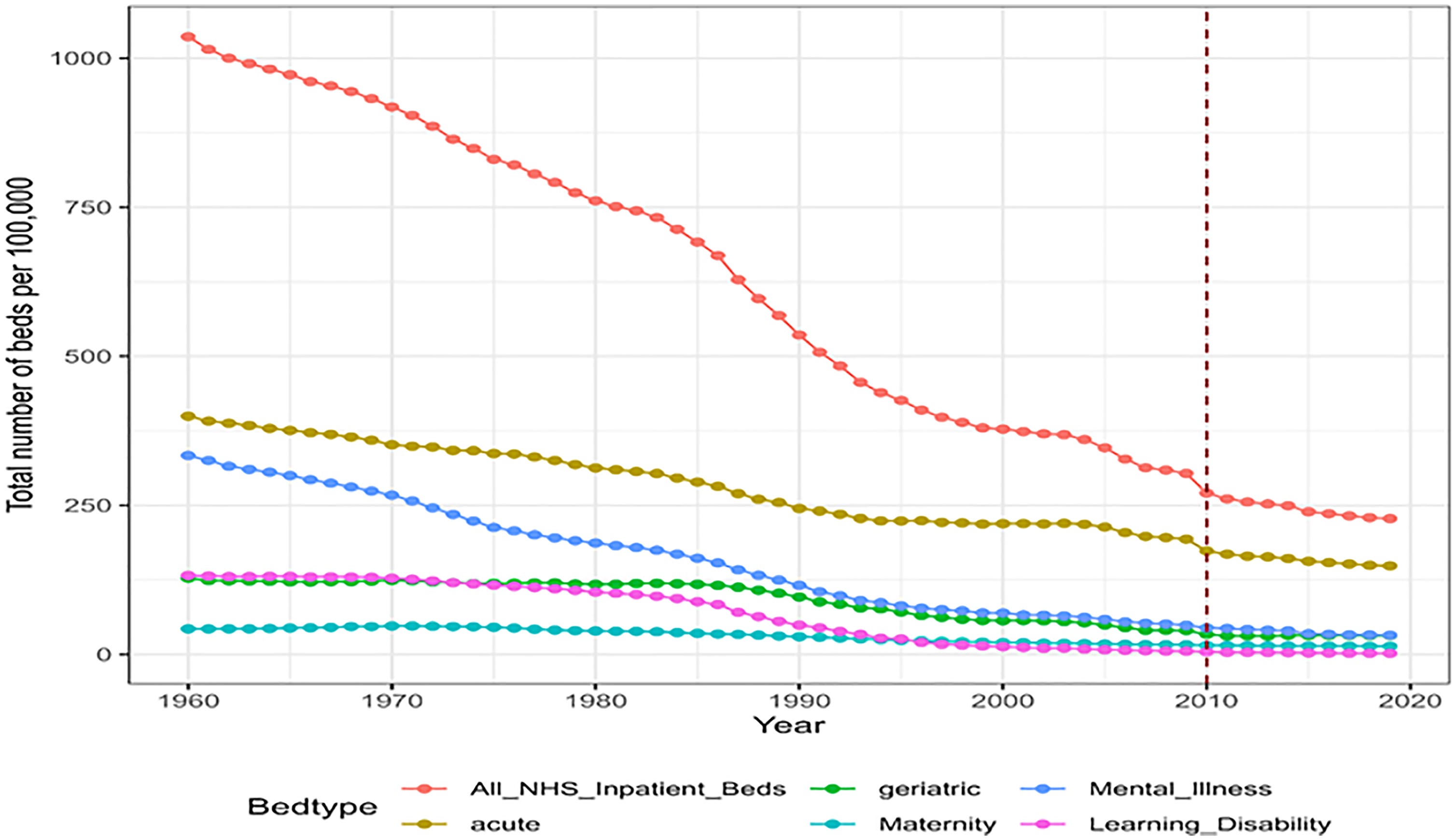
A national shortage of inpatient beds means that patients get admitted ‘out of area’. They may wait days in the emergency department for their admission. While patients in the community who are relapsing may face extended delays to be admitted. This benefits neither mental health patients, nor public safety.
Finally, I want to reflect on the racism and dehumanisation of Valdo Calocane, or VC as he is referred to in the Nottingham enquiry. This shouldn’t detract from the horrific, monstrous acts committed by him, nor the tragedy of the three entirely innocent victims who lost their lives and others who received physical or psychological injury at his hands.
VC has been called a monster. On Twitter, much of the discourse refers to his race and his immigrant background. The most common photograph, which I’m not going to reproduce, is a police mugshot. Eyes half-closed, a blank, glazed expression. It is easy to see the face of someone, whom you know has committed terrible acts, whom you know has a long history of psychotic illness, as other. If not less than human then certainly dangerous and apart from civic life. Many people with severe mental illness experience this stigma, even if they haven’t become violent like VC. When I see patients in hospital who have had their lives wrecked by illnesses like schizophrenia, their alienation from wider society is evident.
It can be illuminating to meet their close relatives. Usually, they are people who bear a physical resemblance to the patient but without the chronic effects of a severe mental illness. Often, they are successful, productive members of society. It makes you think of the hopes and dreams of the patient, their potential, what they could have achieved if they hadn’t been afflicted by an illness like schizophrenia.
VC wasn’t from a dysfunctional family. His mother was an ICU nurse. He was brought up as a church-going Christian. His brother, Elias, gave evidence to the Nottingham enquiry. Like Valdo, Elias is Black and from an immigrant background. He had the same family upbringing, a similar early environment. However, whatever genetic or developmental quirks led Valdo to develop schizophrenia, were not present in Elias. He was a straight-A student, graduating in Computer Science at Cambridge. He is demonstrably intelligent, articulate and well-presented.

I believe VC’s life could have taken a completely different course if he hadn’t developed schizophrenia. In psychiatry we sometimes get people back onto the path their life was heading, pre-illness. More commonly we are able to control symptoms and allow them to function in society. At least, we should be able to keep them and the public safe, if their symptoms do not respond to treatment.
Why did we not do so, in the case of VC? We need to wait for the enquiry’s findings, though presumably both individual and institutional failings will be identified. I hope the preoccupation about race will not distract from the real change we need in psychiatry.
No posts
Comments
Nothing yet. Say the first thing.
Sign in to join the conversation.