

‘Rebound’ on abruptly stopping medication exists across medicine. Stoping anti-hypertensives will shoot your blood pressure up, above its baseline level. Stopping anti-epileptic medication rapidly lowers the seizure threshold. Stopping beta-blockers results in rebound tachycardia .
Rebound is described with certain psychiatric medications too. Rebound insomnia takes places when sleep meds are stopped. Rebound anxiety and dysphoric symptoms are a component of SSRI withdrawal.
The pharmacology of rebound is intuitive. The body adapts to prolonged exposure to a drug, for example by down-regulating receptors which a drug activates, or up-regulating receptors which a drug blocks. When the medication is then withdrawn, the body has overcompensated and doesn’t have time to re-calibrate. Blood pressure goes up, seizure threshold goes down, heart rate goes up.
Whether patients may be put at risk of rebound psychosis after stopping antipsychotic medication is hotly contested. Theoretically, it is something we should expect. The dopamine hypothesis proposes that excessive dopamine activity in the striatum is the final common pathway of psychosis. Antipsychotics exert their action predominately by blocking dopamine receptors. The degree to which these medications occupy the receptor predicts their effectiveness in controlling psychotic symptoms. What happens with long-term antipsychotic treatment? Our simple pharmacological model suggests that dopamine receptors would be up-regulated to compensate for being blocked. When the drug is suddenly stopped, there are so many dopamine receptors that even ‘normal’ levels of dopamine are enough to cause dopamine overactivity. The result? Rebound psychosis. Well, that’s the theory anyway.
Clinically, we do see dysregulation of dopamine when patients receive chronic high-dose dopamine blockade, in the form of the movement disorder tardive dyskinesia. Thankfully, this side-effect is now rare, to the extent that I’ve come across it only a handful of times in my career.
A more speculative concern, voiced by leading figures in psychiatry like Professor Sir Robin Murray, is that treatment with antipsychotics results in up-regulation of dopamine receptors, sometimes called ‘super-sensitivity’. Could our medications actually be making patients worse, with relapses of schizophrenia representing medication withdrawal and subsequent rebound?
Such concerns led to a 2021 paper, A Method for Tapering Antipsychotic Treatment That May Minimize the Risk of Relapse. The author list is interesting. First is Dr Mark Horowitz who, it’s fair to say, is evangelical about the dangers of psychotropic drug withdrawal and has both an NHS and private clinic for tapering antidepressants. The last author is Professor David Taylor, a leading pharmacist, who wrote the Maudsley Deprescribing Guidelines with Mark Horowitz. Robin Murray is a coauthor, as is Dr Sameer Jauhar who, it’s fair to say, is more skeptical of severe withdrawal syndrome.
The paper advocates hyperbolic tapering (I’ve written about this before in the context of antidepressants). This proposes to keeping halving the doses of psychiatric medications over increasingly longer intervals until they reach minuscule, homeopathic amounts. The idea is to give the body time to adapt to each dose change.
The diagram below shows: A. up-regulation of dopamine receptors after chronic antipsychotic use; B. abruptly stopping antipsychotics; C. gradual, hyperbolic reduction in antipsychotic, in this case going down to a tiny (~0.5% of the maximum) dose of haloperidol.
Hyperbolic dose reduction could therefore decrease the rate of relapse following antipsychotic cessation. That’s the theory anyway. So far, there haven’t been randomised trials of hyperbolic tapering or even a clear description of an antipsychotic withdrawal syndrome.
There is one antipsychotic, though, which does have something of a withdrawal syndrome, interestingly, it’s the exceptional one which probably doesn’t have dopamine blockage as its mechanism of action - clozapine. Patients who miss clozapine doses or stop suddenly (often due to blood monitoring regulation), seem to relapse suddenly with a prominent agitated and confusional presentation.
Before going further, let’s think about what we’d expect if rebound psychosis is a consequence of antipsychotic withdrawal. Firstly, we’d expect rapid withdrawal of antipsychotics to result in more relapses than gradual withdrawal (which gives the body more time to regulate receptors in response to lowering doses of the medication). Secondly, we’d expect more relapses around the time medication is stopped and for relapses to gradually even out over time.
Of course, we’d also expect stopping antipsychotic medication to be associated with increased psychotic relapses than continuing the medication but that could be due to the protective effect of antipsychotics against relapse rather than a withdrawal effect.
So let’s test the hypothesis of rebound psychosis.
A landmark paper testing the hypothesis was published in Schizophrenia Bulletin two years ago, Does Slow and Steady Win the Race? Rates of Antipsychotic Discontinuation, Antipsychotic Dose, and Risk of Psychotic Relapse. The lead author is Robert McCutcheon, an Associate Professor at the University of Oxford. The coauthors include the familiar names of Sameer Jauhar, Robin Murray and David Taylor.
Rob made use of the Yale Open Data Access project to find antipsychotic discontinuation trials, whereby patients in remission are randomised to either stop or continue medication. Thanks to long-acting injectable antipsychotics (colloquially, ‘depots’) , we have a readily available slow-stopping medication. These type of antipsychotics are typically given at intervals of weeks-months and gradually dissipate from the body. By contrast, oral antipsychotics are typically given once a day. When stopped, they leave the body much faster. Thus we have two readily comparable methods of stopping medication: depots (the tortoise) and oral antipsychotics (the hare). Even better, some depots are dosed monthly while others are three monthly.
Using discontinuation trials of the antipsychotic paliperidone (the active metabolite of risperidone), Rob was able to calculate relapse risks for oral, monthly and three-monthly formulations. You can see the differences in speed of withdrawal in the diagram below (the dotted green line representing discontinuation drops off so quickly it is almost vertical).
Which do you predict would result in rebound psychosis? According to our hypothesis it would surely be stopping oral meds, which leave the body quickly and so give the brain less time to adapt to the change in dopamine blockade.
What they found might surprise you; there was no difference in relapse risk when stopping oral, monthly or three monthly paliperidone. This means that gradually stopping antipsychotics was not associated with reducing risk of relapse, compared with stopping abruptly.
The results are consistent with another pooled analysis of randomised discontinuation trials by Takeuchi and Watabe which showed no difference in psychotic symptoms between gradual and abrupt stopping. It has also been supported by a subsequent prospective study from the team of Professor Iris Sommer which did not find that the speed of stopping antipsychotics was associated with relapse.
A critique of the study by, you guessed it, Mark Horowitz, and a response from the original authors were published in last month’s issue of Schizophrenia Bulletin. I can’t pretend to be unbiased, as most of the authors including Rob are colleagues. Nevertheless, I think they provide a strong and comprehensive rebuttal.
In his article, titled Comparing Apples to Oranges Obscures Tortoises Beating Hares, Mark notes that discontinuation of oral medication wasn’t compared directly with discontinuation of long-acting medication. He calculates that comparing relapses in the arm who discontinued medication in oral trials versus the arm who discontinued in depot trials, shows the risk of relapse was five times higher in those stopping oral meds.
Is it valid to compare one arm of trial with one arm of another trial? No, of course it isn’t. There are various factors which might affect relapse rates in a trial: how the study was conducted, how patients were selected and how outcomes were measured. As McCutcheon et al. point out in their response, that’s the reason we have comparator arms.
They illustrate this point below, plotting relapse rates in a trial of brexpiprazole (trial 1) versus aripiprazole (trial 2). If we only took the active arm of each trial, it would seem that there are much less relapses in those randomised to brexiprazole than aripiprazole (the dotted blue line versus the solid blue line). It is only when we compare differences between active treatment and placebo (dotted blue line versus dotted red line, and solid blue line versus solid red line) that we can see that the risk of relapse is the same across both interventions.
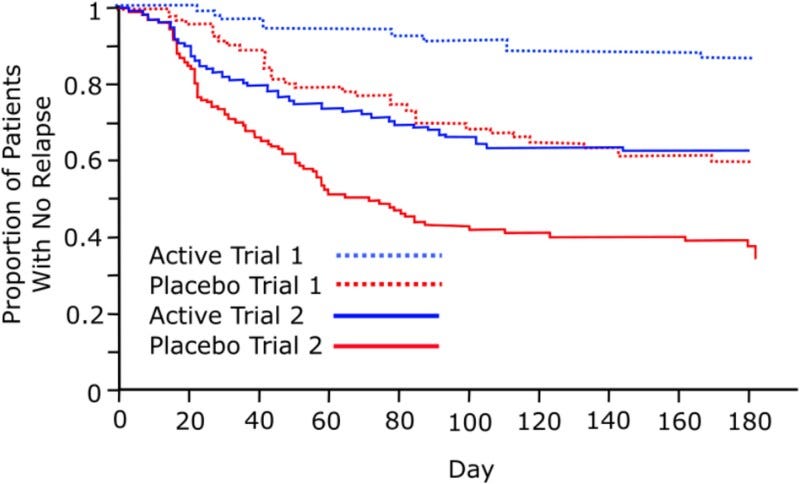
Similarly you can’t just compare relapses in people stopping oral medication versus those stopping depots, instead you need to compare the difference in stopping oral medications versus continuing oral medication against the difference in stopping depots versus continuing depots.
Another consideration is that someone stopping antipsychotics suddenly, say going from 4mg of risperidone to none over two weeks will have less antipsychotic exposure than someone who stops over two months. In the second case, using a linear dose reduction, the patient would still be exposed to an effective dose of risperidone for a month more than someone who stops abruptly.
It turns out that having an effective dose of medication, enough to block ~60% of dopamine receptor is what is needed to prevent relapse, not a slow reduction in the rate of receptors that are blocked. Absolute receptor occupancy, rather than the rate of reducing receptor occupancy is the key.
The defining feature of antipsychotics is blocking the dopamine receptor. The degree of this blockade is associated with clinical response (>60%) and extra-pyramidal side-effects (>80%). For relapse prevention, it is also receptor occupancy, rather than rate of dose changes that prevents relapse.
A Stefan Leucht meta-analysis showed that, for relapse prevention, maintenance doses above the equivalent of 2.5mg of risperidone were needed. Above 5mg of risperidone, there was not much more benefit but increased side-effects, suggesting the sweet spot of 60%-80% receptor occupancy for control of symptoms while minimising side-effects.
McCutcheon et al. found that absolute receptor occupancy (based on antipsychotic dose) predicted relapse risk in discontinuation trials, while speed of stopping did not. This is more consistent with relapse being related to dopamine receptor occupancy falling below a therapeutic level, rather than dopamine receptor up-regulation in response to antipsychotic treatment.
My clinical experience fits this. I’ve met many patients whose psychotic symptoms worsen in the days before they are due their next depot. It’s not uncommon for an injection to be brought sooner for this reason and for subsequent doses to be increased. This scenario doesn’t fit with relapse due to rebound psychosis from sudden antipsychotic withdrawal. By definition, depots are slowly absorbed and then metabolised by the body. Instead it does fit with the slow decrease of medication eventually falling below a therapeutic threshold of receptor occupancy, which then results in the re-emergence of psychosis.
The importance of receptor occupancy rather than rate of decline means that fiddling with very low antipsychotic doses is probably irrelevant for reducing relapse risk (0.5mg of risperidone is ~30% receptor occupancy, much lower than minimum needed to prevent relapses).
In randomised trials of antipsychotic withdrawal, there is a proportion of participants (roughly a quarter) who experience a rapid relapse, with almost immediate worsening symptoms and mean time to relapse of just 10 days after stopping oral medications. Are these people experiencing rebound psychosis? Actually, no.
Although there is a group who experience this rapid relapse when randomised to stopping medication, a similar proportion experience rapid relapse after being randomised to medication continuation.
Huh?
The answer here doesn’t like in pharmacology but in the practicalities of conducting clinical trials. In order to meet inclusion criteria for discontinuation studies, participants need to be stable in mental state, defined as scoring below a threshold on a measure of psychotic symptoms.
Inevitably, researchers recruiting patients to meet their target sample size will be incentivised to score patients slightly below that threshold (perhaps unconsciously) in order to include them in the study. Following randomisation, symptom ratings do not affect the participant taking part in the study and researchers are free to score symptoms without bias.
Dr Matthew Taylor, a psychiatrist in Oxford1 looked at risk of relapse over time in randomised trials of discontinuation. Consistent with what we’ve seen so far, the risk of relapse (discontinuation vs maintenance) did not vary over time - in other words, there was not a greater risk of relapse in the first month following discontinuation compared with later time points.
The evidence against rebound psychosis is compelling. Let’s not overstate the case though. Most of the studies I’ve discussed have used antipsychotics which are relatively selective for dopamine blocking (like risperidone/paliperidone). As I’ve said, clinically there is rebound after stopping clozapine, to the extent that it would be difficult to ethically justify a discontinuation trial. Perhaps other antipsychotics which are pharmacologically more ‘clozapine-like’ (I’m thinking olanzapine) could also produce rebound psychosis?
Likewise, a lack of evidence for rebound psychosis doesn’t discount long-term dysfunction of the dopamine system due to chronic antipsychotic use, such as tardive dyskinesia. Long-term antipsychotic medication should be prescribed judiciously, at the lowest possible dose. Which brings me on to my last point.
Reducing doses slowly increases the length of time on a therapeutic dose of medication. Perhaps more importantly, by reducing the dose step-by-step it allows the clinician and patient to collaboratively find the optimum dose which effectively controls symptoms with minimum side-effects. With careful monitoring, higher doses can be reinstated in the case of early signs of deterioration, nipping a potential relapse in the bud.
Antipsychotics should still be stopped gradually.
Even if rebound psychosis isn’t a thing.
A talk by Dr Taylor in February 2025, ‘Is there rebound psychosis on stopping antipsychotic medications?’, inspired this post
No posts
Comments
Nothing yet. Say the first thing.
Sign in to join the conversation.