
On 20 and 21 May, I attended DTM26 in Berlin, and it honestly felt bigger than just another startup or tech event.
It was two intense days filled with founders, investors, operators, corporates, researchers, and people who are genuinely trying to build the next layer of Europe’s deep tech ecosystem.
But for me, DTM26 was special for another reason too.
I was there as a lead volunteer for matchmaking support and Investor Connect, helping founders, investors, and ecosystem people find the right conversations.
And that gave me a different view of the event.
Not just from the audience side.
Not just from the stage side.
But from the connection layer.
The place where a founder meets a potential investor.
Where a startup finds a corporate partner.
Where one conversation can become a pilot, a funding discussion, or a future collaboration.
That is where I felt the real energy of DTM26.
When people hear “deep tech,” they often think about complicated science, hardware, AI models, space, robotics, defence, energy, or advanced materials.
And yes, all of that was there.
The DTM26 agenda covered areas like energy, advanced materials, manufacturing and robotics, enterprise AI, high-performance computing, space, and defence through pitch competitions, summits, and investor-focused formats. (deeptech.build)
But the biggest thing I noticed was this:
Deep tech is not only about building hard technology. It is about building trust around hard technology.
A founder can have an amazing idea, but that idea still needs the right investor, the right customer, the right timing, and the right story.
At DTM26, I saw founders working hard to explain complex technologies in a way that investors, corporates, and partners could understand.
That is not easy.
Because deep tech founders are not just selling a product.
They are often selling a future that does not fully exist yet.
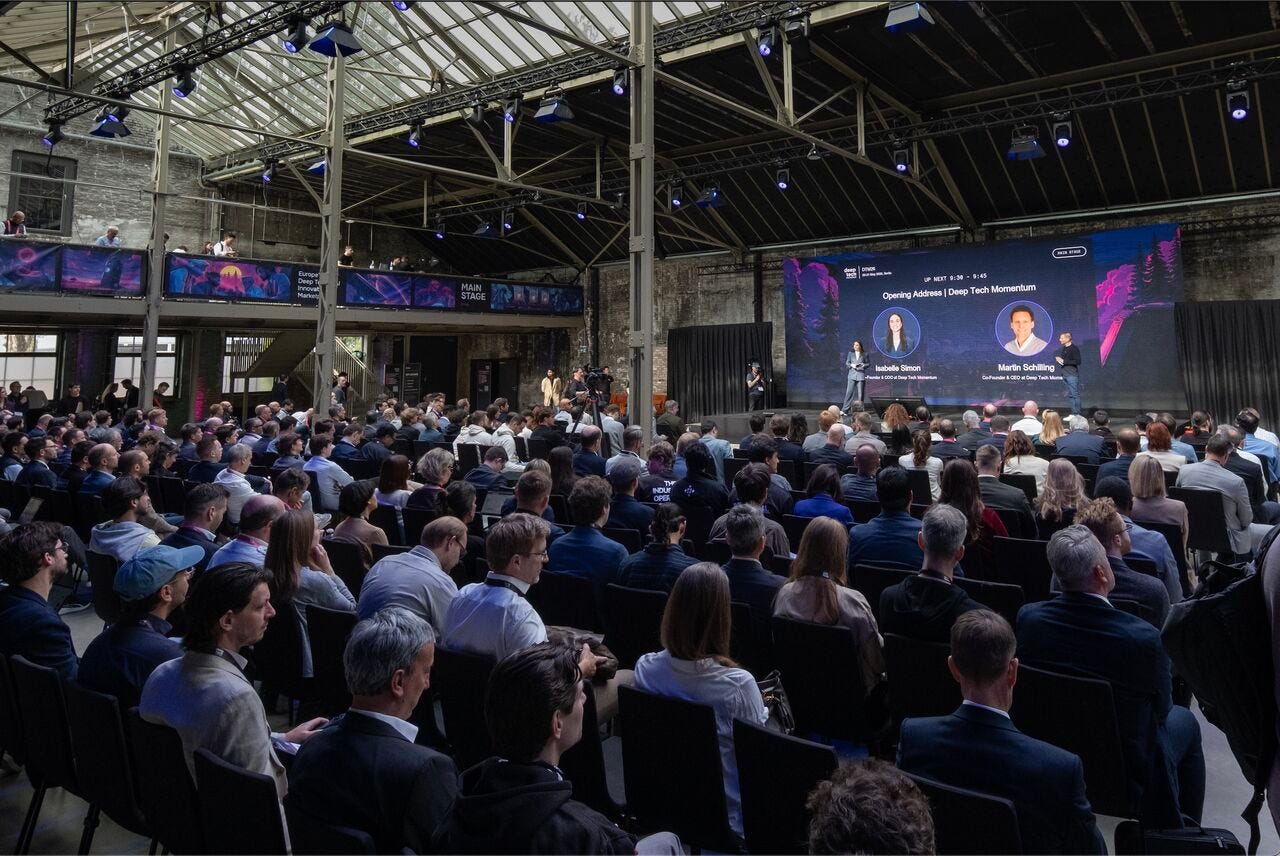
The founders at DTM26 were not just there to pitch.
They were there to be tested.
Tested by investors.
Tested by corporates.
Tested by the market.
Tested by questions they maybe do not get every day.
Some founders were working on energy. Some were building in AI. Some were in robotics, space, materials, defence, or infrastructure.
But the common pattern was clear:
They were all trying to move from invention to adoption.
That is the hardest part.
Building something in a lab, a notebook, a prototype, or a small team is one thing.
Turning it into a company is another game.
You need capital.
You need customers.
You need regulation clarity.
You need talent.
You need distribution.
You need credibility.
And most importantly, you need people who believe that your technology is not just interesting, but necessary.
That is why founder ecosystems matter.
Events like DTM26 are not only about visibility. They create the room where founders can compress months of outreach into a few meaningful conversations.
One of the strongest founder-focused parts of DTM26 was DTM100, the pitch competition that brought together Europe’s top deep tech founders to pitch live in front of corporate leaders and investors. The goal was not only visibility, but also access to decision-ready customers, fundraising opportunities, and ecosystem attention.
What I liked about DTM100 was that it showed how broad deep tech has become.
The competition covered seven key markets: Energy, Defence, Space, Manufacturing & Robotics, Advanced Materials, High-Performance Computing, and Enterprise AI.
That mix says a lot about where the future is moving.
Deep tech is no longer one isolated category. It is becoming the foundation layer for industries that matter: energy systems, compute infrastructure, space, security, manufacturing, and enterprise transformation.
For founders, this kind of platform matters because early-stage deep tech companies often need more than capital. They need customers, industrial partners, credibility, and a serious room where people understand what they are building.
DTM100 made that visible.
It was not just founders pitching ideas.
It was founders trying to move hard technology closer to real adoption.
One thing I really liked was that AI was not treated only like a chatbot trend.
It was connected to real industries.
AI was part of enterprise productivity, energy, robotics, defence, manufacturing, and infrastructure conversations.
The agenda included an Enterprise AI pitch competition on Day 1 and an AI Productivity Summit on Day 2, where enterprise customers and startups were brought together around practical AI collaboration. (deeptech.build)
That felt important.
Because the next phase of AI is not only about who can build the coolest demo.
The real question is:
Can AI reduce cost?
Can it improve decision-making?
Can it help companies move faster?
Can it work inside real business systems?
Can it be trusted in production?
Can it create measurable value?
That is where AI becomes serious.
And at DTM26, the AI conversation felt closer to that serious phase.
Less noise.
More application.
Less “look what this model can do.”
More “how does this help a company, an industry, or a society move forward?”
Another major theme for me was energy.
Energy was not just one topic in the agenda. It felt connected to everything.
AI needs energy.
Data centers need energy.
Manufacturing needs energy.
Defence needs energy.
Europe’s industrial future needs energy.
DTM26 had a dedicated energy pitch competition on Day 1, and Day 2 included a “Titans of Europe” track focused on advanced materials and energy. (deeptech.build)
This made me think about something deeper:
The future of AI is also an energy problem.
We talk a lot about AI agents, automation, productivity, and models.
But behind all of that, there is infrastructure.
Power.
Compute.
Cooling.
Chips.
Materials.
Grids.
Data centers.
Storage.
The digital future is physical too.
And that is why deep tech matters.
Software alone cannot solve everything. The next generation of important companies will probably sit at the intersection of software, hardware, energy, science, and industrial systems.
That is much harder than building a normal app.
But it is also where the biggest opportunities are.
Since I was helping with matchmaking and Investor Connect, I got to see the event from a very practical angle.
Investor Connect at DTM26 was designed around curated one-to-one meetings between deep tech investors and companies worth backing.
That word “curated” matters.
Because random networking is noisy.
A founder does not need to speak with everyone.
An investor does not need to meet every startup.
The real value is in relevance.
Who should meet whom?
Which investor understands this technology?
Which founder is ready for funding?
Which corporate can become a real customer?
Which conversation has the highest chance of becoming something real?
That is the hidden work behind strong ecosystems.
From the outside, people see speakers, booths, panels, and LinkedIn posts.
From the inside, you see the real machinery.
You see people making sure the right founder meets the right investor at the right moment.
And sometimes, that one introduction can change the direction of a startup.
Another thing I felt strongly at DTM26 was Europe’s ambition.
There was a clear theme around technological sovereignty, commercialization, and building stronger European deep tech companies.
The agenda included a CXO Sovereignty Summit, co-hosted by BCG, focused on helping senior policymakers, founders, and CXOs shape regulation for faster deep tech commercialization in Europe.
This is important.
Europe has world-class research, universities, scientists, engineers, and founders.
But the challenge is not only invention.
The challenge is speed.
Can Europe turn research into companies faster?
Can it fund ambitious founders earlier?
Can corporates become better first customers?
Can regulation support innovation without slowing it down too much?
Can European startups scale globally from the beginning?
These are not small questions.
But events like DTM26 show that people are at least trying to build the right environment.
And that gave me optimism.
For me, DTM26 was not only about deep tech.
It was about understanding how the future gets built.
Not in one big moment.
But through thousands of small moments.
A founder explaining their product better.
An investor asking the right question.
A corporate leader discovering a startup that solves a real problem.
A volunteer helping two people find each other.
A conversation that starts casually and becomes something serious later.
That is how ecosystems mov
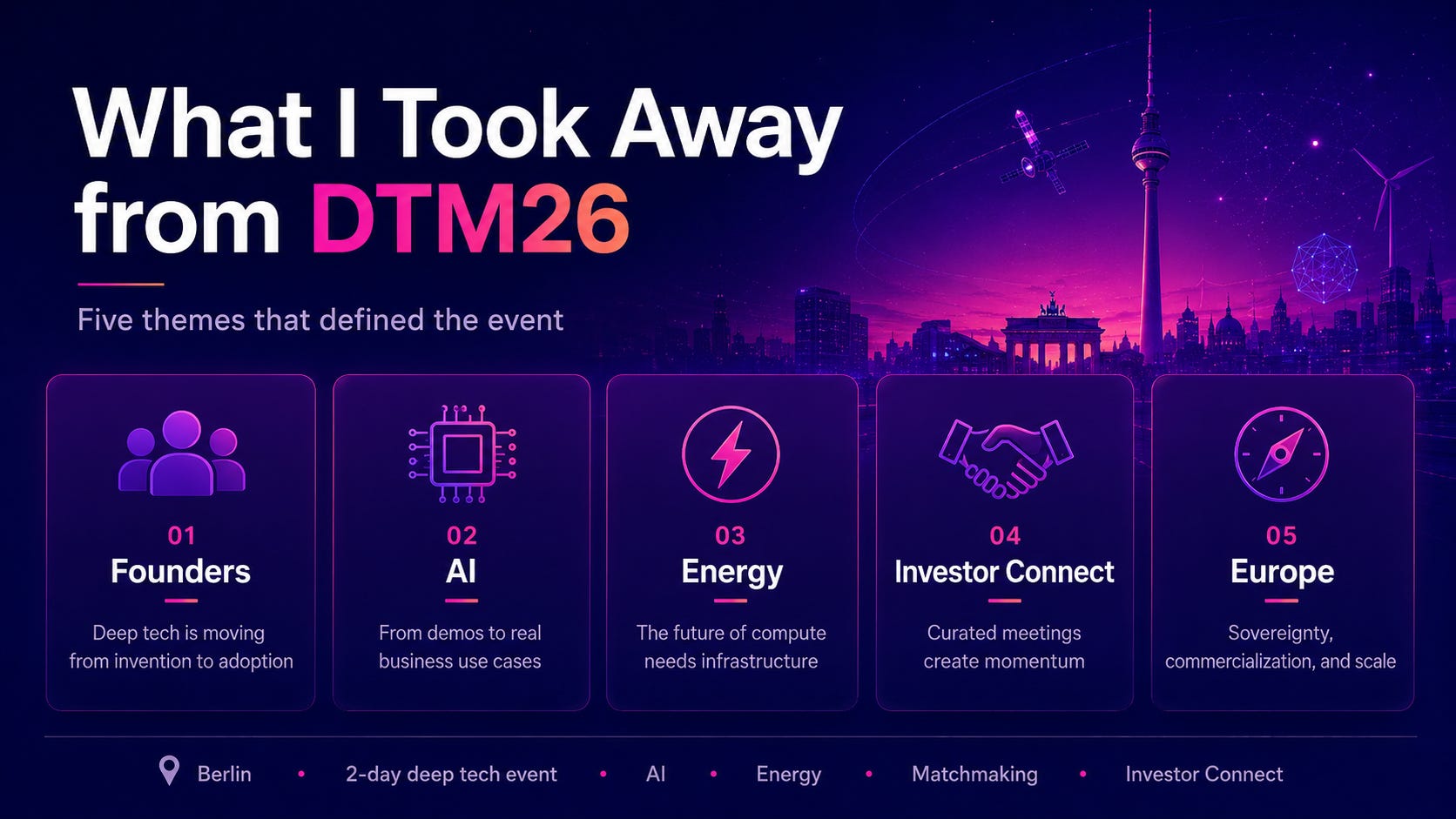
I also realized something about my own path.
As someone building my career around AI, automation, product thinking, and real-world deployment, DTM26 reminded me that technical skills alone are not enough.
You need to understand technology.
But you also need to understand markets, people, trust, communication, and timing.
The future belongs to people who can connect these worlds.
AI with energy.
Science with business.
Founders with investors.
Startups with corporates.
Ideas with execution.
That is the space I want to keep growing in.
After two days at DTM26, one thing became very clear to me:
Europe’s deep tech future will not be built by hype.
It will be built by serious founders, patient investors, brave corporates, strong research, smart policy, and people who know how to connect all of them.
DTM26 gave me a front-row view of that.
Not just as an attendee.
But as someone helping behind the scenes with matchmaking and Investor Connect.
And honestly, that made the experience even more meaningful.
Because I saw that innovation is not only about ideas.
It is about rooms.
It is about people.
It is about trust.
It is about timing.
It is about the right founder meeting the right person at the right moment.
That is where deep tech becomes real.
And that is why DTM26 felt important.
No posts
Comments
Nothing yet. Say the first thing.
Sign in to join the conversation.