
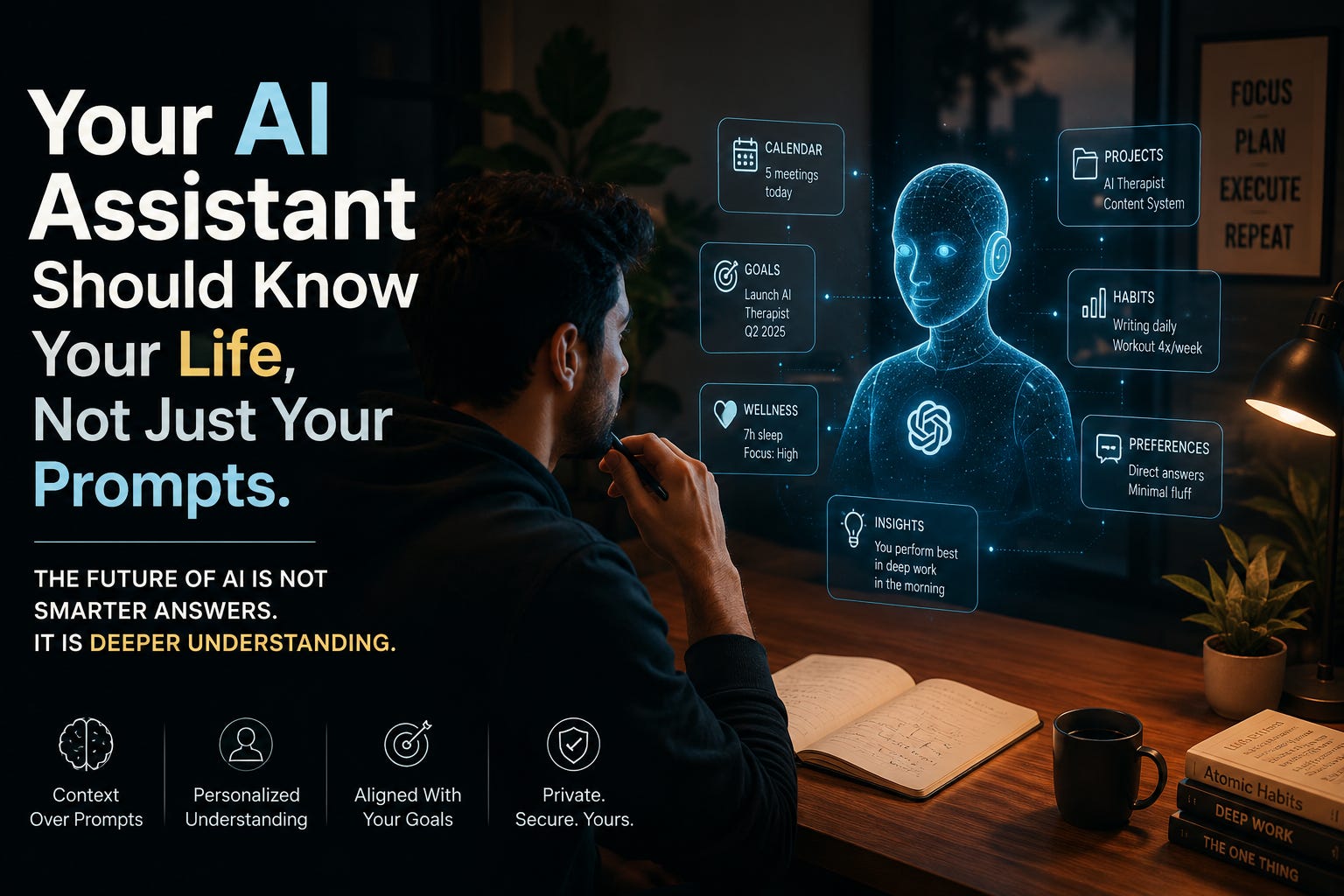
The future of AI is not smarter answers. It is deeper understanding.
A few months ago, I noticed something strange.
Most people around me were using AI every single day.
For emails.
For coding.
For studying.
For content.
For brainstorming.
For productivity.
Yet despite having access to the most powerful technology shift in decades, most people still felt overwhelmed, disorganized, and mentally exhausted.
Why?
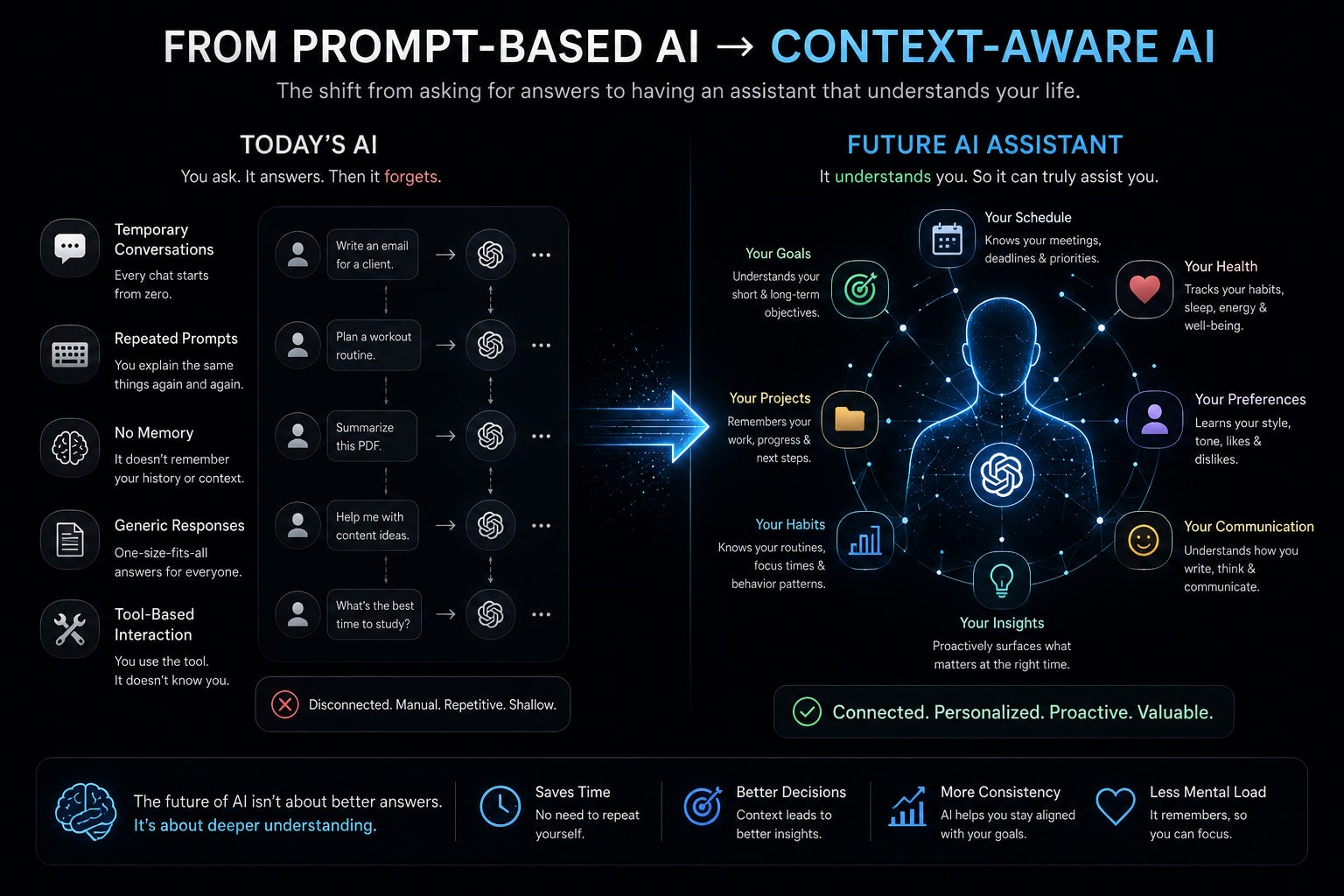
Because today’s AI still works like a stranger.
Every conversation starts from zero.
Every prompt feels temporary.
Every interaction feels transactional.
You ask.
It answers.
Conversation ends.
Memory disappears.
But human life does not work like that.
Your best friend remembers your patterns.
Your mentor understands your goals.
Your therapist notices behavioral changes.
Your business partner understands your priorities without needing everything repeated.
Real intelligence is not just answering questions.
It is understanding context.
And that is where the future of AI is heading.
Not toward “better prompts.”
Toward AI systems that actually understand your life.
We Are Training AI Like Search Engines
Most people still use AI like an upgraded version of Google.
We open ChatGPT or another tool and type:
“Write this email.”
“Summarize this PDF.”
“Give me gym workout.”
“Plan my trip.”
“Fix this code.”
Useful?
Absolutely.
But shallow.
Because the AI knows nothing about:
your habits
your work style
your stress patterns
your goals
your communication style
your energy levels
your relationships
your routines
your long-term direction
So every prompt becomes manual labor.
You repeatedly explain yourself.
Again.
And again.
And again.
Ironically, humans are spending more time teaching AI context than actually benefiting from intelligence.
That is not sustainable.
The Real Future of AI Is Persistent Context
The next generation of AI assistants will not just answer questions.
They will understand continuity.
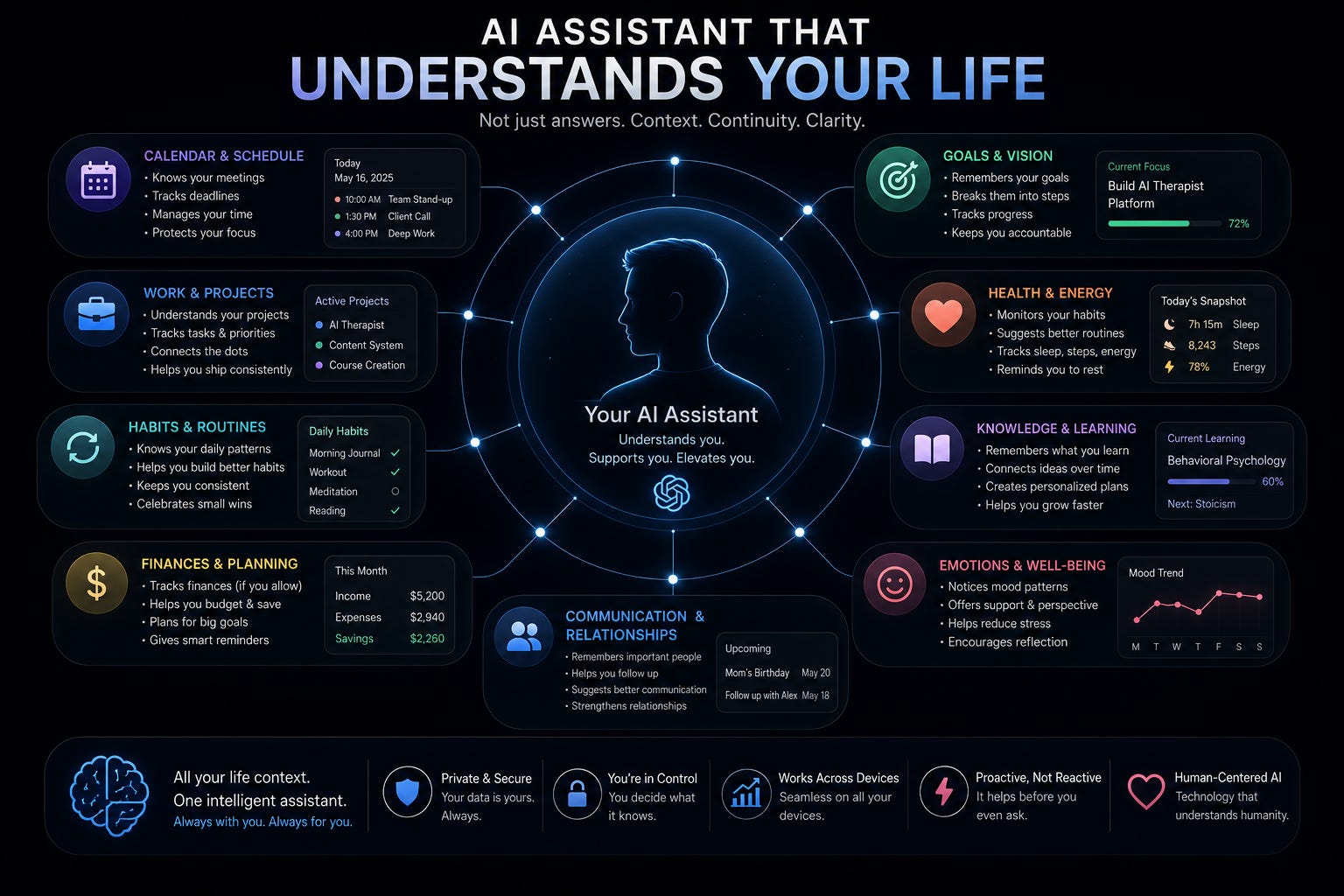
Imagine waking up and your AI assistant already understands:
your calendar
current projects
your learning goals
your health routines
your financial priorities
unfinished tasks
communication patterns
deadlines causing stress
the kind of work that drains your energy
the kind of work where you perform best
Not in a creepy surveillance way.
In a genuinely supportive way.
Like a digital extension of your memory and thinking process.
That changes everything.
Suddenly AI stops being a chatbot.
And becomes infrastructure for your life.
The Difference Between Smart AI and Useful AI
Most AI companies today are competing on intelligence benchmarks.
Faster models.
Better reasoning.
Bigger context windows.
Lower hallucination rates.
Important?
Of course.
But eventually, intelligence becomes expected.
What people will actually value is:
“Does this AI understand me?”
That is the real shift.
Because a highly intelligent system with zero context still creates friction.
Meanwhile, a moderately intelligent assistant with deep personal understanding can feel magical.
Think about it.
A generic productivity app reminds everyone equally.
A personalized AI knows:
when you procrastinate
when you usually lose focus
when you become creative
when you should probably rest instead of work
when you are overcommitting
when you need encouragement instead of optimization
That is not just automation.
That is behavioral intelligence.
AI Will Become More Personal Than Software
Software used to be static.
Same interface.
Same features.
Same experience for everyone.
AI changes that completely.
Two people using the same AI assistant in the future may experience entirely different systems.
One assistant may act like:
a strategic advisor
a calm coach
a creative collaborator
a technical co-founder
a research analyst
a life organizer
The assistant adapts around the person.
Not the other way around.
This is why I believe the future winners in AI are not only the companies building the smartest models.
They are the companies building the deepest understanding layers.
Memory.
Behavior.
Preferences.
Patterns.
Life context.
That is where real value starts compounding.
We Are Quietly Building Digital Versions of Ourselves
This sounds futuristic, but it is already happening.
Every day, we leave behind:
messages
voice notes
calendars
documents
search history
workflows
decisions
habits
preferences
emotional patterns
Over time, AI systems can begin recognizing how we think.
Not perfectly.
Not completely.
But enough to meaningfully assist us.
Your AI assistant may eventually know:
how you write
how you make decisions
what stresses you
what motivates you
what kind of goals you abandon halfway
which ambitions truly matter to you
And honestly?
That future is both exciting and dangerous.
Because context is power.
The Biggest AI Question Is No Longer Intelligence. It Is Trust.
The more AI understands us, the more important trust becomes.
Who owns the memory?
Who controls the data?
Can it be deleted?
Can it be manipulated?
Can companies monetize your personality?
Can your digital behavior become a product?
These are not small questions.
This is why the future of AI cannot only be built by engineers chasing performance benchmarks.
It also needs:
ethics
transparency
privacy-first design
human-centered thinking
emotional intelligence
Because once AI becomes deeply personal, bad design stops being annoying.
It becomes dangerous.
The Best AI Assistants Will Feel Calm
One thing I rarely see people talk about:
The best AI experiences in the future will probably feel invisible.
Not noisy.
Not overwhelming.
Not constantly generating content.
Just quietly helpful.
Imagine an assistant that:
reduces mental clutter
remembers important details
organizes your thinking
surfaces relevant information at the right moment
protects your attention
helps you think clearly
That is far more valuable than endless productivity hacks.
People do not actually want more tools.
They want less chaos.
AI Should Help You Become More Human, Not Less
There is a strange fear that AI will replace human thinking.
In some areas, maybe it will reduce the need for repetitive cognitive work.
But personally, I think the bigger opportunity is different.
Good AI can create space.
Space to think.
Space to create.
Space to reflect.
Space to spend time on meaningful work.
Space to be present with people.
The goal should not be dependency.
The goal should be clarity.
An AI assistant should not replace your life.
It should help you navigate it better.
Final Thoughts
Right now, most people are still learning how to talk to AI.
But eventually, the real transformation will happen when AI learns how to understand people.
Not just prompts.
People.
Their patterns.
Their goals.
Their struggles.
Their ambitions.
Their way of thinking.
That is when AI stops feeling like software.
And starts feeling like a true companion for work, creativity, and life.
The future of AI is not just artificial intelligence.
It is contextual intelligence.
And honestly, we are only at the beginning.
No posts
Comments
Nothing yet. Say the first thing.
Sign in to join the conversation.