
It has been a while since I wrote here.
Not because I had nothing to say.
Actually, it was the opposite.
Too many ideas. Too many things to learn. Too many tabs open. Too many projects half-started. Too many thoughts like:
“I should learn this.”
“I should build that.”
“Everyone else is moving faster.”
“Maybe I am already late.”
And somewhere inside all of that noise, I started realizing something important:
Learning is not about collecting more information.
Learning is about changing how you think, how you act, and how you build.
That sounds simple, but it is not.
Because today, learning has become very confusing.
We have YouTube playlists, online courses, AI tools, newsletters, roadmaps, GitHub repos, bootcamps, podcasts, and people online telling us to master ten things before breakfast.
One person says learn Python.
Another says learn AI agents.
Another says learn system design.
Another says learn business.
Another says learn sales.
Another says learn German.
Another says build a startup.
And honestly, all of them are probably right.
But if everything is important, your brain starts treating nothing as important.
That is where I got stuck many times.
Not because I was lazy.
Because I was trying to learn too many things without a proper system.
For a long time, I thought learning meant finishing content.
Finish the course.
Finish the video.
Finish the book.
Finish the tutorial.
Finish the roadmap.
But now I think that is only the surface.
You can finish ten courses and still not feel confident.
You can watch hours of videos and still freeze when you open VS Code.
You can understand a concept in theory and still not know how to apply it in a real project.
That gap is painful.
And that gap is where real learning starts.
Real learning begins when you stop asking:
“How much did I watch?”
And start asking:
“What can I now do that I could not do before?”
That question changes everything.
Because it forces learning to become practical.
Not just notes.
Not just motivation.
Not just screenshots of certificates.
Actual ability.
This is one idea I am taking seriously now:
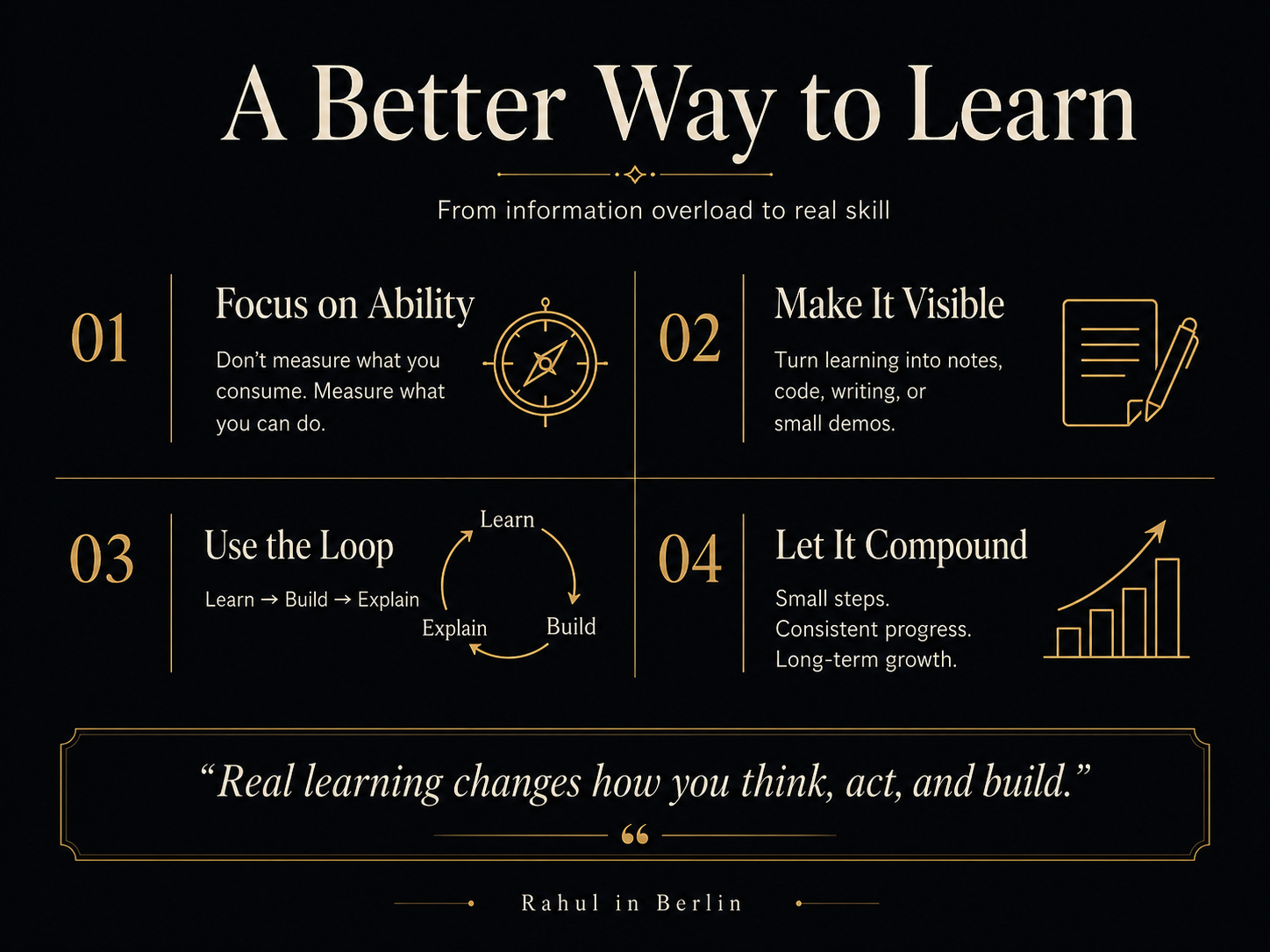
Every week of learning should leave behind some evidence.
Not perfect evidence.
Just visible evidence.
A small GitHub repo.
A blog post.
A notebook.
A diagram.
A small demo.
A written explanation.
A prototype.
A tiny tool.
A clear mistake that I understood and fixed.
Because when learning stays only inside the head, it becomes foggy.
But when learning becomes output, it becomes real.
For example, if I say I am learning machine learning, the question is not only “Which course am I watching?”
The better question is:
Can I clean a dataset?
Can I train a basic model?
Can I explain why the model failed?
Can I compare two approaches?
Can I deploy something simple?
Can I explain the project to a non-technical person?
That is evidence.
And evidence builds confidence.
One of the hardest things today is that the internet makes everyone look fast.
People are launching products in 48 hours.
Posting polished screenshots.
Sharing huge wins.
Building AI tools.
Raising money.
Getting jobs.
Going viral.
And you are sitting there trying to fix one annoying error for two hours.
It can feel like you are behind.
But I am starting to believe that slow learning is not always bad.
Sometimes slow learning means your brain is actually building roots.
The people who only chase shortcuts may move fast in the beginning, but deep skills compound differently.
When you understand fundamentals, you become flexible.
When you understand why something works, not just how to copy it, you can adapt.
That is the kind of learning I want.
Not just “follow tutorial, get output.”
But “understand the system, then build my own version.”
AI tools are amazing.
They can explain things.
Debug code.
Generate ideas.
Create roadmaps.
Review your work.
Summarize papers.
Help you write.
Help you build faster.
But there is a trap.
AI can make you feel like you understand something before you actually do.
Because the answer appears so quickly, your brain thinks the work is done.
But real learning still requires friction.
You still need to ask dumb questions.
You still need to write the code yourself.
You still need to break things.
You still need to get confused.
You still need to explain it in your own words.
You still need to sit with the problem longer than you want to.
AI is not a replacement for learning.
It is a multiplier.
But it only multiplies what you are willing to practice.
If you use AI only to avoid thinking, you become weaker.
If you use AI to think better, build faster, and reflect deeper, you become dangerous.
In a good way.
I am trying to keep learning simple now.
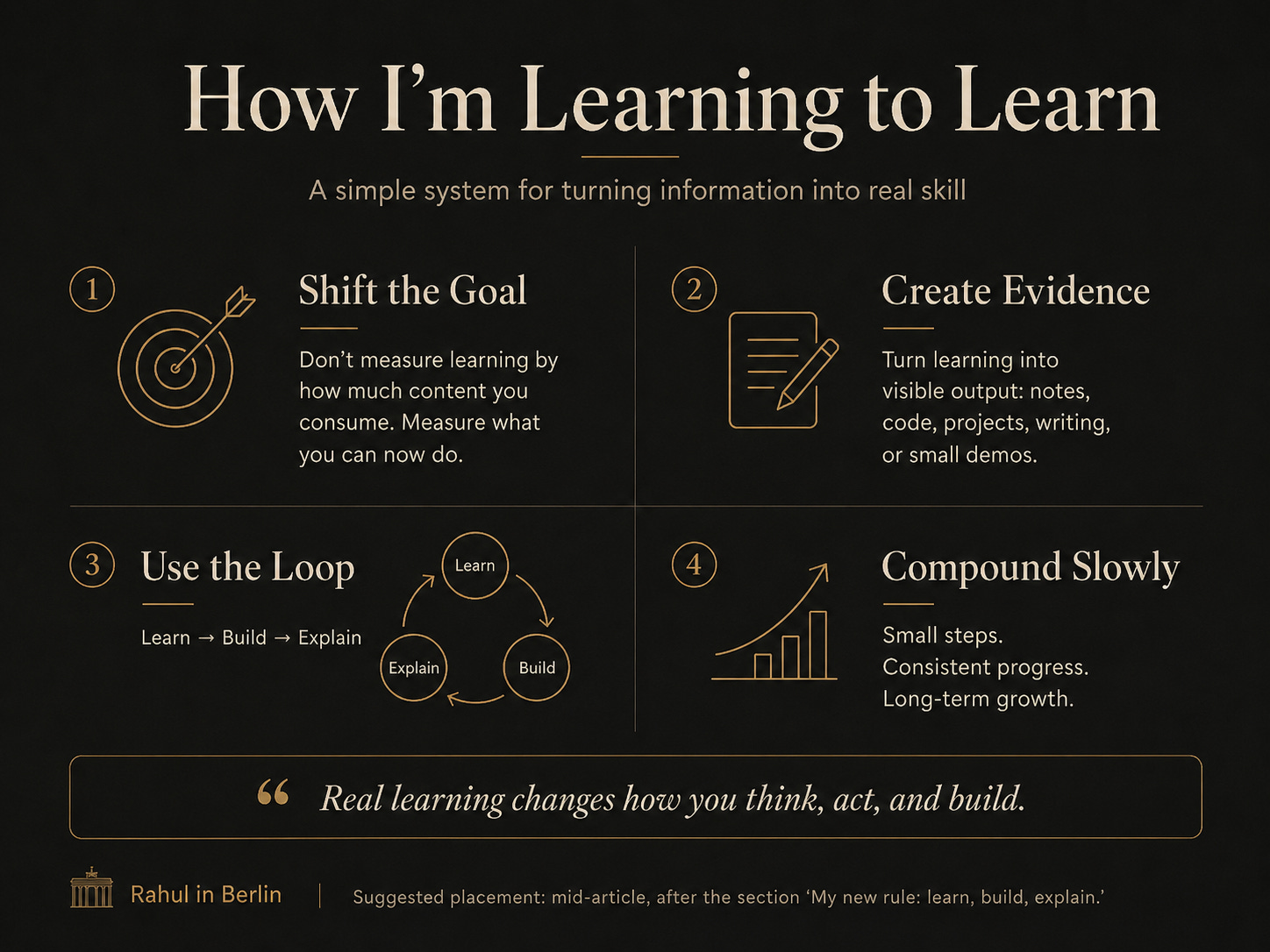
Learn.
Build.
Explain.
Learn the concept.
Build something with it.
Explain what happened.
That loop is powerful.
Because learning alone can become passive.
Building alone can become messy.
Explaining alone can become shallow.
But together, they create understanding.
If I learn about APIs, I should build a small API.
If I learn about databases, I should design a small schema.
If I learn about machine learning, I should train a small model.
If I learn about AI agents, I should create a simple workflow.
If I learn about sustainability or supply chains, I should map one real example.
If I learn about business, I should write one simple business case.
This is how knowledge becomes skill.
Writing this blog itself is part of learning.
Because when you write publicly, even casually, you are forced to organize your thinking.
You cannot hide behind “I kind of understand it.”
You have to ask:
What did I actually learn?
What changed in my thinking?
What mistake did I make?
What would I tell someone else?
That is why I want to write more.
Not only when everything is perfect.
Maybe especially when things are not perfect.
Because the messy middle is where most real growth happens.
The internet has enough success stories.
Maybe we also need more learning stories.
The part where someone is trying, failing, rebuilding, improving, and slowly becoming better.
That is more honest.
And maybe more useful.
Another thing I am learning:
The future does not belong only to people who know one tool.
It belongs to people who can combine skills.
Technical skill plus communication.
AI plus product thinking.
Data plus storytelling.
Coding plus business understanding.
Research plus execution.
Learning plus consistency.
One skill can open a door.
A skill stack can build a career.
For me, that means I do not only want to learn AI in isolation.
I want to understand how AI connects with real problems.
How it connects with products.
How it connects with users.
How it connects with companies.
How it connects with sustainability.
How it connects with automation.
How it creates value.
Because technology alone is not enough.
The real question is:
What problem does this solve?
And for whom?
I used to think I needed confidence before starting.
Now I think confidence comes after doing small things repeatedly.
You do not become confident by waiting to feel ready.
You become confident by collecting proof.
One solved bug.
One finished notebook.
One published post.
One completed feature.
One uncomfortable conversation.
One project demo.
One more attempt after failing.
Small proof creates self-trust.
And self-trust is more useful than motivation.
Motivation comes and goes.
Self-trust stays longer.
I do not want to be the person who only saves resources.
I want to be the person who uses them.
I do not want to only talk about ideas.
I want to test them.
I do not want to only consume AI content.
I want to build with AI.
I do not want to only chase trends.
I want to understand foundations.
I do not want to only learn privately.
I want to share the process.
That is the direction.
Not perfect.
But clear.
This blog is a restart.
A small marker.
A reminder to myself that learning does not need to look aesthetic every day.
Some days learning looks like a clean notebook.
Some days it looks like ten errors in the terminal.
Some days it looks like reading one page slowly.
Some days it looks like asking for help.
Some days it looks like deleting everything and starting again.
But if the direction is right, even messy progress counts.
So from here, I want to write more about what I am learning, what I am building, what I am misunderstanding, and what I am slowly figuring out.
Not as an expert pretending everything is sorted.
But as someone trying to become better in public.
Because maybe that is the real advantage now.
Not knowing everything.
But learning faster, building honestly, and staying in the game long enough for the dots to connect.
No posts
Comments
Nothing yet. Say the first thing.
Sign in to join the conversation.