
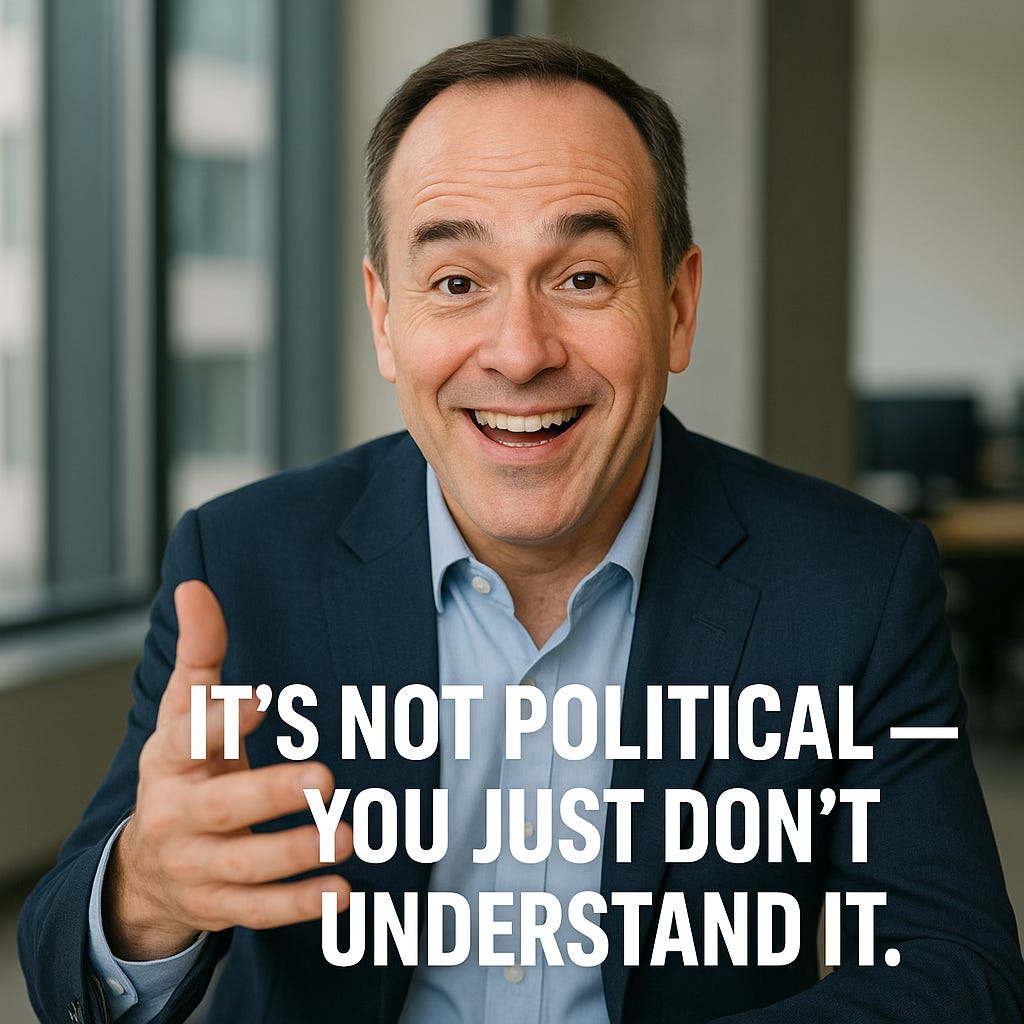
We’ve all heard it. Maybe we’ve even said it — “It’s just so political there.”
It’s the universal shrug of frustration — the professional equivalent of throwing up your hands.
But here’s the truth; when someone says an organization is political, what they’re really admitting is that they don’t understand how it works.
Politics, in this sense, isn’t about corruption or manipulation, it’s about complexity. Hidden agendas, unspoken favoritism, and conflicting incentives don’t just make outcomes hard to predict — they create a shaky foundation of understanding that erodes trust. And when we lose trust in our own judgment and the ability to predict outcomes, we often call it politics.
But that label — “political” — is a lazy substitute for understanding. It’s what people say when they’ve stopped trying to make sense of how decisions are actually made.
Every organization has a system. Some are formal, others are invisible. Some are efficient, others are messy. But all of them make sense once you understand the rules of the game.
The problem is that most people never bother to learn those rules. They don’t take time to identify who the real decision-makers are. They don’t explore the incentives or the trade-offs driving behavior. They don’t see how culture, history, procedure or timing shape the playing field. So, when outcomes don’t line up with their expectations, they blame “politics.”
Of course, there are leaders who intentionally obscure the process because the fog of complexity protects their grip on power. In most business contexts, especially in sales, the cry of “politics” is usually a cover for a lack of effort. It’s easier to blame politics than to admit, “I don’t yet understand how this organization really works.”
Great leaders discipline themselves and their teams to stay curious when others retreat. Instead of complaining about politics, they map the real decision-making framework. They ask:
Who are the actual stakeholders and informal influencers I am yet unaware of?
What are the unspoken assumptions driving resistance or support?
How do incentives, metrics, or culture affect choices that seem irrational?
What does the system reward — and punish — that I haven’t noticed?
When leaders pursue these questions with courage and curiosity, the fog lifts. What once looked like political maneuvering begins to make sense. Patterns emerge. Trust grows. Predictability returns. And with it comes the ability to thrive within complex systems — not in spite of them.
Calling an organization political is easy. Understanding it deeply is hard. But that’s where leadership earns its keep. The leader who refuses to hide behind the comfortable opacity of “politics” — who insists on seeking the truth behind decisions — becomes the rare executive who can influence outcomes with integrity and clarity.
That’s not just political savvy… That’s Business Wisdom®
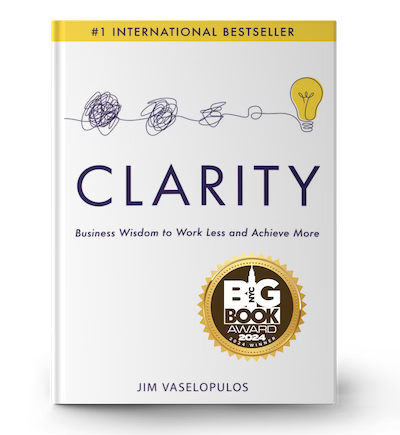
If' you’d like some additional Business Wisdom®… you may be interested in reading CLARITY: Business Wisdom to Work Less and Achieve More
No posts
Comments
Nothing yet. Say the first thing.
Sign in to join the conversation.