
This is section III.3 (that builds upon the previous section here) of the first volume of my book, “Quantum Physics: An Overview of a Weird World.” I plan to post regular updates, including minor and substantial revisions, on Substack. Here is the full table of contents and guidance on how to follow the book as it unfolds.
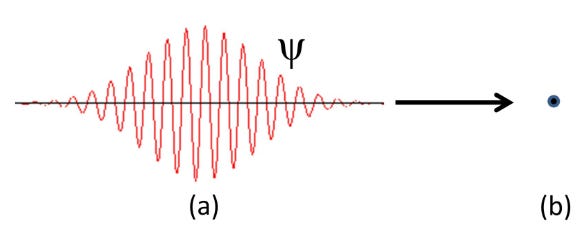
At this point, the question is whether the wave function is simply an abstract mathematical description of the statistical behavior of a system that simply updates our knowledge, or whether it represents a real object in the physical world. And, if it must be considered real, how can it be something that behaves like a wave, say while traveling from the double slits to the detector, and then, once detected on the screen as a point-like pixel, turns out to describe a particle? This seemingly abrupt wave-to-particle change in behavior is the so-called wave function collapse , also called the state reduction or state projection. It is one of the typical quantum philosophical problems and will lead to the more general measurement problem we will discuss later. It can be illustrated with what we already saw in the double slit experiment and what was depicted here, and is summarized in Fig. 1.
First, a plane wave is diffracted by the slits. Then the two expanding concentric circular wavefronts emerging from each of the apertures travel towards the screen. These wavefronts can be described by the wave function Ψ. Once they interact with the screen, the interference fringes form but as a pattern of dots, each representing a point-like interaction at some specific position. Nothing is left of any wave.
This suggests an interpretation that tries (a bit desperately) to reconcile the two apparently opposite points of view. First, before the measurement, we must conceive of the single photon (or electron, or whatever particle we may be talking about) as a wave, or a wave packet which (still before the measurement, that is, before it hits the screen) continues to behave according to the diffraction and interference principles. Nothing should be conceived of as a particle. When the wavefront goes through the slits, it is still a wave and no particle is supposed to go through one or another or both slits.1 Whereas, at the instant of measurement, in our case, at the instant when the wave interacts with the screen, it suddenly reduces, or “collapses,” to a point on the screen, manifesting itself again as a particle. However, before that instant when the act of measurement occurs, we must still consider it to be a wave with an extension in space, not as a single point.
It was first the Austrian-Ungarian mathematician John Von Neumann who introduced the wave function collapse as a postulate and the description of a physical measurement in QM as a discontinuous, non-causal, irreversible and instantaneous process.
The Collapse Postulate: When a measurement is performed, the system’s wave function—previously evolving smoothly and deterministically according to the Schrödinger equation—undergoes a sudden, non-unitary reduction to a single eigenstate corresponding to the measured observable.2
This postulate formalizes the intuition that measurement is fundamentally different from ordinary physical evolution. While it successfully accounts for definite outcomes in experiments, it introduces a conceptual tension at the heart of quantum theory: the laws governing measurement are not derived from the theory’s dynamical equations but are added as a separate rule.
In fact, from the mathematical and formal abstract point of view, everything is clear: You start from the wave function and then take its squared modulus and obtain the probability density where you will find your particle. Then you integrate over a region of interest and obtain a statement about the probability of observing the system in some specific range of possible states (here, the particle to be detected inside as a spatial interval along the screen). The wave function collapse, or state reduction, is simply conceived of as an update of the information we have about the state of a system. Previously, we had uncertainty over a possible range of values that can turn out before a measurement and represented this lack of information with a statistical function. However, once the measurement is made, we know the exact value; therefore, there is no need to use the wave function. One gets only one measurement outcome and updates the knowledge one has about the state of the system. It is just like tossing a dice without looking at it. Before controlling the outcome, one has six possibilities to be realized. However, after one looks at the dice, only one of the six possible outcomes appears to be the truth. Therefore, the problem is not mathematical; we may say it is not even scientific. It is an interpretational problem.
Yet if that is a common interpretation of the probability notion in classical physics, it is not so straightforward in quantum physics because, as the double slit experiment tends to suggest, the wave function seems to be more than a probability wave but, rather, something real propagating from the slits to the detection screen. Otherwise, how can interference come into being in the first place?
Therefore, a question arises in the domain of philosophical speculation. From a strictly practical standpoint, the mathematics alone provides all the predictive power needed to assign probabilities to observations, and for the pragmatist, as most physicists are, that may be enough. However, from the ontological point of view, there is no consensus as to how we should interpret this “collapse” and what kind of objective reality quantum mechanics is describing after all. What kind of thing behaves as a wave unless one looks at it, and then collapses to a point instantly, in an infinitesimal interval of time? What is really “out there”? Before the measurement, it seems that we have only a sort of ghostly entity whose wavy nature we will never observe directly. However, we can infer it from the interference phenomena, and at the measurement act it nevertheless manifests as a completely different entity, a point-like localized interaction. And there is no way to intercept a morphing, a transformation from one entity to another. After all, we are talking about a probability wave travelling through space.
Yet the notion of probability is an abstract mathematical concept; it is just a mathematical function that mathematicians write with pencil on a piece of paper—a concept that we do not think of as an object having a concrete existence moving somewhere. One can see water waves on a lake, hear sound waves, perceive light, and see birds flying, but nobody has ever seen a mathematical function or the square root of -1 moving throughout space.
And yet, this is what quantum physics seems to be about. It seems that not only must we resort to very abstract notions to describe the world but the world itself seems to be a sort of mathematical abstraction, reminiscent of a Platonic realm. Is anything physical “out there”, represented by Ψ? Is the collapse of Ψ only a statistical occurrence, or also a real physical one?
So far, nobody has been able to furnish a convincing and generally accepted answer to these questions. Most physicists simply do not bother and will tell you that they are too busy making calculations. “Shut up and calculate” is their motto. They are happy that the math works. And, indeed, the mathematical foundations of quantum mechanics were extremely powerful in furnishing predictions that could be measured and confirmed, and that led to the tremendously successful standard model (SM) of particle physics, atomic physics, solid state physics, etc. But, from the interpretational point of view, not much progress has been made.
This suggests that we still have not gone deep enough in our understanding of the world. For many years, physicists delighted themselves with calculations but with recent attempts to build quantum computers which require more or less direct answers to these questions, and after decades of unsuccessful attempts to discover a general theory of quantum gravity, that kind of theory that reconciles the gravity force with the electromagnetic and nuclear forces, these foundational issues have gotten more attention again.
The next post will discuss an extension of the wave function, and what determines it: the state vector and Schrödinger’s equation.
Only in this sense, we might be authorized to say that in QM, a single particle goes through both slits and interferes with itself.
If this sounds cryptic be patient. The notions of eigenstate, observable and unitarity will be discussed in more detail later. For now, a non-unitary reduction may be viewed as an abrupt, discontinuous change in the system from an indefinite to a definite state.
No posts
Comments
Nothing yet. Say the first thing.
Sign in to join the conversation.