
Section 1
Both companies profit from the same thing: the world abandoning cash. Beyond that shared tailwind the resemblance ends. Visa built a road and charges a toll on everything that crosses it. It issues no cards, lends no money, and owns no customer. Banks issue the cards and carry the credit risk, acquirers handle the merchant side, and Visa clears and settles the transaction for a fee measured in hundredths of a percent. American Express built an enclosed system in which it does all of those jobs itself. It issues the card, signs the merchant, owns the relationship, charges an annual fee for membership, and lends the money. Same industry, opposite architecture.
The closed loop captures far more per dollar. In the June 2026 quarter American Express earned 2.23% of billed business in merchant discount revenue alone and 4.31% counting every revenue line; Visa earned 0.282% of payments volume across all of fiscal 2025. That is roughly eight times on the merchant fee and fifteen times in total. American Express pays for that position by holding a lending balance sheet, absorbing a credit cycle, funding a rewards and benefits program that consumed 44.6% of revenue last quarter, and submitting to the Federal Reserve as a bank holding company. Visa gives up the economics and keeps almost perfect capital efficiency in exchange. At the August 10 close Visa trades at 32.3 times owner earnings and American Express at 23.1 times, a Visa premium of nearly 40%. Whether that premium is fair payment for a cleaner model or an overpayment for one is the question this piece exists to answer.
Five shared dimensions follow: the model and the moat, the economics of a dollar of spend, returns and the capital each model consumes, resilience through a downturn, and valuation. Each carries a declared winner. The overall verdict names the superior investment at today’s price, integrating business quality and price, risk-adjusted. The question here differs structurally from the earlier comparison of Visa against Mastercard, which set two near-identical open-loop networks against each other and turned on scale, mix, and relative multiple. That piece is available here. This one asks which business model is superior, and at which price.
Section 2
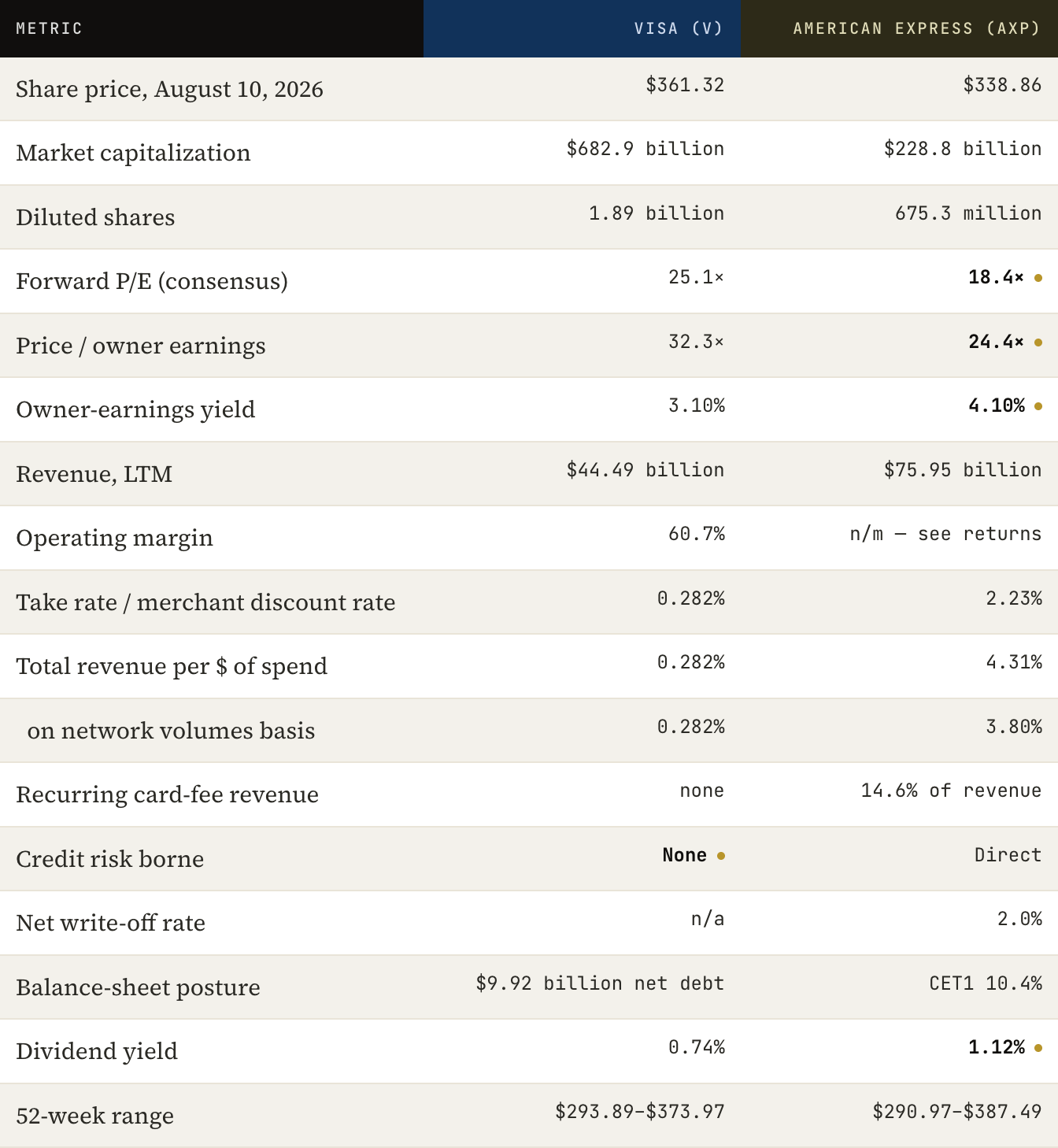
Visa's fiscal year ends September 30; American Express's ends December 31. All last-twelve-month figures are aligned to the common window ended June 30, 2026: Visa as fiscal 2025 plus nine months of fiscal 2026 less nine months of fiscal 2025; American Express as calendar 2025 plus the first half of 2026 less the first half of 2025. Take rate is Visa fiscal 2025 net revenue over payments volume; merchant discount rate is the company-reported ratio for the June 2026 quarter. All figures in United States dollars. American Express revenue per dollar of spend is shown against proprietary billed business of $455.8 billion and, on the wider basis, against network volumes of $516.8 billion, which include volume on cards issued by network partners. Market capitalization for Visa is computed on the 1.89 billion as-converted fully diluted share count used throughout the valuation; quotations based on class A shares outstanding are lower. Gold dot marks the more favorable value where the two are genuinely comparable.
The similarities are real. Both are franchises of a kind ordinary businesses never become, both carry network effects that a well-capitalized entrant cannot buy, both grow with the migration of global spend onto electronic rails, and both have compounded per-share value for decades. Either would pass a demanding quality screen on its own.
The differences begin where the money comes from. Visa’s revenue is one thing wearing four labels: a fee on volume. American Express earns from merchants, from cardholders, and from lending, and its costs include the rewards required to keep the cardholders. That divergence makes several of the most commonly cited comparisons between the two arithmetically valid and analytically empty. Three of them are handled explicitly below.
Section 3
The structural difference is easiest to see as a diagram of where a single transaction goes.
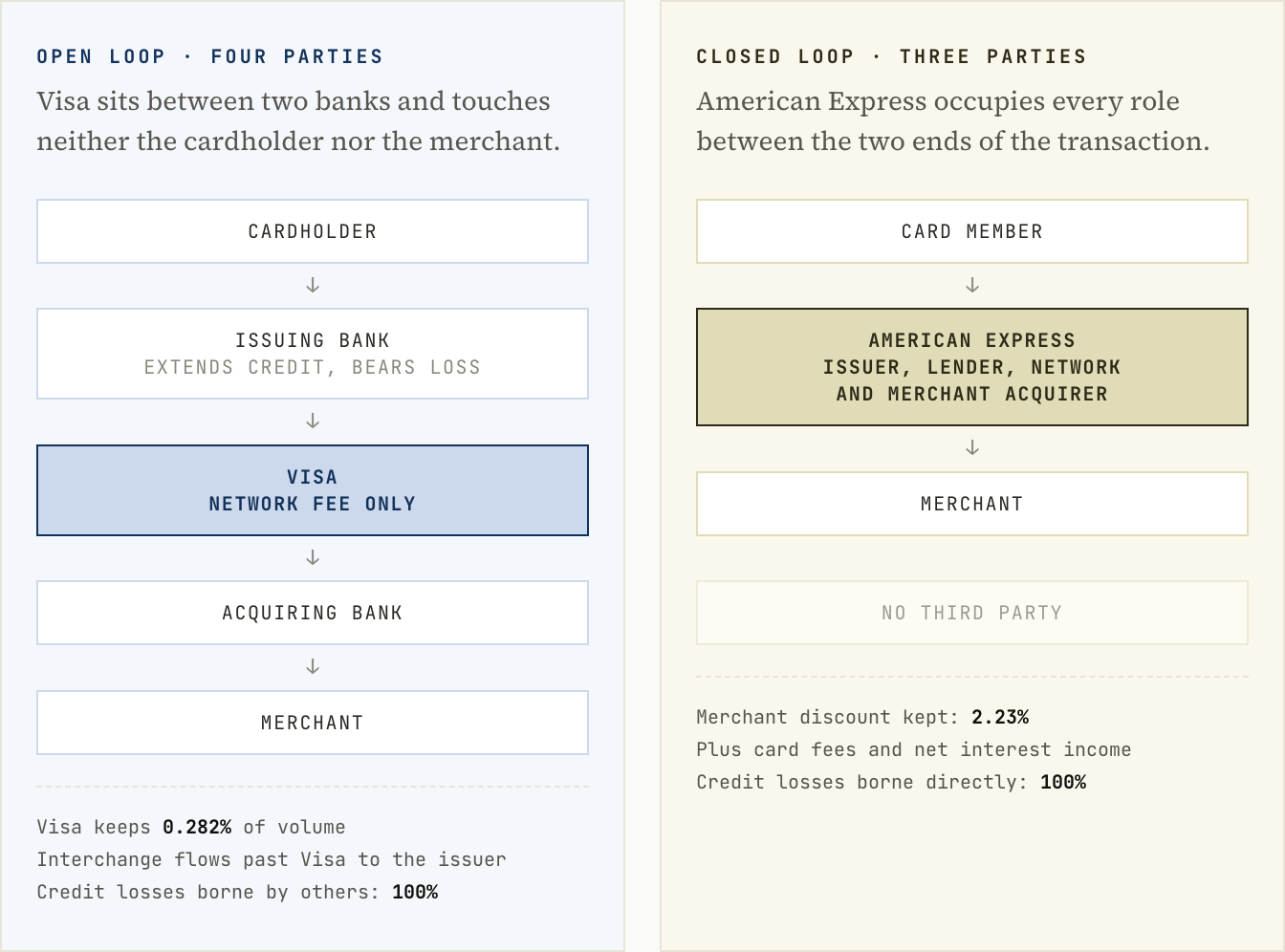
Visa’s four-party flow omits payment facilitators and processors; American Express uses third-party acquirers under its OptBlue program for smaller merchants and licenses its network to partner issuers, which together generated $516.8 billion of network volumes against $455.8 billion of proprietary billed business in the June 2026 quarter.
Comments
Nothing yet. Say the first thing.
Sign in to join the conversation.