
A question we regularly hear from practitioners: ‘Do we need different norms for neurodivergent candidates when assessing personality?’
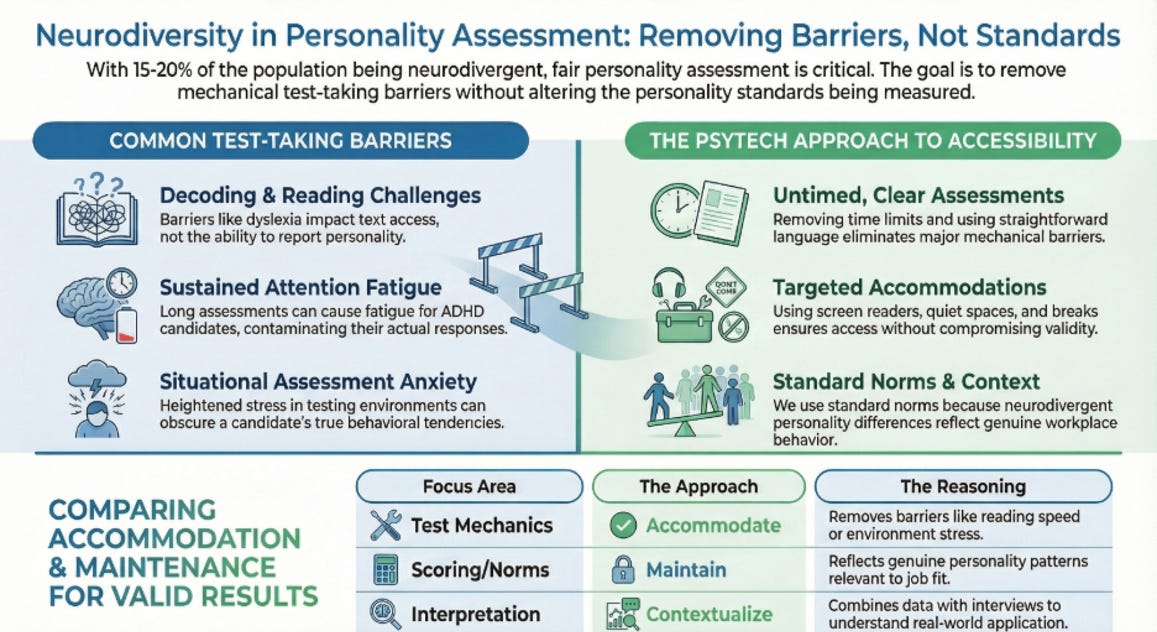
It’s a good question. And like most good questions in psychometrics, the answer is: it depends. But what it depends on might surprise you. With neurodiversity prevalence estimates suggesting that 15-20% of the population has some form of neurodiverse condition (including ADHD, autism spectrum disorder, dyslexia, dyscalculia, dyspraxia, and others) the likelihood that your talent pool includes neurodivergent candidates at any given time is high. The question isn’t whether to accommodate neurodivergence in personality assessment, but how to do so fairly, ethically, and without compromising what we’re actually trying to measure.
This matters because getting it wrong goes in two directions. Over-accommodate and you might inadvertently measure something other than personality. Under-accommodate and you might screen out talent based on test-taking barriers rather than actual job fit. Neither serves the candidate or the organisation well.
The Core Question: What Are We Actually Measuring?
Before we talk about accommodations or norms, we need to be clear about what personality assessments measure and what they don’t. Personality assessments capture behavioural tendencies, preferences, and interpersonal styles. They ask questions like: How do you typically respond to social situations? How do you prefer to organise your work? How do you handle stress? These are fundamentally different from cognitive assessments, which measure reasoning ability, processing speed, or working memory. Cognitive tests are specifically designed to assess mental capacities that may be directly affected by certain neurodivergent conditions. Personality tests are not.
This distinction is critical. A dyslexic candidate taking a timed verbal reasoning test faces a genuine barrier; the test is measuring reading speed and decoding as much as reasoning ability. But the same candidate taking an untimed personality questionnaire about their preferred working style? The condition itself doesn’t prevent accurate self-report of behavioural preferences.
The real question becomes: Are there test administration barriers that prevent accurate measurement of personality, or are we measuring genuine personality differences?
When Neurodivergence Creates Test-Taking Barriers
Some neurodivergent conditions do create genuine barriers to completing personality assessments as designed. These aren’t about the underlying personality constructs, but about test mechanics. Here’s where practitioners need to pay attention:
Dyslexia and reading difficulties:
The barrier is decoding text, not understanding personality questions or reporting on oneself accurately. Accommodations like screen readers, dyslexia-friendly fonts, or having questions read aloud remove the reading barrier without changing what’s being measured. The personality constructs themselves remain valid, you’re simply ensuring the candidate can access the questions.
ADHD and sustained attention:
Long questionnaires requiring sustained focus can be genuinely challenging. But here’s the nuance: if someone with ADHD reports they struggle to maintain focus on routine tasks, that’s valid personality data; it’s how they actually experience work. The accommodation need isn’t about changing their responses; it’s about ensuring they can complete the assessment without fatigue contaminating later responses. Short breaks, shorter assessment sessions, or a distraction-free environment help without compromising measurement.
Autism and question interpretation:
Some autistic candidates may interpret questions very literally or struggle with ambiguous items. This requires careful consideration. If the question ambiguity is poor test design, clarification is appropriate. But if a tendency toward literal interpretation or discomfort with ambiguity reflects genuine workplace behaviour patterns, that’s data worth capturing, rather than a barrier to remove.
Anxiety and assessment stress:
Many neurodivergent candidates experience heightened anxiety in assessment situations, particularly if they’ve had negative testing experiences before. Environmental accommodations (quiet spaces, clear instructions, reassurance that there are no ‘wrong’ answers in personality assessment, etc.) reduce situational stress without changing what we’re measuring.
The Norm Question: Do We Need Separate Reference Groups?
This is where the conversation gets more complex. The question of whether neurodivergent populations require separate norms depends entirely on whether we believe there are systematic, meaningful personality differences between neurodivergent and neurotypical populations, and whether those differences matter for what we’re trying to predict.
Current research suggests that neurodivergent populations do show some personality patterns that differ from general population norms. For instance, autistic individuals may score differently on social extraversion or preference for routine. ADHD populations may show different patterns on impulsivity or preference for variety. But here’s the critical question: are these differences measurement artifacts, or are they genuine personality characteristics that will manifest in workplace behaviour?
Most assessment publishers and researchers take the position that these are genuine personality differences, not measurement problems. An autistic candidate who reports lower social extraversion isn’t misunderstanding the questions, but accurately reporting how they experience and approach social situations. That’s valid data for predicting workplace behaviour and cultural fit.
Using separate norms would actually obscure these differences rather than account for them. If we’re trying to predict how someone will actually behave at work, we want to know their genuine personality profile, not their personality profile adjusted to make it look more like the neurotypical average.
This is fundamentally different from cognitive assessment, where processing speed differences or working memory challenges might not be relevant to job performance but significantly affect test scores. In personality assessment, the behavioural tendencies we’re measuring are typically the ones that matter for work.
Our Approach at Psytech SA: Accommodation Without Compromising Validity
At Psytech SA, we work with personality assessments from Psytech International and Podium that are specifically designed for occupational use. These tools (the 15FQ+, OPPro, PVQ, JTI, PQ10 and Derailers) share several characteristics that make them inherently more accessible for neurodivergent candidates:
They are untimed by design.
This immediately removes one of the most significant barriers in assessment. Candidates can work at their own pace, take breaks as needed, and return to items if uncertain. There’s no penalty for slower reading, more careful consideration, or needing time to process questions.
They use clear, straightforward language.
Items are written to minimise ambiguity and avoid unnecessarily complex vocabulary. This benefits all candidates, but particularly helps those who process language differently or struggle with highly abstract phrasing.
They focus on workplace-relevant constructs.
The questions ask about work behaviours, preferences, and tendencies, rather than clinical symptoms or pathology. This means the content itself is less likely to feel invasive or stigmatising to neurodivergent candidates.
Beyond these built-in features, we support additional accommodations on a case-by-case basis:
Environmental modifications:
Quiet testing spaces, adjusted lighting, noise-canceling headphones, comfortable seating. These create optimal conditions for accurate self-report without changing what we’re measuring.
Format accommodations:
Screen readers, dyslexia-friendly fonts, adjustable text size, and high-contrast displays. These address access barriers without altering content.
Administration support:
Clear instructions, practice items, opportunity for questions, scheduled breaks. These reduce anxiety and ensure candidates understand what’s being asked.
What we don’t do is adjust scoring, create separate norms, or interpret results differently based on neurodivergent status alone. If a candidate reports certain personality characteristics, we take that data at face value as it reflects how they’re likely to show up at work.
When Personality Differences Are Job-Relevant Information
Here’s where some practitioners get uncomfortable: What if a neurodivergent candidate’s personality profile suggests potential challenges for the role? Do we screen them out? Do we adjust our interpretation?
The answer is the same as for any candidate: you assess job-relevance, not neurodivergent status. If someone reports strong preference for routine and structure, and the role requires constant adaptation to changing priorities, that’s a potential fit concern, regardless of whether they’re autistic, have ADHD, or are neurotypical. The question is always: does this personality characteristic predict struggle with essential job requirements?
This is where the legal and ethical framework becomes essential. You cannot screen someone out based on neurodiversity status. But you can make job-related selection decisions based on personality characteristics that genuinely predict performance, as long as you apply the same standards to all candidates.
The key is documentation and consistency. If you’re using extraversion scores to select customer-facing roles, that standard applies to everyone. If you’re assessing preference for detail-oriented work, the interpretation is the same regardless of neurotype. What you cannot do is apply different standards or make assumptions about capability based on disclosed neurodivergence.
The Interpretation Conversation: Context Matters
While we don’t adjust scoring or norms, we do believe in contextual interpretation for all candidates, not just neurodivergent ones. Personality data is most useful when combined with other information: work history, interview observations, skills assessment, situational judgment.
For neurodivergent candidates, this might mean having conversations about how certain personality characteristics manifest in practice. Someone with ADHD who scores high on variety-seeking isn’t necessarily unreliable - they might thrive in dynamic environments where neurotypical colleagues struggle. Someone autistic who scores low on social extraversion might excel at deep, focused work that requires minimal interruption.
The personality profile tells you about tendencies. The candidate conversation tells you about strategies, compensations, and real-world application. This is particularly important for development contexts. When coaching a neurodivergent leader, their personality profile might show patterns that could derail under stress, just like any leader. But the development strategies might differ. A neurotypical leader who is high on scepticism might need coaching in active listening. An autistic leader with the same profile might need different support around reading social cues or managing ambiguous feedback.
Same personality data, different context, different conversation. That’s not separate norms, that’s the value and need for thoughtful, contextualised interpretation.
What About Cognitive Load and Response Patterns?
One legitimate concern practitioners raise: Could neurodivergent candidates show different response patterns that affect validity? For instance, more extreme responding, more inconsistent responding, or more socially desirable responding?
This is where quality personality assessments include built-in validity scales. Our assessments incorporate response consistency checks, social desirability indicators, and acquiescence measures. These flag problematic response patterns regardless of whether it’s neurodivergence, poor test-taking motivation, language barriers, or simple carelessness.
If validity indicators suggest problems, the appropriate response is the same for any candidate: gather more information. Perhaps the assessment wasn’t completed in appropriate conditions. Perhaps the candidate needs better instructions or a different format. Perhaps personality assessment isn’t the right tool for this particular selection decision.
What we don’t do is automatically assume neurodivergence causes invalid responding. Most neurodivergent candidates complete personality assessments without any validity concerns. When issues do arise, we treat them as individual assessment concerns, not categorical neurodivergence problems.
The Practical Workflow: What This Looks Like in Practice
When we work with organisations assessing neurodivergent candidates, here’s our recommended approach:
1. Informed consent and disclosure:
Give candidates the opportunity to disclose any conditions that might require accommodation. Make it clear that disclosure will only be used to provide appropriate support, not to influence selection decisions. Emphasize that personality assessments are untimed and designed to be accessible.
2. Identify test-taking barriers (not personality differences):
Have a conversation about what might make it difficult to complete the assessment accurately. Reading challenges? Attention span? Sensory sensitivities? These are accommodation needs, not reasons to adjust interpretation.
3. Implement appropriate accommodations:
Provide modifications that remove barriers without changing what’s being measured. Document what was provided.
4. Interpret results in context:
Use standard norms and scoring. Consider job-relevance of personality characteristics. Don’t make assumptions about capability based on neurodivergent status.
5. Have development conversations:
For candidates who move forward, use personality data to inform onboarding, development, and support strategies. This is where neurodivergence context becomes valuable — not in changing the data, but in applying it thoughtfully.
The Bottom Line: Fair Assessment Means Removing Barriers, Not Adjusting Standards
The question of whether neurodivergence matters in personality assessment comes down to this: Are we measuring personality accurately, or are test mechanics getting in the way?
For most personality assessments, particularly untimed workplace questionnaires, the condition itself doesn’t prevent accurate measurement. What might prevent accurate measurement are avoidable barriers: inaccessible format, stressful environment, unclear instructions, time pressure.
Remove those barriers and you get valid personality data. That data might show differences from neurotypical averages, and that’s okay! Those differences often reflect genuine workplace behaviour patterns worth understanding, not measurement artifacts worth correcting.
Fair assessment isn’t about making everyone’s profile look the same. It’s about ensuring everyone has equal opportunity to demonstrate who they actually are. That’s what accessibility in personality assessment means. And that’s what we’re committed to supporting.
Questions about assessing neurodivergent candidates in your organisation? We’re happy to discuss practical approaches that balance accessibility, validity, and fairness. Contact us on info@psytech.co.za
Further Reading
Doyle, N. (2020). Neurodiversity at work: a biopsychosocial model and the impact on working adults. British Medical Bulletin, 135(1), 108-125.
Thompson, C., & Miller, H. (2018). Neurodiversity in the workplace: Challenges and opportunities. Journal of Organizational Psychology, 18(3), 45-62.
No posts
Comments
Nothing yet. Say the first thing.
Sign in to join the conversation.