
“We have a candidate with [disability]. Can we still assess them?” is a question the Psytech SA team hear quite often. While we really appreciate that our practitioners are mindful of the implications of disability on psychometric results, often it is difficult for us to give an immediate, standard “yes” or “no” answer. Honestly, the response depends on the tool, the construct being assessed, the role and the normal technical/physical demands that go with it, and what accommodations are available/possible without influencing the assessment’s reliability and validity.
This post tries to give practitioners a framework for thinking this question through. Our intention is not to give you yet another checklist of rules to follow, but a way of reasoning about diversity in all its forms that holds up in the specific situation in front of you.
First, what does the law actually say?
In short: South African law does not prohibit psychometric assessment of people with disabilities. It does, however, stipulate that the assessments be fair.
Disability is a listed ground of unfair discrimination under both the Employment Equity Act (EEA) and Promotion of Equality and Prevention of Unfair Discrimination Act (PEPUDA), but that does not mean assessment of disabled employees is not permissible. Rather, practitioners must ensure, within reason, that the assessment process cannot unfairly disadvantage someone because of factors that are irrelevant to what the test is measuring.
Section 8 of the EEA sets out that psychometric tests used in employment must be scientifically valid and reliable, fairly applicable to all persons, and is not biased against any employee or group. The amended EEA also has an updated definition of disabilities, to include intellectual or sensory impairments which may substantially limit their entry into or advancement in employment. This is aligned with the UN Convention on the Rights of Persons with Disabilities, of which South Africa is also a signatory, and which calls for “reasonable accommodation”, ie. adjustments that don’t impose a disproportionate burden to ensure equal participation.
Operationally, the law requires us to remove barriers that prevent fair measurement, meaning that the question practitioners need to ask is not “should we assess this person?”, but “is our process measuring what it’s supposed to measure, for this person, in this context?”. There have been instances, for example, where clients have asked us whether a detail-checking assessment would not be unfair to administer, given there are a few candidates who have visual disabilities. To this, we’d have to ask – is detail-checking a technical competency required of this candidate in the role, and if yes, how would they do so with their disability? In this case, it is reasonable to say that the assessment in and of itself is not discriminatory, but is unsuitable for this particular context.
Second, what do you actually want to measure with your psychometric battery?
This is the part that most conversations about disability and assessment skip over, yet it is the most important bit. Psychometric tools don’t directly test whether someone can do the job, but rather they assess underlying constructs that predict job-relevant behaviour such as cognitive capacity, behavioural tendencies, motives and preferences. The assessment is just a proxy, sampling the actual behaviours we’re interested in measuring. Whether a disability is relevant to the assessment hinges entirely on whether the disability directly affects the construct (aptitude, personality traits) or the test mechanics (speeded measures, colour-coded items).
Let us discuss an example: Consider a candidate with significant visual impairment completing a perceptual speed test, measuring how quickly and accurately someone can process visual information. Visual processing is the construct. The disability directly affects what the test is designed to measure. No accommodation makes this test valid in the same way, because we can’t separate the impairment from the construct. However, that doesn’t automatically mean “don’t use this test.” It means asking a different question: does this job genuinely require rapid visual discrimination? If it does, for example, roles in quality control or surgical practice, then the score is informative, not discriminatory. If it doesn’t, then the problem is not the candidate or the test; it’s the incorrect choice of test for this role. In short, the ethical (and legal) question isn’t whether a disabled candidate scores lower, but whether what they’re scoring lower on is actually relevant to the job.
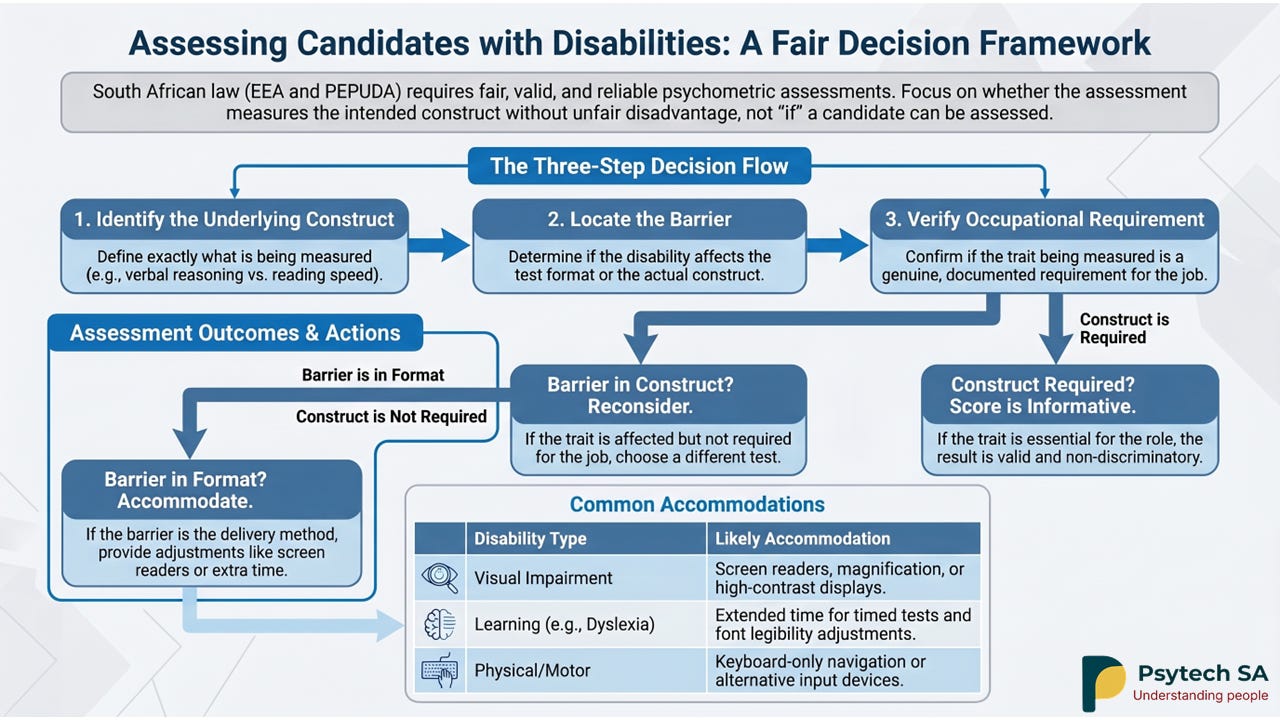
A practical framework: three questions
In short:
If barrier is in the test format: accommodate and measure the construct validly.
If barrier is in the construct, but the construct isn’t genuinely required: reconsider the test.
If barrier is in the construct, and the construct is genuinely required: the score is informative, not discriminatory.
When a candidate has a disability and you’re deciding how to approach assessments, three questions cut through most of the complexity:
1. What does this test actually measure?
Not just the test name, but the underlying construct matters here. “Detail checking” measures perceptual speed and visual accuracy. “Verbal reasoning” measures the capacity to process and evaluate language. “Personality” measures self-reported behavioural tendencies. You need to be specific and fully understand what you are measuring and its purpose, because the answer to the next question depends on it.
2. Is the disability a barrier to the construct, or to the test format?
For example, visual impairment directly affects perceptual speed (construct-level barrier) and also affects the ability to read a personality questionnaire on a standard screen (format-level barrier). However, these barriers need different responses. While the first, construct-level barrier requires you to question whether the test is appropriate at all, the second, format-level barrier just requires accommodation.
3. Is the occupational requirement genuine?
Where a disability does affect the construct, the final question is whether that construct is a genuine, documented requirement of the role, which is a job analysis question more than a psychometric one. If the answer is yes, the score is informative. If the answer is no or unclear, the choice of test needs revisiting.
Some practical guidance by disability type
Without being exhaustive, because every case is specific, here’s a starting point for thinking about disability and assessment:
Hearing impairment or deafness
All of Psytech SA’s personality and cognitive assessments are text-based and don’t require any auditory input, so tools measuring these constructs present no meaningful barrier here. In general though, if you are working with multiple assessment providers, check that instructions aren’t audio-only and that there are no audio stimuli in the items themselves, and you’re largely good to go.
Visual impairment
This one varies significantly with severity of impairment.
Partial sight: display adjustments (magnification, high contrast, font size) are usually sufficient for most personality and cognitive tools.
No functional vision: you need to verify with the platform provider in advance whether screen reader compatibility is in place. Abstract visual reasoning tests in particular need case-by-case consideration of whether the stimuli can be meaningfully rendered and whether the construct is still validly measurable.
Learning disabilities
Extended time is the primary accommodation for timed tests. For personality questionnaires, which are usually untimed any way, focus on font legibility (especially for dyslexia) and item clarity. For dyscalculia, the same construct-versus-format question applies: is the numerical reasoning being measured the impaired function, and is it genuinely required by the role?
Attention-deficit/hyperactivity disorder (ADHD)
Usually extended time and a low-distraction environment are sufficient. For speed tests specifically, it’s worth asking whether the speed element is occupationally relevant or incidental: if the role doesn’t require sustained performance under time pressure, extended time is the right call. Personality questionnaires tend to work well for candidates with ADHD given their self-report format.
Physical and motor disabilities
The main question here is input method: can the platform be navigated via keyboard only, voice control, or an alternative input device? If yes, most cognitive and personality assessments are accessible. If there are platform limitations, that’s something to raise with the provider, or consider being there with the candidate to capture the responses on their behalf. Extended time may also be appropriate where motor difficulty slows response time independent of the construct being measured.
Psychiatric and psychological disabilities
Assessing someone during an acute episode is generally inadvisable because performance may reflect the episode rather than stable, role-relevant functioning. When someone is stable, most tools are appropriate, with the usual care around interpretation and context. However, document your clinical reasoning. Also note that like with all other disabilities, one cannot decide to not employ/promote an employee purely on their psychiatric/psychological health.
Psytech SA’s position on our assessments and platforms
We’ve thought carefully about accessibility, starting with how our assessments are designed, the impact of items on diverse populations, all the way to how our platforms through which these assessments are delivered work. While we definitely do our best to ensure all our assessments are as compliant with law as possible, we also believe in quality user experience. Our first job is to do no harm to our candidates by providing fit-for-purpose measures, but we are also here to help practitioners and organisations see the return-on-investment in these assessments. An assessment process that creates irrelevant barriers produces noisier data, and noisy data serves nobody: not the candidate, not the employer, not the practitioner. We firmly believe that accessibility isn’t about making the assessment easier, but about making sure it measures what it’s supposed to measure, for everyone.
In our abstract reasoning assessments, we’re conscious of the need to avoid colour as a sole differentiator in visual stimuli. Where colour features, it’s always accompanied by shape, line type, or fill pattern so that candidates with colour vision deficiency aren’t systematically disadvantaged by something that has nothing to do with their reasoning ability. As mentioned above, our other cognitive, personality, values, and situational judgement measures generally allow for accommodations to most differently abled individuals.
One final thought
The clients who ask us about disability and assessment are almost always asking in good faith. The challenge is that “getting it right” isn’t a fixed answer; it’s a process of asking the right questions in each specific situation.
Know what your tools measure and whether it’s a real requirement of the job. Accommodate where the barrier is in the format, not the construct. When you’re not sure, please continue to reach out to info@psytech.co.za and ask us, that’s what we’re here for, we can usually help you with accommodation or alternative solutions brainstorming. These conversations are much easier to have before the assessment than after.
No posts
Comments
Nothing yet. Say the first thing.
Sign in to join the conversation.