
We talk about personality at work all the time. It shows up in job descriptions, performance reviews, team dynamics, and leadership conversations. But here’s the thing: many of us are thinking about it wrong.
When someone says ‘they’re not the right fit,’ or ‘we need someone more strategic,’ what are they really talking about? Are they describing stable traits, fleeting behaviours, hidden motivations, or something else entirely?
Personality isn’t a single thing. It’s a constellation of tendencies, values, preferences, and patterns that interact with context, pressure, and opportunity. And if we want to make smarter decisions about hiring, developing, or leading people, we need to understand which layer of personality we’re actually measuring, and why it matters for our organisational (and personal) decision-making.
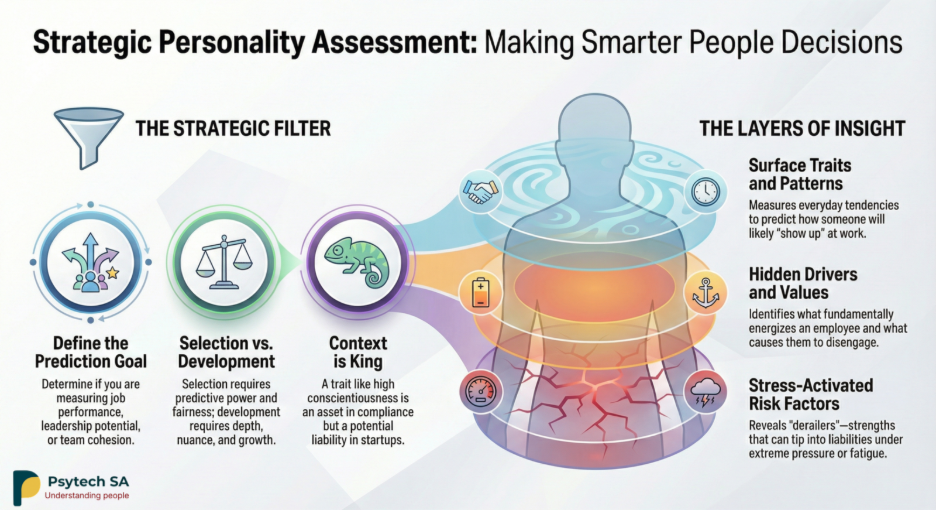
Before you measure personality, you need to answer three fundamental questions. These aren’t administrative checkboxes, but strategic filters that determine whether you’ll get insight or noise.
1. What are you trying to predict?
Job performance? Leadership potential? Team cohesion? Risk of derailment? Each outcome requires a different lens. A candidate who scores high on abstract reasoning might excel in strategic planning but struggle with hands-on execution. Someone with strong interpersonal skills might build great teams but avoid necessary conflict. Personality predicts specific outcomes, not general ‘goodness.’
2. What layer of personality matters here?
This is where most organisations go wrong. They use a single assessment and expect it to answer every question, for every employee, across the organisation. But personality operates on multiple levels: everyday tendencies (how someone typically behaves), underlying motivators (what drives their decisions), cognitive style (how they process information and solve problems), and risk factors (what might derail them under stress). For example, our 15FQ+ reveals thinking patterns and interpersonal styles. The Personality and Values Questionnaire (PVQ) uncovers what motivates someone. The Derailers assessment (new to the SA catalogue!) identifies vulnerabilities that only surface under pressure. As you can tell, each assessment acts as a layer of sorts, telling a different, yet often complementary, story.
3. Is this for selection or development?
Selection demands predictive power and fairness. You’re making high-stakes decisions with limited information. Development demands depth and nuance. You’re helping someone understand themselves and grow. For example, the Occupational Personality Profile (OPPro) is built for occupational settings where role-fit matters. Alternatively, the PQ10 gives you a rapid personality snapshot when time is tight. Inversely, the Jung Type Indicator (JTI) is a development tool used to reveal type preference and how someone approaches judgment and decision-making under uncertainty. Different tools, different purposes.
Here’s the uncomfortable truth: independently, personality doesn’t predict success with 100% accuracy. It predicts patterns. Recent meta-analytic research by Sackett and colleagues (2022) challenged decades of assumptions about how well personality assessments predict job performance, revealing that many earlier estimates had been substantially inflated. The reality is more nuanced than the claims that dominated the field for years.
Someone high in conscientiousness will likely be organised, thorough, and reliable. Conscientiousness has been consistently identified as the strongest personality predictor of job performance across occupations (Wilmot & Ones, 2021). But will they succeed? That depends on whether the role rewards those qualities. In a fast-moving startup where ‘good enough and shipped’ beats ‘perfect but delayed,’ extreme conscientiousness might actually be a liability. In a compliance role where errors have serious consequences, it’s essential.
This is why context matters as much as measurement. A test grounded in the Five-Factor Model, like the 15FQ+ or PQ10, gives you insight into fundamental traits like emotional stability, extraversion, openness, agreeableness, and conscientiousness – often referred to as the building blocks of workplace behaviour. But these traits don’t exist in a vacuum. A leader high in dominance might inspire confidence in a crisis but alienate their team during steady-state operations. An analyst high in openness to ideas might generate breakthrough insights but struggle to follow established procedures.
Personality assessments tell you how someone is likely to show up. Your job is to decide whether that’s what the situation needs.
If you only measure surface-level traits, you’re missing half the picture. Below everyday behaviour sits a layer most organisations ignore: values and motivations.
Two people can have identical personality profiles but make completely different career choices. Why? Because they value different things. One might be driven by achievement and recognition. The other by autonomy and variety. Same traits, different drivers, entirely different performance outcomes.
This is where assessments like the Personality and Values Questionnaire (PVQ) becomes essential. It measures what energises someone, what they’ll sacrifice for, and what will cause them to disengage. Understanding values helps you answer questions like: Why did this high-performer leave after six months? Why does this team member resist an opportunity everyone else would jump at? Why does this leader seem disconnected despite strong results?
Values predict persistence, engagement, and cultural fit in ways traits alone cannot. You can train skills. You can develop behaviours. But you can’t easily change what someone fundamentally cares about.
Here’s a pattern every organisational psychologist has seen: a successful leader who suddenly isn’t. A high-performer who starts creating problems. A reliable team member who becomes a source of conflict.
What changed? Usually, nothing about the person. What changed was the context. Under pressure, fatigue, or threat, our strengths can tip into derailers. The confident leader becomes arrogant. The detail-oriented manager becomes micromanaging. The collaborative team player becomes conflict-avoidant.
This is the insight behind derailment assessments, like the Derailers. Everyone has potential vulnerabilities – those traits that serve them well in normal conditions but become problematic when overused or triggered by stress. The key word is ‘potential.’ These aren’t permanent character flaws. They’re risk factors that emerge in specific situations.
Since prevention beats intervention, measuring derailers helps you do two things: identify situations where someone might struggle, and design development interventions before problems escalate. A leader aware of their tendency toward skepticism can actively seek input before dismissing ideas. A manager who knows they become rigid under pressure can build in flexibility mechanisms before a crisis hits.
So how do you actually choose the right personality assessment from the range Psytech SA offer? By starting with the decision you need to make.
15FQ+: The comprehensive diagnostic
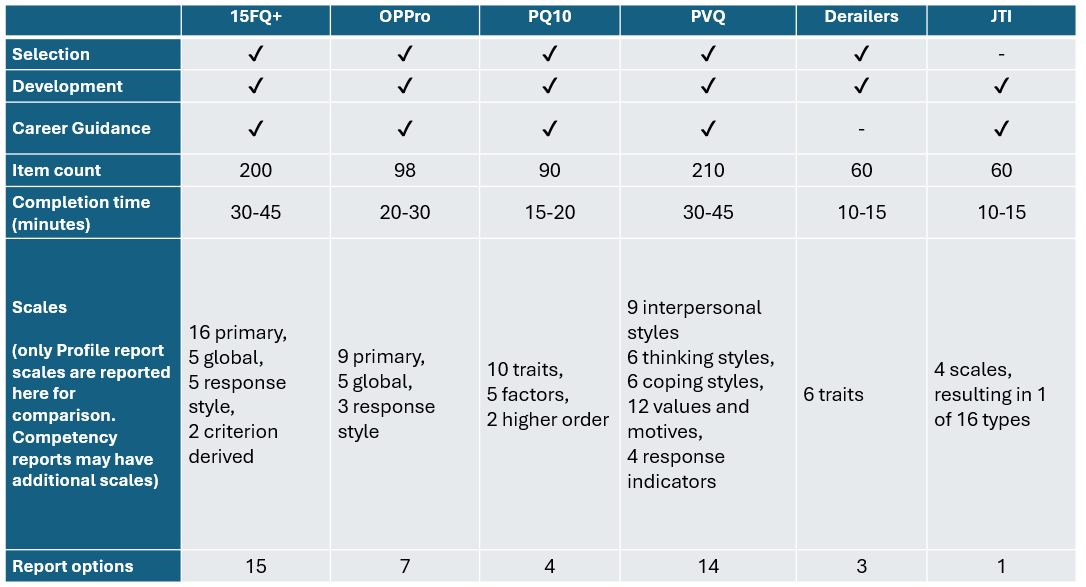
Our flagship assessment offers deep personality structure insight through sixteen primary factors and five global dimensions. Features extensive validation against job performance criteria replicated around the world, availability in multiple languages for multinational projects, and updated 2026 norms. Choose it when you need precision and can justify the 30-45 minute investment.
OPPro: The workplace specialist
Designed specifically for organisational contexts with personality facets grouped into work-relevant domains. Delivers practical, job-relevant insight without extensive interpretation time, bridging comprehensiveness and efficiency.
PQ10: The efficient profiler
Delivers ten factors, the Big Five, plus higher-order stability and plasticity from just 90 items in 15-20 minutes. Provides exceptional time efficiency when you need enough personality data to guide decisions without committing to a fuller assessment.
PVQ: The motivation mapper
Goes beyond capability to capture what drives people, by capturing both personality and drivers in a single assessment. Combines interpersonal styles, thinking styles, coping styles, and values/motives. Especially powerful when paired with ability testing to see both the how and the why of performance.
Derailers: The risk identifier
Focuses on potential vulnerabilities under pressure and stress. Brief (10-15 minutes), but targeted measure of six traits that can undermine effectiveness in high-stakes situations, sets this assessment apart. Use this for risk awareness and management, rather than screening out.
JTI: The preferences framework
Reveals psychological type preferences for perceiving, deciding, and interacting. An exclusively developmental measure of preferences, not competencies. Ideal for self-awareness, team dynamics, and communication workshops.
Most organisations start by asking ‘What personality test should we use?’. But the better question is: ‘What do we need to understand about this person to make a good decision?’
Are you trying to predict job performance? You need trait data. Are you trying to prevent leadership derailment? You need stress-activated risk assessment. Are you trying to understand why someone isn’t engaged despite strong performance? You need values data.
Sometimes you need multiple perspectives. A comprehensive leadership assessment might combine the 15FQ+ for trait structure, the PVQ for motivational drivers, and a Derailers assessment for risk factors. Each adds a layer of understanding the others can’t provide.
The goal isn’t to know everything about someone. It’s to know the right things that actually matter for the decision at hand.
Ask for more information than just the price of an assessment. Understand what you’re measuring, how reliable and valid those results are, and why it matters.
Know your purpose. Understand your context. Choose tools that match your decisions. And remember that personality data is insight, not instruction. It tells you probabilities, not certainties. Tendencies, not destinies.
The best personality assessment isn’t the one with the most factors, the longest history, or the most impressive credentials. It’s the one that helps you make better decisions about real people in real situations.
Need help determining which assessment fits your specific needs? Get in touch with us at info@psytech.co.za - we’d be happy to discuss your context and guide you toward the right approach.
References
Sackett, P. R., Zhang, C., Berry, C. M., & Lievens, F. (2022). Revisiting meta-analytic estimates of validity in personnel selection: Addressing systematic overcorrection for restriction of range. Journal of Applied Psychology, 107(11), 2040–2068. https://doi.org/10.1037/apl0000994
Wilmot, M. P., & Ones, D. S. (2021). Occupational characteristics moderate personality–performance relations in major occupational groups. Journal of Vocational Behavior, 131, Article 103655. https://doi.org/10.1016/j.jvb.2021.103655
No posts
Comments
Nothing yet. Say the first thing.
Sign in to join the conversation.