
Editor’s Note
Some conversations arrive at exactly the right moment. Jess Jorgensen is the Foundress of Sporesight — a futures design practice that uses fungal intelligence as both metaphor and methodology for strategic imagination. She thinks in ecosystems, in timescales, in decomposition – we speak the same language as designers. She is also one of the sharpest thinkers I’ve encountered on what it actually means to design for the future rather than just predict it.
What drew me to this conversation was the seriousness with which Jess treats the non-human world as a source of intelligence — as an actual operational logic. Mycelium as a strategic framework. Rot as a methodology. The 8,500-year-old fungus in Oregon as a planning horizon.
The psychedelic connection is biological and philosophical: fungi gave us psilocybin, and the distributed intelligence of mycelial networks structurally mirrors what expanded states produce in the brain. Jess asks what it might mean to design systems — organisations, cities, cultures — that operate on fungal logic rather than extractive ones.
And here is the thing that stays with you after you sit with this work long enough: we are not separate from any of it. Our bodies already carry fungi. We are already part of the network. And one day, we too will decompose — returning what we borrowed back to the substrate that made us. That is not a morbid thought. It is perhaps the most clarifying one available to us right now.
This is an interview with Jess about decomposition, regeneration, and why we need to stop building new chairs.
Jess joins us as a judge of the 2026 Psychedelics Design Awards — and we are thrilled to have her. She will also be delivering a keynote at our online conference this November, explaining her methodology in detail. Consider this a warm-up.
For Jess, fungi offer a principle 400 million years in the making: rot before you regenerate. Deliquescence first — letting go of what isn’t serving. Then composting: breaking those elements into nourishment for what comes next. Nothing wasted; everything metabolised. “Only from that substrate does something genuinely new emerge.”
This isn’t just metaphor. It’s a methodology she applies to imagination work, strategic foresight, futures design, innovation, and brand — to shift organisations from extractive to regenerative. The method scales: at Future Days in Copenhagen, she and a group of colleagues half-jokingly discussed decomposing the nation state. “So, thinking like fungi means acquiring sporesight: the ability to see, imagine and design regenerative futures.” And we love this!
Hierarchies are extraordinarily bad at sensing weak signals at the edges — and that’s precisely where disruption originates. Conventional foresight puts observers outside the system. AI accelerates analysis but widens the gap further: “lacking culture, emotion, and nuance, it’s closer to a spreadsheet than a being, totally disembodied from the ecosystems it analyses.”
Mycelial networks operate differently. No headquarters. No top-down instruction. Just live, fluid sensing and response, sharing information laterally and allocating resources in real time. For organisations, this means embedded frontline staff — those already sensing constantly — being given frameworks to interpret signals and permission to act on them. “Fungi show us how signal sensing can be truly alive: decentralised, embodied, and responsive as things change.”
Jess works with three intelligences simultaneously: foresight, AI, and fungal logic. Foresight interprets signals and imagines preferable futures. AI detects patterns at speed. Fungi provide what both lack — “holding multiple pathways simultaneously, decomposing what’s dead, emerging into conditions rather than predicting them.”
She’s careful about metaphor, though. The “Wood Wide Web” is the classic trap — implying mycelial networks are purely mutualistic, sharing and caring in perfect harmony. “The reality is richer and stranger: fungi share and deny, cooperate and compete, nurture and predate. Symbiosis is not all happy vibes.” The translation has to be scientifically grounded, developed with both scientists and strategists in the room.
The practical output is simple: map your system, identify what needs to decompose, find the nourishment in the waste, recompose from what’s left.
She went in assuming expertise looked like credentials. She came out thinking differently. Across more than 100 interviews, “the most generative conversations were with growers, healers, farmers, bedroom activists, and citizen scientists — people whose knowledge is embodied and site-specific rather than published and peer-reviewed.”
A mycologist in a lab tells you how a species behaves in controlled conditions. A forager who has walked the same forest floor for forty years tells you how it behaves in this soil, this season, after this weather. Bioregional knowledge carries an intelligence that globalised, abstracted expertise cannot replicate. “We’ve systematically devalued it, and we’re paying for that in our capacity to respond to localised ecological crises.” The most exciting mycoculture, she found, happens outside algorithmic and academic clutches — decentralised, subversive, alive across food systems, wellbeing, art, and soil.
“Regenerative” risks becoming what “sustainable” became: a reputational veneer on business-as-usual. Jess is direct about this. As Jenny Andersson observes in Global headwinds and the regenerative field (1), organisations label themselves ‘regen’ as a buzzword, without the multidisciplinary wisdom it actually takes. There are structural arguments that truly regenerative organisations can't exist within capitalism, as regenerative processes operate on biological timescales that don't conform to quarterly reporting.
Where she sees genuine embodiment is in place-based bio-hubs: farms, campuses, community centres built from the ground up around bioregional logic, with local ecosystems as primary stakeholders. Not retrofitted regeneration; a different root system entirely. Think Lo-TEK: local traditional ecological knowledge, as explained by the Lo-TEK Institute.
In her Decomposition Day sessions, there’s usually a moment she recognises as the real beginning: “someone says something they’ve never said in a meeting room: an admission about what they’ve been pretending is fine but isn’t. That’s the rot beginning. So, regenerative design done well feels less like a methodology and more like a metabolic process: something releases, something else becomes possible.”
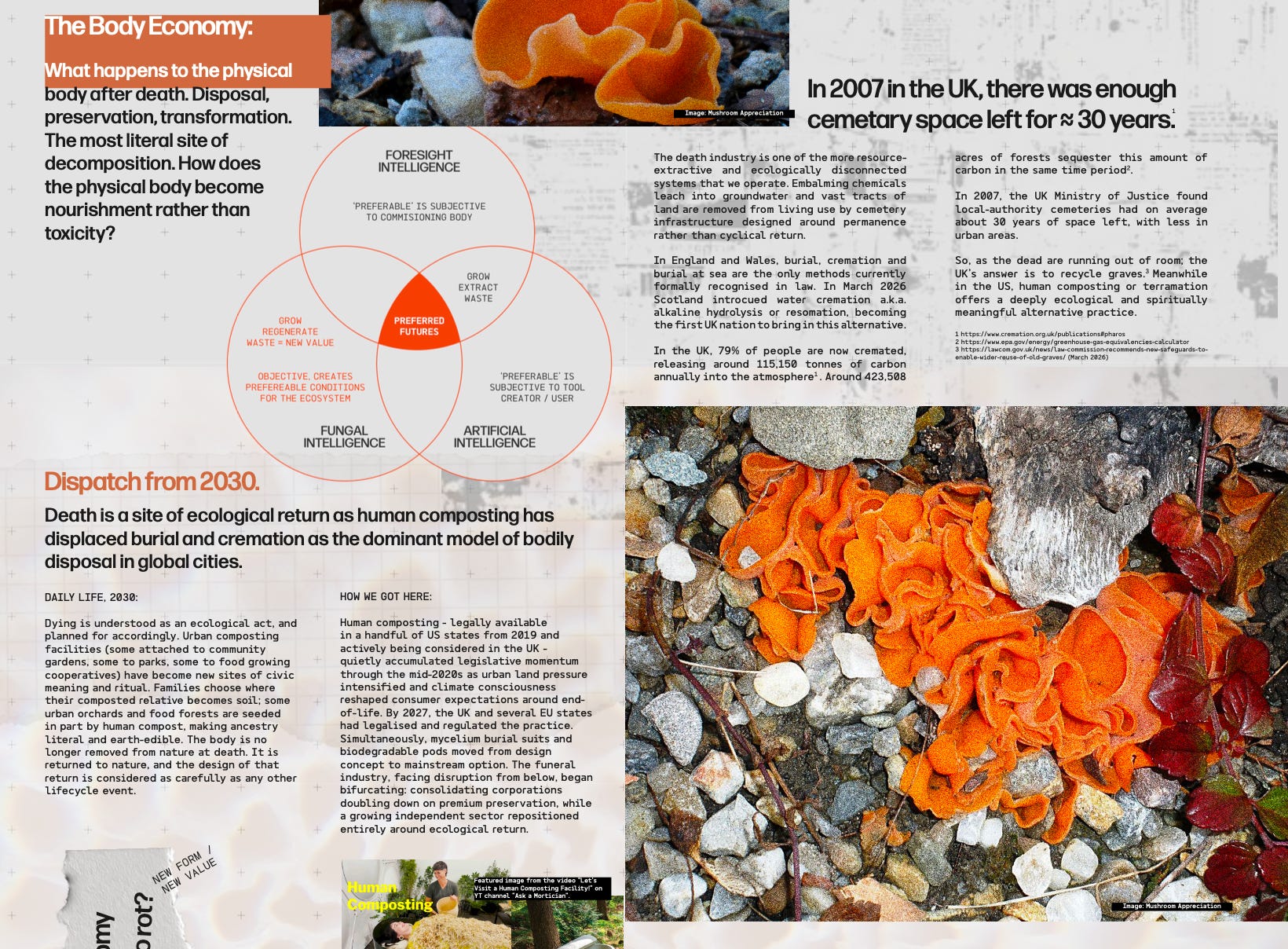
Sporesight starts with decomposition. They identify what the organisation is extracting — from its people, its supply chains, its ecosystems — that it cannot sustain. That question, taken seriously, produces a very different kind of strategic document than a sustainability report.
The shift from symbolic to legitimate happens at one specific moment: “when leadership is willing to name — publicly and specifically — what needs to rot. That takes courage, and is where genuine regeneration begins.”
The connection is both metaphorical and biological. Psilocybin temporarily disrupts the brain’s Default Mode Network — the system responsible for our habitual sense of self and fixed narratives. Research from Johns Hopkins and Imperial College London shows this correlates with increased neural connectivity across regions that don’t normally communicate: “a pattern structurally similar to mycelial networks.”
Both psilocybin and mycelium dissolve rigid boundaries and reveal unexpected connections. “What’s interesting strategically is that most extractive thinking is maintained by precisely the cognitive rigidity that psychedelic research suggests expanded states can loosen. The clinical evidence is compelling. The question is whether we’re courageous enough to apply that underlying logic to how we design systems.”
Conventional strategic planning operates on one-to-three year horizons. Fungi operate differently. The humungous fungus — Armillaria ostoyae — in Oregon’s Malheur National Forest is an estimated 8,500 years old, covering 2,385 acres. It got there by persisting, adapting, and constantly decomposing. Not optimising for quarterly growth.
Jess’s foresight work deliberately stretches time perception, asking organisations to hold multiple timescales simultaneously: the urgent present, the medium-term transition, the longer ecological arc. “What looks like disruption in a three-year horizon often looks like necessary composting in a thirty-year one.”
In Sporesight’s preferred future, design is life-centric rather than human-centric. At their Future Days Copenhagen side event — Growing the Decomposition Economy — thirty futures thinkers decomposed four systems of death. One speculative dispatch, inspired by Orange Peel Fungus applied to the Body Economy, imagined 2030: human composting displacing burial and cremation in global cities; urban composting facilities attached to community gardens becoming sites of civic meaning; ancestry made literal and earth-edible.
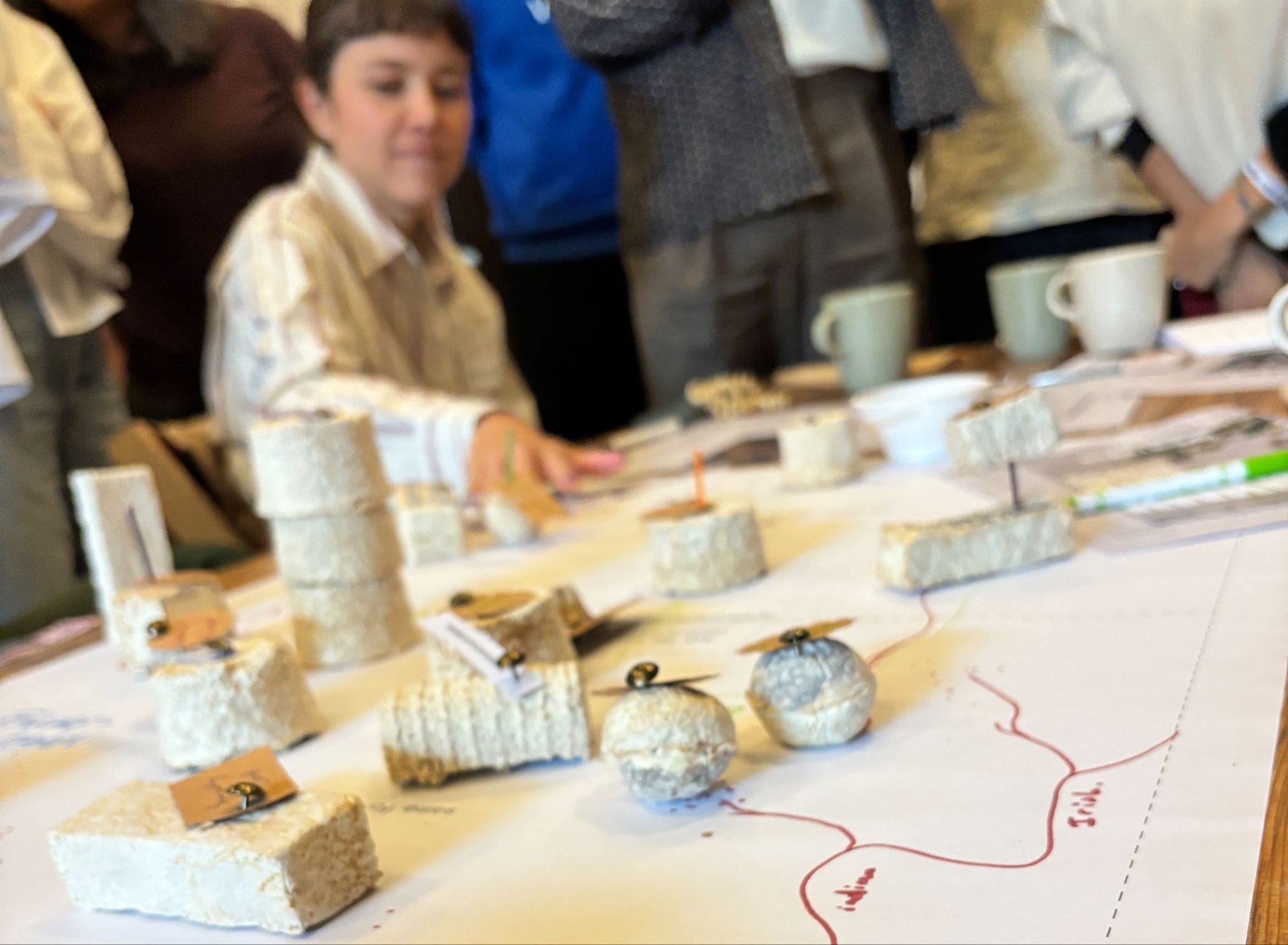
“This isn’t pure speculation. Human composting has been legally available in several US states since 2019. Mycelium burial suits have moved from design concept to mainstream option. A fungal future for design is already composting into existence.” On the culture we’re collectively building
“I believe that we’re designing a culture of community care, rooted in compassion and harm reduction.” And embedded in that is a longer reckoning: the War on Drugs has left lasting damage on communities. Restorative justice isn’t optional — it’s foundational. The field’s future has to be built on ethics and safety, or it will repeat the patterns it claims to be moving beyond.
Decompose before you recompose. Stop asking what we can create next. Start asking what needs to rot first.
“The design industry is addicted to newness. Decomposition should be a non-negotiable phase. What assumptions does this project inherit that need to compost? What things, materials or systems don’t need to be built anew, but can be recomposed from what already exists?”
She leaves us with this: during 3 Days of Design in Copenhagen, a furniture designer who’d seen her work said — “We don’t need more fucking chairs. I’m going to decompose my company.”
Read more
Jess’s playbook Fungi as your Futurist maps ten design principles from fungal intelligence for organisations ready to decompose and recompose.
Check out Sporesight, a way of thinking inspired by fungi.
She’s also a member of RADAR — a decentralised community practising mycelial signal-sensing in real time.
NEWS FROM PSYCHEDELICS DESIGN
• Tickets for the 2026 Conference are now on sale!
Mark your calendars: 6–7 November, online. This year’s theme, Creative Biome, explores the shared ecosystem of psychedelics and creativity as living forces shaping culture, care, and what comes next.
On the lineup so far: Rick Doblin (MAPS), Robin Carhart-Harris presenting ahead of his forthcoming book How Psychedelics Work, Josh Rubin (COOL HUNTING), Jess Jorgensen (Sporesight), Zoe Wilder, and more to be announced.
Tickets from £10 → Get yours here
More information here → psychedelics.design/2026-conference
ON OUR READING PILE
A new regular section — what we’re reading, what’s sitting on the table, what doesn’t fit neatly into any category but belongs here anyway. More books, films, articles, and resources we’ve curated with care over the past year live in our free resources library.
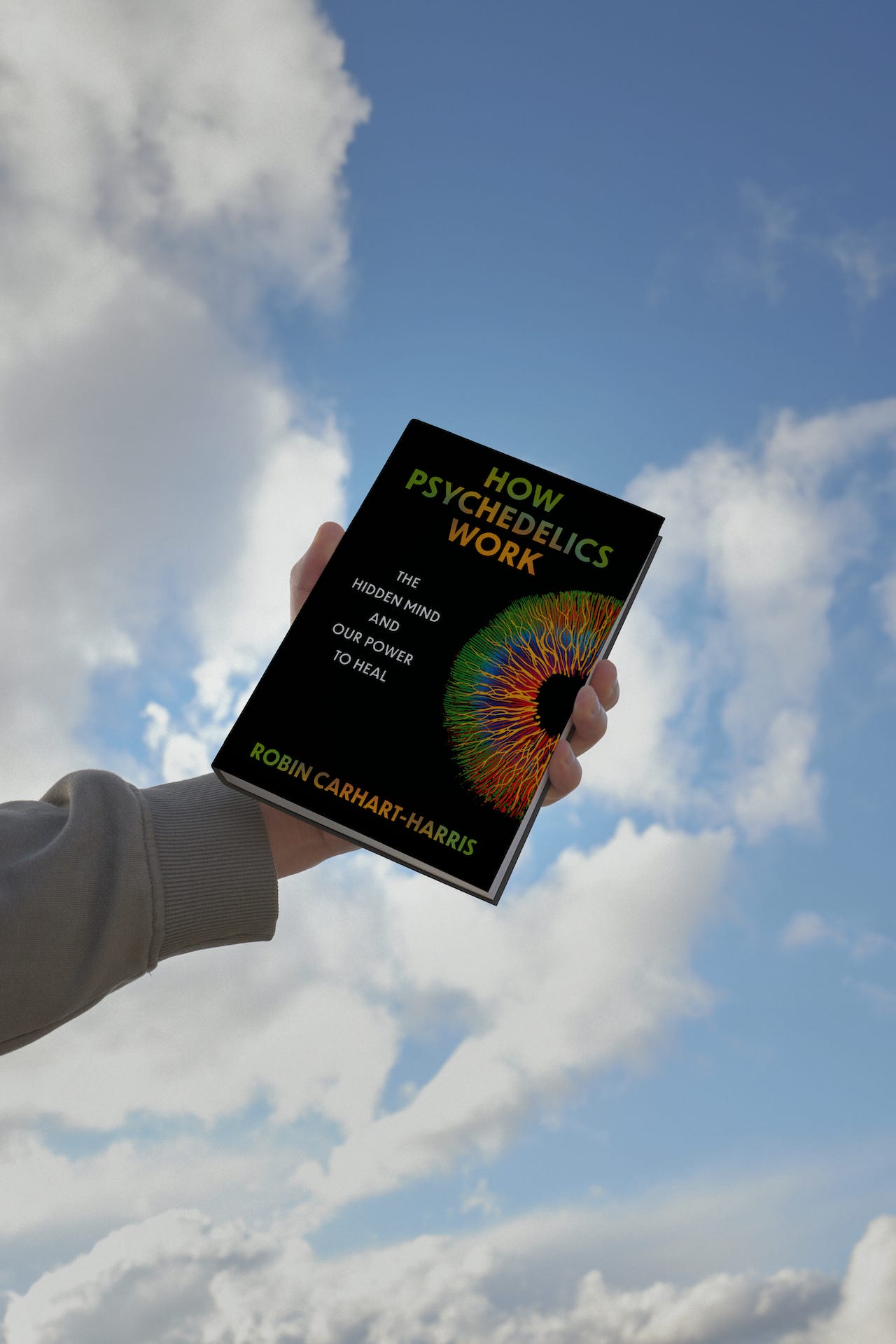
A personal note on this one: I did the original design concept for the cover, ultimately brought to life by the publisher’s in-house design team — and getting to see it out in the world is honestly one of the honours of this year for me.
But set that aside for a second, because the book itself is the real story. Robin distills decades of research — including his own landmark clinical trials — into a genuinely new model of mental health, where beliefs and narratives calcify until they stop bending. It’s rare to see someone this deep in the science write with this much clarity about consciousness, healing, and what a psychedelic experience actually does to a mind.
I’ve read it. I pre-ordered my copies. It’s a must-buy — pre-order it now: https://www.simonandschuster.com/books/How-Psychedelics-Work/Robin-Carhart-Harris/9781668063286
FROM OUR PARTNER

As psychedelic practice continues to expand across Europe, there is a growing need for training that goes beyond theory. The Mirari Foundation Programme is a 12-week interdisciplinary introduction to psychedelic studies and practice, designed for clinicians, coaches, guides, researchers, educators, and anyone seeking a rigorous, evidence-informed foundation.
Led by Programme Director David Drapkin, LCSW, MSW, with curriculum consultants Alex Belser, Max Wolff and Yannick Jacob, the programme draws on an interdisciplinary faculty that includes guest instructors Rayan Safar, Erica Zelfand and Sergio Perez. Through live teaching, practical skills labs, peer learning, and reflective practice, students develop the judgment, ethical grounding, and relational skills needed to navigate this evolving field with confidence.
Applications are now open for the cohort beginning on 30 September.
Enrol by 30 July to receive a 25% Early Bird discount.
“What would design be like if objects were made of a single part? Would we return to a better state of creation?”
– Neri Oxman
Comments
Nothing yet. Say the first thing.
Sign in to join the conversation.