
Editor’s Note
June has been a month of quiet consolidation — and some very significant science.
The awards submissions are now closed. Our jury is doing what juries do best: looking closely, thinking carefully, sitting with the work. We’ll be sharing finalists in the autumn, and winners will be celebrated live at the conference in November.
None of this would have been possible without the people who submitted their work, the partners who amplified the call, and the judges who gave their time and expertise. Thank you — genuinely. Every submission was a small act of courage: a decision to say, this work matters, and I want it seen. We think so too.
To our jury and partners: you make this possible, and we are grateful.
While the field debates policy and the pharma deals get bigger, creatives keep doing what they've always done — integrating the experience, translating the untranslatable, making something that didn't exist before. This issue is honouring that.
MUSIC
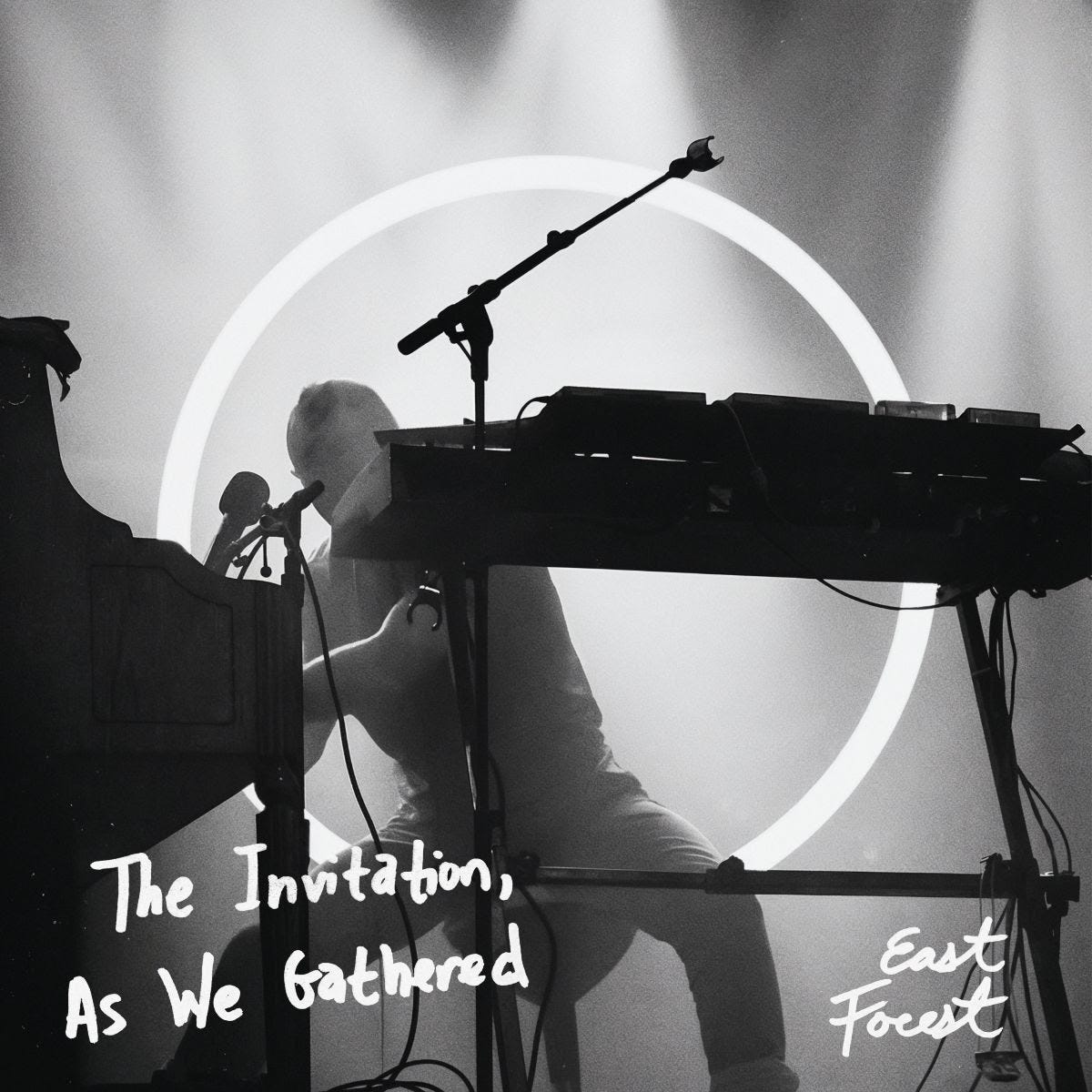
The second single from East Forest’s forthcoming album The Invitation, As We Gathered (out 10 July) dropped on 17 June. “Nature (Gathered)” features Kishi Bashi and, in his posthumous presence through recorded teachings, Ram Dass. The track was performed live and unfolded in real time — an improvisation that found its form in a real moment.
East Forest’s own framing of the album is one of the more honest things we’ve read this month: “Every track was performed and recorded live, around the world, as we gathered. Human connection and co-creation feel like an antidote to the digital and AI uprising around us.”
It is a quietly radical artistic statement for 2026, rooted in the irreducible quality of human creation, presence, of bodies and voices doing something unrepeatable together.
East Forest is on tour right now. You can get tickets here.
Listen to Nature (Gathered) on Spotify · Apple Music · Bandcamp
Our partner, judge, and awards MC Dennis Walker published a piece in Head Magazine this month that is well worth your time. It asks a question that doesn’t get asked nearly enough: where is the music?
The first wave of psychedelic culture was held inside a musical container — Hendrix, the Dead, Santana at Woodstock, the Beatles. Today’s renaissance is largely defined on medical and business terms: clinical trials, policy reform, stock prices. The cultural and artistic dimensions have become, in Dennis’s words, something of a sideshow. The beating heart of the psychedelic zeitgeist, he argues, still belongs to the artists and performers synthesising meaning from their experiences through music — they’re just less visible than the press releases.
The piece features a quote from our fellow judge Edward Crowe — music industry executive and high-dose mushroom ceremonialist — on the artists he believes are carrying the torch. Two of our judges, one article, a question the field needs to keep asking.
Dennis Walker · Head Magazine · Edward Crowe
ARTS & CULTURE
We have never featured a non-psychedelic product in this newsletter. This is not a promotion. But our partner Cool Hunting shared something this month that we couldn’t not talk about — because it isn’t really about the object at all.
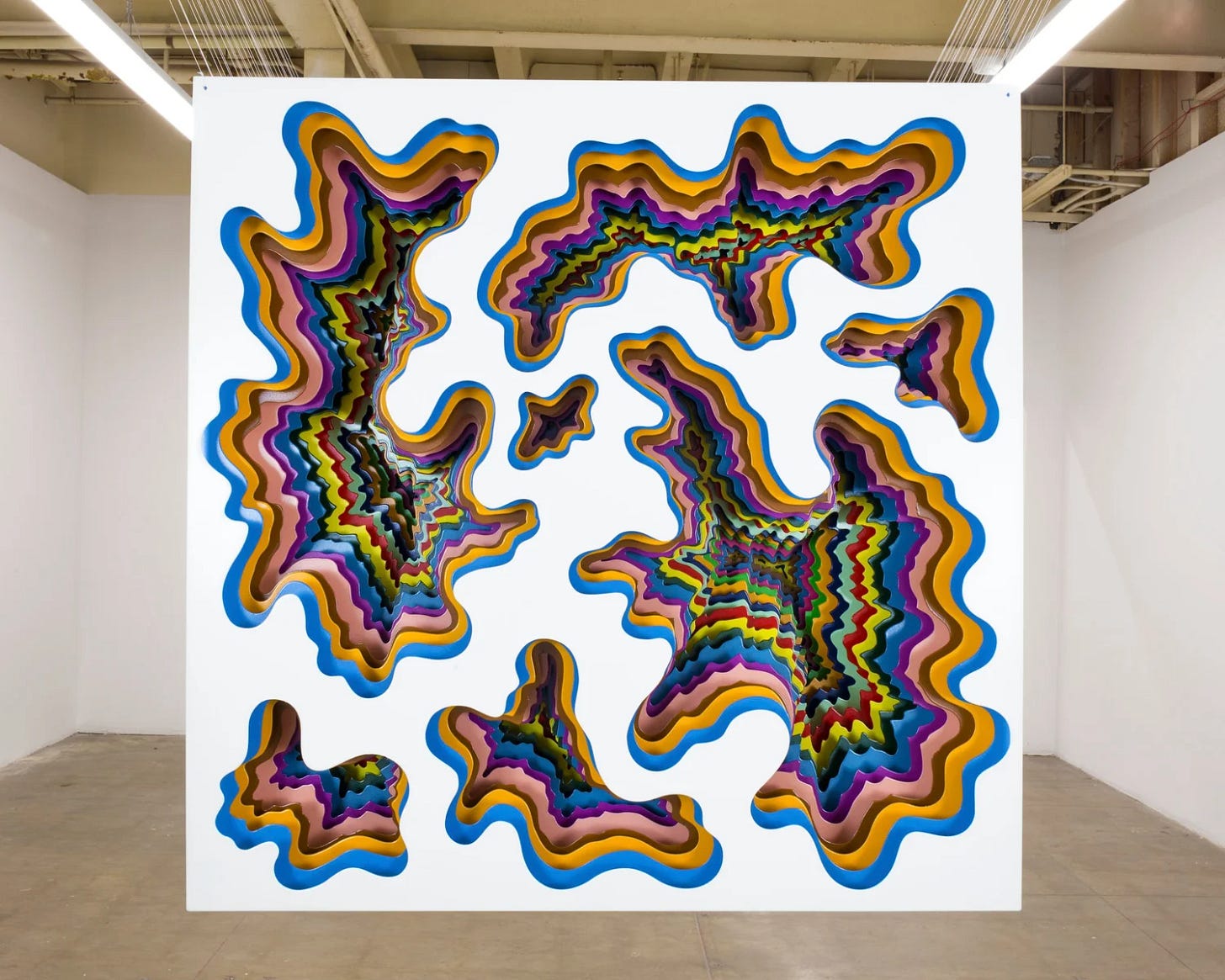
Jen Stark is one of the most consistently compelling artists working in psychedelic visual language today. Her 3D sculptures — vivid, layered, organic, mathematically precise — have a quality that is genuinely rare: they look like what expanded consciousness feels like, without being literal about it. No mushrooms, no geometric clichés. Just colour, depth, and the feeling of something opening.
This month, Stark brought that work to a limited-edition collaboration with pickleball gear brand Volair. A hundred and fifty paddles per design. A signed print. A collector’s box.
The object is almost beside the point. What interests us is where the work ends up. Psychedelic aesthetics are migrating — from gallery walls and album covers into the most unexpected functional corners of everyday life. When the visual vocabulary of expanded consciousness lands on a pickleball paddle, something has shifted in the cultural atmosphere.
Stark’s work deserves the attention wherever it goes.
A Timeout Buenos Aires profile this month introduced many readers to Mariano Peccinetti — a visual artist who blends AI tools and analogue collage to build elaborate, immersive worlds that have found their way into campaigns for Gucci, Rolex, Vogue, and Netflix.
His work occupies a space that is increasingly hard to name: psychedelic in its visual logic, surrealist in its construction, commercial in its reach. Peccinetti’s trajectory is worth tracking not because it is exceptional, but because it is becoming a pattern. Psychedelic aesthetics — the dissolution of rigid forms, the layering of organic and fantastical imagery, the sensory excess — are doing quiet institutional work inside luxury and editorial culture, while the field itself continues to wrestle with what psychedelic design actually means.
What does it mean when the aesthetic travels without the philosophy? That question sits at the heart of much of what we are trying to do here.
RESEARCH
In what researchers are calling a breakthrough moment for the field, a new mega-analysis published in Nature Medicine has demonstrated for the first time that psilocybin, LSD, mescaline, DMT, and ayahuasca all produce a common pattern of brain activity — despite their profoundly different chemistries, durations, and cultural histories.
Led by researchers at McGill University (including Dr. Manesh Girn, a confirmed speaker at our November conference), the study pooled brain imaging data from 267 participants across labs in five countries — the largest analysis of psychedelic brain imaging ever conducted. What they found: across all five substances, normally tight neural networks weakened internally, while distant brain regions that usually stay segregated began communicating more freely. The clearest version of this cross-talk appeared between the brain’s higher-order thinking networks and the systems that handle vision and touch.
“This is a breakthrough in how we think about psychedelic drugs,” said senior author Danilo Bzdok. “For the first time, we show there’s a common denominator among drugs that we currently consider completely separate.”
Read the full write-up on News-Medical · Nature Medicine paper · Dr. Manesh Girn
A large-scale study drawing on data from 5,905 participants in the Great British Intelligence Test found that people with past psychedelic use scored significantly higher on divergent thinking — the capacity to generate multiple solutions to open-ended problems — compared to non-drug users and people who had used other substances but not psychedelics.
The effect held specifically for divergent thinking, not for cognitive reflection or insight measures, suggesting that psychedelic experience may be associated with a particular kind of cognitive flexibility rather than a general intelligence boost.
The study is naturalistic — it captures real-world users, not controlled dosing — and the researchers are careful to note that correlation is not causation. Personality, openness to experience, and the type of person drawn to psychedelics all play a role. But as a data point in an emerging body of evidence, it is significant.
It’s also exactly the kind of research that belongs at the intersection of psychedelics and design. Divergent thinking is not a side benefit of creative work — it’s the core of it.
A paper in Frontiers in Artificial Intelligence argues that psychedelic substances offer both a conceptual and neurocognitive model for designing AI systems that augment human creativity. The central claim: psychedelics enhance creativity by disrupting the Default Mode Network and reducing latent inhibition — and AI systems could be designed to mimic these disruptions by introducing novel cross-domain associations and reframing familiar information in ways that parallel the “associative looseness” seen under psychedelics.
It’s a speculative but thought-provoking frame — and one that sits squarely at the intersection of psychedelic neuroscience and design practice. East Forest’s words above feel like the necessary counterpoint: “human connection and co-creation feel like an antidote to the digital and AI uprising around us.”
Science uses psychedelics to model better machines; artists use them to remember what machines cannot do. Both are live conversations in 2026.
Frontiers in Artificial Intelligence, 2025
NEWS FROM PSYCHEDELICS DESIGN
Two days at the intersection of design, creativity, and psychedelics. Confirmed speakers include Robin Carhart-Harris (UCSF), Rick Doblin in conversation with Zoe Wilder, Manesh Girn, and Rayyan Zafar. Full programme and additional speakers announced soon.
Finalists for the 2026 Psychedelics Design Awards will be announced in the autumn. Winners will be announced at the conference.
Get your summer offer ticket for $33 / £25
(Full price from September: $50 / £40)
Alexandra Plesner spoke with Authority Magazine about the work behind Psychedelics Design — five things she wishes someone had told her when she started.
FROM OUR PARTNERS

Liquid Culture is a revolutionary record label, artist collective, and lifestyle brand redefining the intersection of music, visual art, and cultural innovation. LC's exclusive apparel collection makes the perfect gift for yourself and others—the creatives, music lovers, and culture shifters in your life. Featuring limited-edition drops and original artwork from label artists, the collection includes signature hats, hoodies, and accessories that embody Liquid Culture’s fusion of music, art, and style. Each piece is designed with intention and crafted for those who move freely and live boldly. Discover unique, art-forward gifts at
Our judge, collaborator, and friend Marlena Robbins has launched her consulting practice: Moiré Collective Research.
In her own words: “Moiré brings Indigenous knowledge and scientific rigor together for the psychedelic field. I help programs, researchers, and organizations engage Indigenous communities and knowledge with care — through engagement strategy, research design, program and fellowship building, and Indigenous data sovereignty.”
At a moment when the field is scaling rapidly and the risk of extractive practice is real, Marlena’s work is not a niche specialisation — it is a foundational competency the entire field needs. We are proud to know her and encourage everyone in this community to explore what she is building.
Two notable announcements from MAPS this month. Speaker submissions for Psychedelic Science 2027 — taking place in Denver, May 2027 — are now open. Fingers crossed everyone!
MAPS also published “Relocating the Root” — a first-of-its-kind scoping literature review on the mental health needs of people directly impacted by the criminal legal system, and the potential role of psychedelic healing in that context. It is sober, necessary, and worth reading.
MAPS · PS27 speaker submissions · Relocating the Root
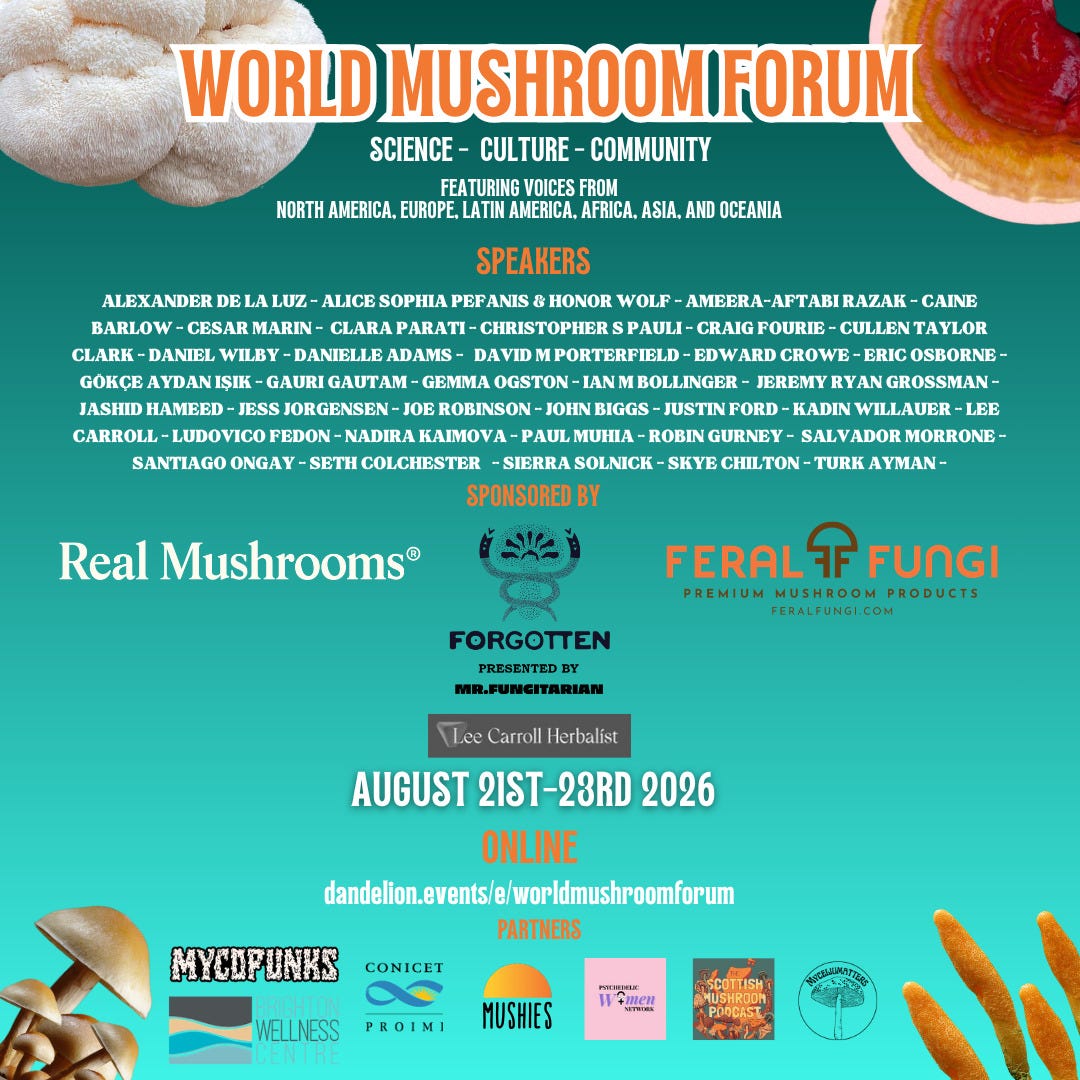
The World Mushroom Forum, produced by Mycopreneur founder Dennis Walker in collaboration with Oli Genn-Bash of The Fungi Consultant, is Our partner Dennis Walker (Mycopreneur) and Oli Genn-Bash (The Fungi Consultant) are launching the World Mushroom Forum — a three-day online gathering bringing together medicinal mushrooms, psychedelic research, regenerative agriculture, biotech, cultivation, policy, and Indigenous perspectives from across the global fungi space.
Like us, they’ve chosen entirely online: a deliberate choice to make access and participation possible across continents rather than concentrated in one room. We love the alignment and can’t wait to join in!
They made us a little discount code, use PSYCHDESIGN10 to get 10% off the ticket!
worldmushroomforum.com · Mycopreneur · The Fungi Consultant
Fireside Project launched Lucy — described as the world’s first AI-powered simulation and training platform designed to prepare clinicians for psychedelic-assisted therapy. Lucy was built on anonymised support conversations from 7,000 Fireside Project users, giving clinicians a way to practise holding difficult psychedelic experiences before they encounter them in clinical settings.
It is a genuinely interesting problem: how do you train a human to be present with another human in a radically altered state?
Above all, Fireside Project offers free, confidential support to anyone navigating a psychedelic experience, now available also through our Fireside Project App! Innovation on all
We are excited to go much deeper on this at the November conference, where Fireside Project founder Joshua White, joined by one of Lucy’s engineers to walk us through the platform from the inside — from ideation and design to how it is working in practice. A rare look at the full arc of a product built at the intersection of harm reduction, AI, and psychedelic care.
We are genuinly honoured to be partners with this innovative organisation!
A new preprint from the Carhart-Harris Lab (based at UCSF) and collaborators at Imperial landed in June: “Distinct brain responses to psilocybin and escitalopram in depression captured by the Fluctuation-Dissipation Theorem.” For those following the ongoing comparison between psilocybin and conventional antidepressants, this is the latest chapter — using a new mathematical framework to map the differences in how the brain responds to each.
We will have more to say about Robin Carhart-Harris’s work in November, when he joins us for the conference ahead of his forthcoming book.
Imperial College London Centre for Psychedelic Research · Carhart-Harris Lab
A £2.5 million Wellcome-funded study — PATHS: Psychedelics as Therapeutics: Harm Reduction and Safety — has launched at the University of Exeter in partnership with the University of Leicester. It is among the first studies designed to examine real-world psychedelic use outside clinical settings: why people are turning to these treatments, how they are managing risk and supporting one another, and what can be done to make informal therapeutic use safer.
This is an important corrective to a research landscape that has largely focused on controlled trial conditions. Most psychedelic use happens outside of clinics. This study finally asks: what can we learn from that?
Drug Science, a partner of Psychedelics Design, sits within the broader ecosystem that supports this kind of evidence-based, harm-reduction-centred research.
Full story: University of Exeter · Drug Science
ON OUR READING PILE
A new regular section — what we're reading, what's sitting on the table, what doesn't fit neatly into any category but belongs here anyway. More books, films, articles, and resources we've curated with care over the past year live in our free resources library.
Journalist, DoubleBlind co-founder, and daughter of the Ram Dass world, Madison Margolin has written a memoir that traces the fault lines between Jewish mysticism and psychedelic culture. Part confession, part reportage, it asks what it means to seek transcendence when you've grown up inside it. A rare book that treats consciousness as something inherited.
Journalist, DoubleBlind co-founder, and daughter of the Ram Dass world, Madison Margolin has written a memoir that traces the fault lines between Jewish mysticism and psychedelic culture. Part confession, part reportage, it asks what it means to seek transcendence when you’ve grown up inside it. A rare book that treats consciousness as something inherited, not just discovered. We’ve been waiting for this one.
We have been missing words that float into sentences that feel poetic and rea — that can carry enormous weight without compromising the quality of the language. De Beauvoir has them. (And yes, also this English translation.) If you haven’t read it yet, I promise this is a rewarding experience!
That's the June roundup. See you soon with another interview and podcast — we spoke with two of our judges this month, and hope to keep inspiring people to explore the questions that sit at the heart of everything we do here: what can psychedelics do for design, and what can design do for psychedelics. ♡
Dr. Edward de Bono, the originator of the term Lateral Thinking, dedicated his life to inspiring, encouraging and enabling us to be better and more creative thinkers.
“There is no doubt that creativity is the most important human resource of all. Without creativity, there would be no progress, and we would be forever repeating the same patterns.”
Edward de Bono
Know a designer, creative director, or agency working adjacent to this space? Forward this to one person who should be reading it.
Comments
Nothing yet. Say the first thing.
Sign in to join the conversation.