
Editor’s Note
There is a version of this moment that is easy to celebrate. Eli Lilly just paid $3.8 billion for a psychedelic drug company. The FDA published its first-ever clinical trial guidance for psilocybin, LSD, and MDMA. Compass Pathways reported the durability data it needed to complete its New Drug Application. Definium’s LSD stock doubled. Our partner Nutritious released an album that sounds like what the inside of a good day feels like. Dr. Grace Blest-Hopley gave the opening keynote at ICPR on women’s psychedelic biology — and is building the first standardised framework for collecting women’s psychedelic data, a topic she was told was niche four years ago. And the speakers for our November conference are coming together, co-curated with Zoe Wilder. For the entire month of August, tickets are £25 / $33 — rising to £35 in September and £50 in October. Get your ticket →
These events don’t belong to the same story. But they happened in the same month — and for a field that spent decades on the margins, the simultaneity is worth sitting with. Something has tipped. The question the next few months will answer is: in whose image, and for whom?
— Alexandra
MUSIC
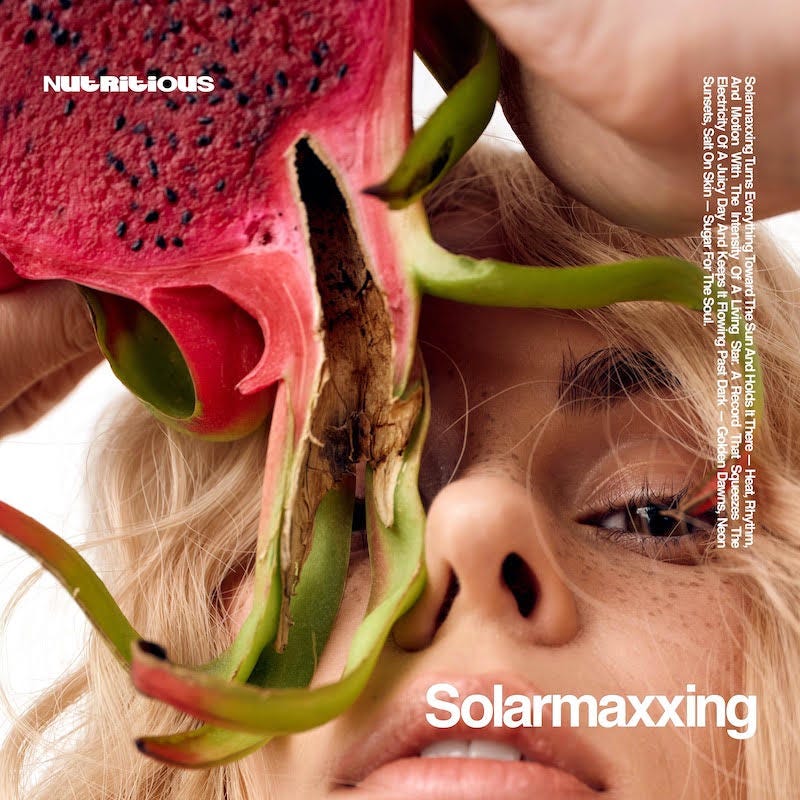
Visionary DJ/producer and cultural alchemist Nutritious – who is also a judge of this year’s Psychedelics Design Awards – lets in the light on his stunning new body of work; his six-song mini-album ‘Solarmaxxing’ turns everything toward the sun, glorious ‘Nu-house’ meant for open air, proper sound systems, all-night rooms… Out July 31st on his own Liquid Culture Records.
‘’Solarmaxxing’ turns everything toward the sun and holds it there - heat, rhythm, and motion with the intensity of a living star. A record that squeezes the electricity of a juicy day and keeps it flowing past dark - golden dawns, neon sunsets, salt on skin - sugar for the soul.’ Nutritious
A true DJ’s DJ, Nutritious, self-taught on cassette & vinyl, blends cosmic disco, deep house, nu-disco, indie dance, and techno in high-energy sets. Meticulously curated and thrillingly spontaneous, he treats his 3-4 turntables like live instruments - improvising remixes in real time, threading rare edits and unique deep cuts. Shows include Pikes Ibiza, Art Basel, Zey Zey Miami, Cielo NYC, Mighty SF, Pacha NYC, The Whitney Museum supported by The Andy Warhol Foundation, Rodarte for New York Fashion Week, international Mushroom Jazz shows with Mark Farina…
Save the album HERE.
Spotify | Instagram | Website | Bandcamp
BUSINESS & CULTURE
On July 16, Eli Lilly agreed to acquire AtaiBeckley — the company formed from the 2025 merger of atai Life Sciences and Beckley Psytech — for $2.8 billion upfront plus up to $1 billion in milestone-based payments, valuing the deal at up to $3.8 billion. It is the largest psychedelic transaction in pharmaceutical history, surpassing AbbVie’s acquisition of Gilgamesh Pharmaceuticals’ lead compound for up to $1.2 billion last year, and Otsuka’s $700 million acquisition of Transcend Therapeutics.
Lilly’s prize is BPL-003, AtaiBeckley’s DMT-based nasal spray currently in Phase 3 trials for treatment-resistant depression, with initial results expected in early 2029. Jefferies estimates BPL-003 could generate $1–2 billion in annual sales if trials succeed. The deal also gives Lilly access to AtaiBeckley’s MDMA-adjacent program and a broader pipeline of tryptamine and phenethylamine candidates.
Why this matters for design and culture: AtaiBeckley now belongs to the company that made Prozac. Lilly's chief science officer explicitly compared the stigma around psychedelics today to the stigma around treating depression in the 1980s — and said that comparison attracts him to the space. The precedent Prozac set was not just clinical: it reshaped how an entire generation understood mental illness through the visual and narrative language of pharmaceutical marketing. Whoever designs the identity of approved psychedelic medicine will face the same responsibility at the same scale. The briefing starts now.
CNBC · BioPharma Dive · Bloomberg · Forbes
On July 14, the FDA published its first-ever final guidance on clinical trial design for psychedelic drugs — covering psilocybin, LSD, MDMA, and related compounds. The document formally addresses the “functional unblinding” problem that contributed to the 2024 rejection of Lykos Therapeutics’ MDMA application: that participants almost always know whether they took a psychedelic, complicating data interpretation. The FDA’s solution requires active placebos, blinding questionnaires, and a complementary dose-response design using no placebo at all. Each session must be monitored in full by two trained observers. Pleasurable psychedelic effects must be recorded as adverse events.
In the same notice, the FDA announced a public hearing for September 14 — a signal the agency is building infrastructure for what may soon be a live approval docket. Compass Pathways holds a Commissioner’s National Priority Voucher, meaning its NDA will receive an expedited 1–2 month review after full submission, targeted for Q4 2026.
Federal Register · Clinical Trials Arena · BioSpace
July delivered the clinical data the field has been waiting for. Compass Pathways reported positive 26-week Part B durability results from COMP006 on July 7 — the final dataset needed to complete its rolling NDA. 39% of participants in the 25 mg psilocybin arm maintained clinically meaningful MADRS reduction at Week 6, with benefit sustained on average through Week 26; nearly 30% of Week-6 responders reached remission following retreatment. A US launch in H1 2027 is now the stated target, subject to FDA approval and DEA rescheduling.
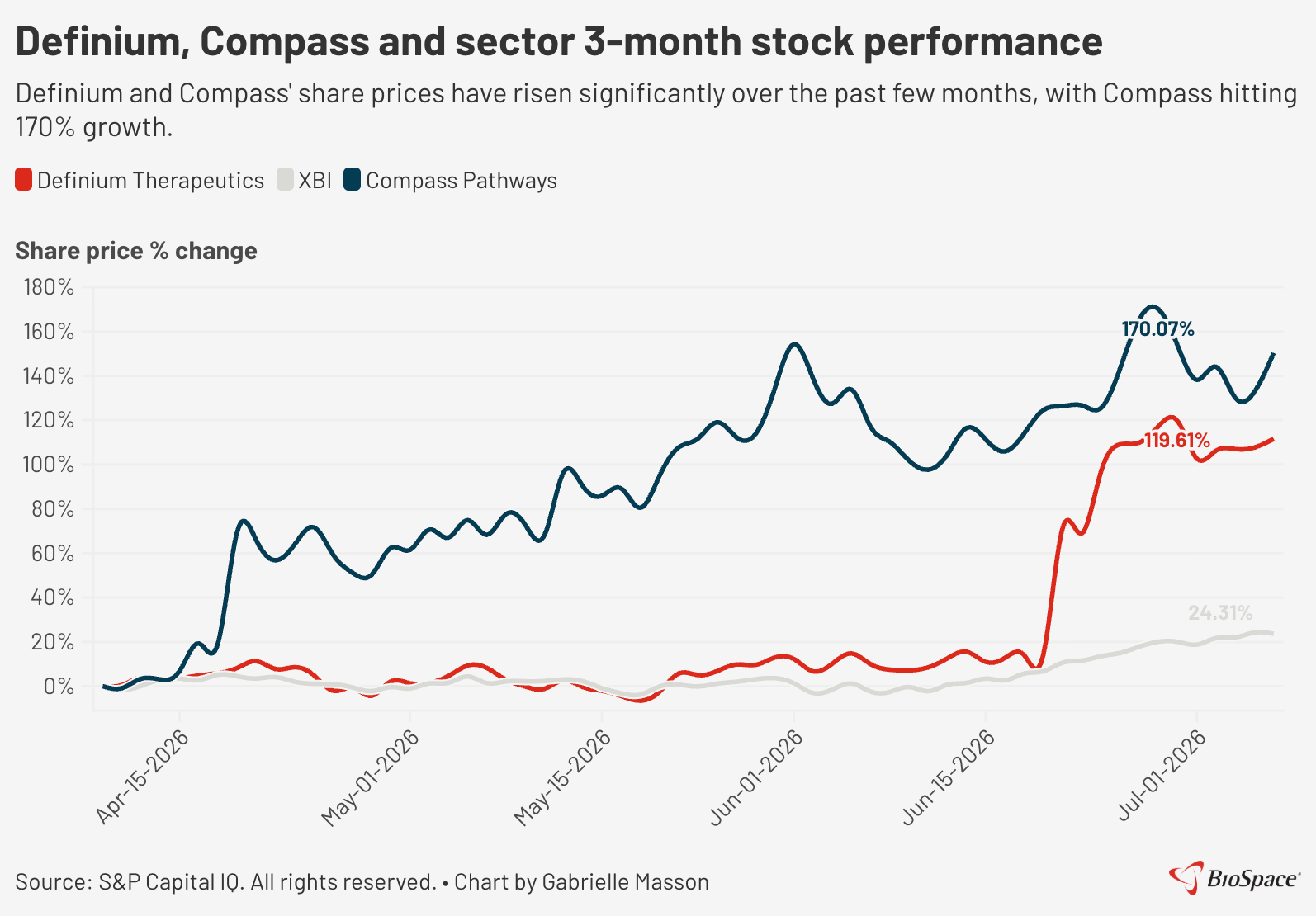
Definium Therapeutics’ Phase 3 Emerge trial of DT120 — its oral LSD candidate for MDD — returned positive results in late June, with an 8.1-point MADRS improvement described by Jefferies analyst Andrew Tsai as delivering “the largest effect size I’ve ever seen.” Definium shares rose 97% over the month. A GAD Phase 3 readout is expected in Q3 2026.
RESEARCH
A study published in Nature Communications by researchers at UCSF and Imperial College London — co-authored by Manesh Girn and Robin Carhart-Harris — found that a single high dose of psilocybin produces measurable changes in both brain activity and brain structure detectable up to a month later, in healthy adults who had never previously used a psychedelic. Within 60 minutes of taking a 25 mg dose, EEG recordings showed a sharp spike in brain entropy — the variety and complexity of neural activity. Participants who experienced the largest increases in entropy were most likely to report greater emotional insight the following day, and that insight predicted improved wellbeing a month later.
Diffusion tensor imaging conducted one month after the dose revealed structural changes in prefrontal-subcortical white matter tracts — suggesting the brain’s physical wiring may be altered, not just its activity patterns. For designers and creative practitioners, the implication is a question about whether a single experience can physically alter the architecture through which you perceive and think.
UCSF · Carhart-Harris Lab · Nature Communications, May 2026
Dr. Grace Blest-Hopley, neuroscientist and founder of Hystelica, opened ICPR in Haarlem with the conference’s first keynote on women’s psychedelic health. Her argument is mechanistic: oestrogen directly affects serotonin production, metabolism, and 5-HT2A receptor density — the same receptor psychedelics act on. Dosing women without accounting for where they are in their menstrual cycle risks amplifying the wrong internal states entirely.
Hystelica’s first female-focused psychedelic survey found improvements in menstrual-cycle symptoms — anxiety, mood, cognitive functioning, and pain — with greater effects among women with PMDD. Some women reported cycles returning after high-dose experiences following stress-related cessation, and improved regularity in PCOS, suggesting possible HPA-axis re-regulation worth studying. Next up: a Delphi study with fifty-plus experts to build the first standardised framework for collecting women’s psychedelic data. None of it currently exists.
Psychedelic Alpha, July 30, 2026 · Hystelica is a Psychedelics Design partner — their brand identity was created by Alexandra Plesner, founder Psychedelics Design.
NEWS FROM PSYCHEDELICS DESIGN
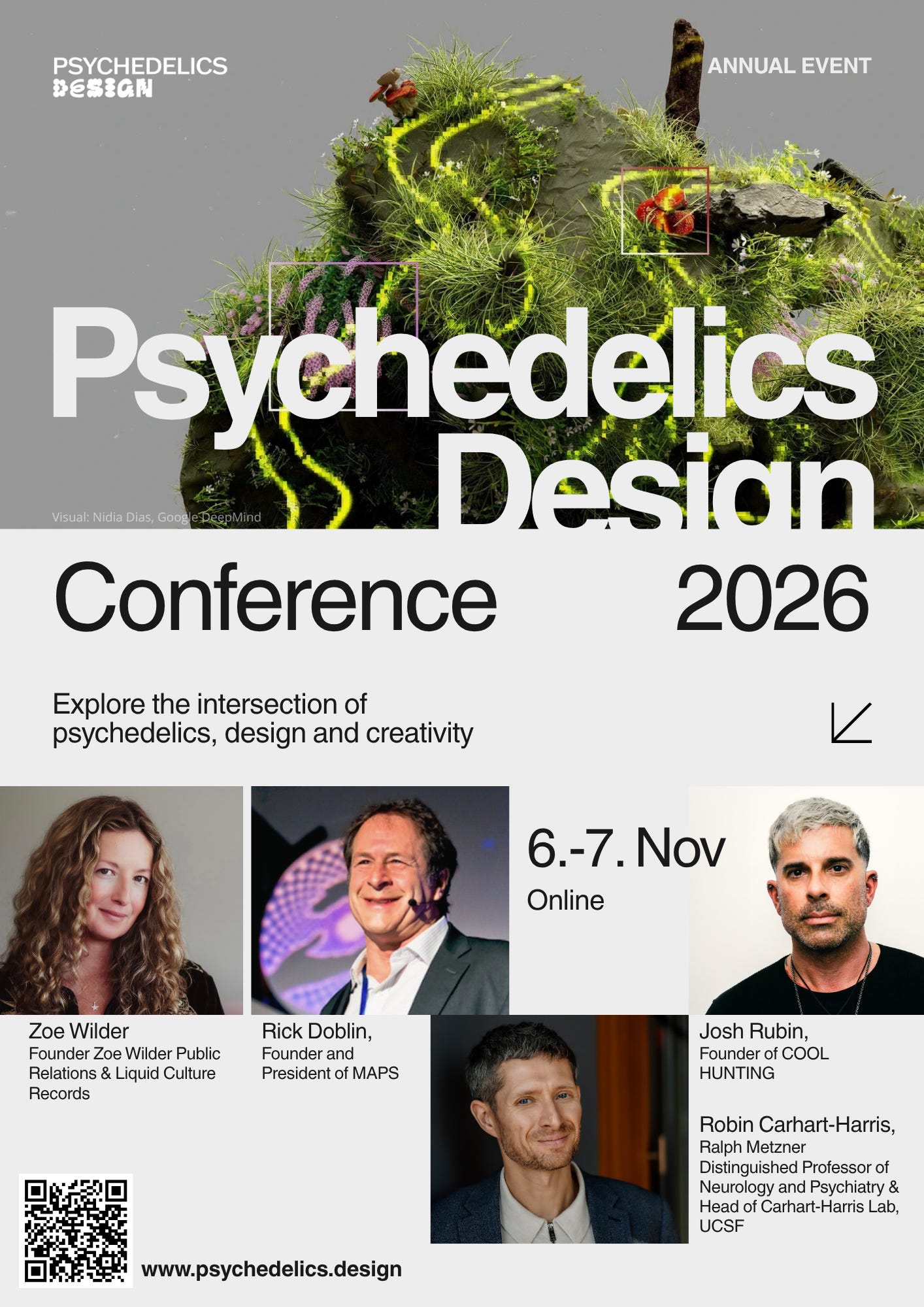
The 2026 Psychedelics Design Conference goes online this November, themed Creative Biome — exploring psychedelics and creativity as living forces shaping culture, care, and future possibility.
The first speakers are confirmed: Rick Doblin (MAPS) in conversation with Zoe Wilder on "The Long Arc of Transformation"; Robin Carhart-Harris (UCSF) on "How Psychedelics Work," speaking ahead of his forthcoming January 2027 book, in fireside conversation with Design Week's David Coveney; COOL HUNTING’s Josh Rubin, Jahan Khamsehzadeh on psychedelic history and creativity; Jess Jorgensen on fungi as a model for strategic design; plus Manesh Girn, Dennis Walker, Joshua White, Rayyan Zafar, and more to be announced.
Get tickets for only £25 until September 1st →
FROM OUR PARTNERS
The Institute of Applied Metaprogramming has launched a self-paced professional training built around the 8-Circuit Model of Consciousness — the framework originally developed by Timothy Leary and Robert Anton Wilson, now updated for applied psychedelic practice by Dr. Rachel Turetzky and Dr. Douglas Wingate. The course covers all eight circuits from somatic safety through to ego dissolution and non-dual awareness, with specific application to psychedelic preparation, facilitation, and integration. It’s designed for clinicians, facilitators, coaches, and serious students — and carries 13 CE credits for eligible mental health professionals. Earn the Certified Metaprogrammer credential (CMPr) on completion. Early bird pricing of $1,499 (down from $1,999) runs until August 15 with code 8CM-PROMO.
Explore the course →
Horizons returns to New York this October — the longest-running psychedelic conference in the world, bringing together leaders across science, medicine, policy, business, culture, and spirituality. It was the second psychedelic conference we ever attended, and it genuinely shaped how I think about this ecosystem. If you haven't been, this is one to start with. horizonsconference.org →
A more intimate gathering for practitioners, clinicians, facilitators, educators, and Vital alumni — people actively shaping the future of psychedelic care and community. Hosted by Psychedelics Today in the mountains of Colorado. Tickets →
ON OUR READING PILE
A new regular section — what we're reading, what's sitting on the table, what doesn't fit neatly into any category but belongs here anyway. More books, films, articles, and resources we've curated with care over the past year live in our free resources library.
The second issue of the print magazine of psychedelic art and literature — themed around connections intimate, hostile, symbiotic, and psychic between humans, animals, plants, fungi, and other lifeforms — is now available. Issue 1 was a Psychedelics Design Award 2025 finalist for storytelling. Founded by Hillary Brenhouse, designed by Chloe Scheffe and Natalie Shields. elasticmag.com →
An insightful, no-fluff guide to microdosing—where research meets lived experience. Blending science, cultural context, and personal stories, it explores how small doses can support clarity, mood, creativity, and gentle shifts in daily life. Clear, grounded, and human-centered, it’s for anyone curious about unlocking subtle change without the hype.
An expansive, mind-stretching exploration of psilocybin’s role in shaping human consciousness—past, present, and future. Merging science, anthropology, and personal insight, it proposes that magic mushrooms didn’t just alter minds, they helped evolve them. Bold, original, and deeply informed, this is a visionary synthesis for anyone curious about how psychedelics could help rewire not just individuals, but culture itself.
That's the July roundup. See you soon with another interview and podcast — we spoke with another judges this month, and hope to keep inspiring people to explore the questions that sit at the heart of everything we do here: what can psychedelics do for design, and what can design do for psychedelics. ♡
“Great things are not done by impulse, but by a series of small things brought together.”
Vincent Van Gogh
Know a designer, creative director, or agency working adjacent to this space? Forward this to one person who should be reading it.
Comments
Nothing yet. Say the first thing.
Sign in to join the conversation.