
Editor’s Note
We talk constantly about set and setting — about how music shapes a room and the people inside it. I wanted to ask the question the other way round. How does the room shape the music?
Nutritious was the right person to ask. He has played the Whitney Museum, Pikes Ibiza, Rodarte at New York Fashion Week; he has toured internationally with Mark Farina; he treats three or four turntables like live instruments. He was also a member of the founding team at DoubleBlind, which makes this conversation a kind of companion piece to the one we ran with Shelby and Madison. And he co-founded Liquid Culture, a record label and artist collective that turns out to have a far more personal origin than I understood before we sat down.
He is also a judge in this year’s Psychedelics Design Awards, and — as of this season — the composer of this podcast’s theme.
I should say that this question isn’t a neutral one for me. I have spent most of my life without a place to belong: driven, restless, often melancholic, and maybe here to admit today, finding it hard to be here at all. The times that lifted were hardly because something shifted inside me. They were because I was in the right room. My cohort at Central Saint Martins. The creative studio Method Inc London, under the leadership it had then. Another creative studio, Normally Ltd, also in London. And now I seem to find similar in the team at the Carhart-Harris Lab, even though we are hardly in the same room, yet alone country. Every piece of work I am actually proud of came out of one of those rooms.
So when Nutritious describes building Liquid Culture as a container for artists who were never given one, I didn’t hear a company origin story. I heard the thing that has somewhat determined the shape of my entire working life. It also reached me somewhere closer than that. The past years have taught me once more, how thin the line can be.
Which is perhaps what set and setting has always meant, underneath the clinical usage: not only the room you take something in, more the room you are permitted to become yourself in.
What stayed with me otherwise is how completely he refuses the separation between disciplines: that the split between music, ritual, architecture and community is the recent anomaly, and the work now is repair.
I asked whether context changes what he plays, and how. For him, the environment isn’t a backdrop to the performance, it’s a participant in it.
“The environment is really everything.”
Architecture, acoustics, who is in the room that day, the mood the audience arrived in, what is happening in the world outside — all of it, he says, sets the table before a single note drops. Approaching a place like the Whitney from the street, walking inside, hearing how sound ricochets off the walls: that reconnaissance shapes the set.
There are two ways to walk into a room. You can arrive with a fixed point of view and impress it on the space. He doesn’t work that way.
“What is the vibe of the moment? Maybe people need to loosen up a bit. Or maybe you’re coming into a situation where the energy is really scattered and it needs something to help get people unified.”
The audience, he’s clear, shouldn’t have to think about any of this. “You want them free of spirit and free of mind so they can just enjoy themselves.” The reading is his job. And at festivals, where some portion of the room is in an altered state, that job carries a weight worth pausing and sitting with.
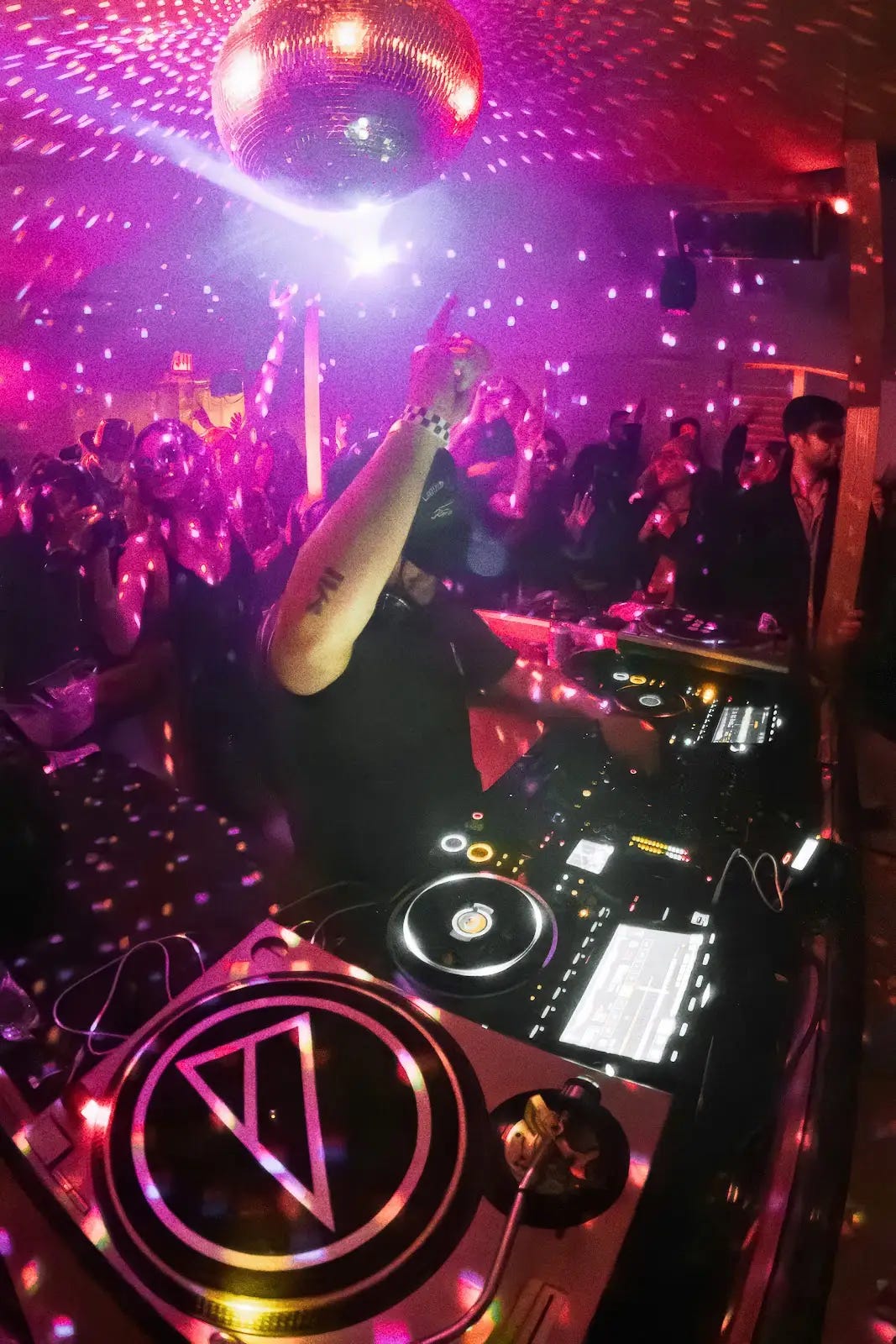
Nutritious’ work is recognisable — you know a Nutritious track when you hear one. He was generous about it, and then gently dismantled the premise.
“I don’t even know that I would know exactly how to do that. It is a journey.”
His references run from classical and jazz through UK garage, drum and bass, house, electronic. But the thing he holds onto is a lot about resonance.
“What I do know: I want the frequency of what I create to resonate. That’s what I hold dearest. Making something that speaks to me and makes me feel whole as I create it.”
The visual side, he’s careful to add, is a collective effort. Album covers, campaign rollouts, the whole visual language around the music comes out of the Liquid Culture community. “I don’t think I could ever do it entirely on my own, nor would I want to.”
This is the part of the conversation I did not see coming, and the part I have thought about most since.
Liquid Culture began, he says, with the death of his older brother. A virtuoso string player — violin first, then electric guitar — coming up in the mid-to-late seventies on Led Zeppelin, Hendrix, Pink Floyd, jazz, classical. More than a decade older, and thrilled, when Nutritious was born, to have someone to make things with. He would sit down his little brother at a Fisher Price drum kit as a toddler and would be jamming with him.
Nutritious’ brother struggled for years. And the stigma around creative people who experimented, in an era long before any destigmatisation of psychedelics, was part of what closed the doors.
“I think that hung over his head in a way that made him feel lost as an artist. And like there was really no viable path to express his point of view and have a real trajectory.”
He took his own life.
“On the other side of that, learning to grieve through the process, really understanding what it was that made him feel that way. We built Liquid Culture so artists are supported. So they know there’s a community that sees their value, sees their ideas, and helps them see it through. Being an artist shouldn’t be a stigmatized path.”
That is the foundation of Liquid Culture. To have a container built in response to the absence of one.
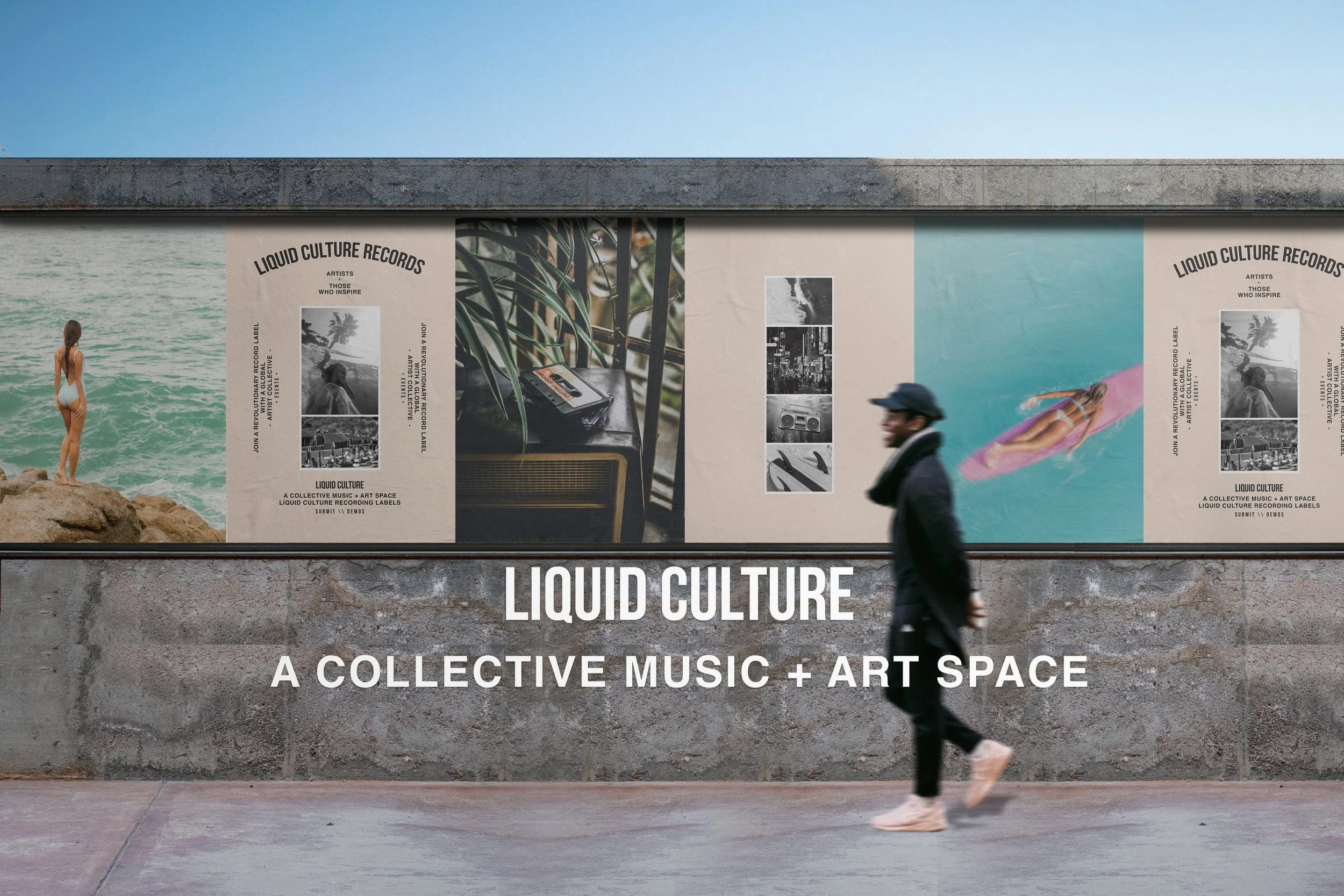
The conversation opened out from there into something bigger. Nutritious reads the current moment as a repair job rather than an invention.
“Way before our time, millennia ago, they were [not] quite so bifurcated and separate lanes.”
Community, ritual, ceremony, plant medicine, architecture, music, dance — even governance. In many ancient cultures these were one continuous way of life, and there are communities today still using plant medicine as a way of reasoning together about the direction of the whole.
“Humans create. Design. Architecture. Music. Governance. Somewhere we got off the beaten track. These things are meant to be built together,
by community, appreciated as one.”
He is also unsentimental about the sixties. The counterculture, he says, was exactly what it needed to be — and then it was used as a political pawn to push through a set of countering laws and restrictions, which left this generation having to build a new counterculture from scratch. The hope is that the pendulum stops swinging.
“What we can do is try our hardest to create the map as best as we can, and create a language — and help refine and keep developing the language that was handed to us.”
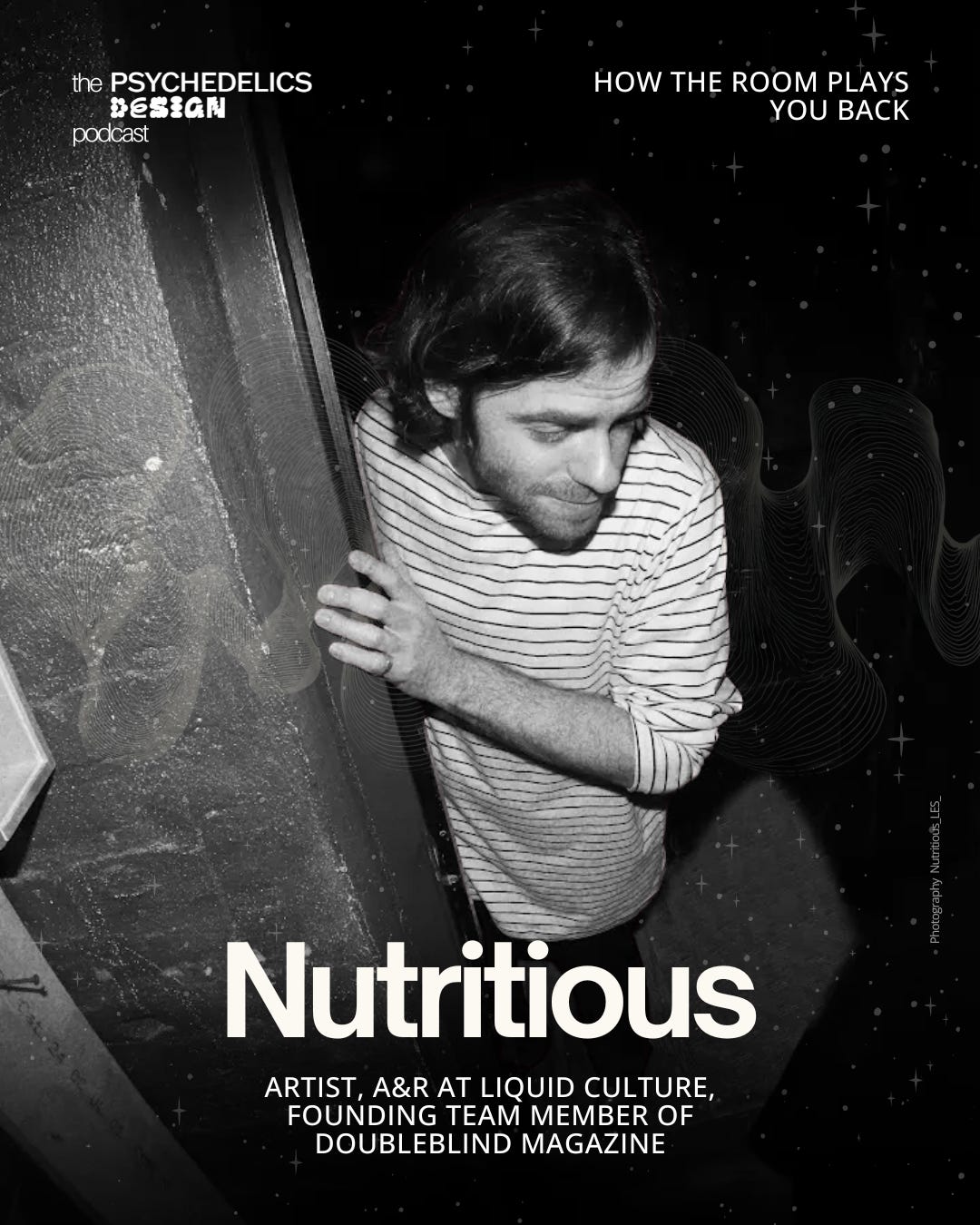
When he writes, he sees rather than hears first.
“I can see it in my mind. I see scenes. I see pictures almost the same way we watch a movie.”
It’s why he moved into film scoring. Every song starts as a place you could move through. He draws on psychedelic journeys for this, and just as much on ordinary ones — a walk, weather, light.
“Nature is the ultimate psychedelic. Especially the sun.”
Which leads to his diagnosis of why the field feels so scattered right now. The differing needs, approaches and mindsets around these medicines come, he thinks, from a culture that hasn’t yet understood its own relationship to nature — beyond the plants and compounds — the cosmos, the sun, air, water, energy. Someone working with medicine in a city, disconnected from all of that, is having a fundamentally different experience from someone in the jungle. Much of what’s happening now is people peeling back that layer.
I asked him where the line falls. His answer complicated the question in the best way.
Yes, there’s a distinction. Psychedelic-adjacent work tends to look more corporate, more mainstream — “something that’s tacked on and is a mimicry.” Work that actually carries the spirit is “a channeling of the experience,” and if you’ve been there, you can feel it immediately.
But he won’t turn that distinction into a hierarchy of value.
“Work that isn't psychedelic can be just as vital to this movement. Carrying the message of connection. With each other. With our world.”
And more than that — nobody has cracked it. “I’m not sure that there’s any creator or artist who’s been able to do a job and say, this is what the psychedelic experience is. And that’s okay. I think that’s important. We can lay the map, we can show people design, we can create fantastic works of art, but you have to experience it for yourself to really feel it.”
His warning is against gatekeeping by taste. People arrive at all of this from wildly different places, and writing something off because it doesn’t speak to one particular relationship with psychedelics does the whole field a disservice.
I asked why he said yes to something this niche.
“It was an easy yes.”
His reasoning: design is the mechanism by which humans bring interior things into the world, and we live in an entirely designed world as a result. A platform that gathers creatives working with that kind of intentionality is, in his view, straightforwardly needed. Naturally, this had me stop and ponder.
What is he hoping to see in the submissions? He’s deliberately open — the surprise is the point — but there is one word he keeps returning to.
“If there’s a through line, it’s devotion. I’m excited to see the devotional process that creators bring to their projects.”
I asked what he’d still love to score. A museum show, it turns out — but not a conventional one.
“Can we put a museum show together where we’re fusing the great psychedelic works of the past with the great modern psychedelics today, the artists in the Liquid Culture community, the Psychedelics Design community — and really show people how this all works together, and why we’re all here doing this in the first place?”
Consider this an open call. We are absolutely on it!
Find Nutritious on:
djnutritious.com • Instagram • SoundCloud • Liquid Culture
🎙️ PODCAST
This interview was recorded as part of the Psychedelics Design podcast. Listen to the full conversation → Psy*Design Podcast
🕊️ IF YOU NEED SUPPORT
If you or someone you know is having a difficult time, free support is available.
This episode touches on suicide, grief, and the loneliness that so often shadows creative life. Talking to someone helps, and every service below is free and confidential.
Anywhere in the world — findahelpline.com lists vetted crisis lines by country, in your own language.
Austria — TelefonSeelsorge, 142. Around the clock, every day of the year, free from any Austrian phone, and the call doesn’t appear on your bill. Chat available daily 16:00–23:00 at telefonseelsorge.at.
UK & Ireland — Samaritans, 116 123. Free, 24 hours.
US & Canada — Suicide & Crisis Lifeline, call or text 988.
During or after a psychedelic experience — Fireside Project’s Psychedelic Support Line, 623-473-7433, daily 11:00–23:00 PT. Free, confidential peer support whether your journey was beautiful, confusing, or overwhelming — and whether it was yesterday or years ago. firesideproject.org
At festivals and events — the Zendo Project has provided psychedelic peer support and harm-reduction training since 2012, and offers a free harm reduction mini course.
NEWS FROM PSYCHEDELICS DESIGN
States of Mind is a new kind of media platform combining original video, podcasts, journalism, and personal stories of healing and growth. Expert insight meets practical tools, for people trying to make sense of psychedelics at every stage of their journey. We love the range.
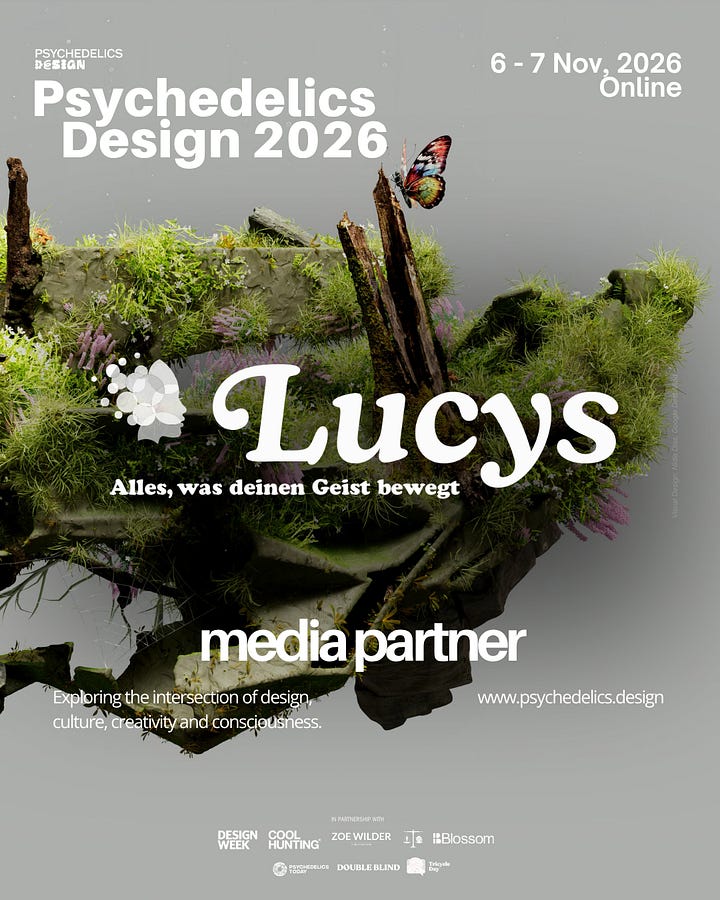
Lucy’s Magazine is the leading European platform for psychoactive news, research, and culture — offering informed, independent coverage of the ongoing psychedelic renaissance. Published by Nachtschatten Verlag, the Swiss publisher that has quietly been one of the most important archives of psychedelic literature and science since 1980s, Lucy’s carries a lineage. They are a fundamental part of the European infrastructure that kept the conversation alive when the mainstream had moved on. We are therefor really proud to be in their orbit.
FROM OUR PARTNERS
How can we look within to transform our outer worlds—and is collective healing, rooted in embodied action, the answer?
Sept. 17, 2025, 5-10pm
Learn more here → psyca.org/ccmh
The Awareness Lectures on Psychedelics in Switzerland (ALPS) 2026 conference is a gathering for those working at the intersection of psychedelic science and medicine. Held at the Kultur & Kongresshaus Aarau, the event is hosted by the ALPS Foundation, a non-profit organisation dedicated to promoting rigorous and evidence-based psychedelic programming. The conference attracts a multidisciplinary audience, including psychiatrists, psychologists, and biologists, as well as students and researchers from across Europe.
October 8, 2026–October 9, 2026
Learn more here → alps.foundation/alps-events/alps-conference
ON OUR READING PILE
A new regular section — what we’re reading, what’s sitting on the table, what doesn’t fit neatly into any category but belongs here anyway. More books, films, articles, and resources we’ve curated with care over the past year live in our free resources library.
Accept & Proceed founder David Johnston spent twenty years mastering the mechanics of desire. Now his framework Signalism asks what that mastery actually costs — and proposes that designers start every project with a question the industry almost never asks: should we do it at all?
It’s the right question for this field too. In a space where aesthetics, healing, and commerce are increasingly entangled, the capacity to pause and ask what realities our signals are creating should not come as optional. It is essentially the whole discipline of the future. creativeboom.com →
The second issue of the print magazine of psychedelic art and literature — themed around connections intimate, hostile, symbiotic, and psychic between humans, animals, plants, fungi, and other lifeforms — is now available. Issue 1 was a Psychedelics Design Award 2025 finalist for storytelling. Founded by Hillary Brenhouse, designed by Chloe Scheffe and Natalie Shields. elasticmag.com →
“That’s the good thing about music — you can’t quite define why it works, but you know when it does.”
– Jarvis Cocker
Enjoying the free newsletter of ours?
Forward this to one person who should be reading it.
Comments
Nothing yet. Say the first thing.
Sign in to join the conversation.