
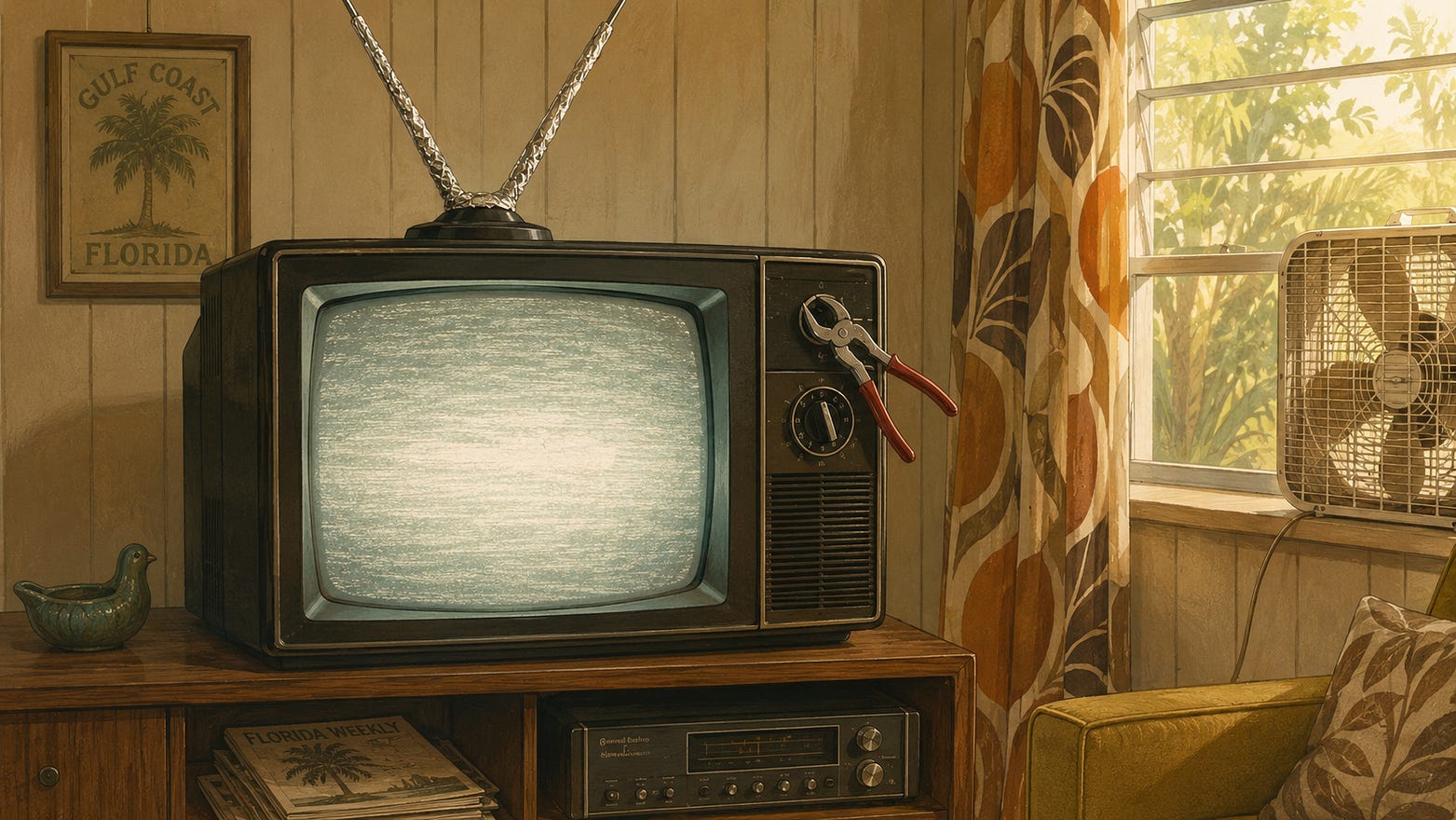
We didn’t have a remote control. We had a pair of vise-grip pliers that lived on top of the television, and when the picture started rolling, or the channel needed changing, somebody walked over and turned the dial with them, because the actual knob had broken off years before I was old enough to remember it being whole. Black-and-white set, rabbit ears wrapped in foil, and if you wanted a clear picture on channel 9, you had to stand in a specific spot near the window and not move. I spent a fair amount of my childhood being the antenna.
That word, poor, wasn’t one anybody in that house used about themselves, not out loud. It was just how things were. The air conditioner was a box fan in the window, and in a Florida summer that fan didn’t cool the room so much as move the heat around and remind you it was there. You slept on top of the sheets, not under them. You learned which hours of the day to stay still.
Dinner most nights was spaghetti with ketchup instead of sauce, because ketchup was cheaper and it was already in the house. I didn’t know this was unusual until I was an adult eating dinner at a friend’s place and asked, with total sincerity, where the ketchup was. The room went quiet in a way I didn’t understand at the time.
Lunch, when it wasn’t at school, was fried bologna on Wonder Bread, the bread itself a day old, bought from the Merita outlet store because day-old bread was half price and sandwich spread covered a lot. My mother would send me in with a dollar or two, and I’d come back with a loaf and whatever else fit in the bag. I got good at that kind of arithmetic before I ever sat in a math class.
None of this felt like deprivation while it was happening. That’s the part people don’t expect when I tell it. It felt like an ordinary day. The heat, the ketchup, the pliers on the TV, all of it was just the furniture of being alive in that house, and you don’t spend a lot of time being upset about furniture.
What I did want out of was being inside that house for too long. So I was outside constantly, and not because I had a bike and a philosophy about nature. Outside was free. Outside was quiet. Nobody’s mood but mine lived out there. A bike, a dirt lot, a ditch that filled with water when it rained hard, that was enough for an entire summer. I built things out of scrap wood that had no purpose except that building them kept my hands busy and my head somewhere else.
That’s the actual thread running under all of it, I think. Not the ketchup, not the wrench, not the day-old bread. I got comfortable, early, with finding a way out of wherever I currently was. Playing outside got me out of a house that was too hot and too small for the number of people and moods living in it. When I was old enough to actually leave, the military was the same exit, just a bigger door.
I didn’t join the Navy because I had a burning patriotic vision at seventeen. I joined because it came with a paycheck, a bed, and three meals a day that didn’t involve day-old bread. Somebody handed me orders instead of asking me what I wanted to do with my life. For a kid who’d spent his whole childhood finding small ways out of a hot house with a broken television, having somebody else finally take a turn at the wheel didn’t feel like losing anything.
I’m not telling you any of this because I think it made me tough. I’ve heard that version of the story from other guys my age, the one where the hardship built the man, and I’m sure that’s true for some of them. I don’t know that it’s true for me. What it built, as far as I can tell, is a specific comfort with not having much and not making a production out of it. When something breaks now, at 62, I don’t panic. I go find the equivalent of the vise grip pliers. There’s usually one around.
I don’t know what kids would make of a black-and-white television with a busted dial. I don’t know if that kind of detail even registers as hardship to somebody who grew up with three streaming services and a phone that does more than that television and the family car combined together. Maybe it doesn’t need to register as anything. Maybe it’s just a fact about a house in Florida a long time ago. A fan in a window. Ketchup on spaghetti. A kid outside until the streetlights came on, because staying inside cost something the outside didn’t.
I still think about that dollar or two for the Merita outlet store sometimes, standing in a grocery store now where I can buy whatever bread I want without doing the math first. It’s a small feeling, not gratitude exactly and not sadness either, just something that shows up the way the heat used to show up, the way the wrench used to sit on top of that television, doing a job it was never built for because that’s what was on hand.
Most paid newsletters sell you a content library and move on to the next subscriber. Not Done Yet works differently. When you upgrade, that's when I start paying attention. I'll answer your questions. I'll engage with your work. I'll spotlight what you're building. Everything I teach here, I do, and I do it alongside you, not from a distance. The upgrade isn't the end of our relationship. It's the start.
Comments
Nothing yet. Say the first thing.
Sign in to join the conversation.